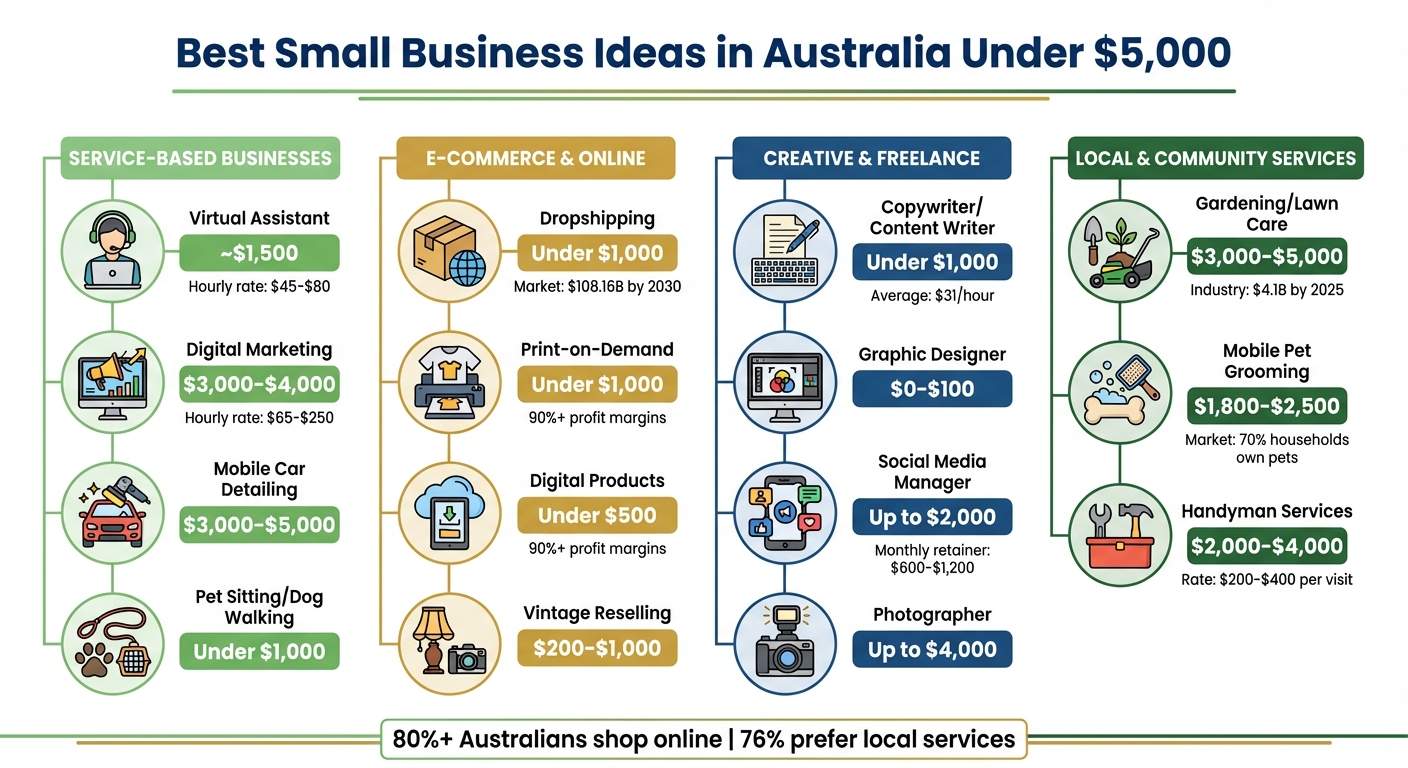
Starting a business in Australia with less than $5,000 is achievable and offers plenty of opportunities. Whether you're looking to start a side hustle or a full-time venture, small service-based businesses, online ventures, or community-focused services can help you generate income quickly. Here's a quick overview of ideas:
- Service-Based Businesses: Virtual assistant services (cost: ~$1,500), digital marketing ($3,000–$4,000), mobile car detailing ($3,000–$5,000), or pet sitting/dog walking (under $1,000).
- E-Commerce: Dropshipping (under $1,000), print-on-demand merchandise (under $1,000), selling digital products (under $500), or reselling vintage items ($200–$1,000).
- Freelance Work: Writing, graphic design, social media management, or photography (startup costs vary from $0–$4,000).
- Local Services: Gardening/lawn care ($3,000–$5,000), mobile pet grooming ($1,800–$2,500), or handyman services ($2,000–$4,000).
Australia's business-friendly setup, low-cost registration, and high demand for convenience and personalized services make it an ideal environment for small businesses. Focus on your skills, budget, and market demand to choose the best idea for you.
Small Business Startup Costs in Australia Under $5,000
🇦🇺 5 Small Business Ideas in Australia 2025 | Australian Entrepreneurs Guide to FAST Success
sbb-itb-08dd11e
1. Service-Based Businesses
Service-based businesses are a cornerstone of Australia's economy, employing more people than any other sector, including healthcare, professional services, and hospitality. These businesses rely on personal expertise, which eliminates the need for inventory and allows profit margins to grow as skills improve.
A key advantage for service providers in Australia is their local knowledge. This includes understanding regulations like the Spam Act 2003 and GST requirements, operating in the same time zone as clients, and having a deep understanding of the local market. Many entrepreneurs start these ventures as side projects to test the waters before committing full-time.
Here are some examples of service-based businesses you can start with minimal upfront costs.
Virtual Assistant
Startup cost: Under $1,500
Virtual assistants handle administrative tasks for busy professionals, such as managing emails, scheduling appointments, updating social media, and organizing invoices. With just a computer, a reliable internet connection, and strong organizational skills, you can start offering these services. This role is particularly appealing to small businesses that need flexible support without hiring full-time staff. Hourly rates typically range from $45 to $80.
Digital Marketing Services
Startup cost: $3,000–$4,000
Small businesses often need affordable help with SEO, Google Ads, and social media but can't afford large agencies. By specializing in hyper-local SEO - helping businesses rank for searches like "emergency plumber Perth" or "mobile mechanic Brisbane" - you can carve out a niche. With 78% of businesses now using AI in some capacity, there's also demand for consultants who can implement automated customer replies and booking systems. SEO consultants can charge anywhere from $65 to $250 per hour.
Mobile Car Detailing
Startup cost: $3,000–$5,000
Convenience is key for Australians, making mobile services highly appealing. For mobile car detailing, you'll need supplies like cleaning products, a portable vacuum, and reliable transportation. This business model eliminates the need for a physical location and is especially popular among busy professionals and apartment residents. The global cleaning services market is expected to surpass $616 billion by 2030.
Pet Sitting and Dog Walking
Startup cost: Under $1,000
Pet sitting and dog walking are low-cost ventures that require little more than basic marketing materials and insurance to get started. Platforms like local social media groups can help you build a client base. Over time, you can expand your offerings - for example, by adding mobile pet grooming services. If you use your own vehicle, the equipment costs for grooming range from $1,800 to $5,000.
2. E-Commerce and Online Ventures
Moving from traditional services to digital entrepreneurship opens up opportunities for rapid growth and broad market access.
The e-commerce sector in Australia is thriving, with projections suggesting it will hit $108.16 billion by 2030. Over 80% of Australians shop online regularly, and mobile devices account for 45% of e-commerce transactions. This trend creates a fertile ground for entrepreneurs to start small and expand quickly, all without the expenses tied to a physical store.
Online businesses benefit from low startup costs and the ability to scale efficiently. Entrepreneurs can test products without holding inventory, target nationwide customers from day one, and maintain minimal fixed expenses. Additionally, with 76% of Australian consumers considering sustainability in their purchases, there's growing interest in eco-friendly and vintage products that cater to conscious shopping habits. Here are some online business models that take advantage of these dynamics.
Dropshipping Store
Startup cost: Under $1,000
Dropshipping allows you to sell products without the hassle of managing inventory. When a customer places an order, your supplier ships the item directly to them. This model is perfect for testing niche markets - like pet accessories or sustainable home goods - without significant financial risk. Initial costs include a Shopify plan (starting at $5/month), domain registration ($10–$20/year), and marketing expenses. Focusing on a specific niche instead of offering a wide range of products can also help reduce customer acquisition costs.
Print-on-Demand Merchandise
Startup cost: Under $1,000
With print-on-demand, you can sell custom-designed items like t-shirts, mugs, or phone cases without holding inventory. Services like Printful or Gelato handle the printing and shipping once an order is placed. All you need to do is create designs using tools like Canva Pro ($17/month), upload them to your store, and earn the profit margin between your selling price and the supplier's cost.
"Selling merch on Shopify has helped bands supplement the money they bring in from shows and generate sales with minimal time and startup costs".
Digital Products
Startup cost: Under $500
Selling digital downloads - such as e-books, templates, or online courses - offers incredibly high profit margins, often exceeding 90%, since there are no inventory or shipping costs. Once created, these products can be sold repeatedly without additional expenses. Startup costs typically include website hosting, a domain name, and basic design software. This model works especially well for those with expertise in areas like budgeting, meal planning, or creating business templates that solve specific problems.
Vintage and Curated Reselling
Startup cost: $200–$1,000
Reselling vintage items taps into Australia's growing interest in sustainable fashion. You can source unique clothing, accessories, or home goods from thrift stores and flea markets, then resell them on platforms like Depop, eBay, or Instagram. "Vintage curation" and upcycling are particularly popular among younger Australians, making this a promising niche with minimal upfront costs. With just $200 for initial inventory, you can start small and expand as your audience grows.
3. Creative and Freelance Opportunities
Building on the idea of digital ventures, creative and freelance opportunities provide another budget-friendly route to entrepreneurial success. These options align with the goal of offering practical, low-cost business ideas tailored for the Australian market.
Creative and freelance businesses allow you to work from home with minimal overhead. By combining your skills with accessible digital tools, you can meet market demands without significant upfront investment. Here are four potential paths to explore:
- Freelance Copywriter/Content Writer
Startup cost: Under $1,000
With just a laptop and free software, you can create a professional portfolio featuring website copy, blog posts, and email marketing campaigns. Back in 2019, freelancers in this field averaged $31 per hour, with annual earnings surpassing $58,000. - Graphic Designer (Digital Assets)
Startup cost: $0–$100
Platforms like Canva (including Canva Pro at $17/month) make it easy to design logos, social media graphics, and templates. Canva itself is a success story, attracting 1 million users within just two years. - Social Media Manager
Startup cost: Up to $2,000
Help local businesses grow their online presence on platforms like TikTok and Instagram. Freelancers in this role often charge monthly retainers ranging from $600 to $1,200. The social media management market is expected to surpass $124 billion by 2032. - Photographer
Startup cost: Up to $4,000
Provide professional photography for events, real estate, or product shoots. Start small with mini-sessions or headshot packages to build your portfolio and gain experience.
Each of these ideas offers a way to turn your skills into a profitable venture while keeping startup costs manageable. With the right approach, you can carve out a niche in these growing markets.
4. Local and Community-Focused Businesses
Local services in Australia thrive on convenience and a personal touch. With 76% of Australian shoppers willing to spend more on locally sourced services, these businesses present a great opportunity for profit without requiring hefty startup costs.
Referrals are the backbone of local businesses. Tools like Google Business Profiles and local Facebook groups can help you secure your first clients without breaking the bank. Here are a few local business ideas that balance affordability with high community demand.
Gardening and Lawn Care Services
Startup cost: $3,000–$5,000
The gardening services industry in Australia is projected to generate $4.1 billion by 2025, with an annual growth rate of 2.2%. A basic setup with a mower, trimmer, and trailer can get you started. Focus on routine maintenance and seasonal cleanups that larger contractors often overlook. Keep in mind that licensing rules apply if your job costs exceed certain thresholds - $5,000 in NSW or $3,300 in QLD.
Mobile Pet Grooming
Startup cost: $1,800–$2,500
With nearly 70% of Australian households owning pets, mobile pet grooming is a service in high demand. Using your vehicle and basic grooming supplies like clippers, you can cater to busy pet owners who appreciate the convenience of at-home grooming.
Handyman and "Small Jobs" Specialist
Startup cost: $2,000–$4,000
Many large tradespeople avoid jobs under $500, leaving a gap for local handymen to handle small repairs, furniture assembly, and routine maintenance. Service rates typically range from $200 to $400 per visit, and some handymen offer subscription plans like "Home Care Clubs", charging $29–$69 monthly for regular upkeep.
Conclusion
Starting a business in Australia with less than $5,000 is not just possible - it’s a smart move in an environment where thoughtful planning outweighs the need for large amounts of capital.
In this dynamic market, success hinges on aligning your business idea with your skills, schedule, and budget. Before diving in, take stock of your expertise, available funds, and time commitment. Keep in mind that different business models generate income at different speeds: service-based ventures often provide quicker cash flow, while digital products may take longer to build momentum.
"Australia rewards entrepreneurs who arm themselves with local knowledge, respect regulations and offer genuine value." - EEA Advisory
Once you’ve settled on your idea, kick things off with the 72-Hour Rule: tackle the basics within three days. This includes registering for a free Australian Business Number (ABN), drafting a simple one-page business plan, and getting a quote for public liability insurance. Taking these steps quickly helps you avoid overthinking and builds early confidence. Thanks to advancements in AI, solopreneurs in 2026 can now handle workloads that once required multiple employees.
Australia is currently in what some experts are calling a "golden era" for micro-businesses, fueled by growing consumer interest in convenience, wellness, and sustainability. Whether you’re starting a mobile pet grooming service or offering virtual assistant support to tradespeople, a small initial investment can lead to big opportunities. Your journey begins here.
FAQs
Do I need an ABN to start?
Yes, if you're planning to start a small business in Australia, you'll need an Australian Business Number (ABN). This is crucial, especially if you intend to register for Goods and Services Tax (GST) or issue invoices. Having an ABN not only formalizes your business but also ensures you're operating in line with Australian laws.
What insurance should I get?
Public liability insurance is a smart way to shield your business from potential risks. It covers you in case someone gets injured or property is damaged due to your business activities. Beyond that, you might want to think about coverage for your business property, equipment, or even professional indemnity, depending on what your business does. These policies are there to help protect your business from unexpected events and liabilities.
Which idea makes money fastest?
The fastest way to start earning money is by offering freelance services or digital products. For example, providing AI setup services or working as a virtual assistant can help you generate income quickly. These opportunities typically have low startup costs and allow you to start making money almost right away.
Related Blog Posts
- Start a Business with Just $500: Complete Guide
- 50 Small Business Ideas in Australia for 2025 (Sorted by Start-Up Cost)
- 21 Low-Investment Business Ideas for Women in Australia
- What Can I Start With $5,000? 27 High-ROI Small Businesses