Starting a carpet cleaning business is a great opportunity due to its high earning potential and manageable startup costs. Here's a quick breakdown:
- Industry Growth: The U.S. carpet cleaning market is projected to reach $5.5 billion by 2026, growing at 3.4% annually.
- Startup Costs: Initial investment ranges from $5,000 (basic setup) to $75,000+ (truck-mounted systems).
- Revenue Potential: Solo operators can earn $50,000–$180,000 annually, while multi-truck businesses can generate $300,000+.
- Profit Margins: Solo operators typically keep 30%–50% of revenue; multi-truck operations net 10%–20%.
- Average Job Price: Residential cleaning averages $285 per job in 2026.
Key expenses include equipment, vehicle costs, insurance, and marketing. Upselling extra services like carpet protectants or deodorizing can significantly increase margins. Efficient scheduling and route planning are crucial for maximizing profitability.
This guide covers everything you need to know about costs, pricing strategies, and profit planning to help you launch and grow your carpet cleaning business.
How to start a carpet cleaning business in 2024 (Step By Step)
sbb-itb-08dd11e
Startup Costs for a Carpet Cleaning Business
Starting a carpet cleaning business means planning for legal requirements, equipment, marketing, and a cash reserve. Depending on your setup, initial costs can range from $5,000 for a basic portable system to over $75,000 for a fully equipped truck-mounted setup.
Business Registration, Licensing, and Legal Fees
Setting up your business properly is crucial. Forming an LLC is highly recommended to protect your personal assets, especially in a field where accidents like property damage or chemical mishaps can occur.
LLC filing fees vary by state, costing between $50 and $500. A general business license costs $25 to $400 annually, and a home occupation permit may add $25 to $150. An EIN (Employer Identification Number) is free through the IRS.
Insurance is another key expense. General liability insurance for a $1M/$2M policy typically costs $500 to $2,000 annually for solo operators. However, standard policies often exclude coverage for damage to carpets being cleaned. Adding a Care, Custody, and Control (CCC) rider fills this gap for $150 to $400 per year. A janitorial surety bond, costing $100 to $300 annually, can also help establish trust with clients.
| Legal/Registration Item | Estimated Cost (USD) | Frequency |
|---|---|---|
| LLC Formation | $50 – $500 | One-time |
| Business License | $25 – $400 | Annual |
| EIN (Federal Tax ID) | $0 | One-time |
| General Liability Insurance | $500 – $2,000 | Annual |
| CCC Insurance Rider | $150 – $400 | Annual |
| Janitorial Surety Bond | $100 – $300 | Annual |
| IICRC Certification (CCT) | $200 – $400 | Every 3 years |
| Registered Agent Service | $100 – $300 | Annual |
It’s also important to verify whether your state taxes cleaning services. For instance, Texas taxes residential carpet cleaning, while California generally does not. Missteps here can lead to tax complications later.
Once your legal obligations are in order, it’s time to focus on equipment and vehicles.
Equipment and Vehicle Costs
After establishing your business legally, investing in the right equipment and a reliable vehicle is essential.
You’ll need to choose between a portable extractor and a truck-mounted system. Portable extractors are more affordable, costing $1,500 to $6,000, and are ideal for apartments or high-rises. However, they clean slower (800–1,200 square feet per hour) and have longer drying times (8–14 hours), which can limit the number of jobs you can handle daily.
Truck-mounted systems, the industry standard, clean faster (1,500–2,500 square feet per hour) and reduce drying times to 4–6 hours. These systems start at $15,000 and can exceed $50,000 for premium models. Used truck-mounted units are a cost-saving option, priced between $8,000 and $15,000.
"The truck-mount is the equipment that builds a real business with commercial credibility and efficient large-job economics." - PulseRevOps Knowledge Library
Many operators begin with a portable unit and upgrade to a truck-mounted system once their schedules are consistently full for 60 days, typically when annual revenue hits $80,000 to $120,000. If financing a $30,000 truck-mounted system at 9% APR over 60 months, monthly payments would be about $623.
| Feature | Portable Extractor | Truck-Mounted System |
|---|---|---|
| Startup Cost | $1,500 – $6,000 | $15,000 – $45,000+ |
| Heat Output | Up to 210°F | 220°F – 250°F (consistent) |
| Drying Time | 8 – 14 hours | 4 – 6 hours |
| Daily Job Capacity | 3 – 4 jobs | 4 – 6 jobs |
| Best For | High-rises, limited budget | Single-family homes, high volume |
For transportation, a used cargo van (3–5 years old) costs $8,000 to $25,000, while a new Ford Transit starts at $30,000 and goes up to $45,000. Installation of a truck-mounted system adds $1,000 to $4,000, and a vehicle wrap for branding costs $2,500 to $5,000.
Supplies and Initial Marketing Budget
Your initial supply budget will include concentrated pre-conditioners, acid-neutralizing rinses, and spot/stain removers. Buying in bulk can reduce costs over time, with an initial investment of $300 to $1,200.
Marketing doesn’t have to break the bank. A free Google Business Profile can drive over 60% of new residential business. Pair this with a professionally designed website, which typically costs $1,000 to $2,500, for a strong online presence.
"We basically started our company with about $7,000 worth of capital... landed a couple of good accounts that helped us fund everything else." - Milton Green, Owner, Mighty Clean Carpet and Upholstery
For local outreach, consider printing 5,000 door hangers ($500–$800) and running Google Ads ($300–$700 per month). These efforts often yield better results than expensive, untested ad packages.
Working Capital and Emergency Reserve
The early months of operation can be unpredictable, so it’s wise to set aside $2,000 to $5,000 for unexpected expenses like equipment repairs or slower business periods. A dedicated business checking account is essential - mixing personal and business funds could compromise the liability protection of your LLC.
Plan to spend $2,500 to $5,000 annually on maintenance. A truck-mounted system typically lasts 5,000 to 7,000 hours before requiring a major rebuild.
These foundational investments will help you understand your monthly operating costs and prepare for long-term success.
Ongoing Operating Costs and Break-Even Analysis
Fixed and Variable Monthly Costs
Monthly costs in this business fall into two categories: fixed and variable. Fixed costs stay consistent regardless of how many jobs you take on. These include things like commercial auto insurance (ranging from $1,200 to $3,500 per year per vehicle), general liability premiums, and subscription fees for field service software like Jobber or Housecall Pro (which can cost $29 to over $200 per month).
Variable costs, on the other hand, scale with your workload. These include fuel, cleaning chemicals, and wear-and-tear on your equipment. Interestingly, chemicals often represent a smaller slice of expenses than new business owners expect - typically just 3% to 8% of revenue, or about $8 to $15 per residential job. Fuel and vehicle maintenance, however, are more significant, generally accounting for 9% to 14% of gross revenue, depending on how well you plan and cluster your routes.
Here's a breakdown of typical monthly expenses for solo operators versus those with employees:
| Expense Category | Solo Operator/Month | With Employee/Month |
|---|---|---|
| Chemicals & Supplies | $150–$300 | $300–$600 |
| Vehicle (Fuel & Maintenance) | $300–$500 | $500–$800 |
| Insurance | $80–$150 | $150–$300 |
| Marketing | $100–$300 | $200–$500 |
| Labor (Wages & Taxes) | $0 | $2,500–$4,000 |
| Phone & Software | $50–$100 | $100–$200 |
| Total Estimated | $680–$1,350 | $3,750–$6,400 |
The next step is understanding how labor costs and owner pay fit into the bigger picture of profitability.
Labor Costs and Owner Pay
If you’re a solo operator, you might not have traditional labor costs, but your time still has value. As Maura Voecks, author and industry expert, points out:
"Many owners forget to pay themselves a market salary and call the leftover cash profit, which hides a structurally unprofitable business." - Maura Voecks
It’s vital to include a realistic owner salary in your overhead from the start. A good benchmark is the median wage for carpet cleaning technicians, which is $17.45 per hour.
Once you hire employees, labor expenses become your largest cost - often making up 30% to 40% of revenue. This includes wages, payroll taxes, and workers' compensation. But there’s another factor to consider: unproductive time. For example, if a technician earning $22 per hour spends only 55% of their day cleaning, their actual cost per productive hour jumps to $40. Tight scheduling and efficient routing can help minimize this inefficiency.
With these labor costs in mind, the next step is calculating how much revenue you need to break even.
How to Calculate Your Break-Even Point
Your break-even point is the amount of revenue you need each month to cover all your costs. To find this, start by calculating your direct job costs. Add up your variable costs per job - like chemicals, fuel, and equipment wear, which typically range from $26 to $52 - and then factor in your owner pay and monthly overhead. This gives you the minimum job price you need to charge.
For reference, the average residential carpet cleaning job is expected to cost around $285 in 2026. A solo operator with monthly overhead of about $1,000 would need to complete four to five jobs per month just to cover their fixed expenses - without paying themselves yet. At a pace of three to four jobs per day, this break-even point could be reached within the first week of the month, leaving the rest of the month’s work as profit.
As April Prothero, founder of Going GreenHouse, advises:
"Understand your costs, margins, and break-even point before you build anything else." - April Prothero
To safeguard your business, consider setting a minimum job charge of $125 to $175. Small, single-room jobs in far-off neighborhoods can end up costing more in time and fuel than they bring in. A firm minimum ensures every job at least covers your fixed costs.
Pricing Strategies and Profit Margin Improvement
After outlining the startup and operating costs, let's dive into how smart pricing strategies and offering extra services can improve profitability.
Common Pricing Models
Once you’ve nailed down your operating expenses, the next step is to develop a pricing strategy that maximizes your profit margins.
For most residential carpet cleaners, per-room pricing is the go-to method, typically charging $50 to $75 per room. Customers like its simplicity, but it’s important to clearly define what counts as a "room" to avoid misunderstandings in large open-concept spaces. For commercial projects, per-square-foot pricing is more common. Residential rates usually range from $0.20 to $0.50 per square foot, while commercial work is priced lower, between $0.08 and $0.25 per square foot, to reflect the economies of scale in larger spaces.
Another option is flat-rate package pricing, such as $175–$275 for three rooms. This approach builds customer trust by eliminating hidden fees, setting you apart from competitors who rely on bait-and-switch tactics. As Tarik Khribech, Founder & CEO of AllBetter, warns:
"The advertised $99 rate relies on bait-and-switch upsells... Clients feel deceived, leave one-star reviews... and never rebook."
Cost-Plus Pricing and Margin Targets
To ensure profitability, calculate your target margin by subtracting variable costs from the total job price. Carpet cleaning businesses typically aim for a 55%–70% gross margin per job. Solo operators often achieve net margins of 30% to 50%, while multi-truck operations may see lower net margins due to higher overhead and labor expenses.
One of the easiest ways to boost profitability is through a small price increase. As Maura Voecks, author of Carpet Cleaning Digital, explains:
"A 10% price increase, if you keep the same volume, can double your net profit because the extra revenue has almost no added cost."
This works because fixed costs - like insurance, software, and vehicle payments - don’t change with a price hike. That means nearly all the additional revenue goes straight to your bottom line.
Next, let’s look at how upselling can further enhance your profit margins.
Upsells and Add-On Services
Upselling is a powerful way to increase margins without significantly increasing costs, especially when your team is already on-site. For example, applying a carpet protectant typically costs $2 to $8 in materials, but you can charge $30 to $50 per room for the service.
| Add-On Service | Typical Price | Estimated Margin |
|---|---|---|
| Carpet Protectant (e.g., Scotchgard) | $30–$50 per room | 80%–90% |
| Deodorizing | $20–$40 per room | High (chemical cost $3–$6) |
| Stain Treatment | $25–$50 per spot | High (chemical cost $2–$5) |
| Upholstery Cleaning | $50–$150 per piece | High |
| Tile & Grout Cleaning | $0.75–$1.50 per sq. ft. | High |
Industry stats show that protectant applications are added to 28% to 35% of jobs, while deodorizers are included in 18% to 24%. Aiming for an upsell conversion rate above 40% is a solid benchmark. Training your technicians to offer these add-ons naturally during service walkthroughs can help you hit this target.
Improving Margins Through Efficiency
While pricing strategies set your profit goals, operational efficiency ensures you achieve them. One major time-waster in this business is excessive driving between jobs, often called windshield time. Reducing drive time from 25 minutes to 12 minutes could free up enough time to complete one extra job per day. Over a month, that extra job can add meaningful revenue without increasing marketing costs.
Maura Voecks highlights the key areas to focus on:
"The biggest margin levers are job pricing, route density, labor efficiency, and customer acquisition cost, not the price of chemicals."
Using scheduling tools like Jobber or Housecall Pro can help you cluster appointments by zip code, cutting down on unproductive drive time. Additionally, keeping up with preventive maintenance is crucial. A broken machine doesn’t just mean canceled jobs - it can also harm your reputation. Monitoring Revenue per Van per Day (with a target of above $1,200) is a great way to gauge operational efficiency.
Realistic Income Scenarios and Profit Planning
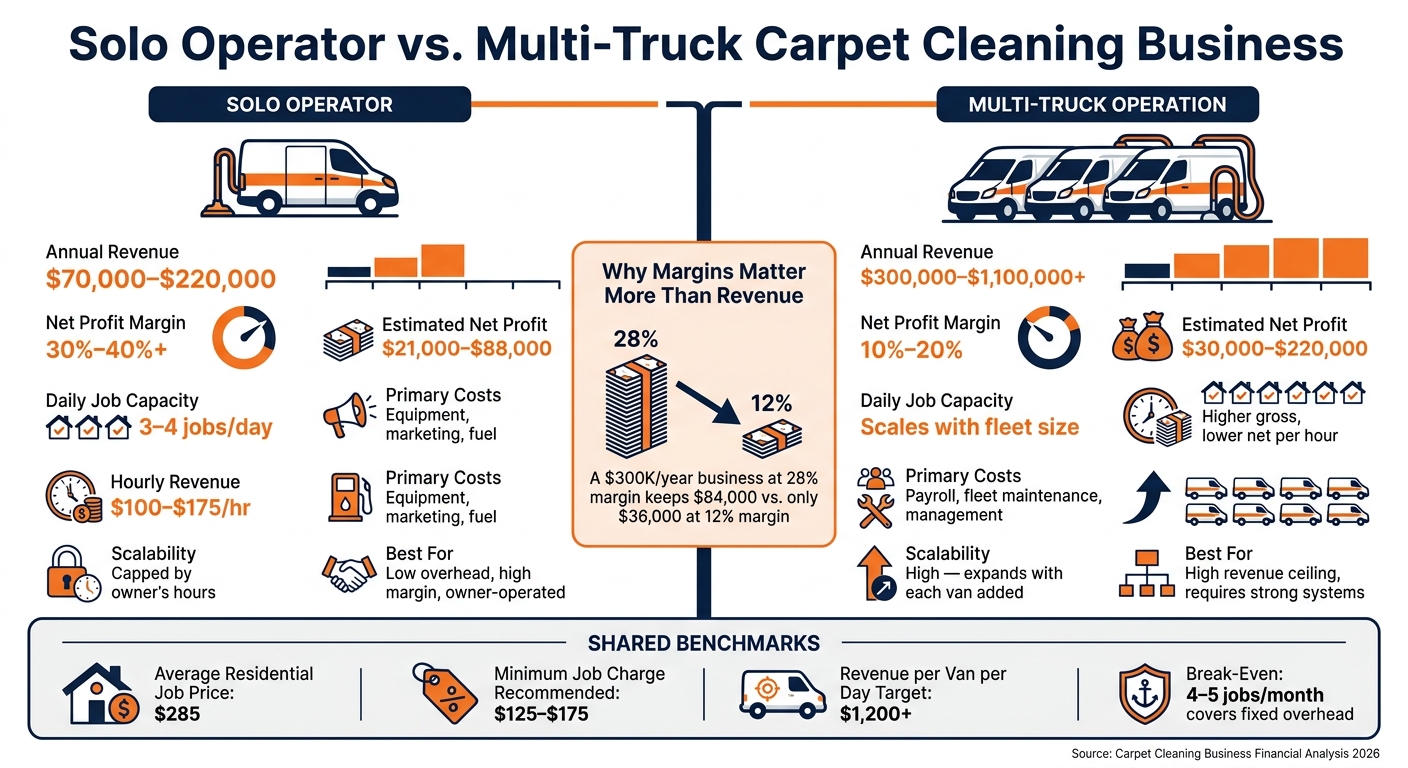
Solo Operator vs. Multi-Truck Carpet Cleaning Business: Costs, Revenue & Profit
Building on the earlier discussion of pricing strategies and cost analysis, let’s take a closer look at what realistic income scenarios might look like for a carpet cleaning business.
Typical Income Ranges for Carpet Cleaning Businesses
Your earnings will largely depend on the type of equipment you use and how many jobs you complete daily. For example, a solo operator using a portable extractor can typically earn $50,000 to $100,000 annually, while upgrading to a truck-mounted system can increase that range to $100,000 to $180,000 per year. Businesses with multiple crews can scale even further, often generating $300,000 to over $1,000,000 annually.
One of the key advantages of carpet cleaning is its high hourly revenue, which averages $100 to $175 per hour - far higher than general house cleaning, which typically brings in $50 to $60 per hour. Tarik Khribech, Founder & CEO of AllBetter, explains the potential clearly:
"A solo carpet cleaning operator averaging three residential projects per day at $175 to $275 each can net $97,500 to $175,500 annually."
Factors like route density, ticket size, and repeat customers play a big role in driving these numbers. Comparing solo operators to multi-truck operations highlights how different business models affect earnings.
Solo Operator vs. Multi-Truck Operation: A Side-by-Side Comparison
Revenue and profit margins vary significantly depending on whether you’re running a solo operation or a multi-truck business. While scaling up can dramatically increase revenue, it often comes with slimmer profit margins. Solo operators benefit from lower overhead costs, maintaining a 30% to 40%+ net margin, whereas multi-truck operations typically operate at a 10% to 20% margin due to expenses like payroll and fleet maintenance. Here’s a breakdown:
| Metric | Solo Operator | Multi-Truck Operation |
|---|---|---|
| Annual Revenue | $70,000–$220,000 | $300,000–$1,100,000+ |
| Net Profit Margin | 30%–40%+ | 10%–20% |
| Primary Costs | Equipment, marketing, fuel | Payroll, fleet maintenance, management |
| Scalability | Capped by owner's hours | High; expands with each van added |
Maura Voecks, author of Carpet Cleaning Digital, sums it up well:
"A business doing $300,000 a year at a 12% net margin keeps $36,000. The same business at a 28% net margin keeps $84,000. The difference is entirely in how the numbers are managed."
This highlights the importance of maximizing profitability before expanding. Jumping into a multi-truck model too soon can lead to thinner margins without the revenue to justify the added complexity.
Managing Cash Flow and Reinvesting Profits
Carpet cleaning revenue tends to fluctuate throughout the year, with winter slowdowns being common in residential work. To prepare for these dips, it’s smart to build a cash reserve of $3,000 to $12,000. This cushion can cover slow weeks or unexpected expenses, like equipment repairs. For instance, a broken truck-mount doesn’t just mean losing a day of revenue - it could also result in canceled bookings and strained customer relationships.
Taxes are another important consideration. Rates vary by state; for example, Texas taxes residential carpet cleaning at 8.25%, while California exempts the service but taxes certain products. Setting aside tax funds from the beginning can save you from financial headaches later.
Before reinvesting profits, ensure you have a solid three-month working capital reserve and a steady flow of weekly bookings, ideally $4,000 to $6,000 . Expanding too early, without fully optimizing your first operation, can lead to stretched margins and unnecessary risks. By managing cash flow carefully and reinvesting strategically, you can grow your business in a sustainable way.
Key Takeaways for Aspiring Carpet Cleaning Business Owners
Checking the Financial Feasibility of Your Business
Before diving in, it's essential to crunch the numbers. One of the most critical metrics to track is billable hours per truck per day - aim for 5 to 6 productive hours as a baseline for profitability. Long drives between scattered jobs can quietly eat into your margins, so careful planning is key.
Tools like IdeaFloat can help you model job volume scenarios and assess your target market before committing. Combine this with a thorough analysis of your local competition and pricing to ensure the financials make sense before signing leases or investing in equipment.
"Operators who fail at carpet cleaning are rarely losing to competition - they lose to their own pricing." - Tarik Khribech, CEO, AllBetter
Once you've confirmed the numbers work, you're ready to move forward with launching your business efficiently.
Next Steps to Launch Your Carpet Cleaning Business
After analyzing the financials, it’s time to turn plans into action. Start by forming an LLC and securing general liability insurance with at least $1M/$2M coverage, including a "care, custody, and control" rider. Next, invest in core equipment, such as a mid-range portable extractor, which typically costs between $3,000 and $6,000. These foundational steps will help you establish a solid base.
In weeks three and four, focus on building early momentum. Offer discounted cleanings to neighbors to gather feedback and engage with local communities through platforms like Facebook and Nextdoor. This grassroots approach can help you refine your services while generating word-of-mouth buzz.
Within your first 90 days, consider obtaining the IICRC Carpet Cleaning Technician (CCT) certification. While not legally required in most states, this certification can unlock opportunities for commercial accounts and insurance restoration work, which often provide more stable revenue streams.
As your business grows, prioritize building a strong online presence. Operators with over 100 Google reviews often see 3–5x more inquiries. Additionally, establish a firm service minimum of $150–$250 to ensure even smaller jobs remain profitable. Finally, resist the urge to expand to multiple trucks until your current operation is consistently booked and generating healthy margins.
FAQs
Should I start with a portable extractor or a truck-mount?
When deciding between the two, it often comes down to your budget and business needs.
- Portable extractors: These range from $1,500 to $6,000 and are a more budget-friendly option. They’re ideal for smaller spaces like apartments or offices where hose access might be limited.
- Truck-mount systems: With prices starting at $15,000 and going beyond $45,000, these systems deliver higher performance and quicker drying times.
Many professionals begin with a portable extractor to generate steady cash flow and later invest in a truck-mount system as their business expands.
How many jobs a week do I need to break even?
To calculate your break-even point, take your monthly fixed costs and divide them by the net profit you make per job. For instance, if your monthly overhead is $1,500 and you earn $167 per job, you'll need roughly 9 jobs each month to break even. Keep in mind, this figure can change depending on factors like your pricing structure, overhead costs, and overall business model. Businesses that operate on high volume but low margins often need to complete more jobs to cover their expenses.
When is it smart to hire my first employee?
When it’s time to hire your first employee, make sure you’ve built a steady client base and reached a point where you can’t manage the workload alone. Before moving forward, confirm that your business can handle the added expenses, such as workers' compensation insurance - a requirement in most states for employees.
Hiring isn’t a one-and-done task; it’s an ongoing effort. Retaining skilled technicians is essential, as a bad hire can set you back significantly, with costs ranging from $8,000 to $15,000. Careful planning and thoughtful decisions here will save you both time and money.
Related Blog Posts
- How to Start a Pressure Washing Business With Under $1,000
- How to Start a Mobile Car Detailing Business: Complete Guide
- Pressure Washing Startup Costs: Gear, Licences, ROI
- Local Service Businesses Ranked by Startup Cost, Margin, and Payback Period