Starting a pressure washing business can be both affordable and profitable. With initial costs ranging from $3,000 to $5,000, many operators break even within 4 to 6 weeks. This industry, valued at $3.1 billion, offers high-profit margins (40%-60%) and steady demand, driven by homeowners and commercial clients alike.
Key takeaways:
- Services: Residential (driveways, roofs, siding) and commercial (parking lots, fleets).
- Pricing: Charge per square foot or flat rates; typical job minimums are $200-$400.
- Startup Costs: Equipment, insurance, and marketing average $4,250 to $12,750.
- Revenue Potential: Solo operators can earn $50,000-$120,000 annually with proper pricing and marketing.
- Seasonal Demand: Northern states see 7-8 months of work, while warmer regions can operate year-round.
A solid business plan, effective pricing, and securing recurring commercial accounts are crucial for success. The guide includes a detailed budget breakdown, revenue projections, and tips to overcome challenges like seasonal dips and inconsistent leads.
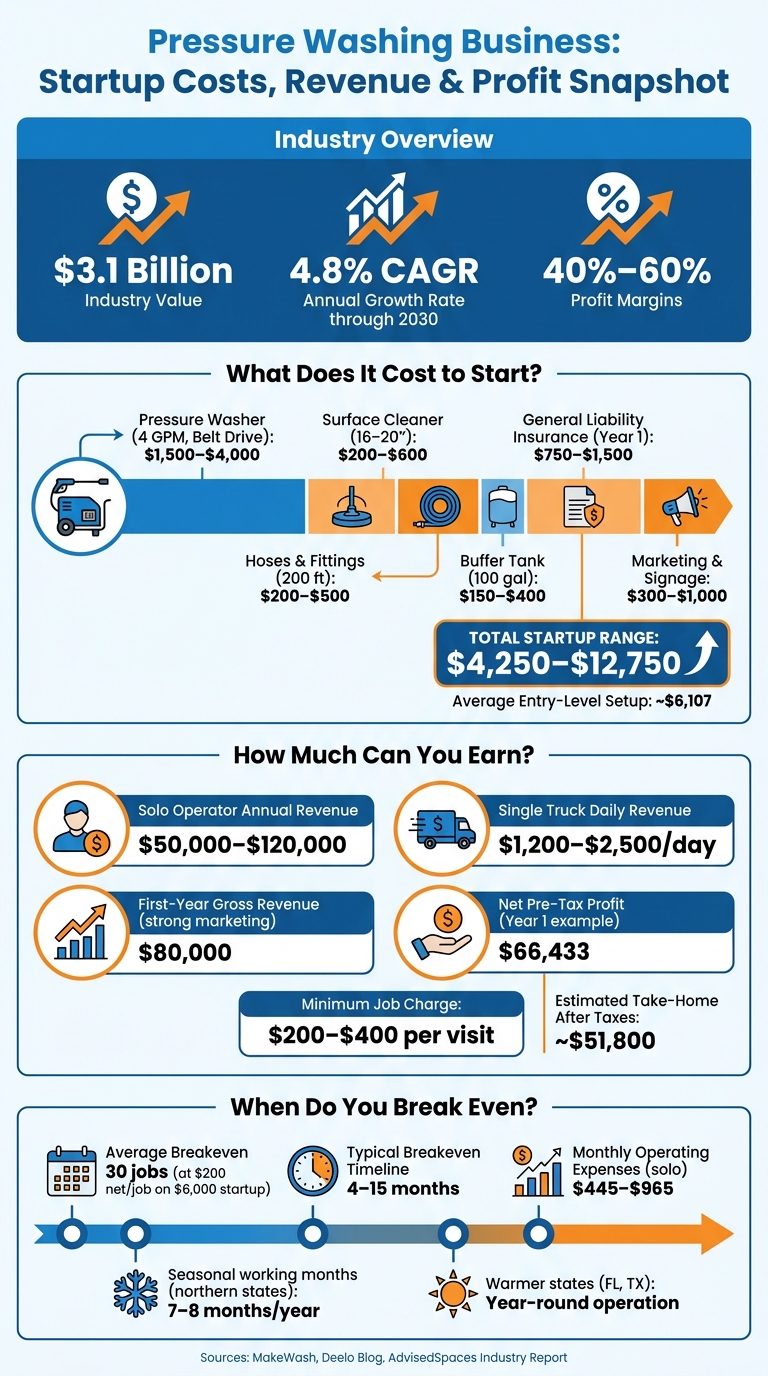
Pressure Washing Business Startup: Costs, Revenue & Profit at a Glance
Pressure Washing Business Makes $500/Day (Find Out How) Pt. 1
sbb-itb-08dd11e
How the Pressure Washing Business Model Works
A solid business plan starts with knowing what drives revenue and keeps costs manageable. At its core, a pressure washing business generates income by providing exterior cleaning services for homes and businesses. With low overhead and high profit margins, this model is particularly appealing. Solo operators often see profit margins between 40% and 60%, and a single truck can bring in $1,200 to $2,500 per day.
Core Services and Customer Types
Pressure washing typically involves two main techniques. High-pressure washing is used for tough surfaces like concrete driveways, parking lots, and masonry. On the other hand, soft washing relies on low pressure combined with chemical solutions, such as sodium hypochlorite, to clean more delicate surfaces like roofs, vinyl siding, and stucco. Matching the method to the surface is critical.
For residential customers, common jobs include cleaning driveways, house siding, decks, roofs, and gutters. On the commercial side, services often cover parking lots, loading docks, dumpster pads, fleet vehicles, and restaurant exteriors. Your client base is likely to include homeowners, property managers for HOAs or apartments, fleet operators, real estate agents preparing homes for sale, and even local governments.
Commercial accounts are a major growth opportunity. By 2026, there’s expected to be a shortage of dependable contractors for commercial work, which gives new operators an edge.
"The money is in recurring commercial accounts: parking structures, vehicle fleets, school campuses, loading docks." - Powerline Industries
Understanding these service categories helps clarify how seasonal trends and pricing strategies influence the overall business.
Seasonal Demand and Revenue Patterns
The demand for pressure washing services is closely tied to weather. In northern states like Minnesota and Ohio, the working season generally spans April through October, lasting about 7 to 8 months. However, in warmer states like Florida and Texas, operators can often work year-round. Keep in mind that rain can cut into productivity, with operators losing about 30–60 days annually due to weather.
In colder, seasonal markets, revenue can drop by 40% to 70% during the winter months of December through February. The most successful operators counteract this downtime by securing recurring commercial accounts. Businesses like restaurants, gas stations, and HOAs often require regular maintenance regardless of the season, providing a steady income even during slower months.
Pricing Methods and Industry Benchmarks
Once services are outlined and seasonal factors considered, pricing becomes the linchpin for maintaining efficiency and profitability. Most professionals avoid hourly pricing, as it penalizes speed and efficiency. Instead, they charge based on square footage or flat rates, which ensures earnings increase with faster work.
"Success depends on accurate pricing, systematic sales, and professional operations." - Deelo Blog
Here’s a snapshot of typical pricing for common services across the U.S.:
| Service | Pricing Method | 2026 Rate Range |
|---|---|---|
| House Washing (Siding) | Per square foot | $0.15 – $0.40/sq. ft. |
| Driveway / Concrete | Per square foot | $0.15 – $0.45/sq. ft. |
| Roof Cleaning (Soft Wash) | Per square foot | $0.30 – $0.80/sq. ft. |
| Wood Decks / Fences | Per square foot | $0.25 – $1.50/sq. ft. |
| Gutter Cleaning | Per linear ft. | $1.00 – $3.00/linear ft. |
| Commercial Flatwork | Per square foot | $0.05 – $0.25/sq. ft. |
| Fleet Washing | Per truck | $35 – $85/truck |
Most businesses also establish a minimum charge of $200 to $400 per visit to cover travel, setup, and material costs. To maximize earnings, operators often bundle additional services - like gutter brightening or window cleaning - during a single visit. This approach boosts revenue without requiring extra travel.
Pressure Washing Business Plan Template
Turning your business idea into a detailed plan is the key to transforming potential into profit. A well-thought-out plan not only guides your decisions but also helps secure financing. With the U.S. pressure washing industry valued at approximately $3.1 billion and growing at a 4.8% CAGR through 2030, there’s a lot of opportunity to tap into - if you’re prepared to plan before you spray.
Executive Summary
Write this section last, but place it first in your plan. It should provide a quick overview of your business name, legal structure, service area, core services, and financial projections. For example:
"[Business Name], an LLC operating out of [City, State], specializes in residential and commercial exterior cleaning services within a 20-mile radius. Estimated first-year revenue: $75,000–$90,000, with a target net margin of 50%."
Decide on your legal structure early - forming an LLC is a smart move to protect your personal assets. Also, define what makes your business stand out, whether it’s eco-friendly cleaning solutions, fast online booking, or something else that resonates with customers. Make sure your summary aligns with market research and realistic financial expectations to show a clear path to success.
"I definitely recommend investing in commercial equipment when starting in this industry; customers deserve professionalism." - Mause Ramirez, Owner, MCS Cleaning Services
Market Analysis
The primary goal of your market analysis is to determine if there’s enough demand in your area to sustain your business. Start by defining a 15–30 mile service radius, then evaluate it using key benchmarks. The secret to profitability is route density - getting multiple jobs close together. As one industry report notes:
"Route density is your profit. Ten driveways within 5 miles of each other is worth more than thirty scattered across three counties." - AdvisedSpaces Industry Report
Here’s how to analyze your target area:
| Factor | Target Metric | Red Flag |
|---|---|---|
| Housing Density | 500+ single-family homes/sq. mi. | Under 300 homes/sq. mi. |
| Median Household Income | $65,000+ | Below $50,000 |
| HOA Penetration | 30%+ of subdivisions | No HOAs in service area |
| Local Competition | Fewer than 20 established operators | 40+ operators with strong reviews |
| Average Home Age | 15–40 years old | Under 5 years old |
Homes that are 15 to 40 years old typically require more exterior maintenance, and neighborhoods with active HOAs can generate 15 to 30 clients from a single targeted campaign. To validate demand, drive through your service area and look for algae-stained driveways, "For Sale" signs, and grime-covered siding. Once demand is confirmed, you can finalize your service offerings and pricing strategy.
Services and Pricing Strategy
Start with a focused list of services and assign clear pricing for each. For residential clients, stick to core services like house washing, driveway cleaning, roof cleaning, and deck washing. If you have the right equipment, you can add one or two commercial services to diversify your income. Avoid trying to offer too much at the beginning - operators who overextend themselves often struggle with pricing and quality.
Adopt a simple flat-rate pricing model with a minimum charge of $250–$400 per visit. This ensures you cover travel, material costs, and overhead while making every job profitable from day one. Offering upsell options like gutter brightening or concrete sealing can increase your revenue per visit by over 150%.
"The people who clear six figures in year two charge correctly from day one and turn down the customers who haggle." - MakeWash Industry Guide
Startup Budget and Financial Plan
Estimating Startup Costs
Startup costs can vary widely depending on the equipment and setup you choose. A simple, lean setup might start at $4,250, while a fully branded mobile rig could push costs beyond $12,750. On average, most professional entry-level setups in U.S. markets hover around $6,107.
Here’s a breakdown of typical costs for a professional entry-level setup:
| Item | Low Estimate | High Estimate |
|---|---|---|
| Pressure Washer (4 GPM, Belt Drive) | $1,500 | $4,000 |
| Surface Cleaner (16–20") | $200 | $600 |
| Hoses & Fittings (200 ft) | $200 | $500 |
| Buffer Tank (100 gal) | $150 | $400 |
| General Liability Insurance (Year 1) | $750 | $1,500 |
| Marketing & Signage | $300 | $1,000 |
| Total Estimated Startup | $4,250 | $12,750 |
A cold-water pressure washer in the $1,500–$4,000 range is an excellent starting point. Upgrading to a hot-water unit, which costs $4,000–$8,000+, should only be considered once you secure contracts that require it, such as commercial grease-removal jobs.
Once you’ve covered your initial setup, focus on managing monthly operating expenses to keep your business running smoothly.
Monthly Operating Expenses
Monthly expenses are split into fixed costs (like insurance and depreciation) and variable costs (such as fuel and marketing). For a solo operator, these typically range between $445 and $965 per month. Here’s how those costs break down:
| Expense Category | Monthly Cost Range |
|---|---|
| Fuel (Truck + Machine) | $150 – $300 |
| Chemicals & Supplies | $50 – $150 |
| General Liability Insurance | $40 – $80 |
| Marketing (Ads/Flyers) | $50 – $200 |
| Vehicle/Trailer Maintenance | $50 – $100 |
| Phone & Business Software | $30 – $60 |
| Equipment Replacement Fund | $25 – $75 |
| Total Estimated Monthly | $445 – $965 |
Reducing costs is possible with smart strategies. For example, grouping jobs by zip code can cut fuel expenses by up to 20%. A simple but effective tactic: after completing a job, leave door hangers at nearby houses to build route density without additional advertising costs.
To stay financially organized, track all expenses from the start using tools like Wave or QuickBooks. Also, set aside 25% to 30% of your income for taxes in a separate account. Poor financial planning is a common reason why 44% of service businesses fail, so don’t let disorganized bookkeeping hold you back.
Revenue Projections and Breakeven Analysis
With your costs outlined, you can start projecting revenue. Multiply your average job ticket by the number of jobs you expect to close each month. For instance, if you close 50% of 30 leads per month with an average ticket of $350, you’d earn about $5,250 in gross monthly revenue - or roughly $63,000 annually in your first year.
With strong marketing efforts, solo operators can realistically aim for $80,000–$120,000 in gross revenue in their first year. Below is an example of a profit and loss scenario based on $80,000 in revenue:
| Year 1 Solo Operator P&L (Strong Marketing) | Annual Figure |
|---|---|
| Gross Revenue | $80,000 |
| Equipment Depreciation (3-year) | -$1,667 |
| Insurance (GL + Auto + Inland Marine) | -$1,800 |
| Fuel (Truck + Machine) | -$3,500 |
| Chemicals & Supplies | -$2,500 |
| Marketing & Software | -$2,000 |
| Net Pre-Tax Profit | $66,433 |
| Estimated Take-Home (After Taxes) | ~$51,800 |
Source: MakeWash Realistic Year 1 P&L
To calculate your breakeven point, divide your total startup costs by the profit per job. For example, if your startup costs total $6,000 and you net $200 per job, you’d need to complete 30 jobs to break even. Many operators achieve this within 5 to 10 months.
As you expand your offerings - such as adding roof soft washing or concrete sealing around month three - you can increase your average ticket from $200 to $400–$700, helping you reach profitability faster.
"The number one reason why people go out of business is financial management... they don't know their cash flow, they don't know their money in, money out." - Jason Geiman, Founder, King of Pressure Washing
Common Challenges and How to Handle Them
Underestimating Costs
New operators often focus on the big-ticket items, like the pressure washer and trailer, but it’s the smaller, recurring costs that can sneak up on you. Expenses such as licensing and permits (ranging from $50 to $1,000) and commercial auto insurance (typically $1,500–$2,500 annually) can quickly add up. Then there’s environmental compliance - ignoring EPA regulations can lead to fines as steep as $50,000 per day for improper chemical discharges. If commercial jobs are in your plans, don’t overlook the cost of a wash water reclamation setup, which typically runs $2,000–$3,000. Planning for this upfront can save you from scrambling and unexpected expenses later.
Consumables like O-rings, nozzles, and hose fittings also wear out faster than you might expect, and not having spares on hand can bring your work to a halt. To stay ahead, consider adopting a "Pay-Yourself-First" strategy by setting aside 10% of each job's revenue for repairs and upgrades. Another smart move: take photos of every surface before starting a job. This simple step can protect you from fraudulent damage claims.
"One broken window or one slip-and-fall on a customer's property can end your business. General liability insurance is not optional." - StartAHomeService
While managing hidden costs is critical, seasonal revenue dips can pose an equally tough challenge.
Seasonal Revenue Dips
For operators in colder climates like Minneapolis or Detroit, the working season may only last 6–9 months each year. To offset this, securing recurring commercial accounts can provide a steady income stream. For example, a $250/month dumpster pad cleaning contract adds up to $3,000 annually for just 90 minutes of work each month. Landing 5–10 similar contracts can create a reliable revenue floor to help you weather slower months. Property management companies overseeing multiple HOAs are particularly valuable clients - a single contact can lead to multiple opportunities.
"Residential is one-time or annual. Commercial monthly recurring is the cash flow that survives the off-season." - Deelo Blog
Diversifying your services can also make a big difference. Adding offerings like gutter cleaning, patio sealing, or roof soft washing during the off-season can fill gaps in your schedule. These services often don’t require significant new equipment, making them a cost-effective way to boost your bottom line.
Inconsistent Lead Generation
If your bookings are inconsistent, the issue is often tied to marketing rather than a lack of demand. Platforms like Nextdoor and Facebook neighborhood groups are excellent for generating free, high-quality leads. A simple weekly post featuring a before-and-after photo and a targeted offer - like "$189 for driveways under 800 sq ft" - can attract local customers ready to book. Another cost-effective tactic is branded yard signs, which can generate 1–2 solid leads over 3–5 days at just $5 per lead.
Automating follow-ups is another game-changer. Send a thank-you text on the day of the job, request a Google review a few days later, and follow up with a rebooking reminder 6–12 months down the line. Referral incentives can also work wonders - offering $25 off a future service when a neighbor books can turn satisfied customers into active promoters. These strategies not only keep your schedule full but also align with the financial and operational tips mentioned earlier.
Conclusion: Turning Your Plan into Action
Running a pressure washing business as a solo operator can bring in annual revenue ranging from $50,000 to over $100,000, with gross margins typically falling between 30% and 50%. However, reaching these numbers requires treating the venture as a full-time business. That means having a written plan, a realistic budget, and a clear grasp of your breakeven point. Before diving in, take the time to review your financials and strategy so you can move forward with confidence.
"The owners who build real businesses - not just side hustles that fizzle out by August - are the ones who treat it like a business from day one." - StartAHomeService
Once your financial and operational strategy is set, focus on breaking it down into actionable steps. For most new operators, reaching breakeven takes 4–15 months, depending on factors like startup costs and how quickly they secure commercial accounts. Those who reach profitability sooner tend to set a minimum job charge (usually between $200 and $350), price jobs based on value rather than hourly rates, and lock in recurring commercial contracts early.
Your plan doesn’t have to be flawless; update it as your market shifts and expenses change. Use slower winter months to analyze customer acquisition costs, refine your pricing, and prepare your marketing efforts for spring. Businesses that combine a clear startup budget, disciplined pricing, and a focus on recurring commercial accounts are better positioned to grow. A strong, adaptable plan will help you build on early momentum and scale effectively.
FAQs
Do I need a trailer to start?
No, you don’t need a trailer to kick off your pressure washing business. Plenty of people get started using a truck bed, securing equipment with plywood mounts and ratchet straps. Others manage just fine with compact pressure washing units transported in a car trunk, protected by rubber mats. While a trailer-mounted setup can make things easier for larger operations, it’s something you can invest in down the line as your business and income expand.
What insurance policies should I carry?
To operate a pressure washing business, having the right insurance is crucial. Start with general liability insurance - many clients expect at least $1,000,000 in coverage to protect against potential property damage. You'll also need commercial auto insurance for your work vehicles and inland marine coverage to protect your equipment. If you employ workers, most states require workers' compensation insurance, and for specific contracts, a surety bond might also be necessary.
How do I find recurring commercial contracts?
To land ongoing commercial contracts, start by building relationships with property management companies. A single connection here can open doors to numerous opportunities. Consider joining local business groups, keeping an eye on online bidding platforms, and scanning local newspapers for open contract opportunities.
For your outreach efforts, try cold calling businesses or emailing facility managers to pinpoint the key decision-makers. When it’s time to bid, make sure your proposals are polished and professional. Include proof of insurance, references, and detailed descriptions of your service packages to stand out.
Related Blog Posts
- How to Start a Pressure Washing Business With Under $1,000
- Pressure Washing Startup Costs: Gear, Licences, ROI
- How to Start a Pressure Washing Business for Under $1,000
- Pressure Washing Business Startup Costs: Gear, Vehicle, Licences, and Insurance