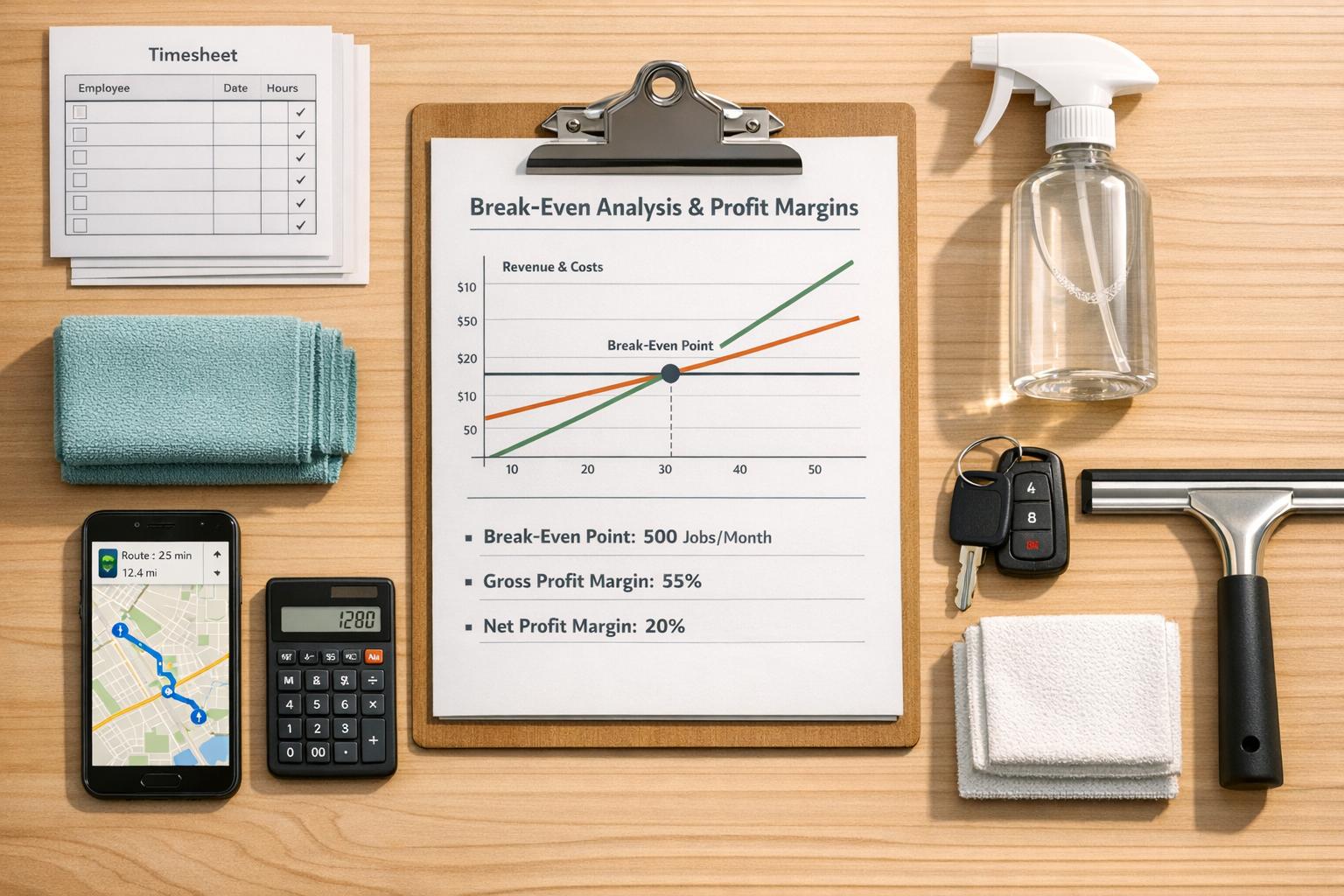
Running a cleaning business is more than just keeping busy - profitability hinges on understanding two key metrics: profit margins and the break-even point.
- Profit Margins: Net profit margins in the cleaning industry average 6.3%, but well-run businesses can achieve 10–28%. Gross margins vary by service type - residential cleaning (50–65%), commercial cleaning (28–38%), and specialty services (40–55%).
- Break-Even Point: This tells you how much revenue or billable hours you need to cover costs. For example, if your fixed costs are $3,500/month and your gross margin per hour is $26, you need 135 billable hours to break even.
Key Takeaways:
- Labor is the largest expense, making up 40–50% of revenue, with payroll taxes adding 15–25% on top.
- Hidden costs, like drive time and employee turnover, can erode profits if not accounted for.
- Pricing must cover all costs (labor, supplies, overhead) and include a profit margin. For example, aiming for a 20% margin means dividing total costs by 0.80 to set your rates.
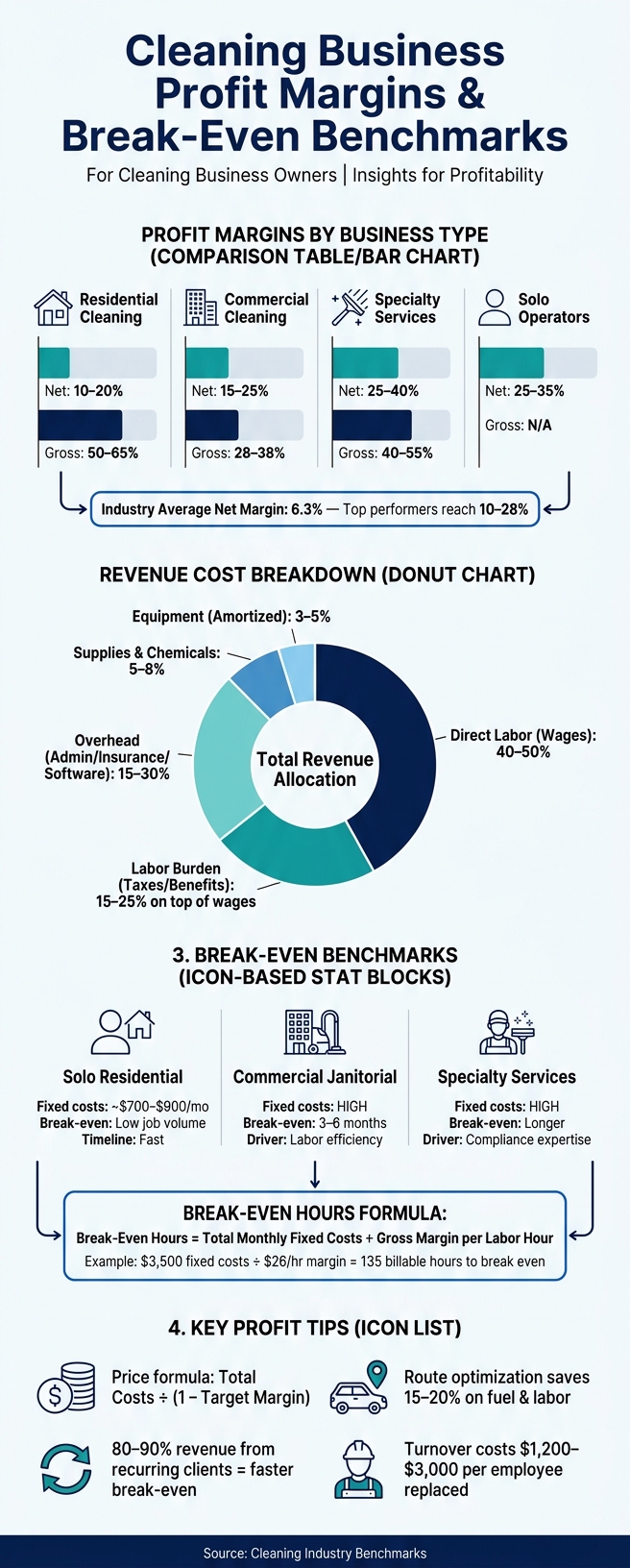
Cleaning Business Profit Margins & Break-Even Benchmarks by Business Type
Cleaning Business Profit Margins... MUST KNOWS 🚀
sbb-itb-08dd11e
Profit Margins in Cleaning Businesses Explained
Profit margins show how much of your revenue remains after covering direct and operating costs. Understanding them is key to improving your cleaning business's financial health.
Types of Profit Margins and How They Work
There are three main profit margin types every cleaning business owner should monitor:
- Gross Profit Margin: This calculates revenue after deducting direct job costs like labor and supplies. For residential cleaning, gross margins typically range between 50%–65%, while commercial cleaning averages 28%–38%.
- Operating Profit Margin: This takes gross profit and subtracts operating expenses, such as vehicle costs, software subscriptions, and administrative fees.
- Net Profit Margin: The bottom line - this measures what's left after all expenses, including taxes, are deducted. It ultimately reflects your business's financial health.
For example, if your business generates $200,000 in revenue and nets $24,000 in profit, your profit margin is 12%.
Typical Profit Margin Ranges in the Cleaning Industry
Profit margins can vary widely depending on the type of cleaning service offered. Here's a breakdown:
| Business Type | Typical Net Margin | Typical Gross Margin |
|---|---|---|
| Residential Cleaning | 10%–20% | 50%–65% |
| Commercial Cleaning | 15%–25% | 28%–38% |
| Specialty Services | 25%–40% | 40%–55% |
| Solo Operators | 25%–35% | N/A |
Commercial cleaning tends to have more stable profit margins due to recurring contracts and predictable schedules. Specialty services, like medical facility sanitization or post-construction cleanup, often command higher net margins (25%–40%) because of premium pricing. However, these jobs can require additional training, compliance measures, and higher equipment investment.
"The industry is characterized by extreme fragmentation... and by labor intensity that drives direct labor costs to 50–65% of total revenue, creating structurally thin net margins in the 4–7% range." - COREView
These figures highlight that profitability is driven by your business model, service offerings, and operational efficiency - not just revenue size.
Key Cost Ratios to Track
To maintain healthy profit margins, you need to monitor specific cost ratios. Here's a typical breakdown of how revenue is allocated in a cleaning business:
| Cost Category | Benchmark Range |
|---|---|
| Direct Labor (Wages) | 40%–50% of revenue |
| Labor Burden (Taxes/Benefits) | 15%–25% on top of wages |
| Supplies & Chemicals | 5%–8% of revenue |
| Equipment (Amortized) | 3%–5% of revenue |
| Overhead (Admin/Insurance/Software) | 15%–30% of revenue |
Labor is typically the largest expense, yet many business owners underestimate its true cost. If you're paying a cleaner $20/hour, the real cost might be closer to $23–$25/hour once payroll taxes, workers' compensation, and benefits are added.
"Every dollar you don't allocate to overhead in your bid is a dollar that comes out of your pocket at the end of the month." - GetBidClean
While supply costs generally stay within 5%–8% of revenue, if direct payroll exceeds 55%, it could indicate that your pricing is too low or that operational efficiency needs improvement.
Next, we’ll explore how to use this financial data to calculate your margins with precision. By understanding these benchmarks, you’ll be better equipped to evaluate and refine your business's financial performance.
How to Calculate Your Cleaning Business Profit Margins
Financial Data You Need to Collect
To accurately calculate your profit margins, you’ll need to gather some essential financial details. This includes your revenue broken down by service type, labor costs (including overtime), supply expenses, and fixed overhead. Don’t forget to factor in payroll burden, which typically adds 15–20% to base wages.
| Category | Specific Data Points to Gather |
|---|---|
| Revenue | Gross sales per service type (residential, commercial, specialty) |
| Direct Labor | Hourly wages, overtime pay, field supervisor pay |
| Labor Burden | FICA (7.65%), FUTA (0.6%), SUTA, Workers' Comp (7–10%), benefits |
| Supplies | Chemicals, microfiber cloths, paper goods, trash liners |
| Fixed Overhead | General liability insurance, vehicle payments/fuel, rent, scheduling/invoicing software |
| Equipment | Purchase price and maintenance for vacuums, scrubbers, sprayers |
Once you’ve collected these numbers, you’ll have the foundation to calculate your profit margins accurately.
Step-by-Step Margin Calculations
Now that you have your data, you can calculate your margins using the following formulas:
| Margin Type | Formula | What It Includes |
|---|---|---|
| Gross Margin | (Revenue − COGS) ÷ Revenue | Direct labor (with payroll burden), supplies, equipment wear |
| Operating Margin | (Revenue − OpEx) ÷ Revenue | Gross costs plus rent, insurance, software, marketing, and admin expenses |
| Net Margin | (Revenue − All Costs) ÷ Revenue | Every expense including taxes and interest |
Here’s an example: If your monthly revenue is $20,000, with $9,000 in labor (including payroll burden), $1,200 in supplies, and $3,500 in overhead, your gross profit would be $9,800 (a 49% margin). After accounting for operating expenses, your operating profit becomes $6,300 (31.5% margin). Finally, subtracting all costs, your net profit is $5,100 (a 25.5% margin).
These calculations are critical for setting bids that cover all costs while ensuring profitability. Use this formula to price your bids effectively:
Bid Price = (Labor + Supplies + Allocated Overhead) ÷ (1 − Desired Profit Margin)
For instance, if you aim for a 20% net margin, divide your total costs by 0.80. Be careful not to confuse markup with margin - a 25% markup on costs typically results in only a 20% profit margin.
Hidden Costs That Affect Your Margins
Some costs aren’t immediately obvious but can eat into your margins if overlooked. For example, drive time between jobs is a labor cost that often goes unaccounted for but can reduce margins by 2–5%. To factor this in, calculate your overhead per hour by dividing your total monthly fixed costs by your billable hours. For example, if you operate solo with $900 in monthly overhead and 172 billable hours, your overhead rate is about $5.23 per hour, which should be included in every bid.
Another hidden cost is scope creep, such as doing unbilled extras like cleaning an oven or additional windows. These extras can cost around $75–$100 per month per account in uncompensated labor and overhead. Similarly, callbacks for missed spots add to your labor costs without bringing in additional revenue, impacting your bottom line.
"Your bid must cover labor, supplies, overhead, AND profit. No shortcuts." - GetBidClean
Lastly, don’t underestimate the cost of employee turnover. Replacing a single employee can range from $1,200 to $3,000, factoring in recruiting, background checks, and training. With annual turnover rates in the cleaning industry reaching 150–200%, budgeting for these costs is essential to maintaining healthy profit margins.
Break-Even Benchmarks for Cleaning Businesses
Profit margins are important, but knowing your break-even point is just as critical. It tells you exactly how much revenue you need to stop operating at a loss. This is a key metric for assessing whether your cleaning business is financially sustainable.
Break-Even Formulas You Need to Know
As a cleaning business owner, there are two key formulas you should have in your toolkit.
The first helps you calculate your break-even revenue each month:
Break-Even Revenue = Total Fixed Overhead ÷ Contribution Margin %
The contribution margin is the portion of revenue left after covering variable costs like labor and supplies. For example, if you charge $48/hour and your variable costs are $22/hour, your contribution margin is $26/hour, or about 54%.
The second formula determines how many billable hours your team needs to work monthly to cover fixed costs:
Break-Even Hours = Total Monthly Fixed Costs ÷ Gross Margin per Labor Hour
Let’s break it down: if your fixed monthly costs are $3,500, and your gross margin is $26/hour, you’ll need to hit 135 billable hours to break even. Lower your gross margin to $15.30/hour, and the break-even point jumps to 229 hours per month. This shows how pricing and labor costs directly affect your break-even point, tying back to the pricing strategies discussed earlier. Knowing these numbers also helps you manage the fixed and variable costs we’ll dive into next.
Fixed vs. Variable Costs in Cleaning Operations
To understand your margins and break-even points, you need to categorize your costs accurately.
- Fixed costs stay constant regardless of how many jobs you take on. These include expenses like general liability insurance, vehicle payments, scheduling software, office rent, and professional licenses.
- Variable costs, on the other hand, change with the number of jobs. These include hourly wages, payroll taxes (FICA, FUTA), cleaning supplies, consumables like trash bags, and fuel.
One common mistake is underestimating labor costs. Payroll burden - things like taxes and benefits - typically adds 15–20% to base wages. If you overlook this, your contribution margin might look better on paper than it actually is, potentially pushing your break-even point higher than expected.
"Most cleaners fail because they calculate job costs perfectly but forget to allocate overhead to each contract. Then they wonder why they're 'making money' on paper but broke in the bank." - GetBidClean
Break-Even Points by Business Model
Break-even points vary significantly depending on your type of cleaning business. Here’s a quick comparison:
| Business Model | Typical Net Margin | Fixed Cost Level | Break-Even Driver |
|---|---|---|---|
| Residential (Solo) | 25–35% | Low (home-based) | Volume of jobs |
| Commercial Janitorial | 8–15% | High (office, insurance) | Labor efficiency / workloading |
| Specialty (Medical/Floor) | 20–40% | High (specialized gear) | Compliance expertise |
Solo residential cleaners typically have low overhead - often just $700–$900 per month - making it easier to reach break-even with fewer clients. Commercial operations, however, face higher fixed costs and tighter margins. These businesses usually break even within 3–6 months, but only if they keep a close eye on labor efficiency.
In commercial cleaning, workloading - the square footage a cleaner can handle per hour - plays a huge role in profitability. For instance, a contract priced at $0.13/sq. ft. is profitable at 5,000 sq. ft./hour but loses money at 2,500 sq. ft./hour. Specialty services, like medical or floor care, fetch higher rates ($0.14–$0.29/sq. ft.). However, these require significant upfront investments in training and equipment, raising the break-even threshold before you can start turning a profit.
One often-overlooked issue is cash flow. Many commercial clients pay on Net 30 to Net 60 terms, but you’ll likely need to pay your staff weekly. To avoid cash flow problems during the break-even period, you should keep a buffer of at least two months’ operating expenses.
Each type of cleaning business has unique break-even challenges. Understanding these differences is key to tackling them effectively and improving profitability, which we’ll explore in the next section.
How to Improve Margins and Reach Break-Even Faster
How to Set Prices That Cover Costs and Generate Profit
Pricing your services effectively means factoring in profit right from the beginning. A helpful formula to use is: Price = Total Operating Costs ÷ (1 – Target Margin). For instance, if your total costs are $80 per job and you aim for a 25% margin, your price should be $106.67 - not $100.
Consider shifting from hourly billing to flat-rate pricing to incentivize efficiency. For example, if your cleaner finishes a 2,000 sq. ft. house in 2.5 hours instead of 3, your hourly rate effectively increases. As of 2026, flat-rate pricing typically falls between $185 and $225 per visit for homes sized 2,000–2,500 sq. ft., and $285 or more for homes over 3,500 sq. ft.. For commercial cleaning, leverage ISSA production rates - such as cleaning 3,500–5,000 sq. ft. of office space per hour - to estimate labor hours before setting your rates.
Additionally, build price escalator clauses into your contracts. A 3–5% annual increase protects you from rising costs like wages and insurance without requiring yearly renegotiations. These strategies not only safeguard your profit margins but also help you achieve break-even faster.
"If your only response to pushback is lowering your price, your model isn't strong enough yet." - Jaclyn Tyson, Sweptworks
Let’s now look at ways to reduce costs without compromising service quality.
Ways to Cut Costs Without Cutting Quality
Labor costs typically account for 45–55% of revenue. Paying slightly above the market rate can actually save you money in the long run. For example, offering $1 more per hour than competitors might save over $3,000 annually per employee on recruitment and retraining costs, especially since industry turnover rates range from 150% to 400%.
Clearly define your service scope in writing and charge for any extras outside that scope. This prevents unbilled tasks from eating into your margins. On the supply side, using concentrated cleaning solutions and negotiating better supplier contracts can help you keep material costs within the 2–5% of revenue range.
By managing costs effectively, you create more room to focus on increasing revenue through better capacity planning.
Capacity Planning to Increase Revenue Per Hour
Reducing unpaid drive time is a simple but powerful way to boost revenue. Grouping jobs by zip code improves route density, ensuring your cleaners spend more time working and less time stuck in traffic. This can reduce fuel and labor costs by 15–20%. Pair this with recurring contracts to stabilize revenue and make scheduling more predictable.
Top-performing cleaning businesses generate 80–90% of their revenue from repeat clients. Recurring customers not only stabilize cash flow but also lower customer acquisition costs and provide consistent billable hours, which shortens the time it takes to reach break-even.
"The single biggest predictor of profitability isn't how fast you clean. It's your mix of recurring vs. one-time work." - Revofield
Conclusion
Running a profitable cleaning business hinges on understanding and managing key metrics effectively. While most new businesses in this field can break even within 3 to 9 months, success depends on more than just tracking expenses. Allocating fixed overhead to every billable hour, rather than simply recording it on a spreadsheet, is a critical step.
The real challenge to profitability isn’t competition or seasonal slumps - it’s the hidden costs of unallocated overhead and payroll burden. On average, a cleaner’s actual cost is 15–20% higher than their base wage due to payroll taxes and benefits. When you factor in the industry’s 200% turnover rate, it’s clear that even small missteps can have big consequences. Keeping overhead and payroll under control is absolutely essential.
To stay ahead, price your services with a built-in profit margin, monitor your gross margin per labor hour, and plan jobs strategically to minimize drive time. Securing recurring clients is another game-changer. In fact, 73% of thriving cleaning businesses report losing less than 10% of their accounts annually. High client retention like this can turn a break-even operation into a profitable one.
FAQs
What’s a healthy profit margin for my type of cleaning business?
A healthy net profit margin for a cleaning business usually falls between 10% and 28%, depending on the business model. Solo residential cleaners often enjoy margins of 25%–30% because their overhead costs are minimal. On the other hand, mid-size cleaning businesses with employees typically see margins around 8%–15%.
Specialty services, such as deep cleaning or post-construction cleaning, often bring in higher profits. These services command higher pricing due to the specialized skills required, resulting in margins of 20%–35%.
How do I calculate my break-even billable hours each month?
To figure out your break-even billable hours, take your total fixed monthly overhead costs and divide them by your gross margin per labor hour.
To calculate the gross margin per labor hour, subtract the total hourly cost of labor (including wages and payroll expenses) and consumables from your billable hourly rate. For instance, if your monthly overhead is $3,500 and your gross margin per hour is $15.30, your break-even point would be 229 hours ($3,500 ÷ $15.30).
How should I price jobs to cover overhead, drive time, and profit?
To set job prices accurately, start by figuring out your true cost per hour. Here's how: take your total monthly overhead (this includes things like insurance, vehicle expenses, and supplies) and divide it by the number of billable hours you work. Don’t forget to factor in non-billable time, like driving or handling administrative tasks, since these also eat into your schedule.
Once you’ve nailed down your hourly cost, tack on a target profit margin - typically between 10% and 20%. This gives you your fully loaded rate, which ensures you're covering costs and making a profit.
For recurring jobs, flat-rate pricing can be a smart move. It rewards efficiency, allowing you to pocket more as you streamline your work. Most importantly, base your pricing on your costs rather than relying on local averages. This way, you avoid underpricing and ensure your business remains sustainable.
Related Blog Posts
- How to Start a Profitable Cleaning Business: 2025 Step-by-Step Guide
- Cleaning Business Startup Costs: Supplies, Insurance, Hiring, and Marketing
- Local Service Businesses Ranked by Startup Cost, Margin, and Payback Period
- Carpet Cleaning Business Startup Costs and Profit Margins