You can start a home business in Australia without holding stock, and some of the fastest paths are services, tutoring, coaching, and digital products. If I wanted the shortest path to income, I’d look at freelance writing, VA work, tutoring, or customer support. If I wanted income less tied to hours, I’d look at courses, templates, affiliate content, print-on-demand, or dropshipping.
Here’s the short version:
- Fastest to start: freelancing, VA work, tutoring
- Best for repeat client income: specialist VA, bookkeeping, customer support
- Best for scaling past hours: courses, coaching, digital templates
- Lowest-touch models: affiliate marketing, print-on-demand, dropshipping
- Main Australia rules to watch: ABN, GST at A$75,000 turnover, business name registration, council limits, insurance, and tax records
- Key tax fact: working-from-home claims can use the 67¢ per hour fixed rate if records are kept
- If paid in U.S. dollars: keep each sale recorded and convert income to AUD for tax
The article groups the main options into four buckets:
- Freelance services
Writing, copywriting, virtual assistant work, and tutoring - Client support services
Specialist VA work, bookkeeping, BAS-related support, and customer support - Digital and education products
Online courses, coaching, and digital templates - Audience and e-commerce models
Dropshipping, print-on-demand, and affiliate marketing
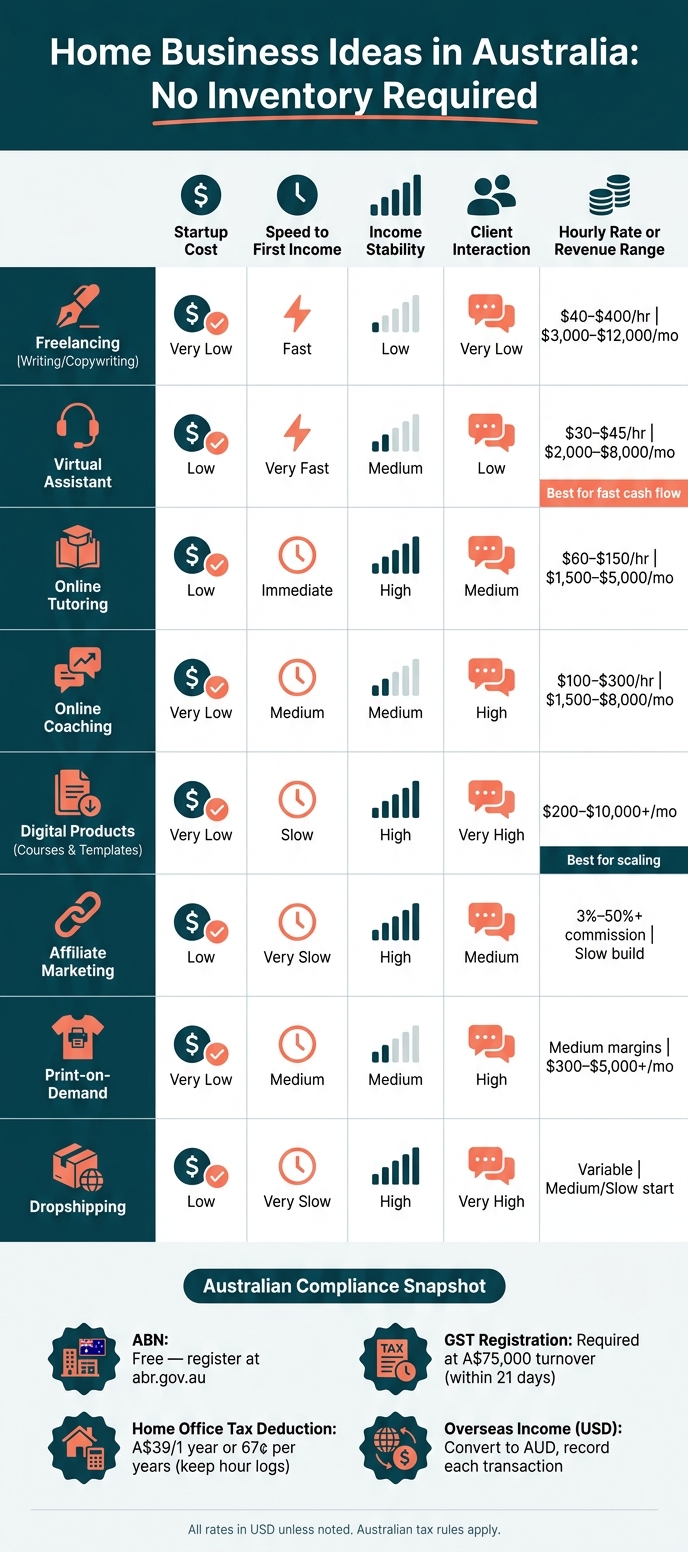
Home Business Ideas in Australia: Cost, Speed & Income Comparison
10 Simple Businesses You Can Start for Under $100 in Australia
sbb-itb-08dd11e
Quick Comparison
| Path | Cost to Start | Time to First Income | Main Trade-Off |
|---|---|---|---|
| Freelancing | Low | Fast | Tied to your hours |
| Virtual Assistant | Low | Very fast | Client-heavy work |
| Tutoring | Low | Fast | Can be seasonal |
| Specialist VA / Bookkeeping | Low | Fast | Needs software or finance skill |
| Coaching | Low | Medium | High one-on-one time |
| Courses / Templates | Low | Slower | Takes time to build and sell |
| Affiliate Marketing | Low | Slow | Traffic takes time |
| Print-on-Demand | Low | Medium | Thin margins |
| Dropshipping | Low | Medium to slow | You still handle buyer issues |
Bottom line: if I wanted cash flow now, I’d start with a service. If I wanted room to grow later, I’d build a digital product or audience-based model after that. The rest of the article walks through each option, who it fits, what it can earn, and what to set up first in Australia.
Before You Start: Australian Home Business Basics
Before you pick a business model, get the legal and tax setup sorted. If you skip this step, small issues can turn into expensive headaches later. It also affects your startup cost, your level of risk, and which ideas still count as low-overhead.
Your first call is business structure. A sole trader setup is the simplest and cheapest option. But there’s a catch: you’re personally liable, so your own assets can be at risk if things go wrong. A company (Pty Ltd) gives you limited liability protection, which can feel a lot safer. The trade-off is cost and admin. Setup fees are A$576 in ASIC fees, and you’ll also deal with separate tax returns and ASIC reporting.
If you’re running a business to make a profit, you’ll need an ABN. It’s free to register through the Australian Business Register. An ABN also helps with invoicing and can stop tax from being withheld from payments. And if you want to trade under a business name instead of your own legal name, you’ll need to register that with ASIC. The fee is A$39 for one year or A$92 for three years.
Then there’s GST registration. Once your annual turnover hits, or is likely to hit, A$75,000, registration becomes mandatory. You must register within 21 days, add 10% GST to taxable sales, and lodge Business Activity Statements (BAS).
Home-based businesses also come with a few extra rules that can change how simple your setup stays. Your local council may limit client visits, signage, noise, or staff who don’t live in the home, so it’s smart to check early. Insurance matters too. Standard home insurance often doesn’t cover business activity, which means you may need business cover like Professional Indemnity or Public Liability. On the tax side, the ATO fixed rate lets you claim 67¢ per hour for working from home, as long as you keep a log of your hours.
If you earn money through overseas platforms or in USD, keep clean records for each sale and convert that income to AUD. It sounds boring, but it’ll save you a mess at tax time.
| Compliance Point | Threshold / Trigger | What to Do |
|---|---|---|
| ABN | Any business activity for profit | Register free through abr.gov.au |
| GST | A$75,000+ annual turnover | Register with ATO; lodge BAS |
| Business Name | Trading name ≠ your legal name | Register with ASIC (A$39 for 1 year or A$92 for 3 years) |
| Home Office Tax | Working from home | Log hours; claim 67¢/hr |
| Council Approval | Client visits or signage | Contact your local council |
| Insurance | Business use of home | Get business-specific cover |
| Overseas Income | USD or platform-based earnings | Convert sales to AUD; keep records for each transaction |
1. Freelance Services
If you already have a skill people will pay for, freelance services are one of the fastest ways to start a business with no inventory. You're selling your time and know-how, not physical products. That keeps startup costs low. All rates below are in USD.
Freelance Writing & Copywriting
Freelance writing is a common way in. Entry-level writers often earn $40–$70 per hour, while specialists in conversion copy or B2B software content can charge $150–$400 per hour. A full website copy project can go past $5,000. In most cases, you just need a laptop, solid internet, and strong grammar. Local businesses often need blog posts, website copy, and email sequences. If you understand Australian audiences, you may be able to charge more.
Virtual Assistant (VA) Services
If you're organized, steady, and quick to reply, VA work makes a lot of sense. Rates usually fall between $30 and $45 per hour, and income grows as you add clients. Common tasks include inbox management, calendar scheduling, and general admin support. Picking a niche can make marketing easier and help you charge more.
Online Tutoring
Online tutoring has steady demand in Australia, especially for HSC and VCE subjects such as Math and English. Rates range from $60 to $150 per hour, with an average of about $101 per hour. Sessions usually happen over Zoom or Google Meet, so the whole setup can stay home-based.
| Service | Hourly Rate | Monthly Revenue | Best For |
|---|---|---|---|
| Freelance Writing | $40–$70/hr | $3,000–$8,000 | Writers with content or SEO skills |
| Copywriting | $150–$400/hr | $5,000–$12,000 | Writers with conversion or B2B focus |
| Virtual Assistant | $30–$45/hr | $2,000–$8,000 | Organized, detail-oriented generalists |
| Online Tutoring | $60–$150/hr | $1,500–$5,000 | Subject-matter experts and former teachers |
If you prefer work built around helping clients day to day instead of handing over one-off projects, the next section moves into client support services.
2. Client Support Services
Client support services are a solid way to earn from home if you’d rather build repeat client work than chase one-off gigs. The work is practical, steady, and built around helping businesses handle admin and customer tasks they don’t have time to manage themselves.
Specialist Virtual Assistant
Specialist VAs work inside tools like Xero, HubSpot, or Salesforce and often charge $50–$80 per hour. Their job is simple in theory: take recurring admin off a business owner’s plate so that owner can focus on sales, delivery, or growth. In Australia, the large small-business market helps keep demand steady for this kind of skilled admin support, and monthly retainers often sit around $650–$900 for 20 hours.
Online Bookkeeping and BAS Services
This is a strong fit for people with a finance background who want home-based client work. Remote bookkeepers often support tradies, which makes sense. They’re usually out on-site, busy with jobs, and short on time for paperwork. The work often includes reconciliations, BAS prep, and monthly reporting through cloud platforms like Xero or MYOB. Rates usually land between $40–$70 per hour.
Remote Customer Support
A lot of businesses hand off inboxes, live chat, and phone calls to remote support teams. That can mean answering customer emails, handling chat requests, or taking support calls throughout the day. Pay usually falls between $25–$35 per hour. If you’re calm under pressure and communicate well, this can be a good entry point.
| Service | Hourly Rate | Best For |
|---|---|---|
| Specialist VA (Xero/CRM) | $50–$80 | Admin pros with software expertise |
| Remote Bookkeeping | $40–$70 | Finance backgrounds, detail-oriented |
| Remote Customer Support | $25–$35 | Strong communicators, flexible schedules |
If you want income that scales beyond client hours, the next section covers digital and education products.
3. Digital & Education Products
If you want income that can grow past your billable hours, digital products are a strong fit. You make them once, then sell them again and again. No inventory. No shipping. And because there’s no cost of goods sold, profit margins on digital downloads can reach 75%.
Online Courses
You can turn what you know into a self-paced course and host it online. In a high-demand niche, a course with solid marketing can bring in $10,000+ per month. That said, most first-time course creators start much smaller, often around $200–$500/month while they build an audience.
A smart move here is to test the idea before you spend months recording lessons. Run a beta workshop. Offer a presale. If people buy early, that’s a good sign you’re building something people want.
Online Coaching
Coaching takes your knowledge and turns it into live, structured sessions over video. Unlike a course, coaching is usually billed by the session or through a monthly retainer. Rates often fall between $100–$300 per hour, based on your niche and level of experience.
Demand is strong in areas like:
- Business
- Career
- Health
- Mindset
The nice part? You can get started fast. A video call tool and a simple booking page are often enough. Later, you can add group programs or recorded materials so you’re not stuck trading only one-on-one hours for income.
Digital Templates and Planners
This category covers things like Canva social media layouts, Notion budget trackers, wedding planning timelines, and niche contract templates. These products are often simple to make, but the game is in the listings.
Established shops with 50–100 well-optimized listings can earn $300–$5,000+/month. In plain English: one template usually won’t do much on its own. A shop tends to do better when it has a larger catalog, clear listing titles, and search-friendly wording.
| Product | Startup Time | Monthly Revenue Potential |
|---|---|---|
| Online Course | 3–6 months | $200–$10,000+ |
| Online Coaching | 1–2 weeks | $1,500–$8,000 |
| Digital Templates | 1–4 weeks | $300–$5,000+ |
If you collect buyer emails, add a Privacy Policy to your site. Once turnover hits $75,000, register for GST. One helpful detail: digital products sold to overseas customers are generally GST-free.
If you’d rather have someone else handle fulfillment instead of making the product yourself, the next section looks at audience-led and ecommerce models.
4. Audience & E-commerce Models
These are low-touch models. You market the offer, while a supplier takes care of storage, printing, or fulfillment. That means you can sell without making, storing, or shipping your own inventory.
The upside is leverage. The catch? These models often take longer to get going than services or digital products. They work best if you want a business that leans on systems, not stock in your garage.
- Dropshipping You run the store and choose the price. The supplier ships each order for you. Your profit is the gap between what the customer pays and what the supplier charges. One big point here: niche selection matters more than trying to sell everything to everyone. A focused store usually has a better shot than a broad one. If you're operating in Australia, the legal side matters too. Under Australian Consumer Law, you are still responsible for refunds, product claims, and delivery standards.
- Print on Demand (POD) With POD, you make the design. A POD provider prints it on a t-shirt, mug, or tote bag only after someone places an order. So there’s no need to buy stock upfront. This model fits creators and influencers who want to sell branded merchandise without getting stuck with boxes of unsold items. The trade-off is margin. Production costs are higher, so your cut is usually smaller. Also, order samples before launch. What looks great on a screen can look very different in your hands.
- Affiliate Marketing This is the lightest model in the group. You don’t run a store or handle fulfillment. Instead, you recommend products through a blog, social media, or an email list. If someone buys through your link, you earn a commission. Your job is content and traffic. The supplier handles the rest. In Australia, commission rates often range from 3% to over 50%, depending on the niche. Affiliate programs are common in retail, software, and education. The trade-off is time. Traffic usually takes months to build, so income tends to start slowly. And in Australia, affiliate relationships must be disclosed clearly. Label affiliate links in a way people can easily see and understand.
The $75,000 GST threshold still applies.
How to Choose the Right Idea for Your Skills, Budget, and Lifestyle
Now that the main models are on the table, it’s time to pick the one that lines up with what you have right now - your skills, your schedule, your budget, and how soon you want to start earning.
Some ideas get money coming in fast but need more client contact. Others take longer to pay off, yet can bring in steadier income later. That’s the trade-off.
Use the table below to compare your options at a glance.
| Business Idea | Startup Cost | Speed to First Income | Income Stability | Client Interaction | Complexity |
|---|---|---|---|---|---|
| Freelancing | Very Low | Fast | Medium (project-based) | High | Low |
| Virtual Assistant | Very Low | Very Fast | High (retainers) | High | Low |
| Online Tutoring | Very Low | Immediate | Medium (seasonal) | High | Low |
| Online Coaching | Low | Medium | High (per client) | Very High | Medium |
| Digital Products | Low | Slow | High (passive) | Very Low | Medium |
| Affiliate Marketing | Low | Very Slow | Long-term | Very Low | High |
| Print-on-Demand | Low | Medium | Medium | Low | Medium |
| Dropshipping | Low | Medium/Slow | Low | Medium | High |
One simple pattern shows up often: the more specific your offer, the more you can usually charge. A niche bookkeeper serving one trade can often charge more than a generalist.
Before you launch, check your shortlist against demand and pricing data. And before you commit, use IdeaFloat to test demand, pricing, and breakeven with live market data.
Conclusion
These models make it possible to start from home with low overhead and no inventory. The best pick comes down to your skills, budget, and the time you can put in.
Before you launch, sort out the legal and tax basics. Register your ABN for free through the Australian Business Register. If you’re not trading under your own legal name, register a business name with ASIC for A$39 for one year. It also helps to separate business and personal bank accounts from day one.
For tax, you can claim 67¢ per hour for home office work, and you should keep digital records for at least five years. Those simple steps can save you a headache later and keep your home business easy to run.
Pick the model that matches how fast you want to start earning. Then test demand with a poll, direct outreach, or a small paid trial. IdeaFloat can help you check demand, pricing, and breakeven before launch. Validate first, then launch.
FAQs
Which home business is best for beginners?
The best home business for a beginner depends on your skills, your goals, and the time you can put into it. There isn’t one perfect choice for everyone.
Some beginner-friendly options stand out because they’re simple to start. Dropshipping works well if you want to sell products without storing inventory yourself. Transcription is a solid pick if you want a low-cost service business. And if you already have admin or communication skills, virtual assistance or freelance writing can be a smart way to get started.
Do I need an ABN to start from home in Australia?
Yes. You can trade without one, but having an ABN makes running a home-based business in Australia a lot easier.
In most cases, you’ll need an ABN to send invoices, deal with the ATO, open a business bank account, and register a .com.au domain. Without an ABN, businesses that pay you may need to withhold tax at the top rate.
The good news? ABN registration is free and you can do it online.
How can I test demand before launching?
Test demand before you spend too much time building. The goal is simple: get feedback from real people and see if the problem is painful enough that they’d pay to fix it.
Start by talking to at least 10 potential customers. Ask where they get stuck, what frustrates them, and how they deal with the issue now. Then dig a little deeper: what would they actually pay for a better option? Those conversations can save you from building something nobody wants.
You can also test interest in simple ways, depending on what you’re selling.
- For services: offer a free trial or a short intro call
- For products: set up a simple landing page to collect emails or pre-sell at an early-bird rate
That last part matters. It’s one thing for people to say, “Yeah, I’d use that.” It’s another thing for them to book a call, join a waitlist, or pull out a credit card. That’s the kind of signal worth paying attention to.
Related Blog Posts
- 21 Low-Investment Business Ideas for Women in Australia
- Best Small Business Ideas in Australia Under $5,000
- What Business Can You Start in Australia With $10,000? 15 Realistic Ideas for 2026
- 19 Low-Cost Business Ideas in Australia With High Profit Potential