A product price has one job: cover costs, leave profit, and still make sense in the market. If I skip even one part - fees, shipping, overhead, or competitor pricing - I can end up selling a lot and still lose money.
Here’s the short version:
- I start with cost per unit
- Then I add a markup to get a first price
- Next, I check break-even volume
- After that, I compare markup vs. margin
- Last, I test the number against 5–10 competing offers
A simple example: if my unit cost is $20.00 and I add a 30% markup, my price becomes $26.00. If my fixed costs are $1,500 per month and each sale leaves $12.00 after variable costs, I need 125 sales per month to break even.
What stood out to me most is this: pricing is math first, market check second. The article’s core point is simple - build a floor from costs, test profit with formulas, then see whether buyers will pay that number.
Here’s the article at a glance:
| Step | What I check | Simple formula |
|---|---|---|
| 1 | Cost per unit | Direct costs + (fixed costs ÷ expected units) |
| 2 | Starting price | Cost × (1 + markup) |
| 3 | Break-even sales | Fixed costs ÷ (price − variable cost) |
| 4 | Profit check | Margin and markup are not the same |
| 5 | Market fit | Compare with 5–10 similar offers |
My takeaway: this guide is less about finding the “perfect” price and more about finding a safe starting price I can test and change.
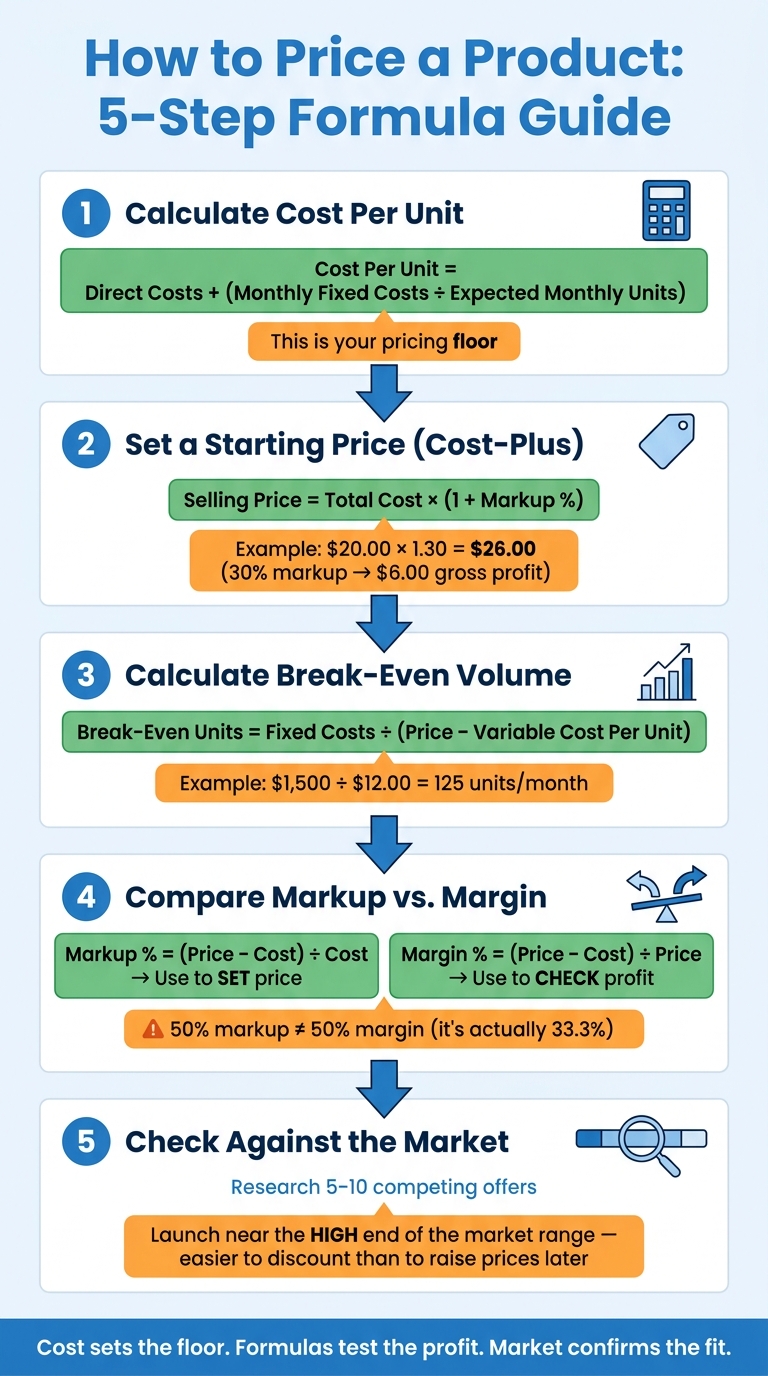
How to Price a Product: 5-Step Formula Guide
Getting Started: Beginners Guide to Calculating Cost & Setting Selling Prices
Step 1: Calculate Your Cost Per Unit
Start by figuring out your cost per unit. Here’s the formula:
Cost per unit = direct costs per unit + (monthly fixed costs ÷ expected monthly units sold)
Treat this as your pricing floor, not a perfect accounting number. You’ll use it in the cost-plus and break-even formulas in the next step.
Add Up Direct and Variable Costs
Direct costs are the expenses tied to making or delivering one unit.
For a physical product, that usually includes raw materials, billable labor, packaging, shipping, and payment fees. For a service, it includes billable labor time, subcontractor fees, and project-specific tools.
Some costs slip through the cracks more often than people think. If you offer free shipping, the postage still comes out of your pocket, so it belongs in your unit cost calculation. Payment fees matter too. In the U.S., they’re often 2.9% + $0.30 per transaction, and they can eat into your margin fast if you ignore them. If your price doesn’t cover these costs, you lose money on every sale.
Spread Monthly Overhead Across Each Sale
Next, take your monthly fixed costs and divide them by your expected monthly sales to get overhead per unit. Then add a small buffer - about 10% - to that overhead.
Once you combine your direct cost per unit with your overhead per unit, you get a more usable cost per unit number. That’s the figure you’ll carry into Step 2.
Step 2: Use Simple Formulas to Set a Starting Price
Take your cost per unit from Step 1 and treat it as your floor. From there, run three basic checks: cost-plus, break-even, and margin vs. markup.
Cost-Plus Pricing Formula
Selling price = Total cost × (1 + markup percentage)
Here’s what each part means:
- Total cost is your cost per unit from Step 1.
- Markup percentage is the profit you want to add on top, written as a decimal.
- Selling price is what the customer pays.
Let’s say your total cost per unit is $20.00 and you want a 30% markup. The math looks like this:
$20.00 × 1.30 = $26.00
That leaves you with $6.00 in gross profit before overhead.
This is where people get tripped up. Freight, packaging, and fees often push landed cost above invoice price. If your total cost is too low on paper, your markup won’t do the job you expect.
So think of this as a starting point, not the last word on price.
Break-Even Formula for Units Sold
After you have a price, test whether it can carry the business.
Break-even quantity = Fixed costs ÷ (Price per unit − variable cost per unit)
Price minus variable cost gives you your contribution per unit. That’s the amount each sale puts toward fixed costs.
For example, say your monthly fixed costs are $1,500, your price is $26.00, and your variable cost per unit is $14.00. Your contribution per unit is $12.00, so your break-even point is:
$1,500 ÷ $12.00 = 125 units per month
If that sales target feels doable, you’re in decent shape. If it looks too high, you likely need to cut costs or lift the price.
Put simply: if the volume needed to break even feels out of reach, the price needs another look.
Margin vs. Markup: Formulas and Key Differences
Markup and margin sound close, but they’re not the same thing. The difference comes down to the base each one uses.
- Markup % = (Selling price − Cost) ÷ Cost
- Margin % = (Selling price − Cost) ÷ Selling price
Here’s a common mistake. A 50% markup on a $20.00 cost gives you a $30.00 selling price. But that works out to only a 33.3% margin.
That gap matters. If you build your plan around “50% profit” but you’re using markup while calling it margin, your profit will come in lower than expected.
The short version:
- Markup is the percent added to cost to get to price. Its base is cost.
- Margin is the percent of the selling price that stays as profit. Its base is selling price.
Use markup to set the price. Use margin to double-check the profit.
Once you’ve got a starting price, compare it with the market in Step 3.
sbb-itb-08dd11e
Step 3: Check Your Price Against the Market
Your cost-plus price gives you a floor. Market research tells you if buyers will go along with that floor. From there, compare it with actual market prices.
Find a Realistic Market Price Range
Start by checking 5–10 products or services like yours and writing down their prices. But don't stop at the sticker price. Look at what's included, like shipping, warranty, and support. Also pay attention to how each brand presents itself. The goal is to spot the low and high anchors - the range where most similar offers sit.
Say similar products bunch up around $25–$35. That range is your market signal. If you go below it, people may wonder if the quality is lower. If you go above it, you need a clear reason for the extra cost.
Very low prices can signal lower quality.
Adjust Your Price Without Going Below Your Minimum
Use that market range to pressure-test your floor, then change your price only if you need to. If your cost-plus price comes in below the market range, you may be able to charge more and still stay competitive. If it comes in above the range, look at your costs first. Then decide if you can support the higher price with better quality, stronger features, or a clearer reason to pay more.
Use cost-plus to set your floor, break-even to test volume, and market research to see if the price fits.
One practical rule: launch near the higher end of your range instead of the low end. It's much easier to run a discount or promo than to push prices up after customers have already locked onto a lower number.
Use IdeaFloat to Check Your Pricing Faster
IdeaFloat can make competitor research, pricing checks, cost analysis, and break-even modeling a lot easier. IdeaFloat supports competitor analysis, price testing, cost analysis, and financial projections and break-even analysis.
Here’s what each part does:
- Competitor Analysis helps you map the high and low ends of your market.
- Price Testing helps you try different price points using AI and proven pricing frameworks.
- Cost Analysis helps you build a complete cost base so your floor price reflects your actual expenses.
- Financial Projections & Break-Even Analysis lets you model how price changes affect profit before you commit.
Use it to test price points before launch.
Conclusion: Set a Price You Can Test and Adjust
Now you have what you need to pick a launch price with some confidence.
Start with your actual costs. Add your markup, check your break-even point, confirm your margin, and then compare that number against the market. That gives you a price based on cost, margin, and market data, not guesswork.
Treat that first number as a launch price, not a forever price.
If the price covers your costs, leaves room for profit, and still fits the market, you’re ready to go live. Then pay close attention to the early signals. If customers never push back on price, that’s often a sign you’re undercharging. If conversions fall and traffic quality hasn’t changed, the price may be too high.
Once you launch, keep reviewing the price as costs and demand shift. A good rule of thumb is to review pricing every quarter, and sooner if supplier costs or market conditions change.
Launch, watch the data, and adjust fast.
FAQs
What if I don’t know my expected monthly sales yet?
You can still set a baseline price by looking at your cost floor - the lowest amount you can charge without losing money.
Start with two numbers:
- your variable cost per unit
- your fixed costs for a set period, like a month
Here’s the key part: fixed cost per unit drops as sales volume goes up. So your first price should be treated as a starting point, not a final answer. Then adjust it as you collect actual sales data.
How should I price a service instead of a physical product?
Service pricing follows the same basic logic as product pricing: cover your costs, line up with the market, and price in a way that reflects the value you bring.
Start with your cost floor. That means your labor, subcontractor fees, and any project expenses tied to the work. If a job costs you more than you charge, the math just doesn't work.
From there, pick a pricing model that fits how you run your business. Common options include:
- Hourly
- Project-based
- Retainer
- Value-based
Be clear about scope from the start. Spell out what’s included, what isn’t, and how many revisions the client gets. That one step can save a lot of back-and-forth later.
And when you talk about price, focus on results, not just hours. Clients usually care less about how long something takes and more about what they get from it.
When should I raise or lower my price?
Pricing isn’t a one-time call. It needs regular review, especially when the market shifts or something inside your business changes.
You may want to update your price if:
- Your cost of goods sold changes by more than 5%
- A major competitor enters or leaves the market
- Your conversion rates move up or down
- Your gross margins drop below target
- Shipping or supplier costs change in a meaningful way
Even small shifts can add up fast, so pricing works best when you treat it like a living part of the business, not something you set once and ignore.
Related Blog Posts
- How to Price Your Product: A Beginner's Guide
- Idea to Pricing: A Simple Formula for Your First 3 Offers
- How to Calculate Gross Margin, Markup, and Break-Even Price
- How to Price a New Product When You Have No Sales History