Start with the Lean Canvas if you're testing an idea. Use a Business Plan when you're ready to secure funding or scale.
The Lean Canvas is a quick, one-page tool that helps you validate your business idea by identifying key assumptions and risks. It’s ideal for early-stage entrepreneurs who need to test their concept without investing too much time or resources.
On the other hand, a Business Plan is a detailed document (15–30 pages) designed to showcase your strategy, market analysis, and financial projections. It’s essential when seeking funding from banks, investors, or grant committees.
Key Takeaways:
- Lean Canvas: Quick, internal tool for idea validation. Takes ~20 minutes to create.
- Business Plan: Detailed, external document for funding or scaling. Takes 4–8 weeks to complete.
- Recommendation: Start with the Lean Canvas to test your idea. Transition to a Business Plan once your idea is validated and you’re ready to present it to stakeholders.
Quick Comparison:
| Feature | Lean Canvas | Business Plan |
|---|---|---|
| Purpose | Idea validation | Funding and growth strategy |
| Length | 1 page | 15–30 pages |
| Time to Create | ~20 minutes | 4–8 weeks |
| Audience | Founders, mentors | Banks, investors, lenders |
| Financial Details | Basic overview | 3–5 year projections |
Use the Lean Canvas first to refine your idea. Then, create a Business Plan for external stakeholders when you’re ready to scale or secure funding.
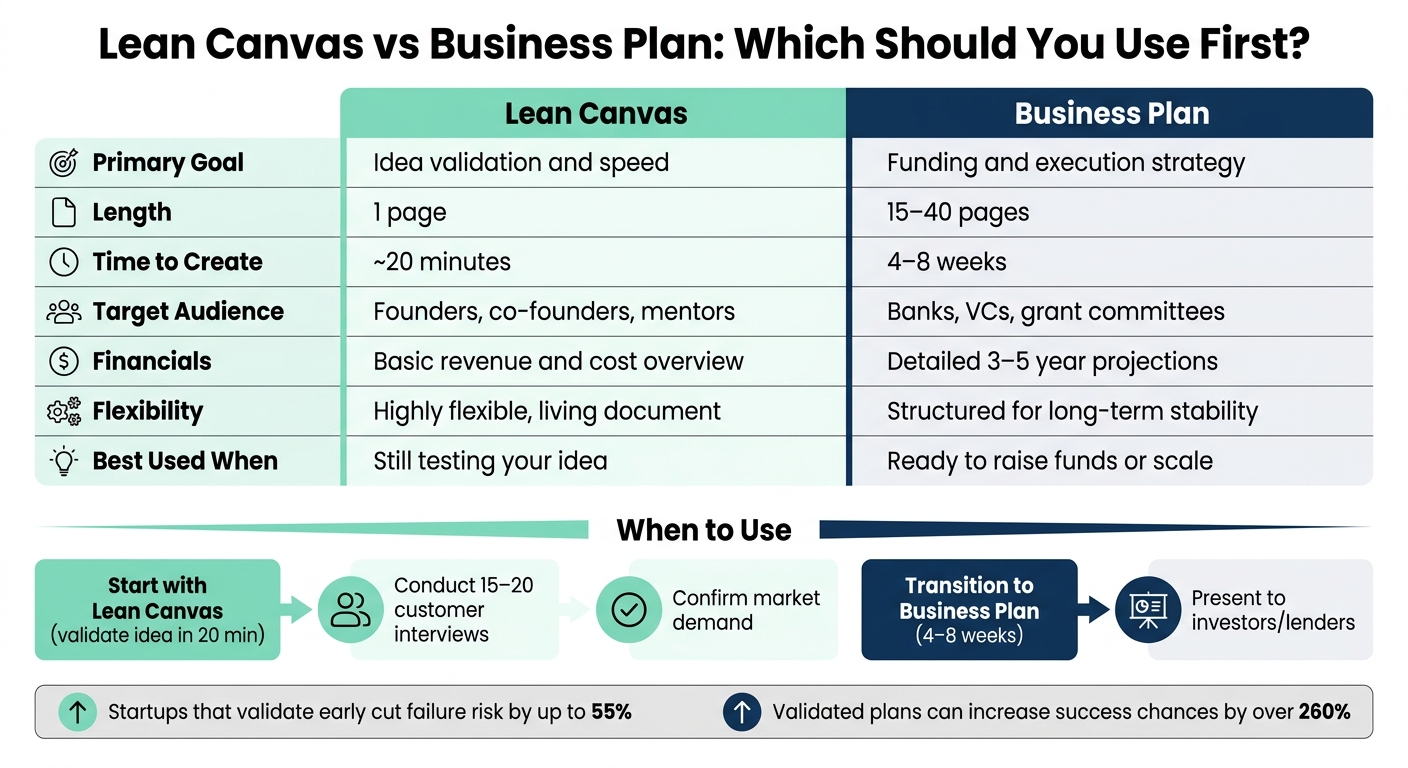
Lean Canvas vs Business Plan: Side-by-Side Comparison
Don’t Write a Business Plan. Create a Business Model Instead
sbb-itb-08dd11e
Lean Canvas: A Tool for Fast Idea Validation
The Lean Canvas, developed by Ash Maurya, is a streamlined adaptation of Alexander Osterwalder's Business Model Canvas. It’s specifically tailored for early-stage entrepreneurs, focusing on uncovering and addressing the riskiest assumptions in a business idea before making any significant investments.
"The Lean Canvas is a tool for finding a business model that works, not for documenting one you already have." - Ash Maurya, Creator of Lean Canvas
The 9 Building Blocks of a Lean Canvas
The Lean Canvas simplifies the process of idea validation by breaking down a business model into nine core components. The process starts with identifying Customer Segments and defining the Problem, as these two elements form the foundation of the entire model. Everything else stems from understanding who you’re serving and the challenges they face.
| Block | What It Captures |
|---|---|
| Problem | The top 1–3 pain points your target customer faces |
| Customer Segments | The specific people or organizations you're targeting |
| Unique Value Proposition | Why your product is different and worth buying |
| Solution | The minimum features needed to solve the problem |
| Channels | How you reach customers (SEO, ads, direct sales) |
| Revenue Streams | How the business makes money (subscriptions, one-time fees, etc.) |
| Cost Structure | Fixed and variable costs, including customer acquisition cost (CAC) |
| Key Metrics | The 3–5 numbers that track the health of your business model |
| Unfair Advantage | Something competitors can't easily copy or buy |
It’s common to leave the Unfair Advantage section blank initially, as genuine competitive edges - like proprietary data or network effects - often take 12–24 months to materialize. For the Unique Value Proposition, Ash Maurya’s team suggests distilling your idea into a simple one-line analogy. For example, "YouTube is Flickr for video" provides a quick, relatable way to explain the concept.
What Makes the Lean Canvas Useful
The Lean Canvas is all about speed and clarity. Updating it takes just 5 minutes, compared to the 12–25+ hours often required for traditional business plans. Its one-page format is intentional: if your business model can’t be summarized on a single page, it likely needs more refinement. Each section represents a hypothesis - an educated guess that must be tested and validated with real customer data. This approach helps identify critical assumptions and ensures they are tested before committing time or money.
"If you haven't done a Lean Canvas first, you're not ready to write a business plan. The plan will just be a longer version of unvalidated assumptions." - Foundra Editorial Team
The next step is exploring how tools like IdeaFloat can make creating a Lean Canvas even easier.
How IdeaFloat Makes Lean Canvas Creation Easier
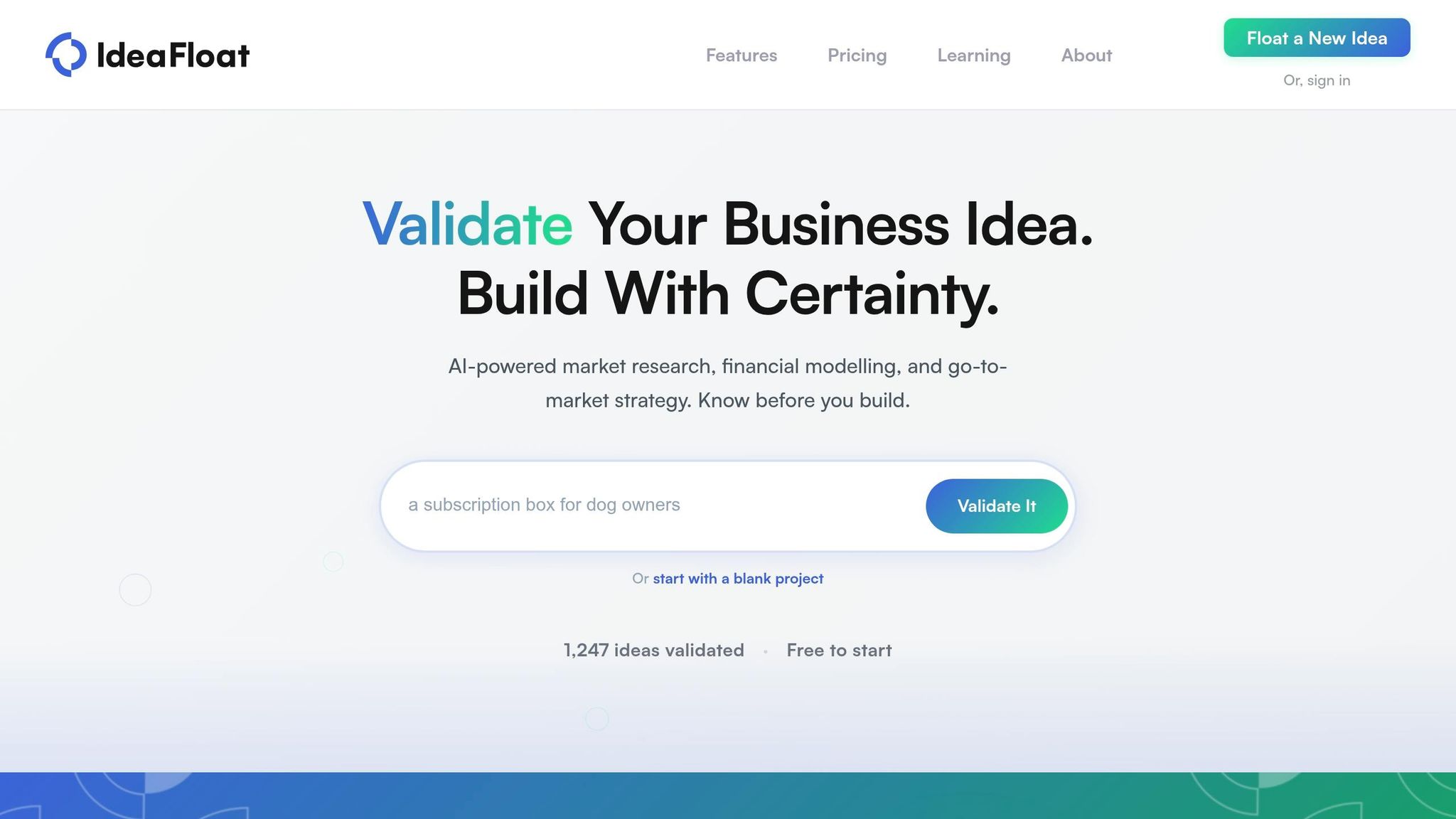
Creating a Lean Canvas from scratch requires insights from customer feedback, competitor analysis, pricing strategies, and market research. IdeaFloat simplifies this process with its Lean Canvas feature, which auto-populates the canvas using data from its workspace tools.
Business Plan: A Tool for Strategy and Funding
A business plan is far more than just a document - it's your roadmap for success and a key tool to secure funding. Unlike the Lean Canvas, which is great for quickly testing ideas, a business plan dives deep into your strategy, operations, and financials. Typically spanning 15–25 pages, it provides the level of detail that investors and lenders need to feel confident in your business's potential.
"Investors want to feel confident they'll see a return on their investment. Your business plan is the tool you'll use to convince people that working with you... is a smart choice." - U.S. Small Business Administration
The Main Sections of a Business Plan
Every section in a business plan has a clear purpose, especially when you're asking for outside funding. Here's a breakdown of the core sections and their importance. A pro tip? Write the Executive Summary last - it’s much easier to summarize your pitch once the rest of the plan is complete:
| Section | Purpose |
|---|---|
| Executive Summary | Provides a high-level overview of your business and funding needs, designed to grab attention |
| Market Analysis | Demonstrates demand using a market size assessment with data on Total Addressable Market (TAM), Serviceable Available Market (SAM), and Serviceable Obtainable Market (SOM) |
| Management Team | Highlights the expertise and experience of the founders to instill confidence |
| Financial Projections | Offers a 3–5 year forecast of revenue, expenses, and cash flow |
| Funding Request | Details exactly how much money you need and where it’ll be spent |
| Operating Model | Describes the day-to-day logistics, showing how the business will operate smoothly |
Together, these sections create a comprehensive picture of your business's potential and operational soundness.
Why a Business Plan is Crucial
The value of a business plan lies in its thoroughness. Studies show that businesses with formal plans grow 30% faster than those without one. Beyond impressing potential investors or lenders, the process of creating a plan forces you to confront tough questions and solve problems before they arise.
For U.S. entrepreneurs aiming for SBA-backed loans, like the 7(a) or 504 programs (which can provide up to $5 million), a detailed business plan with 3-to-5-year projections is a must. Similarly, federal grants such as SBIR/STTR require structured plans with clear technical milestones. Michelle Razavi, cofounder of Elavi, emphasizes the importance of knowing your audience:
"A lot of business owners, especially at the earlier stage, want to just word-vomit the whole story and they send an essay. It's really about thinking about who's reading it on the other side."
This audience-first approach is critical. A bank lender will focus on cash flow and debt repayment, while a venture capitalist is more interested in growth potential and market traction. Tailor your plan to address their priorities.
How IdeaFloat Simplifies Business Plan Creation
Writing a business plan from scratch can be overwhelming. Gathering market data, building financial models, and analyzing competitors can take weeks. That’s where IdeaFloat steps in. Its Business Plan Generator streamlines the process by pulling verified data from your workspace - market sizing, financial forecasts, cost breakdowns, and go-to-market strategies - and turning it into a polished, investor-ready document.
The final plan can be exported as a PDF, Word, or PowerPoint file, saving you from tedious formatting. For instance, IdeaFloat’s sample plan for Green Garden, a fictional direct-to-consumer succulent retailer, outlined a clear growth strategy. It included milestones like achieving a $25,000 monthly revenue run rate by Month 6 and scaling to $50,000 by Month 12, with a Year 3 goal to automate 80% of fulfillment in a 10,000 sq ft warehouse. This level of precision, backed by real numbers, is exactly what investors and lenders want to see.
Lean Canvas vs Business Plan: A Direct Comparison
Now that we've explored the purpose of each tool individually, comparing them side-by-side helps clarify their distinct roles. The Lean Canvas is designed for quickly mapping out and testing your ideas, while the business plan focuses on presenting a comprehensive strategy, often to secure funding or partnerships. Here's how they stack up:
Comparison Table: Lean Canvas vs Business Plan
| Feature | Lean Canvas | Business Plan |
|---|---|---|
| Primary Goal | Idea validation and speed | Funding and execution strategy |
| Length | 1 page | 15–40 pages |
| Time to Create | ~20 minutes | 4–8 weeks |
| Target Audience | Founders, co-founders, mentors | Banks, venture capitalists, grant committees |
| Financials | Basic revenue and cost overview | Detailed 3–5 year financial projections |
| Flexibility | Highly flexible | More structured for long-term stability |
The time investment difference is striking - drafting a Lean Canvas takes about 20 minutes, while crafting a full business plan can take 4 to 8 weeks. This contrast underscores when and why to use each tool. While the Lean Canvas is ideal for early-stage brainstorming and testing, the business plan becomes critical when you're seeking funding or formalizing your strategy.
Clearing Up Common Misconceptions
Despite their overlapping value, these tools serve different purposes at distinct stages of business development. A common misconception is that a Lean Canvas can replace a business plan. In truth, they complement one another. As the Foundra Editorial Team explains:
"The choice between them is the choice between 'I'm figuring out what to build' and 'I'm ready to formally pitch.'"
Even for small-scale funding, a detailed business plan is often necessary - one-page summaries like the Lean Canvas usually won't cut it. On the other hand, some founders mistakenly believe they need a complete business plan before taking any action. This can lead to weeks of effort based on untested assumptions, which can be risky. After all, 42% of startups fail because they create products no one wants.
The best approach? Start with a Lean Canvas to test your assumptions. If your core idea doesn't hold up, no amount of added detail in a business plan will make it viable.
Which Tool Should You Use First?
Start with the Lean Canvas. Your choice of planning tool should depend on your startup's current stage, not personal preference or what seems impressive. The stage of your business is the key factor here.
Kicking things off with a Lean Canvas helps you avoid building on untested assumptions.
Use Lean Canvas When You Are Still Testing Your Idea
If you're still working out your product details, identifying your target audience, or gauging market demand, the Lean Canvas is the best place to begin. It only takes about 20–90 minutes to complete and pushes you to confront the riskiest assumptions in your business.
A good benchmark is conducting 15–20 customer interviews to confirm that the problem you're addressing is significant enough for people to pay for a solution. During this phase, treat your Lean Canvas as a living document - update it weekly as you learn more. Startups that validate their ideas early can cut the risk of building a product nobody wants by up to 55%.
Once you’ve confirmed your idea has potential, it’s time to move on to a business plan for scaling and securing external funding.
Use a Business Plan When You Are Ready to Raise Funds or Scale
After validating your idea through the Lean Canvas, a full business plan becomes essential when you’re focused on scaling or securing external funding. This shift is often triggered by external needs - like applying for an SBA loan, securing a bank loan over $50,000, pursuing a government grant, or preparing a formal investor pitch. These audiences expect detailed 3–5 year financial projections, market analysis, and operational plans - things a single-page canvas simply can’t provide.
Statistics show that businesses with a formal plan are 16% more likely to achieve viability than those without one. Additionally, startups with a validated model attract 133% more investment capital than those without one.
How IdeaFloat Supports Both Tools
Switching from a Lean Canvas to a full business plan doesn’t mean starting over. IdeaFloat is designed to support both stages seamlessly, allowing you to build on the work you’ve already done.
In the early stages, the Problem Validator helps you test whether your idea solves a problem people are willing to pay for, bridging the validation gap before you commit to a more detailed plan.
When you’re ready to scale, IdeaFloat’s Financial Projections & Breakeven Analysis tool generates month-by-month revenue and cost forecasts - essential for formal business plans. The Lean Canvas feature pulls from your existing workspace, and the Business Plan Generator creates a polished, investor-ready document in PDF, Word, or PowerPoint formats. This saves you hours of manual effort.
The transition mirrors the natural growth of your business. For instance, the "Problem" box in your Lean Canvas evolves into a full "Market Opportunity" section, while your early revenue and cost estimates expand into a complete financial model.
Conclusion: Picking the Right Tool for Where You Are Now
Each tool serves a different purpose, depending on your stage and audience. The Lean Canvas is a quick, internal tool to help you determine if your idea has potential before pouring in resources. On the other hand, the Business Plan is crafted for external stakeholders - like banks, investors, or grant committees - who need detailed financials and a structured strategy before they commit funds. Early-stage testing naturally transitions into long-term planning once your idea shows promise.
It's not about one tool being better than the other. Presenting a Lean Canvas to an SBA loan officer could signal you're unprepared, while a lengthy business plan built on untested assumptions is just an elaborate guess.
The best approach? Start lean, then formalize. Use the Lean Canvas to challenge your assumptions quickly - hours instead of weeks. Once your idea is validated, create a full business plan to present to external stakeholders. This is often the first step before you run a pitch meeting to secure backing. Research shows that validated plans can increase your chances of success by over 260%, but only when they’re built on a foundation of tested assumptions.
FAQs
How do I know my idea is “validated”?
Your idea is validated when you have clear proof that people not only need your solution but are also ready to pay for it. Here are some key indicators:
- Pinpointing a specific and pressing problem that your potential customers are struggling with.
- Testing demand through methods like landing pages, waitlists, or other experiments that gauge interest.
- Collecting genuine feedback through direct customer interviews to understand their needs and pain points.
- Basing your revenue projections on actual data from the market, not just assumptions or guesses.
- Defining your target audience and what makes your solution stand out, using insights from real-world testing.
Can I use a Lean Canvas to get a loan?
A Lean Canvas can be a fantastic tool for organizing and validating your business idea in its early stages. However, when it comes to securing a loan, it typically falls short. Lenders and SBA loan applications usually require a formal business plan.
Why? Because a business plan includes critical details like:
- Financial projections: Lenders want to see your expected revenue, expenses, and profit margins.
- Cash flow statements: These show how money will move in and out of your business.
- Market analysis: This demonstrates your understanding of the industry and your target audience.
While a Lean Canvas is helpful for structuring your initial strategy, it’s just the starting point. Use it as a foundation to build a more comprehensive business plan that meets lender expectations.
What financials should I estimate first?
In the beginning, prioritize your revenue model and break-even analysis over long-term financial forecasts. Use the Lean Canvas to map out your revenue streams - think pricing strategies and customer lifetime value - alongside your main expenses, including both fixed and variable costs. As your business develops, transition to a 12- to 18-month plan that dives into startup costs, cash flow management, and funding requirements. Leave the detailed income statements and balance sheets for when you're ready to pursue loans or attract investors.
Related Blog Posts
- Business Plan vs Lean Canvas: Which to Choose?
- IdeaFloat: The 15-Minute Business Plan Solution
- How IdeaFloat Automates Your Entire Business Planning Process
- Lean Canvas vs Business Plan in 2025: Which Gets You Funded Faster?