Starting a business doesn’t have to be expensive or time-consuming. Here are four practical ways women in the U.S. can start earning with low upfront costs (under $500) and flexible hours:
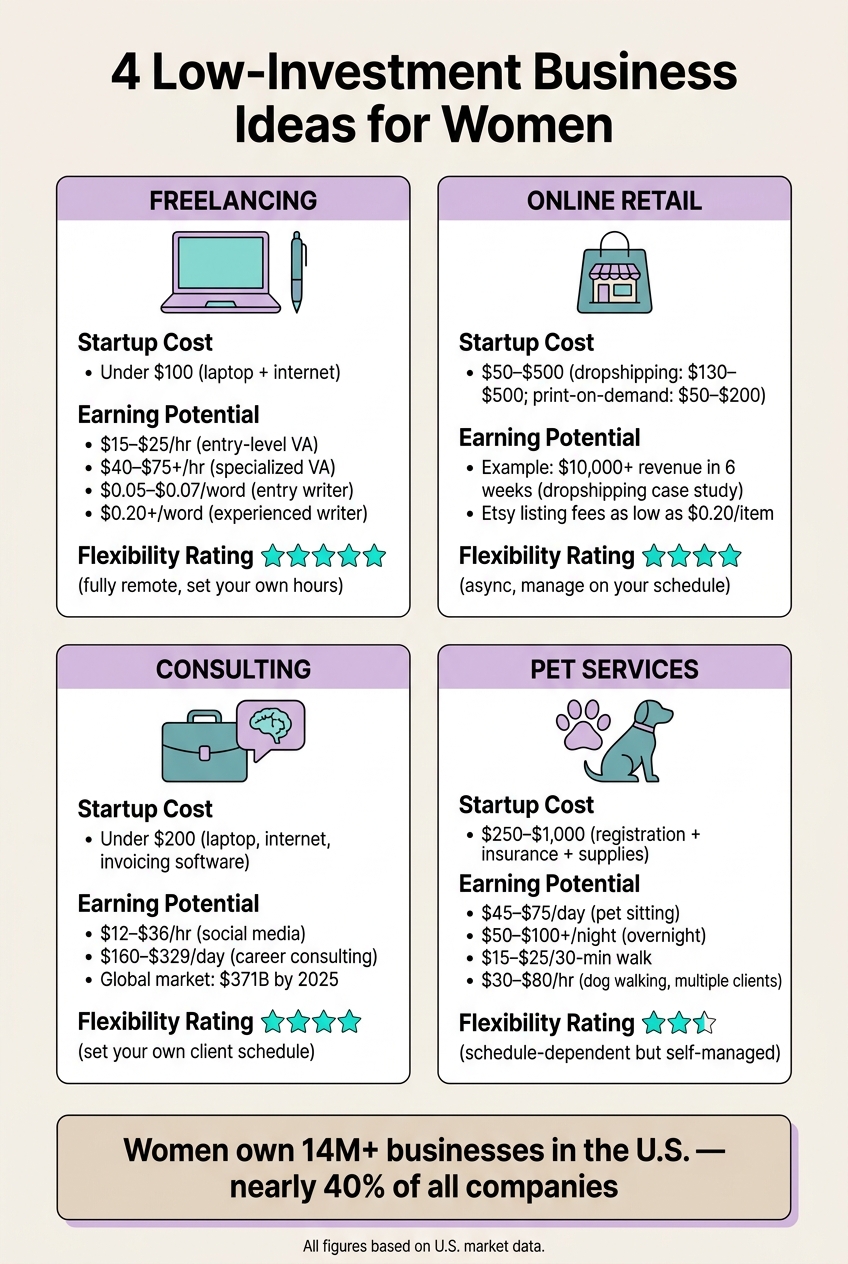
- Freelancing: Offer services like virtual assistance or writing. You can start with just a laptop and internet connection. Entry-level virtual assistants earn $15–$25/hour, while experienced freelancers can charge much more.
- Online Retail: Start a dropshipping store or a print-on-demand business. Both require minimal investment (as low as $50–$200) and no inventory management. Platforms like Shopify or Etsy make it easy to get started.
- Consulting: Use your professional skills in areas like marketing, HR, or social media. Consultants can earn $12–$36/hour, with niche expertise commanding higher rates.
- Pet Services: Pet sitting and dog walking are growing markets. Pet sitters can earn $45–$75/day, while dog walkers charge $15–$25 per 30-minute walk.
Each option offers a low-risk way to earn income while maintaining control over your schedule. Whether you’re looking for quick returns or a steady side income, these ideas can help you get started.
4 Low-Investment Business Ideas for Women: Costs, Earnings & Flexibility
10 small business ideas Women can start under $100
sbb-itb-08dd11e
1. Freelancing
Freelancing is a flexible way to turn skills like writing, organization, and communication into a source of income - without the need to develop a product or manage a physical storefront.
Virtual Assistant (VA) Services
Virtual assistants help busy business owners by handling tasks like managing emails, organizing calendars, processing data, and providing customer support. It’s possible to land your first client within just a few weeks. For entry-level VAs, rates range from $15–$25 per hour, while those with specialized skills can earn $40–$75+ per hour. Rowan Mercer offers this insight:
"The faster path to higher VA income isn't working more hours. It's narrowing who you serve and positioning yourself as the obvious choice for that specific type of client."
If you’re just starting, consider reaching out to former colleagues or local small business owners to build your initial client base. Once you’ve gained some experience, platforms like Belay and Upwork can connect you with a broader range of opportunities. And if you excel in communication, there are even more freelancing avenues to explore.
Freelance Writing and Copywriting
Freelance writing is another way to earn from home with minimal investment - just a laptop and an internet connection. Writers can produce blog posts, articles, or marketing copy, all while working on a flexible schedule. Entry-level writers typically earn $0.05–$0.07 per word, but experienced professionals who carve out a niche can charge $0.20 per word or more.
Keisha Singleton, a seasoned freelance writer, emphasizes the importance of specialization:
"In order to set yourself for the long run, it's really important to establish a niche."
To kickstart your freelance writing career, platforms like Upwork, Fiverr, and ProBlogger are excellent places to find clients. With persistence and a clear focus, freelancing can become a sustainable and rewarding income stream.
2. Online Retail
After considering service-based ventures, shifting to product-based businesses might be the next logical step. If selling products appeals to you more than offering services, online retail offers a straightforward entry point with low startup costs and minimal space requirements. Two standout models - dropshipping and print-on-demand (POD) - are ideal for keeping expenses down and schedules flexible.
Dropshipping
Dropshipping allows you to sell products without needing to manage inventory. When a customer places an order, a third-party supplier handles the shipping directly to them. Your role? Run the online store and market the products. Starting a dropshipping business can cost anywhere between $130 and $500, covering essentials like domain registration, platform fees, and initial product samples. Shopify, for instance, offers a Starter plan beginning at just $5/month, making it an affordable option to get started.
Take Miandra Delport’s story as an example. In March 2026, this 42-year-old mother of three launched a baby products dropshipping store using Sellvia. Working just 30 minutes daily (with a few extra hours for marketing), she earned over $10,000 in revenue within six weeks. Reflecting on her experience, she said:
"It feels like I bought a lifestyle. I got my life back."
To maximize success, focus on a specific micro-niche instead of broad categories. For instance, selling "eco-friendly gym gear" might lead to better ad conversions and search rankings than generic "fitness products". And don’t skip ordering product samples before launching - this ensures quality and reliable shipping times.
For those with a creative streak, print-on-demand offers a similar inventory-free setup.
Print-on-Demand (POD)
Print-on-demand is perfect for creative entrepreneurs. You create custom designs, and a fulfillment partner prints them on items like t-shirts, mugs, or wall art only when a customer places an order. Startup costs are even lower than dropshipping, typically ranging from $50 to $200. Platforms like Etsy, which had 96 million active buyers in 2025, are a go-to for POD businesses. Searches for "custom print" products have also grown by 34% year-over-year. Plus, listing fees are as low as $0.20 per item.
Tools like Canva make it easy to design graphics, allowing you to balance work and personal life seamlessly. To attract early customers, leverage free platforms like TikTok, Instagram Reels, or Pinterest to promote your products without spending on ads.
Both dropshipping and POD offer flexible ways to build income streams while complementing other ventures, such as consulting or freelance work. These models let you explore entrepreneurship without overcommitting financially or time-wise.
3. Consulting
If you have professional experience in areas like marketing, HR, or finance, consulting can be a straightforward way to earn flexible income. It requires minimal upfront investment - just a laptop, internet connection, and invoicing software. With the global consultancy market projected at $371.04 billion by 2025 and continuing to expand, the demand for skilled consultants is growing steadily.
Specialization is crucial. By focusing on a specific niche - like email marketing for coaching funnels - you can enhance your credibility and make it easier for clients to choose you. As Savvy Business Coach explains:
"Consulting means using your expertise to help clients achieve results faster and with fewer errors."
Here are two consulting paths that offer low startup costs and flexible schedules:
Social Media Consulting
If you’re well-versed in platforms like TikTok, LinkedIn, or Instagram, social media consulting could be an excellent choice. Consultants in this field help businesses create content strategies, train teams on best practices, and use analytics to drive better results. Rates typically fall between $12 and $36 per hour, but those with niche expertise can charge significantly more. Interestingly, 85% of independent consultants secure their first clients through personal or professional networks, so your first opportunity might be closer than you think.
Career Consulting
For those with HR or recruiting experience, career consulting offers a chance to support job seekers in meaningful ways. Services might include resume writing, interview preparation, or helping clients switch industries. On average, career consultants can earn $160 to $329 per day. Starting part-time is a smart way to build your portfolio and gather testimonials. Offering "beta pricing" - lower rates for your first few clients in exchange for feedback - can help you refine your services and confidently increase your rates over time.
4. Pet Services
Americans spent nearly $152 billion on their pets in 2024, with about $13 billion going toward pet sitting and dog walking services. With 97% of U.S. households treating their pets like family, the need for reliable and personalized pet care continues to rise. Starting a pet services business for under $500 lets you work on your own terms while catering to a growing market. These types of businesses thrive on low startup costs and the personal attention that pet owners highly value.
"Starting your own professional pet-sitting business in 2026 could be the perfect fit... with more pet parents than ever and a growing need for trustworthy, in-home pet care, there's never been a better time to jump in." - Beth Stultz-Hairston, Pet Sitters International
Here are two simple ways to get started in the pet services industry:
Pet Sitting
Pet sitting involves caring for pets in their homes while their owners are away. Responsibilities often include feeding, playing, and offering companionship. Typical rates range from $45–$75 per day, with overnight stays bringing in $50 to $100+ per night. The initial investment is quite low:
- Business registration: $50–$500
- Liability insurance: $150–$400 per year
- Basic supplies (e.g., leashes, first aid kit): $50–$100
Before accepting clients, make sure to get a "care, custody, and control" (CCC) insurance policy, as standard liability insurance often doesn’t cover pet-related damages.
Dog Walking
Dog walking offers a flexible way to earn steady income. Independent walkers typically charge $15–$25 for a 30-minute walk and can make $30–$80 per hour by scheduling multiple clients in the same area. Working independently - rather than through platforms that take 20%–40% in commissions - ensures you keep all the money you earn. To build your client base, skip expensive advertising. Instead, reach out directly to friends, neighbors, and local groups on platforms like Facebook or Nextdoor. This approach can help you secure your first 5–10 bookings quickly.
Conclusion
We've explored several flexible, low-investment business models that can help you take steps toward financial independence. The four options discussed - freelancing, online retail, consulting, and pet services - offer different paths to earning income while maintaining control over your schedule. Interestingly, women now own over 14 million businesses in the U.S., accounting for nearly 40% of all companies. Much of this growth stems from self-funded, scalable models like these.
The key is choosing the idea that best aligns with your lifestyle and current needs. If you’re looking for quick revenue, service-based options like freelancing or consulting can often deliver results within 30–60 days. On the other hand, if you need something more adaptable to an unpredictable schedule, online retail allows you to earn at your own pace. As Rowan Mercer, Business Writer, insightfully notes:
"A business you can work for eight hours a week consistently outperforms a theoretically higher-earning business you drop after month three because the schedule destroyed you."
When deciding between these options, consider their profitability, customer reach, and compatibility with your life. A practical approach is the Three-Filter Test: assess the margin (target at least 60% to weather slower months), the distribution (can you reach customers without heavy ad spending?), and the fit (does it align with your available time and energy?). This framework can help you identify the most sustainable and rewarding choice.
Thanks to modern tools like Canva, Shopify, and Zoom, starting your own business is more accessible than ever. Once you've applied these filters and chosen a direction, focus on landing your first paying client - even if everything isn’t perfect yet. Progress beats perfection every time.
FAQs
Which idea fits me best?
Choosing the best business idea depends on how quickly you need to earn and what kind of work suits you best. Here's a breakdown:
- If you need quick income (within 60 days): Consider service-based roles like freelance writing, virtual assistance, or consulting. These options usually require low startup costs and can start generating income almost immediately.
- If you're thinking long-term: Look into product-based ventures like dropshipping, print-on-demand, or creating digital products. While these take more time and effort to set up, they have the potential to bring in passive income down the road.
Your choice comes down to balancing immediate needs with future goals!
How can I get my first client quickly?
If you're looking to land your first client fast, skip the time-consuming tasks like building a website or crafting a brand. Instead, focus on direct outreach.
Start with a concise, one-sentence pitch: "I help [specific group] with [specific problem]." This clarity makes it easier for potential clients to immediately understand what you offer.
Next, create a list of 10–20 potential clients. These could be friends, colleagues, or even local businesses that might need your services. Reach out to them directly with a simple, no-frills message.
To make it even more appealing, propose a low-risk trial project. This approach reduces hesitation and gives them a chance to see your value firsthand. And here’s a crucial tip: when they reply, respond fast - ideally within 60 minutes. Quick responses show you're serious, reliable, and ready to get started.
Do I need licenses or insurance?
Yes, most businesses need a local business license, even if you’re working from home. The specific requirements depend on your location, the type of business you’re running, and local regulations. For home-based businesses, you might also need a home occupation permit or additional state-level licenses if you’re in regulated industries like childcare or food services.
Although business insurance isn’t typically mandatory, it’s a smart idea to have it. Standard homeowner’s or renter’s insurance policies often don’t cover business-related liabilities, leaving you exposed to potential risks.
Related Blog Posts
- 21 Low-Investment Business Ideas for Women in Australia
- What Can I Start With $5,000? 27 High-ROI Small Businesses
- Best Small Business Ideas in Australia Under $5,000
- Best Business Ideas in Australia for Women Starting From Home