Yes - in Australia, $2,000 can be enough to start a small business in 2026, but only if you keep it lean. The best fit is a service business, not a shop, lease, or stock-heavy setup. In most cases, your money will go toward an ABN setup, business name, insurance, basic software, a little marketing, and simple tools.
Here’s the short version:
- I’d focus on low-cost services first because they can lead to a first sale faster than product businesses.
- The main cost pressure points are insurance and equipment.
- You may need extra checks or permits for food, child-facing work, pet care, chemical use, or on-site services.
- GST registration kicks in at AU$75,000 in annual turnover.
- The best way to test demand is simple: ask for a deposit before spending most of your budget.
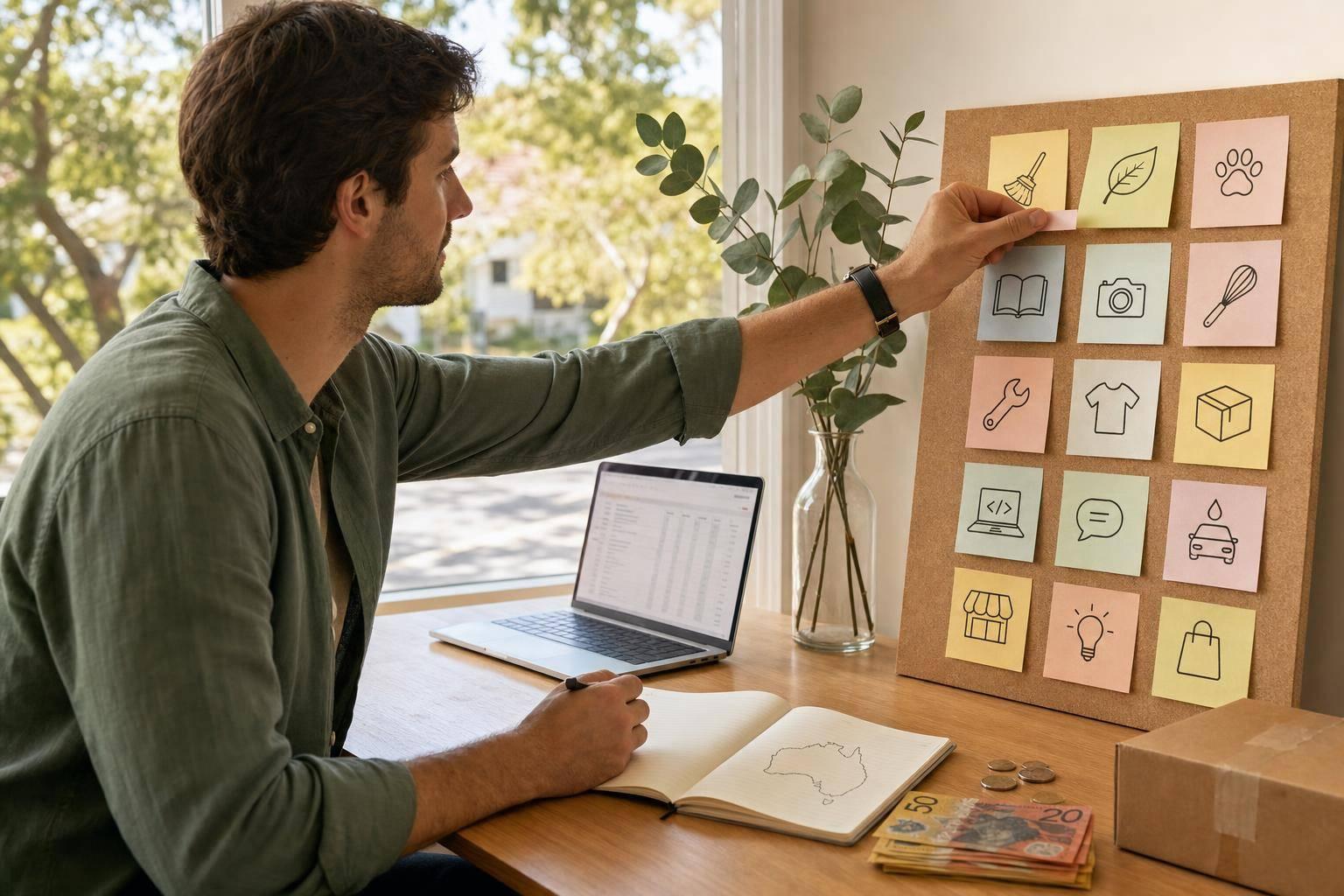
The 15 ideas in the article fall into four groups:
- Home & property services: budget lawn mowing, home handyman, Airbnb/short-stay co-host, recurring home maintenance
- Pet, family & education services: online subject tutoring, STEM/coding coach for kids, home-based pet grooming, family meal prep
- Digital & admin services: virtual assistant for tradies, AI workflow setup, local social media manager, SEO & AI content studio
- Product, food & local experience businesses: handmade products, specialty baked goods & dessert boxes, tourism micro-experiences
What stood out to me is this: the lowest-risk options are usually the ones you can start with a laptop, phone, or basic tools you already own. That means ideas like tutoring, VA work, co-hosting, and social media support often make more sense than anything that needs stock, a van, or a fit-out.
How Much Does It Cost to Start a Business in Australia?
sbb-itb-08dd11e
Quick Comparison
| Business Type | Startup Cost | First Sale Speed | Main Setup Need |
|---|---|---|---|
| Home & property services | Under AU$500–AU$2,000 | Fast | Insurance, ABN |
| Pet, family & education | Under AU$500–AU$1,500 | Fast to medium | WWCC, food/pet cover where needed |
| Digital & admin services | Under AU$500–AU$1,000 | Fast to medium | Laptop, ABN |
| Product, food & experiences | Under AU$1,500–AU$2,000 | Medium | Permits, insurance, small stock/setup |
If I were starting with only AU$2,000, I’d look for three things: low setup cost, local demand, and a short path to getting paid. That’s the filter that matters most in this article.
What $2,000 Can Actually Cover When Starting a Small Business in Australia
A $2,000 budget can get a lean service business off the ground in Australia. But it won’t stretch far enough for anything tied to a lease, a shop fit-out, or a lot of stock. In most cases, that money goes toward registration, insurance, software, basic marketing, and maybe one small equipment purchase. The smart move is simple: pay for required setup first, then put whatever is left into tools and marketing.
Here’s a quick cost map to help screen which of the 15 ideas can start within $2,000:
| Expense Item | Estimated Cost (AUD) | Frequency |
|---|---|---|
| ABN Registration | $0 | One-off |
| Business Name (ASIC) | $42 | Annual |
| Public Liability Insurance | $500–$1,500 | Annual |
| Accounting Software (e.g., Xero, Rounded) | $180–$600 | Annual |
| Google Business Profile | $0 | Free |
| Local Marketing (flyers/ads) | $100–$300 | Initial test |
| Typical First-Year Essentials | $822–$2,442 | First year |
That last row tells the story. To stay under $2,000, you need to keep insurance and equipment costs near the low end. If your first-year setup costs drift above that mark, the business idea probably doesn’t belong on this list.
Some business types are out straight away. Lease-heavy and inventory-heavy models just don’t fit this budget. Public liability insurance is usually nonnegotiable and often runs $500–$1,500 per year. In many cases, clients and local councils want to see at least $10 million in cover before you can begin physical work. That’s why insurance comes first in the budget, not last.
Equipment is the next pressure point. One good way to save money is to buy second-hand commercial gear where you can. It can lower startup costs without giving up durability. A commercial lease, on the other hand, is a budget killer. Bonds, legal fees, and fixed monthly overhead can burn through $2,000 before the business even opens its doors.
Once you know what this budget can and can’t do, the next step is to sort out the basic Australian registrations and insurance before spending on tools.
Australian Startup Basics to Handle Before You Spend
Most of the 15 ideas in this article can work under a sole trader structure. The upside is simplicity. The downside is that if something goes wrong, your personal assets are on the line. Before you put money into the business, get the registrations and insurance in place for the idea you’ve chosen.
Start with an ABN (Australian Business Number). It’s free, and you need it to invoice clients and register for GST. If you’re trading under a name other than your own legal name, you’ll also need to register a business name.
GST registration becomes mandatory once your annual turnover exceeds $75,000 in a 12-month period. Once you pass the $75,000 GST threshold, register.
Some business types come with extra state or council rules. Food businesses, child-facing services, chemical spraying, and on-site work are common examples. Tutors and child-focused coaches will often need a Working With Children Check. Chemical spraying usually calls for a state chemical-user certificate.
For food, pet care, landscaping, and other on-site physical work, $10 million in public liability cover is the standard minimum that many councils and real estate agents expect before they’ll let a contractor through the door. It’s also smart to open a separate business bank account from day one. That makes BAS and tax reporting a lot less messy.
Once those basics are sorted, test demand before you spend the rest of your budget.
How to Validate Demand Before Using Most of Your Budget
Validate demand before you sink most of your $2,000 into the business. A lot of the best checks cost little or nothing. The aim is simple: make sure people want what you're selling before the money goes into tools, insurance, or inventory. Use these checks to sort the 15 ideas below before you buy stock or gear.
Start with people already in your orbit. Tell former employers, builders, suppliers, and other contacts what you plan to offer, then pay close attention to how they respond. If people lean in, ask questions, or want pricing right away, that's a good sign.
Next, put yourself where local buyers already look. Set up a free Google Business Profile so you can show up in local search results. Join suburb-based Facebook groups too, and reply when someone asks for a recommendation. A handful of genuine reviews can help a new local business get traction fast.
For local services, simple flyer drops still work. You can distribute 500–1,000 flyers across 2–3 target suburbs for around $50–$200. It doesn't need to be fancy. It just needs a clear offer, a phone number, and a reason to contact you now.
If you're selling digital or admin services, the same idea applies in a different channel. LinkedIn outreach and direct emails to small business owners or agencies can get your first conversations going.
For service businesses, direct outreach tends to work best when your offer is clear and easy to grasp. The biggest signal of real demand isn't praise. It's money. The fastest proof of real demand is a deposit. For larger jobs, ask for a 50% deposit upfront to cover initial material costs. And if you're quoting local work, same-day, in-person quotes can help you close more jobs.
Before you spend, run the idea through IdeaFloat. Use it to check demand, pricing, and margins. Then give the idea 90 days of active selling before you decide whether to keep going. Use the same filter on every idea in the list below: low upfront cost, clear demand, and a short path to the first sale.
1. Home & Property Services
These are solid local service ideas because you can test them before you buy much gear or commit to big fixed costs. All four can fit within a $2,000 budget. Two can get off the ground for under $500, and lawn mowing only pushes toward the top end if you need to buy equipment. If you want local customers fast without a lease or stock sitting in a garage, this group makes sense.
The common thread is simple: start with work that needs little more than tools, a phone, and people nearby who already need help.
- Budget Lawn Mowing
- Home Handyman (Small Jobs Specialist)
- Airbnb / Short-Stay Co-Host
- Recurring Home Maintenance
Budget Lawn Mowing
The Australian gardening and lawn services industry generated $4.1 billion in 2025 across more than 17,400 businesses. That tells you one thing right away: demand is already there. A solo operator can earn good money once the route is steady.
The smart move is to begin with second-hand equipment, not brand-new domestic machines. A mower, trimmer, and blower are enough to start, and new household-grade gear often breaks down within 100–300 hours of professional use. A standard suburban lawn can be priced at $55–$80 per job. It also helps to group jobs across 2–3 suburbs so you spend less time driving around unpaid. Routine mowing and small maintenance jobs usually don't need a trade license, though bigger landscaping jobs may.
Home Handyman (Small Jobs Specialist)
This one works because many bigger contractors don't want small jobs. Work priced at $200–$400 often gets turned down because the margin isn't worth the hassle. That's the gap you can step into.
If you already have basic hand tools, startup costs can be as low as $500. Before you go on-site, you'll need an ABN and $10 million public liability insurance, which usually costs around $500–$800 per year. Early on, speed beats polish. Same-day, in-person quotes tend to win more work, so getting back to people fast matters more than having a fancy website.
Airbnb / Short-Stay Co-Host
Some property owners like the income from short-stay rentals but don't want to deal with guest messages, check-ins, or booking admin. That's where a co-host comes in. You handle the day-to-day management and take a 15–20% commission on bookings.
Startup costs are under $500. In most cases, you just need a laptop, a phone, an ABN, and professional indemnity insurance. No heavy gear. No van. No workshop. That's a big part of the appeal.
Recurring Home Maintenance
This model is built around monthly recurring revenue. Homeowners pay a flat $29–$69 per month for small repeat tasks like smoke alarm checks, filter changes, and seasonal prep.
You don't need much to begin. Basic hand tools and testing gear are enough, and total startup costs usually land between $500 and $1,500. If you want a service that can stack into steady monthly billing instead of one-off jobs, this is the one to look at.
These four are among the fastest home-service ideas to test because each one can be checked with a single local offer before you spend much money.
2. Pet, Family & Education Services
These four ideas can be run online, on mobile, or from home. That matters because you can get started on a $2,000 budget without paying for a lease or buying heavy equipment. If you're after a low-cost business that leans more on trust and local demand than gear, this group makes a lot of sense. For services that involve children, you'll need a WWCC.
Online Subject Tutoring
HSC and VCE tutoring can run fully online, so there's no need for a physical location. Startup costs can stay under $500, and core subjects like Maths, Science, and English often bring in $60 to $150 per hour. To land your first clients, focus on local search and direct outreach.
STEM & Coding Coach for Kids
More parents want help teaching their kids coding, robotics, and STEM problem-solving. You can start this kind of business for under $1,500 with basic kits and some early marketing. And because it's more focused than general tutoring, it's often easier to stand out.
Home-Based Pet Grooming
You can start from home or use a shared space instead of paying for a fitted van, which helps keep startup costs under $1,500. Your insurance should include Animal Bailee cover in case a pet gets injured while in your care. If you plan to add pet boarding, check your local council's home occupation and zoning rules first.
Family Meal Prep
For busy households, home-based meal prep can be a practical low-cost service. You still need to follow state food safety rules and local council requirements. Startup costs can stay under $1,500 for ingredients, packaging, and local marketing. Keeping deliveries within a 10- to 15-minute radius of home can help control travel time and costs.
| Business Idea | Est. Startup Cost | Earning Potential |
|---|---|---|
| Online Subject Tutoring | Under $500 | $60–$150/hr |
| STEM/Coding Coach | Under $1,500 | High (niche demand) |
| Home-Based Pet Grooming | Under $1,500 | High (service-based) |
| Family Meal Prep | Under $1,500 | Scalable (home-based) |
3. Digital & Admin Services
If you'd rather work from a laptop than do hands-on jobs, these four ideas are a solid fit. They keep startup costs low, stay lean on overhead, and each one goes after a clear Australian buyer. That matters because it's much easier to test demand when you know exactly who you're selling to, or validate your business ideas before you spend a cent. Best of all, all four can fit within a $2,000 budget.
Virtual Assistant for Tradies
Australian tradies often need help with the day-to-day admin that eats up time: quoting, scheduling, and invoicing. A virtual assistant who focuses on this niche can sell monthly retainers for 20-hour or 40-hour support blocks, and startup costs are often under $500. Sticking to one trade can make your offer easier to pitch and easier for clients to understand.
AI Workflow Setup
Small business owners want help putting AI to work in practical ways. That can mean customer-response systems, booking systems, or smoother admin workflows. You can charge $500 to $2,000 per project. The smart move here is simple: price the outcome, not the hour.
Local Social Media Manager
Cafes, gyms, and real estate agents already spend money on local social media support. That makes this idea easier to test than people think. Monthly retainers usually land between $600 and $1,200 per client, while startup costs are often under $1,000.
SEO & AI Content Studio
An AI-assisted content studio can create SEO content for local businesses, with human editing to keep quality in check. Startup costs are usually under $800. It also has room to grow, since one workflow can support multiple clients without adding much overhead.
4. Product, Food & Local Experience Businesses
If you want a business built around something you can make, serve, or host nearby, these ideas keep startup costs under $2,000.
Handmade Products (Candles, Bath Bombs, or Artisan Chocolate)
Candles, bath products, and artisan chocolate are all solid small-start options. The per-unit cost is low, and the markup is easy to see. Candles can cost about $5 to make and sell for $10 to $25. Startup equipment for artisan chocolate comes in at around $500.
A smart move is to test demand first. Try farmers' markets or Facebook Marketplace before you buy stock in bulk.
Specialty Baked Goods & Dessert Boxes
Custom cakes, cookie boxes, and themed dessert sets tend to get steady interest through local markets, social media, and word of mouth. You can often begin from a home kitchen using equipment you already have, which helps keep early costs down.
Food registrations and permits usually cost $200 to $400, and most states require a food safety certificate before you can sell. Keep the menu small at first and use pre-orders to cut waste as you grow.
Tourism Micro-Experiences
In tourist-heavy areas, small guided experiences can start with very little: a clear route, a set plan, and a booking page. Places like Noosa, Byron Bay, and Margaret River are a good fit for low-cost options such as sunrise photography tours, secret lookout tours, wildlife experiences, or foodie drives.
Start with a fixed itinerary and avoid gear-heavy setups. That keeps the business simple and helps you stay well within a $2,000 budget.
Quick Comparison: Cost, Skill Level, and Time to First Sale
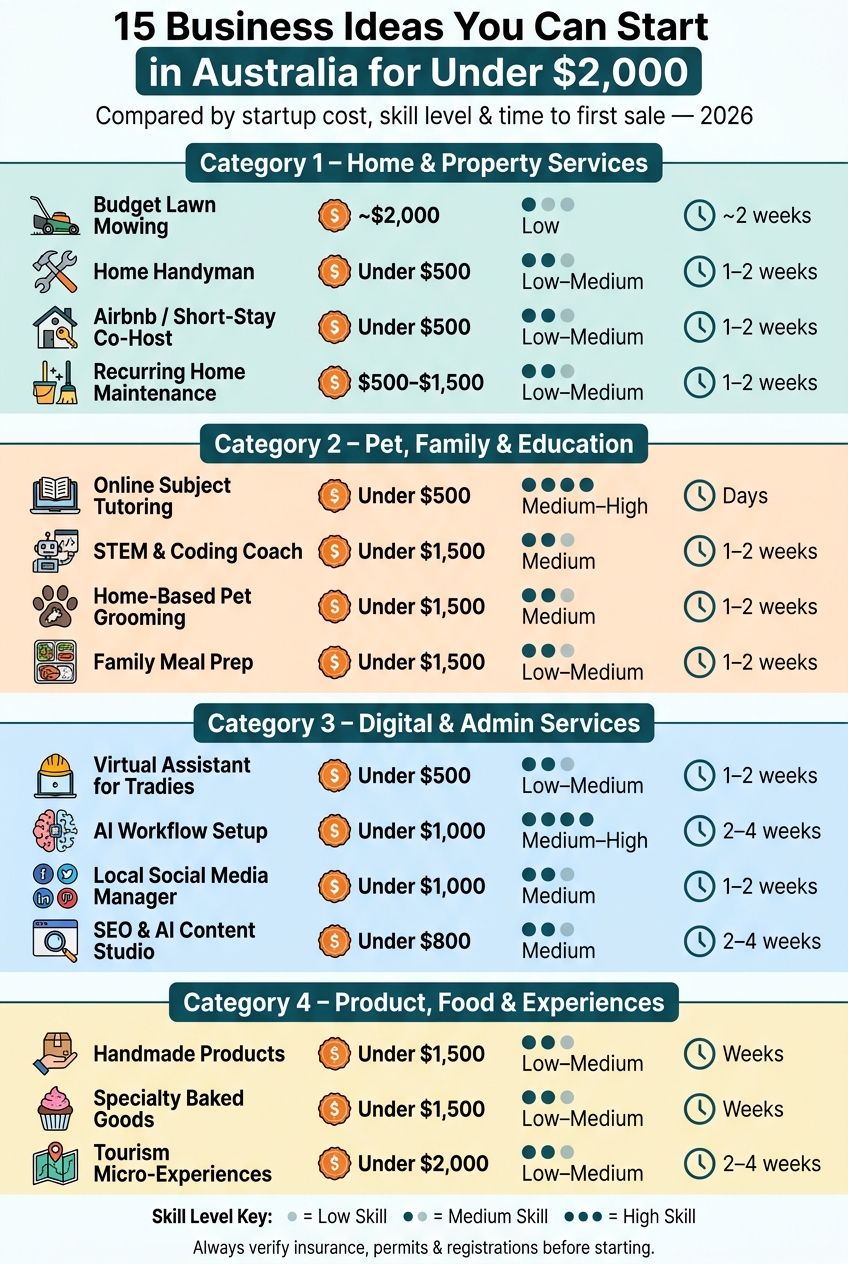
15 Low-Cost Business Ideas in Australia Under $2,000 (2026)
If you’ve already checked demand, this table makes the next step easier: pick the option that gets you to a first sale with the least friction.
The biggest differences here come down to three things: startup cost, skill level, and how long it usually takes to land that first customer.
| Business Idea | Approx. Startup Cost | Skill/Credential Needed | Typical Time to First Sale | Key Requirement |
|---|---|---|---|---|
| Budget Lawn Mowing | Near top of budget | Low | ~2 weeks | Public liability insurance |
| Home Handyman | Under $500 | Low–Medium | 1–2 weeks | ABN, public liability insurance |
| Airbnb / Short-Stay Co-Host | Under $500 | Low–Medium | 1–2 weeks | ABN, professional indemnity insurance |
| Recurring Home Maintenance | $500–$1,500 | Low–Medium | 1–2 weeks | ABN, public liability insurance |
| Online Subject Tutoring | Under $500 | Medium–High (subject knowledge) | Days | Working with Children Check |
| STEM & Coding Coach | Under $1,500 | Medium (STEM knowledge) | 1–2 weeks | Working with Children Check |
| Home-Based Pet Grooming | Under $1,500 | Medium | 1–2 weeks | Animal Bailee insurance |
| Family Meal Prep | Under $1,500 | Low–Medium | 1–2 weeks | Food safety certificate, council permit |
| Virtual Assistant for Tradies | Under $500 | Low–Medium | 1–2 weeks | ABN, laptop |
| AI Workflow Setup | Under $1,000 | Medium–High | 2–4 weeks | ABN, laptop |
| Local Social Media Manager | Under $1,000 | Medium | 1–2 weeks | ABN, laptop |
| SEO & AI Content Studio | Under $800 | Medium | 2–4 weeks | ABN, laptop |
| Handmade Products | Under $1,500 | Low–Medium | Weeks | ABN, product liability insurance |
| Specialty Baked Goods | Under $1,500 | Low–Medium | Weeks | Food safety certificate, council permit |
| Tourism Micro-Experiences | Under $2,000 | Low–Medium | 2–4 weeks | ABN, public liability insurance |
A few patterns jump out.
Low-barrier ideas like co-hosting, virtual assistance, and online tutoring can get off the ground with little more than an ABN and basic insurance. By contrast, services tied to checks, permits, or food rules usually take a bit longer to set up before you can make that first sale.
There’s also a clear split between services and products. Service businesses tend to bring in cash sooner. Product-based businesses often need more prep, more setup, and more waiting before money starts coming in.
For local services, speed matters too. Same-day, in-person quotes often close faster than remote follow-up. That makes a big difference when you’re trying to get paid early instead of letting leads go cold.
Use the table to cut your shortlist down to the one option that fits your budget, skills, and timeline best before moving to the final takeaway.
Conclusion
$2,000 can be enough if you keep costs tight, test demand first, and pick a business model that fits what you already know how to do.
Start with the basics: registration, banking, and any insurance you need.
After that, check demand the cheap way before you spend money on tools, inventory, or extra setup. You can list your service on Airtasker or Upwork, or post in local Facebook groups. A website can wait.
Then choose the idea that lines up with your skills, local demand, and the amount of compliance work involved.
The first sale is the milestone that matters. Keep your offer simple, make sure your pricing leaves room for profit, and get paid for that first job before you spend more on gear or branding.
FAQs
Which business idea is best if I need income fast?
Side hustles like freelance digital services or online tutoring can bring in income in a fairly short time, often within a few weeks to a few months.
For most people, these are the fastest paths to getting paid because startup costs stay low and demand can show up right away.
What licenses or insurance do I need before I start?
Before starting a business in Australia, you’ll usually need an ABN. Your business setup may also call for licenses or permits tied to your industry.
Insurance matters too. Many business owners look at professional liability, general liability, and equipment insurance. That’s even more important if you work from home, travel to clients, or rely on tools like laptops or cameras.
It’s also smart to budget for the costs that keep showing up after launch, like registration, accounting, and tax compliance.
How can I test demand without spending my full $2,000?
Start with low-cost market research and simple validation methods. IdeaFloat recommends using surveys, landing pages, or small pilot programs to get direct feedback before you spend more.
You can also run a simple social media ad, track inquiries or engagement, or offer a basic version of your service or a free trial. That gives you a clearer read on demand before you put the rest of your budget to work.
Related Blog Posts
- What Business Can You Start in Australia With $10,000? 15 Realistic Ideas for 2026
- Best Small Business Ideas in Australia Under $30,000
- What Business Can You Start in Australia With $500? 15 Realistic Ideas for 2026
- 19 Low-Cost Business Ideas in Australia With High Profit Potential