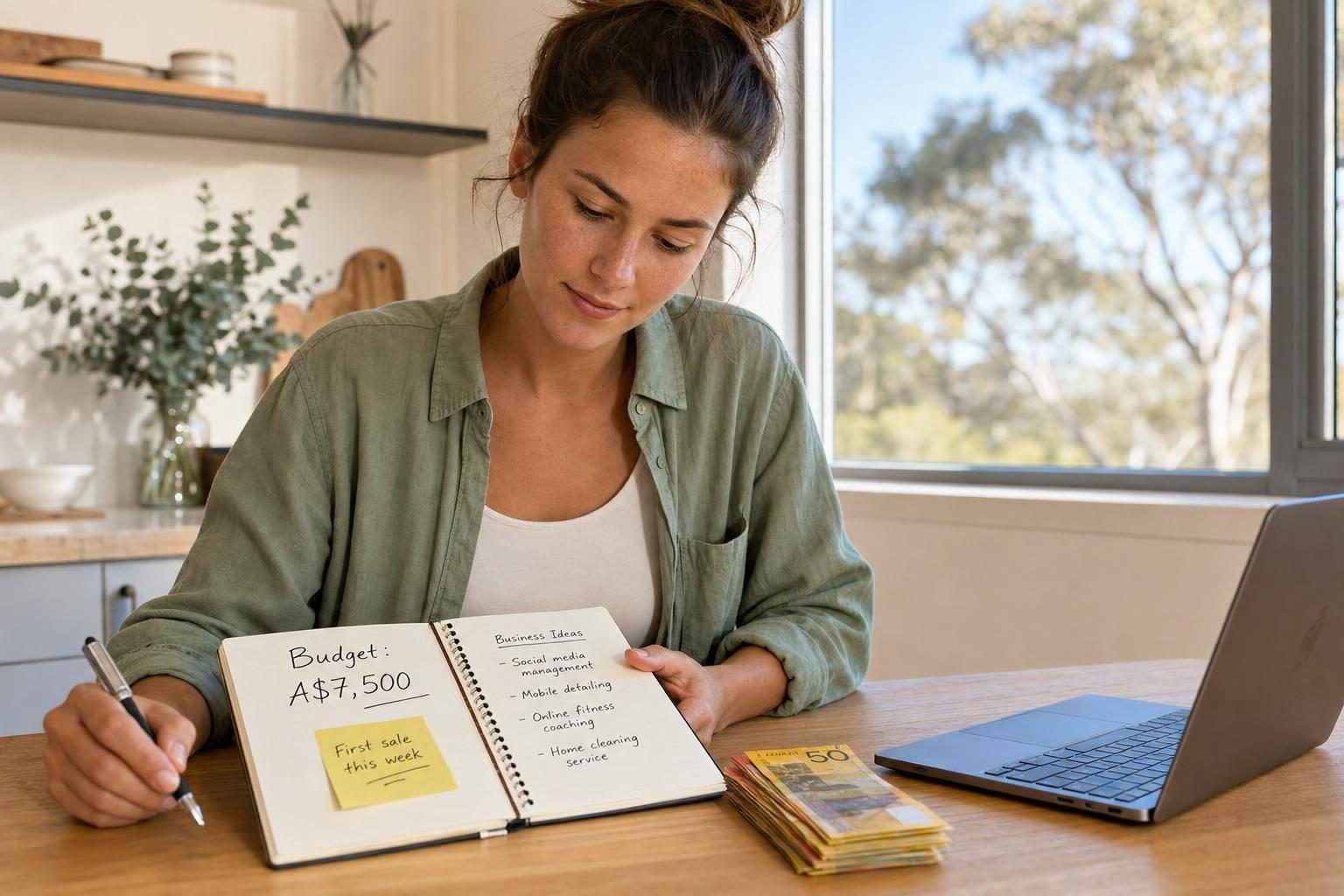
Yes - you can start a business in Australia with $5,000, and in many cases you can start for far less. The article’s main point is simple: if I keep overhead low, test demand first, and pick a model that gets to a first sale fast, $5,000 USD is about A$7,500 in 2026 and that is enough for many lean businesses.
Here’s the short version:
- Service businesses are often the fastest path to income.
- Digital products cost less to start, but they often take longer to earn.
- AI-based services can have low tool costs and higher client fees.
- Insurance, checks, and state rules can add costs fast.
- GST registration is required at A$75,000 in annual turnover.
- Research cited in the article says 68% of Australian small businesses started with under $1,000.
The 15 ideas fall into four simple groups:
- Service-based skills: virtual assistant, freelance writing, tutoring/coaching, bookkeeping
- Local services: lawn mowing, cleaning, handyman work, in-home tutoring
- Digital products: Etsy printables, mini courses, niche downloads, membership content
- AI services: AI automation, chatbot setup, AI content for one niche
The big takeaway: I would not spend money on logos, stock, or paid ads first. I’d talk to buyers, check reviews, test pricing, and work out break-even before launch.
Quick Comparison
| Type | Startup Cost | Time to First Sale | Main Watch-Out |
|---|---|---|---|
| Service skills | Under A$1,500 | 1–4 weeks | Pricing and client wins |
| Local services | A$1,000–A$5,000 | 1–4 weeks | Gear, transport, insurance |
| Digital products | Under A$1,000 | 4 weeks to 18 months | Slow early sales |
| AI services | Under A$500 for tools | 2–6 weeks | Need a clear niche and offer |
If I wanted the safest path on a small budget, I’d start with a skill-based service, keep costs tight, and sell the smallest version first.
sbb-itb-08dd11e
How a $5,000 Startup Budget Works in Australia
For this article, $5,000 is about A$7,500 in 2026. That gives you enough room to cover the basics, but only if you stay sharp about where the money goes.
Where you live also changes the math. Founders in metro areas tend to spend more on ads and transport. Founders in regional areas often put more money into fuel.
Here are the main costs most lean businesses run into:
| Expense Category | Estimated Cost (AUD) | Frequency |
|---|---|---|
| ABN Registration | $0 | One-time |
| Business Name (ASIC) | $42–$44 | Annual |
| Public Liability Insurance | $500–$1,500 | Annual |
| Accounting Software | $15–$35/month | Monthly |
| Website & Hosting | $120–$200 | Annual |
| Starter Marketing | $50–$500 | One-time or variable |
The biggest expenses usually come from insurance, software, hosting, and a small launch push.
Some business types can get off the ground with very little cash. Freelancing or virtual assistance, for example, can start for well under A$1,000 if you already have a laptop. That leaves most of the A$7,500 budget untouched, which gives you some breathing room.
Local mobile services work a bit differently. Lawn mowing or cleaning often need more money upfront for equipment and transport. Still, they can fit inside an A$7,500 budget if you start small and keep the setup lean.
The ideas below start with the lowest-cost models, then move into options that need more gear.
Validate Before You Spend: Planning a Low-Cost Business in 2026
Before you pick from the 15 ideas below, check demand first. With a $5,000 budget, one bad call can eat up a big chunk of your cash. So skip branding, logos, and inventory until you know people want what you're selling.
The good news? Most of this early work costs nothing. Start with Google Business Profiles and local Facebook groups. Look at how crowded the niche is, and pay close attention to what customers keep complaining about. In many cases, 1-star and 3-star reviews tell you the most. They show where rivals are dropping the ball or just barely doing enough to keep people satisfied.
Once you spot a possible gap, talk to actual people before spending a dime. Try to speak with at least five potential customers. Ask a simple question: is this a problem they'd pay to fix? You don't need a long interview. A 15-minute video call is often enough to get blunt, useful feedback.
Pricing trips up a lot of new founders. Your hourly rate has to do more than pay you for the job itself. It also needs to cover tax, insurance, software, and the admin work no one pays for. So if you earned $45/hour as an employee, you may need to charge $75 to $90/hour as a contractor to end up with similar take-home pay after tax, superannuation, insurance, software, and admin time. Superannuation rises to 12% in July 2026.
Then work out your break-even point. How many jobs or clients do you need each month just to cover fixed costs? A 12-month cash flow forecast helps you see whether the business makes sense before launch. It can also help you work out startup costs and your break-even point before you commit.
With demand and pricing checked, the ideas below start with the lowest-cost service options.
1. Service-Based Skills
If the market is there, service work is often the fastest, lowest-cost way to bring in money. In Australia, service businesses are among the cheapest to start. You usually need very little equipment, you can work from home, and you can sell skills you already have. Before you begin, check your ABN, insurance, and any licensing rules that apply. The four ideas below start with the simplest service setups.
- Virtual Assistant (VA)
Startup cost: under $500, mostly for basic online tools. In the VA market, Certified Xero users can charge $60 to $80 per hour. It also helps to focus on one type of client, like trades or real estate. That makes it easier to stand out and charge more. - Freelance Copywriting or Content Writing
Startup cost: under $1,000, mainly for a portfolio website, basic SEO tools, and professional indemnity insurance. A clear niche can make client wins easier and support higher rates. - Online Tutoring or Coaching
Startup cost: low. You’ll need reliable internet, a webcam, and scheduling software. Recurring sessions can lead to steadier income, which is a big plus when you're starting out. - Bookkeeping
Startup cost: $500 to $1,500, mostly for accounting software and insurance. Narrowing in on one industry, such as trades, can help cut down on competition and support higher rates.
2. Home and Mobile Local Services
If your market check showed real local demand, these four services are usually the easiest place to start. For a $5,000 budget, local services are often the fastest route to cash flow with low overhead. The first two need the least gear. The next two lean more on skill than equipment.
- Lawn mowing and yard maintenance: $2,000 to $5,000 with used gear. Mowing by itself does not usually need a trade license, but herbicide spraying does require state chemical-use compliance. You’ll also need an ABN, public liability insurance, and to meet local council rules.
- Cleaning services (residential, Airbnb, or end-of-lease): Under $1,000 for a lean setup. Think commercial vacuum, microfiber cloths, chemicals, and invoicing software. An ABN and public liability insurance still apply, and some clients may ask for a National Police Check.
- Handyman and minor home repairs: Often under $5,000 if you already own tools. In NSW, general handyman work under $5,000 usually does not need a contractor license. In Victoria, the threshold is $10,000. State rules matter here, especially before you touch electrical, plumbing, or larger building work.
- In-home tutoring for school students: Very low startup cost. In most cases, you just need a laptop, materials, and booking software. A Working with Children Check (WWCC) is required before tutoring minors, and state fees vary: NSW (~$91), VIC (~$129), QLD (~$103), and WA (~$87). Professional indemnity insurance usually costs $300 to $600 per year.
These are the quickest low-cost local options. The next group moves more toward online and digital models.
3. Online and Digital Products
If service work feels a bit too hands-on, digital products can be a simpler path with less overhead. You make the product once, then sell it again and again. There’s no inventory sitting in your garage, no shipping labels, and no packaging runs. That’s the appeal. But don’t build first and hope people show up. Use the same demand test from earlier: look at search interest, read comments, and check early buyer response before you spend time making anything.
Here are four realistic options you can start within a $5,000 budget:
- Printables and templates on Etsy: Create planners, resume templates, or niche worksheets with Canva Pro, which costs about $24/month AUD, and list them on Etsy for about $0.31 AUD per listing. Etsy also takes a 6.5% transaction fee on each sale, but the upside is access to a built-in global audience that can help you test demand fast.
- Mini online courses or paid workshops: Start by selling a live workshop first. Then, once people pay and show interest, turn that material into a course.
- Niche digital downloads: Pick one tight niche, like a specific hobby or profession, instead of trying to sell to everyone.
- Subscription content or membership site: Recurring memberships or template subscriptions can bring in steadier revenue than one-time sales.
If you already own a laptop, startup costs for any of these can stay well under $1,000. The bigger investment is your time, but you can learn how to launch more efficiently. A smart move is to test demand with organic social content before spending money on ads.
These models are simpler to launch than service businesses, but they still depend on one thing: a niche that wants what you’re selling.
4. AI-Assisted and Tech Services
If you want to sell a higher-ticket service without pouring a lot of money into setup, AI tools can help. Right now, only 20% of Australian businesses use AI in their operations. That gap leaves room for people who can step in and solve a clear problem.
The big idea here is simple: the software is cheap, but the service is what clients pay for. The strongest offers use AI to fix one specific business headache. So instead of trying to help everyone, pick a lane, like NDIS providers, tradies, or real estate agents, and go deep.
In most cases, the best service models use AI to cut admin time, reply faster, or get content out the door. Under a $5,000 budget, these are the three most practical options:
- AI Automation for Small Businesses
You review a small business’s repeat admin tasks, like appointment scheduling, invoice handling, or lead follow-up, then build automations with tools like Zapier or Make.com. Software plans usually cost about AUD $20–$30 per month, while project fees often land between AUD $2,000 and $10,000. If you focus on one niche, it’s also easier to charge a monthly retainer. - AI Chatbot Setup
You install an AI chat or call-answering system for a local business so it can capture leads and answer common questions 24/7. Setup fees usually range from AUD $1,500 to $5,000, with optional monthly support at AUD $200 to $800. The pitch is pretty straightforward: in a major Australian city, one missed plumbing call can mean AUD $400 to $800 in lost job value. That makes the return easy to show. One saved booking or lead can pay for the setup. - AI Content Service for One Niche
You use AI writing and design tools to create blog posts, social media content, and email newsletters for local businesses. Monthly retainers for this kind of service usually sit between AUD $1,000 and $5,000, based on output and scope.
Most of the tools you’d need stay under AUD $100 a month.
Quick Comparison: Cost, Complexity, and Time to First Revenue
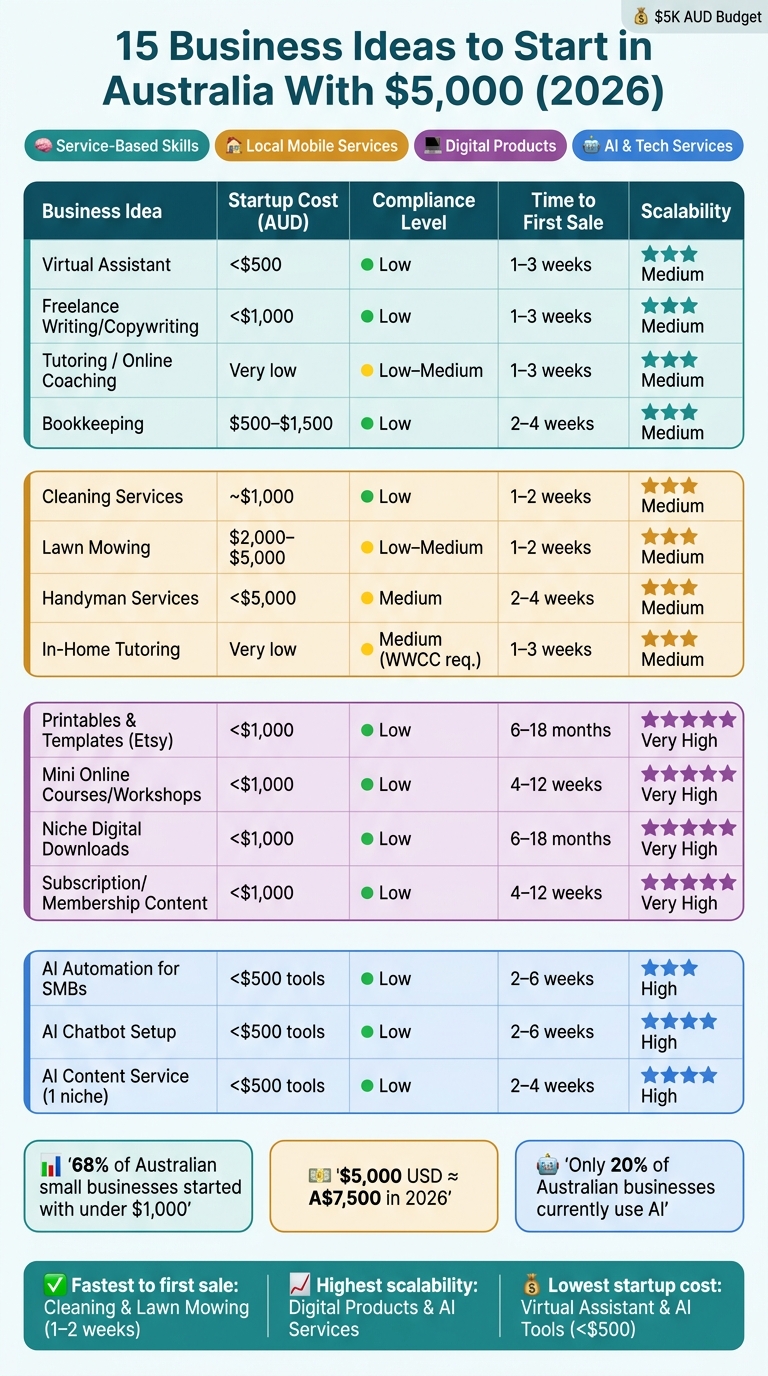
15 Business Ideas to Start in Australia With $5,000 (2026)
Once you’ve looked at the ideas one by one, this snapshot makes the tradeoffs easier to see.
Before you commit, look at cost, compliance, and time to first revenue side by side. That matters more than most people think. A business can look cheap on paper and still be a pain to get off the ground if permits, insurance, or state rules get in the way.
In plain English: fast-paying ideas are often the simplest to launch. Service businesses usually get you paid sooner. Digital products, on the other hand, usually take longer to earn their first dollar, but they have more room to grow once they start working.
One more thing: low startup cost does not mean low friction. If your idea involves children or a regulated trade, you may need permits, background checks, or certifications before you can take your first booking. Check your state’s licensing rules before you launch.
Use the table below to narrow the list to the options that fit your budget and timeline.
| Business Idea | Startup Cost | Compliance | Time to First Sale | Scalability |
|---|---|---|---|---|
| Virtual Assistant | Very low (<$500) | Low | 1–3 weeks | Medium |
| Freelance Writing / Copywriting | Very low | Low | 1–3 weeks | Medium |
| Tutoring / Online Coaching | Very low | Low–medium | 1–3 weeks | Medium |
| Bookkeeping | Low ($500–$1,500) | Low | 2–4 weeks | Medium |
| Cleaning Services | Medium (~$1,000) | Low | 1–2 weeks | Medium |
| Lawn Mowing | Medium ($2,000–$5,000) | Low–medium | 1–2 weeks | Medium |
| Handyman Services | Medium (<$5,000) | Medium | 2–4 weeks | Medium |
| Digital Products / Printables | Very low | Low | 6–18 months | Very high |
| Online Courses / Workshops | Very low | Low | 4–12 weeks | Very high |
| AI Automation / Chatbot Setup | Low (<$500 tools) | Low | 2–6 weeks | High |
| AI Content Service | Low | Low | 2–4 weeks | High |
Use the table to narrow down your best-fit options before you move on.
Conclusion
A $5,000 budget is enough to launch a real business in Australia in 2026 - if you choose the right model. The best options on a lean budget tend to have a few things in common: they use skills you already have, keep overhead low, and don't need a shopfront or a team on day one.
Service businesses usually bring in cash faster. Digital products often take more time upfront, but they can scale more easily.
So the next step is simple: validation. Before you spend a dollar, talk to potential customers and find out whether people will pay for what you're offering. Once you know there's demand, launch the smallest version you can sell.
Pick one idea, check your state rules, and take one real step this week.
FAQs
How do I choose the best business idea for my skills and budget?
Choose a business idea by checking five basics: proven demand in Australia, low startup costs - ideally under $500 - a path to earning your first dollar in 2 to 4 weeks, the flexibility you need, and room to grow.
Start with ideas that lean on your current strengths and fix a specific market need. Then validate your pick with a lean business plan that covers your target audience, branding, and early marketing.
What legal checks should I do before launching in my state?
Before launching, check the basics for compliance:
- Choose a business structure and register for an Australian Business Number.
- Register a business name with ASIC if you’re not using your legal name.
- Confirm local council zoning, permits, and any lease or strata by-laws for home-based businesses.
- Arrange any required licenses, public liability insurance, and legal documents.
How can I validate demand before spending my startup money?
Start with a feasibility check. Look at competitors, what your target market needs, and how much margin you might make. The goal is simple: pick one specific problem that people will pay to fix.
Then test the idea in a lean way. If you're starting a service business, reach out to potential clients through local community groups, social media, or LinkedIn. If you're building a product business, try dropshipping first so you can measure demand without buying inventory up front. A clear business plan can help you confirm who your audience is and whether the market need is there.
Related Blog Posts
- Best Small Business Ideas in Australia Under $5,000
- What Business Can You Start in Australia With $10,000? 15 Realistic Ideas for 2026
- What Business Can You Start in Australia With $500? 15 Realistic Ideas for 2026
- 19 Low-Cost Business Ideas in Australia With High Profit Potential