
Looking to start a business in Australia? Here's how to make the right choice.
Starting a business can be life-changing, but picking the wrong idea can lead to wasted time and money. In Australia, industries like health care, cybersecurity, AI services, and personal services are thriving, but success depends on aligning your idea with market demand, your skills, and financial feasibility.
This guide breaks it down into 5 steps:
- Identify a real customer problem: Focus on solving specific issues people care about.
- Evaluate market demand: Use tools like ABS data, Google Trends, and competitor analysis.
- Match the business to your strengths: Leverage your skills and interests for better outcomes.
- Check financial feasibility: Estimate startup costs, taxes, and ongoing expenses.
- Test your idea: Validate customer interest before committing fully.
Follow these steps to reduce risks and build a stronger foundation for your venture.
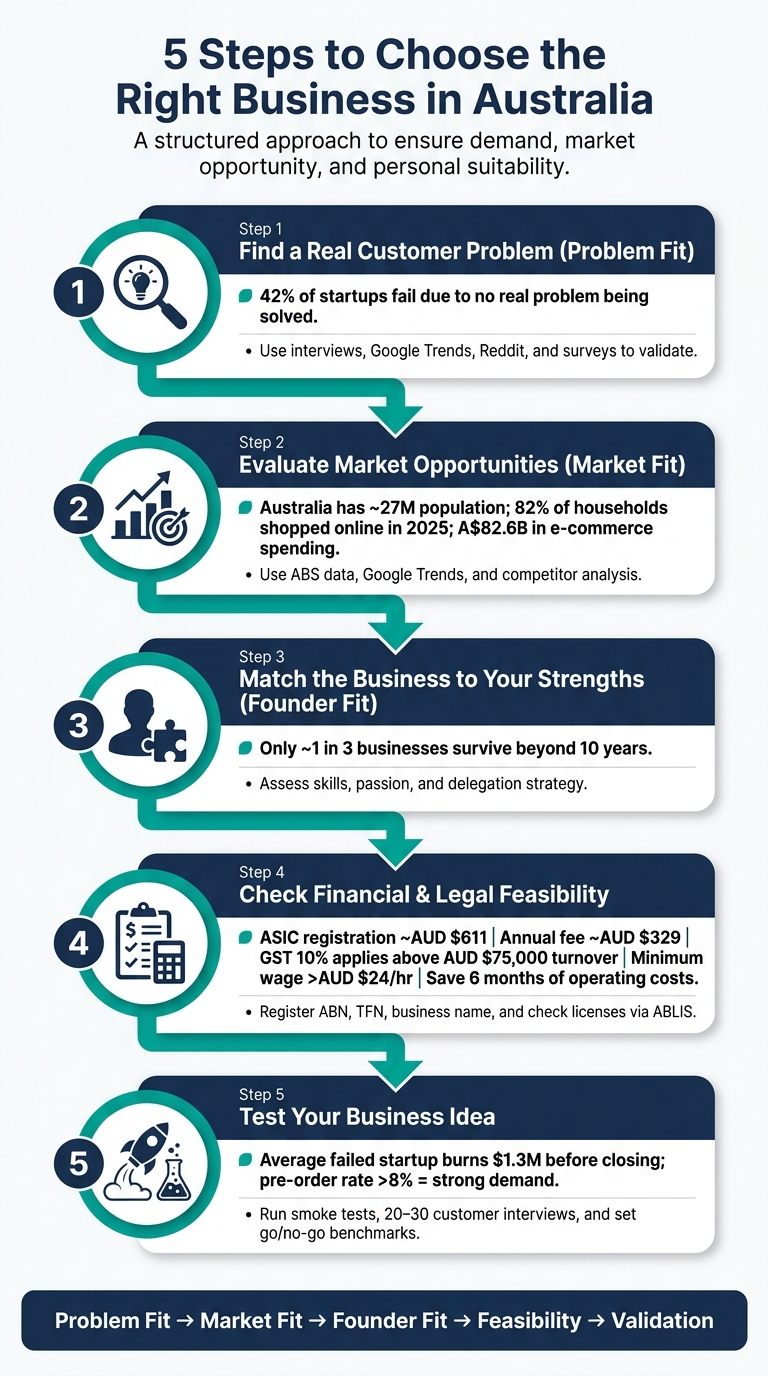
5-Step Framework to Choose the Right Business in Australia
20 High-Demand Business Ideas for Australia in 2026
Step 1: Find a Real Customer Problem (Problem Fit)
The first step in choosing the right business in Australia is pinpointing a genuine customer problem. Forget about branding or pricing for now - focus on identifying whether a real issue exists. Why is this so critical? Research shows that 42% of startups fail because they don’t solve a problem people care about. That’s not a failure of the product itself - it’s a failure to do the homework.
How to Define the Problem
A well-defined problem is specific and actionable. Avoid vague statements like, “people want healthier food.” Instead, go for something like: “busy professionals in Sydney can’t find affordable, nutritious meal prep options that don’t require cooking.” See the difference? Specificity makes it easier to craft a solution.
It’s also smart to focus on industries you already know. For example, Australia’s e-commerce sector is booming - 82% of households shopped online in 2025, with total spending hitting A$82.6 billion. This growth has created real challenges in areas like delivery speed, returns, and customer service.
"Problems are everywhere, but we often overlook them because we've adapted to them." - Stone & Chalk
Who Has This Problem and Why It Matters
Once you’ve nailed down the problem, figure out who feels it the most. The best customers are those who experience the issue frequently, find it frustrating, and are willing to pay for a solution. In Australia, small to medium enterprises (SMEs) are often a great audience, especially in sectors like health and wellness, e-commerce, and technology.
Ask yourself:
- How often does this person face the problem?
- What workarounds are they currently using?
- What’s the cost - in time, money, or stress - of leaving it unsolved?
The answers will tell you if the demand is strong enough to build a business around. Then, use tools to confirm your assumptions.
Tools to Confirm the Problem Is Real
Problem validation is all about turning assumptions into evidence. The best way to do this? Talk directly to the people experiencing it. The "Mom Test" approach is a great way to get honest feedback - focus on their past behavior rather than hypothetical opinions. For instance, instead of asking, “Would you use a product like this?” try, “Have you ever tried to solve this problem?”
Other validation methods include:
- Interviews: Speak to potential customers to uncover real frustrations.
- Google Trends: Check if there’s growing interest in your problem area.
- Community Research: Platforms like Reddit or Facebook groups are goldmines for unfiltered feedback.
- Surveys: Tools like SurveyMonkey or Google Forms can help you collect structured, quantitative data.
Look for evidence that people are actively trying to solve the problem.
"The goal of market validation isn't to find a perfect, risk-free idea. It's to find enough evidence that people are already behaving in a way that suggests they'll pay for your solution." - Simplified Business and Accounting
Platforms like IdeaFloat can also help. They use AI to measure urgency, identify weak signals, and suggest next steps - saving you time and effort before you make a big investment.
Once you’ve validated the problem, you’re ready to move on to evaluating market opportunities in Step 2.
Step 2: Evaluate Market Opportunities (Market Fit)
After validating the problem, the next step is to figure out if the market is big enough to support your business. This involves assessing the potential before committing significant resources.
How to Measure Market Demand
With a population of about 27 million, Australia is smaller than many U.S. states. This makes precise market analysis crucial. A business model that thrives in a larger market might not work in Australia without some adjustments.
Start by conducting secondary research. The Australian Bureau of Statistics (ABS) is a great resource for demographic data and industry reports, helping you estimate the size of your target market. Tools like Google Trends can provide additional insights into interest trends, showing whether a category is gaining traction, holding steady, or declining. Current growth areas in Australia include AI services, health and wellness, and e-commerce.
"Market research allows you to identify risks before they impact your business and spot growth opportunities early." - The Business Plan Company
To complement secondary data, use primary research methods like surveys, interviews, or polls. Once you have a clear understanding of market demand, shift your attention to analyzing the competition.
How to Analyze Your Competition
Understanding your competitors is just as critical as knowing your customers. Start by identifying both direct and indirect competitors in your space.
"To uncover gaps in the market, you need to analyze and understand your customers and competitors." - Business Queensland
Here’s a simple framework to guide your competitor research:
| Step | What to Do |
|---|---|
| Identify competitors | List both direct and indirect players in your market |
| Assess strengths and weaknesses | Determine what they excel at and where they fall short |
| Spot market gaps | Look for underserved or ignored customer segments |
| Develop unique selling propositions | Identify what you can offer that others don’t |
For instance, a 2026 study of Australia’s cleaning services industry revealed that partnering with real estate agencies for end-of-lease cleaning was an untapped channel - most competitors weren’t leveraging it. Identifying such gaps can set your business apart. Tools like IdeaFloat’s Competitor Analysis can streamline this process by scanning the web for competitive insights and highlighting underserved areas.
After evaluating competitors, ensure your business complies with local regulations and plan your finances accordingly.
Australian Regulations to Know
Understanding Australia’s regulatory landscape is essential. Every business must register with the Australian Securities and Investments Commission (ASIC) and the Australian Taxation Office (ATO). ASIC registration costs AUD $611, with an annual compliance fee of AUD $329. Additionally, you’ll need an Australian Business Number (ABN) and a Tax File Number (TFN) to handle tax obligations.
Don’t overlook Australia’s 10% Goods and Services Tax (GST), which applies to most goods and services. This tax impacts your pricing and profit margins, so factor it into your financial planning from the start. Another consideration is the national minimum wage, which exceeds $24/hour, raising operating costs compared to many other markets.
If you’re exploring a franchise model, be aware of the Franchising Code of Conduct, which outlines disclosure and conduct standards to protect franchisees. For foreign entrepreneurs, the Proprietary Limited (Pty Ltd) structure is the most common option, but it requires at least one Australian-resident director.
Step 3: Match the Business to Your Strengths (Founder Fit)
Once you've confirmed a solid market opportunity, it's time to evaluate whether your personal skills align with the demands of the business. Even the best market potential can't save a venture if the founder isn't equipped to lead it effectively.
Matching Your Skills to the Business
Start by listing the key functions your business will rely on - things like sales, operations, marketing, and finance. Then, compare these needs with your own skill set. Having relevant experience can save you money and time because you won’t need to outsource everything immediately. As Jotika Teli, CPA at Xero, explains:
"Relevant experience reduces startup costs and improves success rates."
Next, figure out your natural founder type. Are you a Creative, an Analytical thinker, a Connector, or an Operator? This self-awareness helps you understand how your strengths align with your business model. And when your skills match the business needs, you’re setting yourself up for smoother operations.
Why Personal Interest Matters
Passion isn’t just a feel-good concept - it’s a practical advantage. Founders who are genuinely interested in their industry tend to learn faster, identify opportunities earlier, and weather challenges better. Considering that only about one-third of businesses survive beyond 10 years, intrinsic motivation can be the difference between sticking it out and giving up.
To check your level of interest, try a simple Passion Test: ask yourself if you’ll still be excited about this business three years from now - not just in the short term. If you’re unsure, it’s worth reconsidering before you invest significant time and money.
Execution Challenges to Prepare For
Even with the right skills and passion, execution can still be a major hurdle. Starting a business often means stepping into an all-encompassing leadership role, where you’re suddenly responsible for HR, finance, marketing, operations, and more. This shift can be overwhelming and lead to decision fatigue.
The best way to handle this is to identify your weaknesses upfront and decide how to address them: Will you learn the skills yourself, outsource the tasks, or bring in a partner? Business coach Federico Re advises:
"Smart business operators delegate responsibility to other people, to maintain momentum and performance. This can include business coaches, advisors, and other consultants."
Take, for example, Cassidy Caulk, who launched Kindred Label, a shoe brand, in 2022 without prior experience in footwear. Instead of hiring costly experts, she turned to YouTube to teach herself cobbling and prototyping. By building her skills first, she was able to create momentum before scaling.
Matching your abilities with the needs of your business is a critical step before moving on to test your idea in Step 4.
sbb-itb-08dd11e
Step 4: Check If the Business Is Feasible
With your skills and market research in place, it’s time to verify whether your business idea makes sense financially and legally. This step ensures that the numbers, time commitment, and legal requirements align with your vision, helping you avoid costly surprises down the road.
How to Estimate Startup and Operating Costs
Starting a business comes with both initial and ongoing expenses. It’s important to map out these costs before you launch.
Startup costs often include things like ASIC company registration (around $611 AUD), business name registration (approximately $44 AUD for one year or $102 AUD for three years), legal documents (like privacy policies or terms and conditions), as well as inventory and equipment. On the other hand, ongoing costs cover rent, software subscriptions, salaries, marketing, insurance, and the ASIC annual review fee (about $329 AUD).
Experts recommend having at least six months’ worth of operating costs saved up before opening your doors. As business advisor John English says:
"Start small but think big. Financial discipline allows you to be brave."
Don’t forget about taxes. If your annual turnover hits $75,000 AUD or more, you’ll need to register for GST. Businesses with turnovers under $50 million AUD are taxed at a corporate rate of 25%. To stay ahead, set aside 30% of each payment you receive in a separate account to cover future GST and tax obligations.
Time and Resources You Will Need
Launching a business takes more than money - it also requires time and the right resources. A good way to evaluate feasibility is by breaking it into three parts: financial resources (can you fund the launch and sustain operations?), legal requirements (do you know which registrations and permits apply?), and operational needs (do you have the team, tools, and suppliers lined up?).
If you plan to hire employees, factor in more than just their wages. Australia’s national minimum wage is over $24 AUD per hour, but additional costs like superannuation (set to reach 12% by the 2025–26 financial year), workers’ compensation, and payroll tax can increase labor costs by 15–20% above the base rate.
Once you’ve worked out your costs and resources, make sure all legal and administrative requirements are covered.
Legal and Administrative Steps to Take
Navigating the administrative side of starting a business in Australia is straightforward if you follow the right steps. Here’s a quick breakdown:
| Step | Details | Cost |
|---|---|---|
| Choose a business structure | Decide on a structure: sole trader, partnership, company (Pty Ltd), or trust | Varies |
| Get a Director ID | Apply for a Director Identification Number via ABRS before becoming a director | Free |
| Register for an ABN | Obtain an Australian Business Number to identify your business to the government | Free |
| Register your business name | Register your trading name if it’s different from your legal name | ~$44–$102 AUD |
| Register for GST | Required if your annual turnover exceeds $75,000 AUD | Free |
| Obtain licenses and permits | Use ABLIS to determine the permits required for your industry | Varies |
| Open a business bank account | Keep personal and business finances separate | Varies |
First-time business owners must apply for a Director Identification Number through ABRS before completing ASIC registration. This step is free and quick, but skipping it can delay your entire registration process.
If you’re hiring, set up Single Touch Payroll (STP) before your first employee starts. This ensures tax and superannuation information is automatically sent to the ATO. Also, starting in July 2026, employers will need to pay superannuation at the same time as wages. Make sure your payroll system is ready for this change to avoid compliance headaches.
Step 5: Test Your Business Idea Before You Commit
Once you've established a solid legal and financial foundation, it's time to see if your idea resonates with real customers. Will people actually pay for what you're offering? Testing your concept early can save you from costly missteps. Here's why it matters: 42% of startups fail because there’s no market need for their product. On top of that, the average failed startup burns through $1.3 million before closing its doors. A few weeks of structured testing could save you from becoming part of that statistic.
How to Get Feedback from Real Customers
Instead of relying on friends or family, who might sugarcoat their feedback, reach out to unbiased potential customers. Platforms like LinkedIn, Reddit, and local industry meetups are great places to find people who fit your target audience.
Aim to have 20–30 conversations to identify recurring patterns. The key is to focus on their past behavior rather than hypothetical future actions. Ask questions like, “How did you solve this problem before?” or “What did it cost you?” This approach helps cut through polite answers and gets to the heart of real customer pain points.
"I've always been taught to take smart risks. So I knew that if I was going to leave my career in finance to start my own company, I wanted to feel really good about what I was going to embark on." - Nancy Twine, Founder, Briogeo
A practical way to test demand is by using a "smoke test." This involves creating a simple landing page with a “Join Waitlist” or “Pre-order” button. Run targeted ads with a budget of $200–$500. If people are clicking and signing up, that’s a strong signal of interest. If not, you’ve still gained valuable insights without committing to a full-scale launch.
This feedback is invaluable as you move toward testing pricing and revenue potential.
Testing Pricing and Revenue Potential
Once you’ve gathered initial customer insights, it’s time to validate your pricing. During interviews, try mentioning a specific price point and observe their reactions. Another option is to create a basic pre-order page using tools like Carrd (around $19 per year) with Stripe for payment integration. This allows you to see if customers are willing to commit funds upfront.
For those operating in Australia, make sure your revenue projections clarify whether they include or exclude GST. That 10% difference can significantly impact your financial analysis.
How to Make a Go or No-Go Decision
Before diving into testing, set clear success criteria. For example, you might decide, “If fewer than 5% of visitors to our landing page sign up, we’ll pivot.” Defining these benchmarks in advance helps you stay objective when it’s time to evaluate results.
To assess your idea, rate it across five key areas: problem severity, market size, competitive gap, willingness to pay, and customer acquisition feasibility. If your idea scores consistently low, it’s not a failure - it’s a data point that tells you to adjust your approach. On the other hand, strong signals suggest you’re onto something worth pursuing.
Here’s a simple framework to interpret your results:
| Validation Signal | What It Means | Next Step |
|---|---|---|
| Pre-order rate >8% | Strong demand | Move forward with confidence |
| Pre-order rate 3–8% | Moderate demand | Adjust pricing or messaging, then retest |
| Pre-order rate <2% | Weak demand | Rethink the problem or the audience |
| CPA < Gross Margin | Unit economics work | Scale your marketing efforts |
Conclusion: Putting Validated Insights into Action
Key Takeaways from the Framework
Selecting the right business isn't about chasing a flawless idea - it’s about following a structured process. Each stage of this framework builds on the one before, helping you reduce risks and refine your focus. Here’s how it all comes together:
- Problem fit ensures you're addressing a genuine issue.
- Market fit confirms there’s enough demand and an opportunity to seize.
- Founder fit evaluates if you’re the right person to lead this venture.
- Feasibility aligns your ambition with realistic costs and timelines.
- Validation replaces speculation with evidence from the real world.
"Thorough, methodical research at the start of your journey is the cheapest way to save (or earn) lots of money later." - Business Victoria
Skipping any of these steps could mean overlooking critical insights. But once you’ve worked through the framework, you’re ready to shift gears from preparation to execution.
Next Steps for Aspiring Entrepreneurs
After confirming strong market demand through validation, it’s time to get practical. Start by registering your ABN and business name, and set up a separate business bank account to keep your finances clear. If you plan to hire, make sure to account for all wages and regulatory benefits. And don’t forget - if your annual turnover is expected to exceed $75,000, registering for GST is mandatory.
Draft a short, focused business plan - just one or two pages. Highlight the problem you're solving, your solution, your revenue model, and what sets you apart. Tools like IdeaFloat can help you organize customer feedback, plan your validation experiments, and stay on track without losing momentum. Remember, the goal isn’t a perfect document - it’s a working plan to guide your next steps and adapt as you learn.
"Perfection is the enemy of progress. The market is the ultimate source of truth, and you can't get feedback from it until you are in it." - Dotto
FAQs
How do I know the problem is worth paying to solve?
When a problem causes regular and significant friction - whether it's wasting time, draining money, or adding stress - it becomes something people are willing to pay to solve. The key is to identify if customers are actively searching for or already spending on solutions. Evidence of this can include things like discussions on forums or social media, where people vent frustrations or share experiences. Even better, when frustrations are voiced without prompting, it’s a clear sign of demand.
The most compelling proof, though? Securing commitments. This might come in the form of pre-orders, pilot program sign-ups, or any tangible action showing people are ready to invest in solving the issue.
How big does the Australian market need to be for my idea?
To determine if your business idea can work in Australia, there’s no set minimum market size - it all depends on your business model. Start by calculating how many customers you need. Take your fixed costs (like rent, insurance, and wages), add your desired profit, and divide that total by your average transaction value. If the potential market can’t realistically provide enough customers to meet this number, the idea might not be viable.
What’s the fastest way to test demand before I register a business?
The fastest way to gauge interest in your product or service is to sell a simplified version. Look for indicators such as pre-orders, deposits, or sign-ups for a waitlist.
You can also try a "Painted Door" test. Here's how it works: run targeted ads for a week and send the traffic to a straightforward landing page. If people join the waitlist or engage by clicking through, you've got solid proof that there's demand.
Related Blog Posts
- What Business Can You Start in Australia With $10,000? 15 Realistic Ideas for 2026
- Best Small Business Ideas in Australia Under $30,000
- High-Margin Small Business Ideas in Australia for One-Person Teams
- 19 Low-Cost Business Ideas in Australia With High Profit Potential