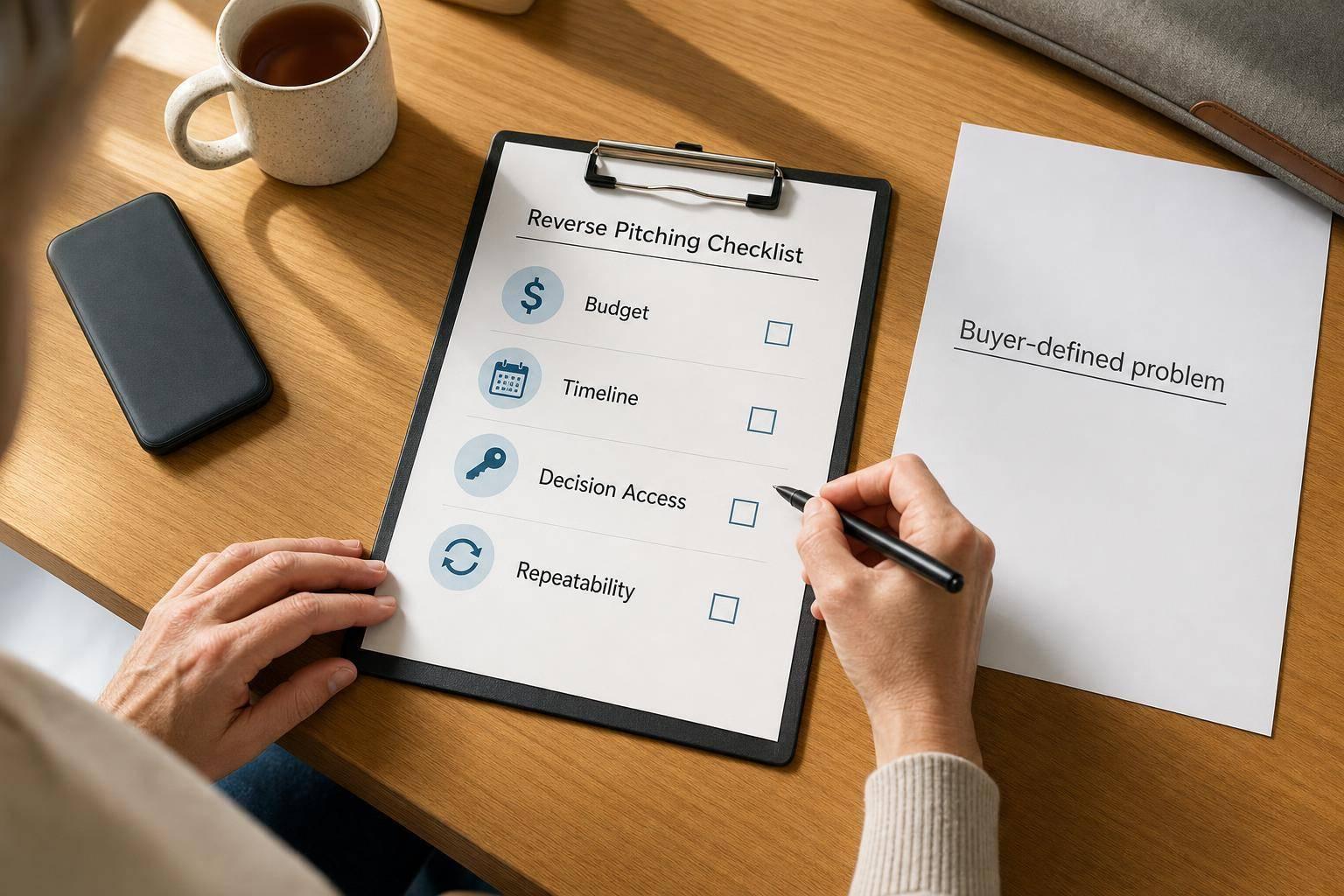
Reverse pitching works best when the buyer already knows the problem and you need to prove fit fast. I’d use it when the brief includes a timeline, budget, decision path, and success metrics. If those pieces are missing, I’d treat the chance as weak and avoid spending too much time on it.
Here’s the short version:
- Reverse pitching = the buyer goes first and states the problem
- Standard pitching = the seller goes first and states the solution
- I’d use reverse pitching for:
- investor themes
- brand or agency briefs
- pilot or LOI-based demand tests
- I’d use a standard pitch when:
- buyers don’t yet see the problem
- I need to shape demand
- I already have a proven offer and want reach
What I’d check before replying:
- Budget: Is there a clear range, like $25,000–$50,000, or is it vague?
- Decision access: Can I reach the person who can say yes?
- Timing: Is the deadline tied to a launch, board review, or other fixed event?
- Repeat use: Is this a one-off ask, or a problem many buyers have?
A few facts stand out from the article:
- Reverse pitching shifts the job from persuasion to fit checking
- Q&A matters because it helps narrow scope before submission
- Early proof should come from written signals like LOIs, pilot deals, or budget approval
- Big-name buyers can still be bad opportunities if there’s no sponsor or no path to close
Quick comparison
| Approach | Who starts | Best use | Main risk |
|---|---|---|---|
| Reverse pitch | Buyer | Clear brief, known problem, pilot or theme match | You spend time on a weak brief or unpaid work |
| Standard pitch | Seller | New category, demand creation, proven offer | You pitch something no one asked for |
If I had to boil the whole article down to one rule, it would be this: I’d use reverse pitching when the problem is already defined, and I’d use a standard pitch when I still need to define the problem for the buyer.
How the Reverse Pitching Process Works, Step by Step
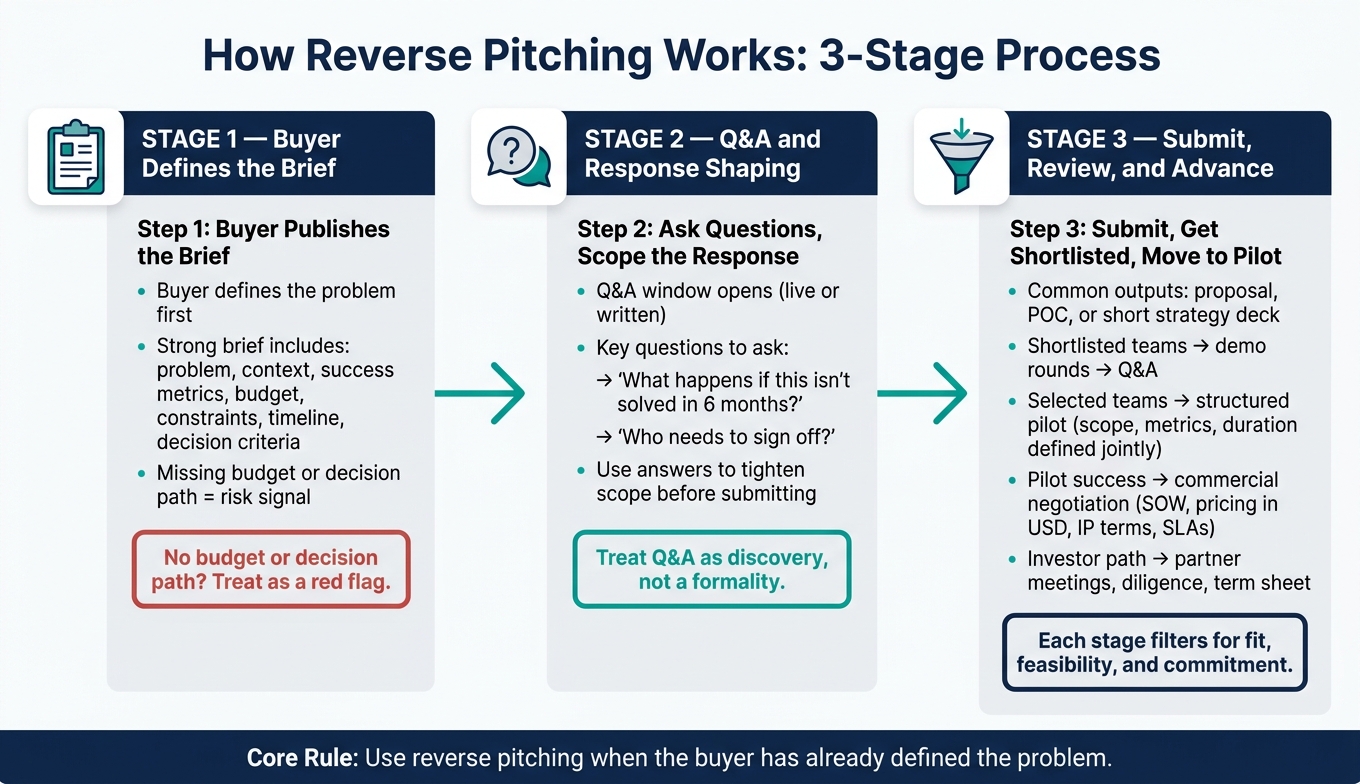
How Reverse Pitching Works: 3-Stage Process Explained
Once the brief is published, the process usually moves through three stages.
Step 1: The Buyer or Investor Defines the Brief
The buyer publishes a structured brief. Reverse pitching works because the buyer defines the problem first, and the respondent checks fit against that brief instead of guessing what the audience wants.
A strong brief covers the problem, context, success metrics, budget, constraints, timeline, and decision criteria. If a brief leaves out budget, measurable outcomes, or a clear decision path, treat that as a risk signal.
A sharper brief leads to better questions and a stronger response.
Step 2: Participants Ask Questions and Shape a Response
Once the brief is live, reverse pitch programs usually open a Q&A window, either through a live session or written submissions. This is where prepared teams can pull ahead, but only if they treat it like a discovery conversation, not a box to check.
Focus your questions on what matters most:
- "What happens if this problem isn't solved in six months?"
- "Who needs to sign off?"
Use the answers to scope your response. That step can save a lot of wasted effort. Instead of trying to cover everything, you can tighten the scope before you submit.
Step 3: Solutions Are Submitted, Reviewed, and Advanced
Common outputs are a proposal, a POC, or a short strategy deck. Sponsors are usually looking for proof that you understand the problem and can execute, not a finished product.
After submissions close, sponsors shortlist teams based on fit, feasibility, and alignment with their stated criteria. Shortlisted teams are invited to short demo rounds and Q&A. From there, a small number of teams move into a structured pilot, where scope, success metrics, and duration are defined jointly.
If the pilot goes well, the next step is commercial negotiation: statements of work, pricing in USD, IP terms, and service-level expectations. In investor-led reverse pitches, promising teams move to partner meetings, diligence, and term sheet discussions.
Each stage filters for fit, feasibility, and commitment.
sbb-itb-08dd11e
When Reverse Pitching Works Better Than a Standard Pitch
Reverse pitching works best when demand is unclear but the buyer can spell out the problem. In plain English: the brief already exists, and your job is to show fit. That's why it tends to work best with investor themes, brand briefs, and early validation work.
If fit matters more than broad reach, reverse pitching often gives you a better shot.
| Dimension | Standard Pitching | Reverse Pitching |
|---|---|---|
| Who defines the problem | Founder or agency | Buyer or investor |
| Validation strength | Low - based on assumptions | High - demand is explicit |
| Speed | Fast to start, slower to reach fit | Slower to start, faster to qualify |
| Flexibility | High - you control the message | Lower - constrained by brief and KPIs |
| Risk | High market risk (no one wants it) | Higher execution risk - you must meet the brief |
Those tradeoffs show up most clearly in three settings: investor themes, brand briefs, and early validation.
Situations Where Reverse Pitching Fits Best
Start with reverse pitching when the buyer already has a tight brief and you need fit, not broad reach.
The clearest example is investor thesis alignment. When a fund publishes a thesis or theme, founders can respond to a stated priority instead of sending a cold pitch. That changes the whole dynamic. You're no longer trying to guess what matters to the investor. You're speaking to something they already said they want.
For agencies, the parallel is a brand brief with fixed KPIs. If a brand sets the audience, budget, timeline, and KPIs upfront, the agency can respond against clear criteria. That usually makes the pitch sharper and easier to judge.
Reverse pitching also works well for demand validation. Before building a full product, founders can ask potential buyers to define their problems and desired outcomes. From there, they can test whether those buyers will commit to a pilot or sign an LOI before development starts. Only written LOIs, pilot contracts, or budget approvals should count as real demand signals.
Situations Where a Standard Pitch Is Still the Better Choice
Use a standard pitch when you need to create demand instead of replying to it.
A standard pitch still makes sense when the offer is already mature and proven. If you have a validated product and a clear ideal customer profile, the goal is reach and message control. Reverse pitching is narrow by nature. It depends on specific briefs, and those briefs won't cover your full market.
It's also the better choice when buyers don't yet recognize the problem. In new categories, buyers may not see the issue yet. If they don't understand the problem, reverse pitching is the wrong tool. In that case, you need to shape the story first. If you need reach and already know the message works, lead with a standard pitch.
Once you know the format fits, the next step is judging whether the brief is worth answering.
How to Evaluate and Respond to Reverse Pitch Opportunities
Once you know reverse pitching makes sense, there’s a second call to make: is this brief worth your time? That’s a different decision. And if you miss it, the cost adds up fast.
How to Judge Whether a Brief Is Worth Your Time
Use four simple checks to screen each brief: budget, decision access, timing, and repeatability. If any of those are fuzzy, treat the brief as weak. A vague budget or a murky approval path usually points to a shaky deal.
Scope mismatch is another problem. If the buyer wants enterprise-level work on a startup budget, the math just doesn’t work no matter how polished your response is.
Internal agreement matters too. This comes up a lot in B2B. A brief can look solid at first glance, but the buyer’s team may not even agree on the problem. If the person who sent the brief can’t explain who else needs to approve it, take that as a warning.
| Filter | What to Look For | Red Flag |
|---|---|---|
| Budget realism | Scope, timeline, and price are consistent | Vague phrases like "open to ideas" or no range given |
| Decision-maker access | Direct contact with buyer or internal champion | Brief routed through a coordinator with no authority |
| Timeline credibility | Deadline tied to a real event (launch, board review, etc.) | "Sometime this quarter" with no stated reason |
| Repeatability | Problem is common across many buyers | One-off request with little reuse potential |
How to Build a Stronger Response Using Research and Validation
If the brief clears your filter, move from screening to proof.
A strong reverse pitch response does two things:
- It mirrors the buyer’s language
- It shows the problem is real beyond this one buyer
Before you sink much time into the reply, validate the problem. Do a quick market-size check to confirm demand. Then see whether the buyer’s pain point shows up again and again across similar companies or segments. If it does, your response can speak to a pattern, not just a one-off issue.
From there, shape the response around the buyer’s own success metrics. If the brief is about speed, lead with turnaround time and low implementation friction. If it’s about reducing risk, put evidence and proof points front and center. The aim is to show fit fast, not to overwhelm them with pages of material.
Common Mistakes That Weaken Reverse Pitch Responses
Even a solid brief can fall apart if the response is generic, too big, or rushed.
The biggest mistake is sending a generic capability deck. That tells the buyer you read the brief, but didn’t take it in. In most cases, that ends the pitch on the spot.
Another common mistake is doing too much before you’re selected. Detailed specs, mockups, or full strategy docs before you’ve confirmed budget and decision access turn the process into unpaid work. Show enough to prove you get the problem. Don’t hand over the whole answer.
Then there’s the logo chase. A brief from a big-name brand or fund can look like a must-win deal. But if there’s no real internal sponsor, no clear decision path, or no believable route to close, it usually doesn’t deserve a big time investment. Prestige doesn’t fix bad economics.
Conclusion: A Simple Rule for Deciding When to Use Reverse Pitching
After you screen the brief, the choice comes down to one simple test: use reverse pitching when the buyer has already defined the problem, and use a standard pitch when you still need to define it for them. If the brief includes clear constraints, success metrics, and a real timeline, reverse pitching makes sense. If you’re still building awareness or persuading a market that the problem exists, start with a standard pitch.
For startups, agencies, and founders, that rule works across every use case in this article. Check the brief, check the economics, and check the decision path. Used this way, reverse pitching helps turn buyer-defined problems into clearer validation and stronger business opportunities.
FAQs
How is reverse pitching different from responding to an RFP?
An RFP is usually a reactive process. You respond to a buyer’s set requirements, often in a crowded field of applicants, and the goal is simple: meet the brief and win the contract.
Reverse pitching works differently. It’s more proactive and more selective. Instead of only replying to a list of requirements, you present your business as the opportunity. And just as important, you assess whether the investor or partner fits your goals, experience, and terms.
What should I do if a brief looks promising but leaves out the budget?
If a brief looks promising but leaves out the budget, don’t treat that as a red flag right away. Treat it as an opening for a clear, honest conversation.
Ask open-ended questions about what they want to achieve, what success looks like, and what the problem is costing the business today. That shifts the discussion away from a flat price tag and toward the outcome.
From there, focus on the value you bring and the results you can help create. When buyers get clearer on their needs, it becomes much easier for them to set a budget that lines up with the ROI you offer.
How can I tell if a reverse pitch opportunity is worth the time?
Check whether the investor fits your business stage, industry focus, and market know-how.
Then look a bit deeper. Review their recent deals, usual check sizes, pace, and what they bring besides money, like introductions, operating experience, or help from the portfolio team. It also helps to confirm the fund is still active and writing checks.
If those pieces don’t line up, it’s probably a bad fit and not worth spending time on.
Related Blog Posts
- Tailoring Pitches for Technical vs Non-Technical Audiences
- Why Investors Rejected My First Pitch But Funded My Second
- The "Reverse Pitch" Technique That Investors Can't Resist
- Tailoring Your Pitch for Technical vs Non-Technical Investors