If I were starting with one vending machine today, I’d plan for at least $2,000 to $5,000 up front. And if I wanted a smart or refrigerated unit, I’d expect the cost to jump to $8,000 to $15,000+.
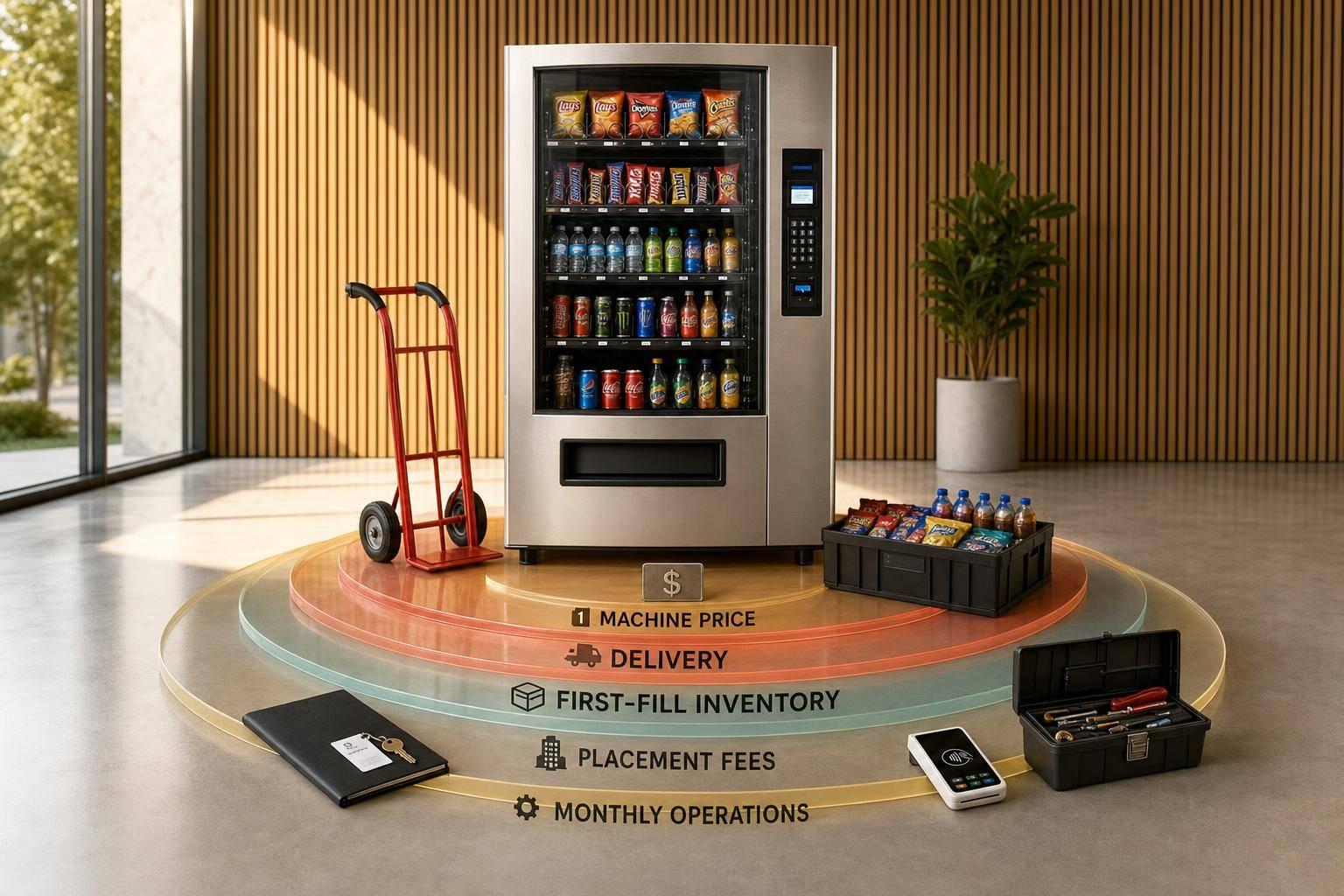
Here’s the short version: the machine is only part of the bill. I also need money for delivery, placement fees, card reader setup, first-fill inventory, permits, insurance, and a repair reserve. That’s why a machine that looks cheap at first can still turn into a bad buy.
Before I spend anything, I’d focus on four numbers:
- Machine cost: about $500 to $15,000
- Setup and delivery: about $850 to $2,800
- First-fill inventory: about $400 to $1,200+
- Monthly costs: often include electricity, card fees, commissions, fuel, and repairs
A few points stand out fast:
- A used machine cuts upfront cost but can bring more repair bills.
- A new or refurbished machine costs more on day one but may mean less downtime early on.
- Revenue share is often 10% to 25% of gross sales.
- Card processing can take 5% to 6% of card sales.
- Many operators keep $300 to $2,000 in extra cash per machine for the first 90 days.
| Cost Area | Typical Range |
|---|---|
| One-machine startup budget | $2,000 to $5,000 |
| Smart machine startup | $8,000 to $15,000+ |
| Freight and delivery | $400 to $1,200 |
| First-fill inventory | $400 to $1,200+ |
| Monthly repair reserve | $50 to $100 |
| Location commission | 10% to 25% of gross sales |
My takeaway: I wouldn’t judge a vending business by machine price alone. I’d look at the full cash needed to buy, place, stock, and keep the machine running before I decide if the deal makes sense.
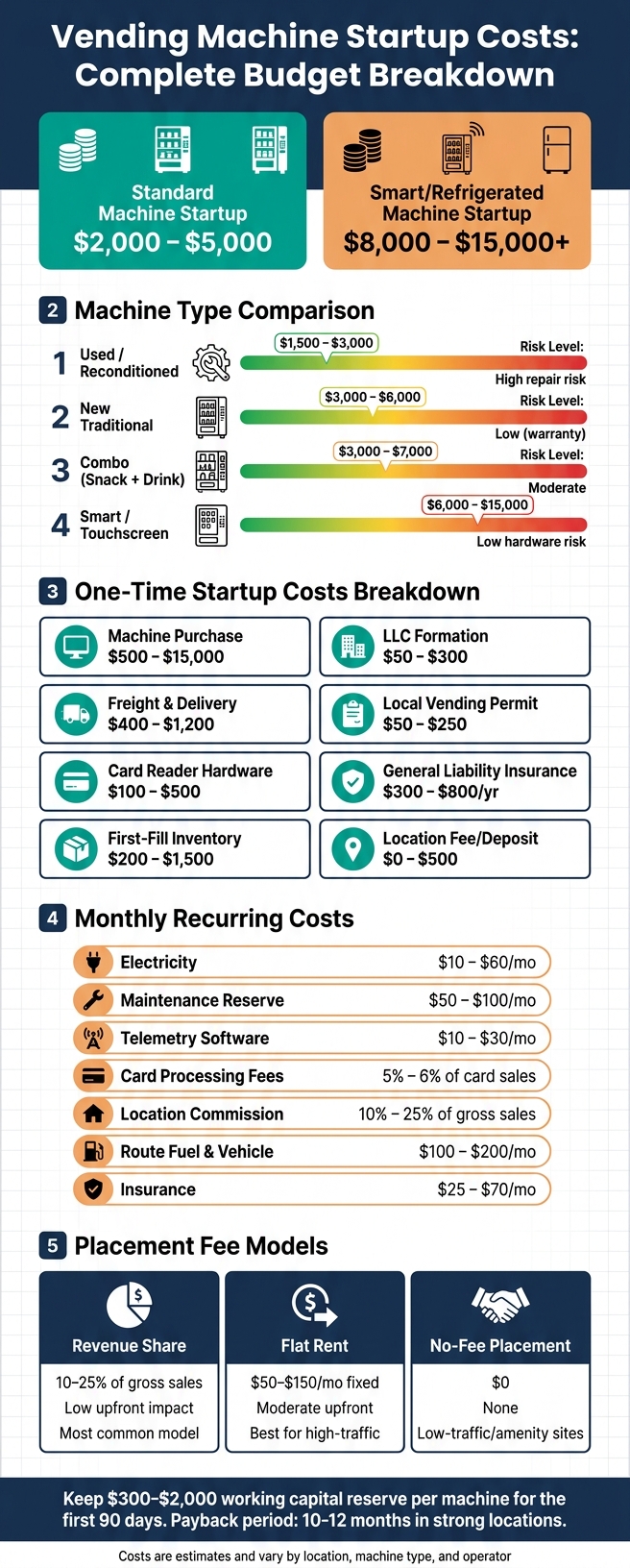
Vending Machine Startup Costs: Complete Budget Breakdown
Startup Cost Breakdown
Core startup costs by line item
Startup costs usually land in four main buckets: the machine itself, placement and setup, first-fill inventory, and the monthly costs of keeping the machine alive and earning.
That’s the part people often miss.
The price tag on the machine matters, sure. But the bigger picture is what it costs to place it, stock it, and keep it running at a profit.
Here’s what those line items usually look like:
| Expense | One-Time Cost | Recurring Cost |
|---|---|---|
| Machine purchase | $500 – $15,000 | $0 (or about $150/mo if leasing) |
| Freight and delivery | $400 – $1,200 | - |
| Card reader hardware | $100 – $500 | $10 – $30/mo + processing fees |
| First-fill inventory | $200 – $1,500 | $200 – $500/mo (restocking) |
| LLC formation | $50 – $300 | - |
| Local vending permit | $50 – $250 | Annual renewal |
| General liability insurance | $300 – $800/yr | Annual premium |
| Location fee, deposit, or revenue share | $0 – $500 | 10% – 25% of gross sales or fixed rent |
| Electricity | - | $10 – $50+/mo |
| Maintenance reserve | - | $50 – $100/mo |
Freight and delivery may also cover basic installation or placement labor. Once you map out those base costs, the next step is figuring out which machine type is worth the upfront spend.
How machine type changes the budget
Machine type can swing your budget by a lot.
Snack-only machines usually cost $2,000 to $5,000 new and use less electricity. Beverage machines usually run $3,000 to $6,000 because refrigeration adds to the price.
Combo machines sit in the $3,000 to $8,000 range. They also need more inventory up front since they carry both snacks and drinks, plus separate cooling zones.
Smart machines are the most expensive, usually $6,000 to $15,000. What you’re paying for is more than the box. These models add cashless payment, real-time inventory tracking, and remote monitoring, which can cut wasted service trips.
That price spread is why machine choice comes next.
sbb-itb-08dd11e
Vending Machine Purchase or Lease
Used vs. new vs. smart and combo machines
Your machine choice sets the floor for your upfront spend and says a lot about your repair risk.
Used machines are the cheapest way in. That can be a good move if you're testing a location and don't want to sink a lot of cash into an unproven spot. The catch is simple: repair bills can pile up fast, and those “cheap” savings can disappear before long.
Refurbished and new machines usually mean fewer early problems and less downtime. If you're placing a machine in a spot with steady foot traffic, that extra peace of mind often makes sense. And if you're running more than one machine, remote telemetry tends to pay off the most because it helps you track sales, stock levels, and service needs without constant site visits.
| Machine Type | Typical Price Range | Upfront Risk | Best Use Case |
|---|---|---|---|
| Used / Reconditioned | $1,500 – $3,000 | High repair risk | Testing new, unproven locations |
| New Traditional | $3,000 – $6,000 | Low, backed by warranty | Established locations with steady traffic |
| Combo (Snack + Drink) | $3,000 – $7,000 | Moderate | Small lobbies, apartments, laundromats |
| Smart / Touchscreen | $6,000 – $15,000 | Low hardware risk, higher capital | High-traffic hubs, large fleet operations |
Once you've picked the machine type, the next question is how you'll pay for it. That's what shapes how much cash you need on day one.
Lease and financing costs
Leasing or financing can make the upfront hit a lot easier to handle.
Leasing usually costs $100 to $300 per month per machine. You'll often pay more over time than if you bought the machine outright. Still, leasing can make sense if you want to test a location first instead of tying up cash right away.
Equipment financing often lands in the 6% to 15% range over 36 to 60 months. If you're buying several machines at once, SBA microloans may also be worth a look.
Buying outright costs the most at the start, but it usually gives you the lowest total ownership cost. You also end up with an asset you can resell later.
The next cost jump shows up when it's time to place the machine and stock it for launch.
Location Fees, Placement Costs, and Initial Stocking
Flat rent, revenue share, and no-fee placements
Once you've picked the machine, the next step is figuring out what it costs to place it somewhere people will use it. In most cases, operators use one of three placement models.
| Payment Model | How It Works | Upfront Cash Impact | When It Makes Sense |
|---|---|---|---|
| Revenue Share | Operator pays 10–25% of gross sales to the property owner | Low - paid from earnings, not upfront | Most common model; aligns both parties' interests |
| Flat Rent | Fixed monthly fee, typically $50–$150 | Moderate - owed even if sales are slow | High-traffic spots where a percentage cut would cost more |
| No-Fee Placement | No fee or commission paid | None | Low-traffic sites or locations that view the machine as an employee or resident amenity |
Revenue share is usually the easiest way to start because you only pay when money is coming in. Flat rent works better after you've confirmed that a location has strong volume. If not, you're stuck with a fixed bill while sales are still a question mark. Locations with a captive audience often do better than places that rely on casual walk-by traffic.
Once the machine is in place, the next big cash hit is the first inventory load.
Placement setup costs before the machine goes live
Getting a machine installed can add a lot to your upfront spend.
Freight shipping usually costs $400–$1,200 for domestic delivery. If the site doesn't have a loading dock, liftgate service adds another $75–$150. If you need inside placement, white-glove delivery runs $150–$400. You should also set aside $200–$800 for electrical checks and professional leveling to help prevent coin jams and keep the machine safe to use. Local vending permits usually cost $50 to $250 per machine per year, depending on the city and state.
All in, pre-launch setup can add $850–$2,800 before you make your first sale.
First-fill inventory for snacks, drinks, and combo machines
For a standard snack, drink, or combo machine, the first fill usually costs $400–$1,200. If you stock premium products, that number can go above $1,500.
For your first round of products, keep it simple. Stick with proven name-brand basics like chips, candy, water, and soda. Save the niche items for later, after you've looked at 30–60 days of sales data.
After launch, plan to hold a $300–$2,000 working capital reserve per machine to cover the first 90 days while you fine-tune the product mix. Monthly restocking usually runs $200–$600 per machine, so that reserve gives you breathing room while sales settle in. After launch, maintenance, repairs, and payment fees become the next recurring costs.
Maintenance, Monthly Operating Costs, and Conclusion
Recurring costs that matter most after launch
Once your machine is stocked and running, the monthly costs start to tell the full story. The first fill becomes regular restocking, and any placement fee can turn into a steady monthly expense.
The main recurring costs are:
- Insurance: $25–$70/month
- Telemetry software: $10–$30/month per machine
- Card processing fees: 5%–6% of gross card sales
- Location commissions: 10%–25% of gross revenue at busy locations
- Electricity for refrigerated units: $25–$60/month
- Route fuel and vehicle costs: $100–$200/month
- Repair reserve: $50–$100 per machine per month for compressor failures or board replacements
For most operators, profit doesn’t show up right away. First, the machine has to cover fees, fuel, and repairs. In stronger locations, machines often pay back startup costs in 10 to 12 months. Slower spots usually need more time.
Final takeaway: estimate your capital before you buy
That’s why you need to look at upfront cost and monthly burn at the same time. A first machine can fall anywhere in the $2,000–$10,000+ startup range, depending on the machine, delivery, inventory, and placement terms. Refurbished machines usually keep the upfront cost lower. Smart machines and premium inventory can push it up.
Before you pick up a second or third machine, run the numbers on both your startup cash and your monthly costs. A machine can post decent sales and still be a poor buy if commissions, processing fees, fuel, and repair bills eat up too much of the money.
The Real Startup Cost of a Vending Machine Business (No BS Breakdown)
FAQs
How much cash should I keep in reserve?
Keep a separate cash reserve on top of your startup budget. That extra cushion helps protect cash flow and keeps day-to-day operations steady when things don’t go as planned.
Many operators recommend setting aside at least $5,000 for surprise costs, like emergency repairs, maintenance, or sales that start slower than expected.
A good rule of thumb is to build in at least three months of working capital as part of your total capital needs. That money can cover things like restocking, insurance, and commissions.
Should I buy a used or new vending machine?
It comes down to your budget and how much upkeep you're willing to deal with.
Used machines usually run $1,500 to $3,500. They cost less up front, but they may need more repairs and often don't come with a warranty.
New machines usually cost $3,000 to $10,000+. You pay more, but you also get better reliability, newer features, and a manufacturer's warranty.
A lot of operators look at refurbished machines as the middle option.
One thing matters no matter which route you pick: lock down a location before you buy the equipment.
What makes a vending location profitable?
Profitability mostly comes down to high foot traffic and a captive audience.
The best spots are places where people hang around for a while and don’t have many other food or drink choices close by. Think offices, hospitals, gyms, apartment complexes, transit hubs, and manufacturing facilities with shift workers.
In plain terms, location can make or break a machine’s performance. A busy, well-placed machine often does far better than one in a weak spot.
It also helps to match the product mix to the location. A gym might do better with water and protein bars, while an office may move more coffee, soda, and snacks. That kind of fit can help keep sales steady and cut down on spoilage.
Related Blog Posts
- How To Work Out Start-Up Costs: A Step-by-Step Guide
- Hidden Costs That Kill New Businesses
- Vending Machine Business: Locations, Stocking, Margins (2025)
- Coffee Cart: Licences, Locations, Margins