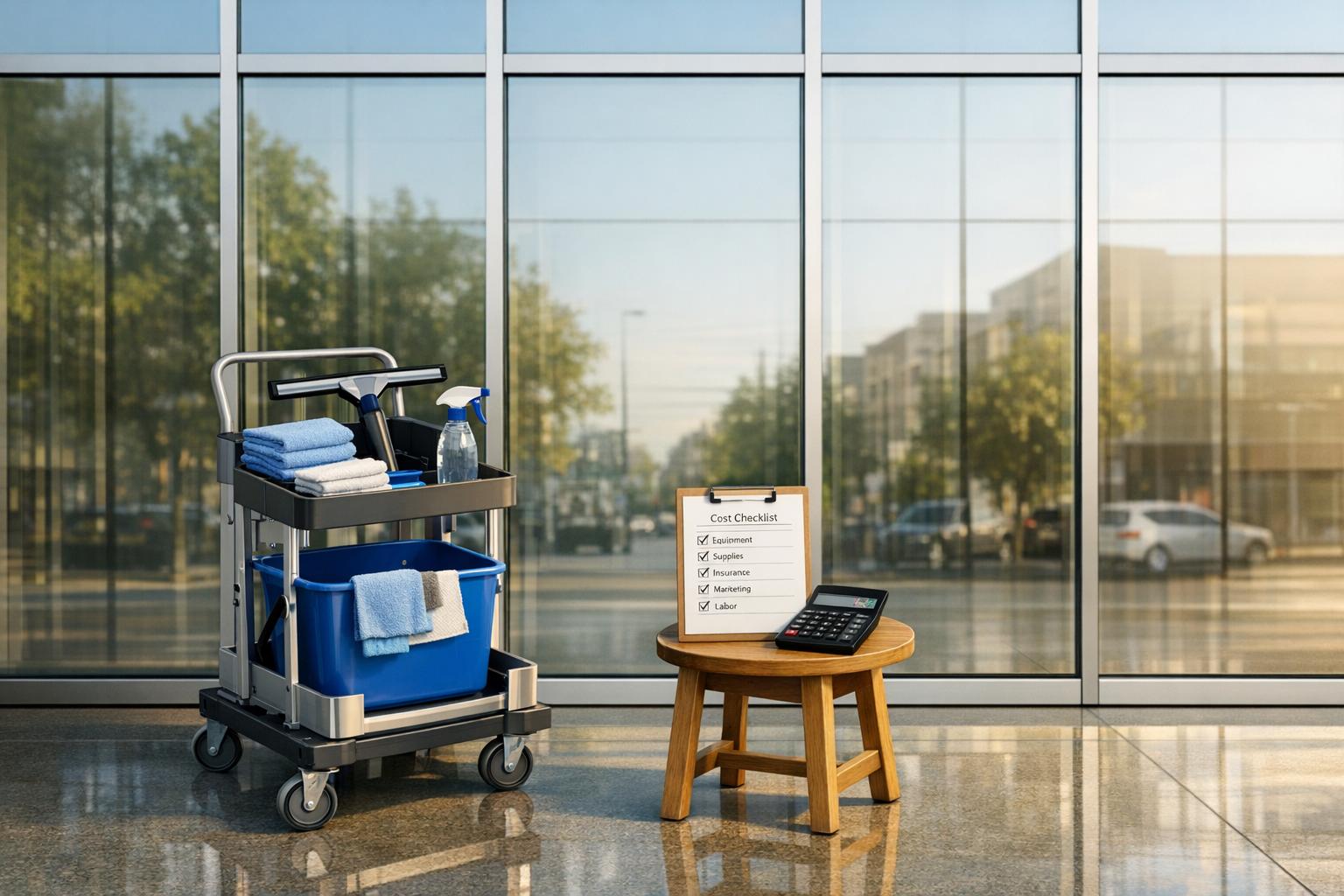
Starting a window cleaning business can cost as little as $1,700 or go beyond $18,000, depending on your setup. A basic residential kit starts at $300–$1,000, while a professional Water Fed Pole system can add up to $5,000. Other key expenses include insurance ($500–$3,000/year), permits ($25–$150/year), and a vehicle if needed ($3,000–$8,000). Marketing costs range from $200 to $1,500 initially.
For pricing, aim for 40–60% net profit margins by understanding your costs and using formulas like:
(Labor + Materials + Overhead) × (1 + Profit Margin).
Charge $4–$8 per pane for residential jobs, with extras like hard water stain removal adding $10–$30 per pane. Set a minimum trip fee of $75–$150 to cover smaller jobs.
Key Takeaways:
- Recurring revenue is crucial: Offer discounts (10–20%) for quarterly or semi-annual cleanings.
- Break-even point: Most startups achieve this within 3–12 months.
- Route density and rebooking rates (70–80%) are critical for profitability.
With proper planning and pricing, solo operators can earn $40,000–$100,000 annually. Focus on efficiency, repeat clients, and clear pricing strategies to succeed in this $10 billion industry.
The Cheapest Way to Start a Window Cleaning Business
sbb-itb-08dd11e
Startup Costs for a Window Cleaning Business
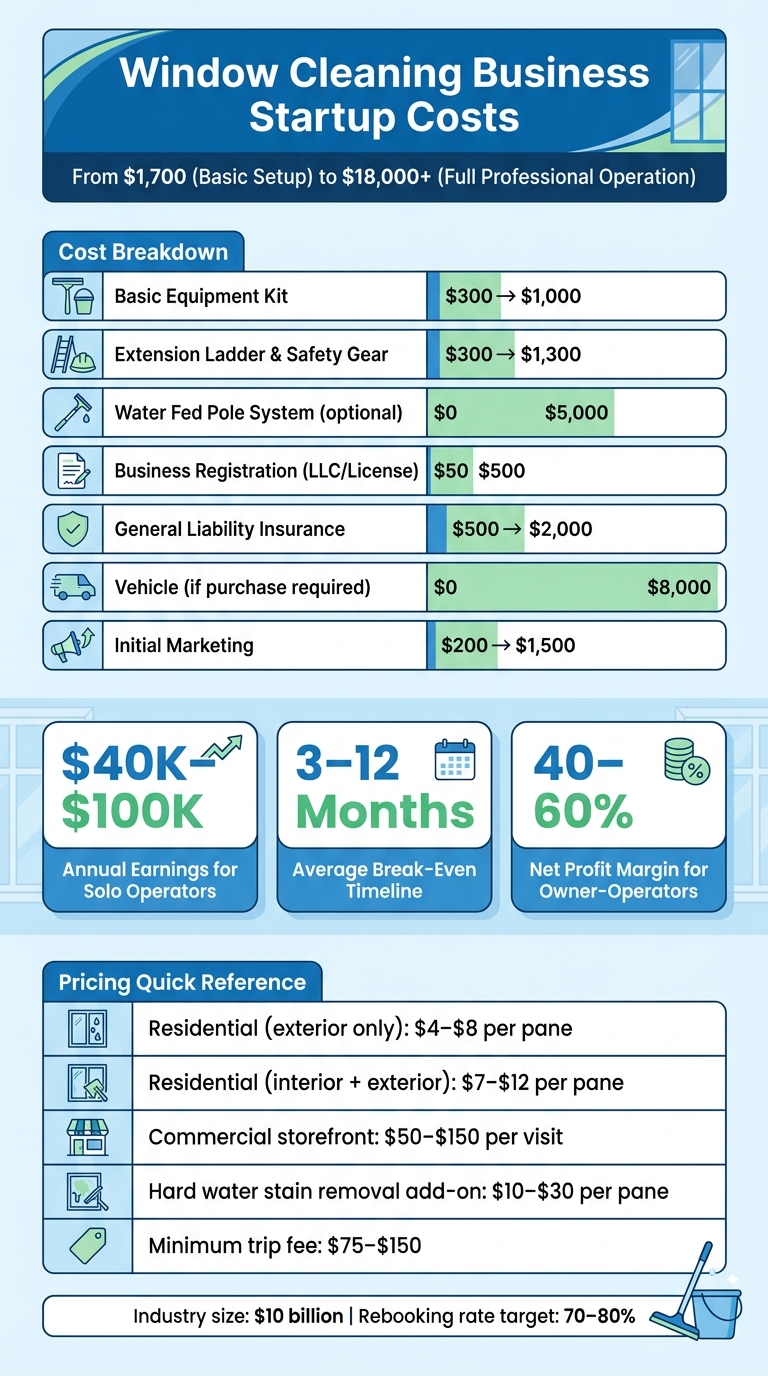
Window Cleaning Business Startup Costs at a Glance
Starting a window cleaning business involves initial costs ranging from $1,700 to over $18,000. Here's a look at the major expenses you should plan for.
Equipment and Tools
Getting the right tools is a must. A basic setup for residential cleaning - like squeegees, scrubbers, buckets, and towels - will typically cost between $300 and $1,000. Adding an extension ladder and safety gear brings the total to $500–$1,500 for a basic residential kit.
If you’re planning to handle larger jobs, investing in a Water Fed Pole (WFP) system can be a game-changer. These systems, available from brands like Tucker, Xero, and Gardiner, range from $400 to $5,000. They allow you to clean windows up to 4–6 stories high from the ground, saving time and effort. For long-term reliability, stick with professional-grade tools from brands like Ettore, Unger, or Moerman.
"Window cleaning is a route-based recurring-service business wearing the costume of a simple trade." - Pulse RevOps
Licensing, Permits, and Legal Setup
For most residential window cleaners, a general business license is all you need. Costs for this range from $25 to $150 per year, depending on your location. Setting up an LLC is a common choice for protecting personal assets, with state filing fees between $50 and $500. For example, in California, forming an LLC costs around $70, plus an $800 annual franchise tax.
If you plan to hire employees or open a business bank account, you’ll need a free EIN from the IRS. In states like Texas or Washington, where cleaning services are taxable, you’ll also need to register for a sales tax permit. For specialized work, such as high-rise cleaning, additional licenses like California’s C-61/D-28 contractor license may be necessary.
Once these legal steps are completed, securing insurance is a critical next step.
Insurance and Liability Coverage
Insurance is essential to protect your business. General liability insurance for residential work typically costs $500 to $800 per year, while commercial or high-rise jobs may require coverage between $1,500 and $3,000 annually. Keep in mind that many policies have height exclusions (usually 15 to 25 feet), so ensure your policy covers the heights you’ll be working at.
"General liability insurance that explicitly covers window cleaning work (including height limits) is essential - broken windows and property damage claims are common." - StartPermit
If you hire employees, workers' compensation insurance is mandatory in most states and costs between $2,000 and $6,000 per employee annually. Additionally, many commercial clients require a surety bond, which costs around $100–$300 per year.
Transportation Costs
A reliable vehicle is crucial for transporting your tools and equipment. If you don’t already own one, buying a used van or truck can cost $3,000 to $8,000. Don’t forget to add commercial auto insurance, which typically runs $1,200–$2,500 per vehicle annually. To maximize exposure, consider adding vehicle signage for around $500–$1,500, turning your vehicle into a mobile advertisement.
Initial Marketing Expenses
Attracting your first customers doesn’t have to break the bank. Setting up a basic website, creating a social media presence, and printing materials like business cards or door hangers can cost between $200 and $1,500. If you want to grow faster, you can invest in paid advertising on platforms like Google Local Services or Facebook, which might push your initial marketing budget to $5,000. Building credibility early on is key, so aim to gather at least 12 authentic online reviews to attract more clients.
| Startup Cost Item | Low Estimate | High Estimate |
|---|---|---|
| Basic Equipment Kit | $300 | $1,000 |
| Extension Ladder & Safety Gear | $300 | $1,300 |
| Water Fed Pole System (optional) | $0 | $5,000 |
| Business Registration (LLC/License) | $50 | $500 |
| Insurance (General Liability) | $500 | $2,000 |
| Vehicle (if purchase required)* | $0 | $8,000 |
| Initial Marketing | $200 | $1,500 |
| Total Estimated Cost | $1,700 | Over $18,000 |
*If you already own a suitable vehicle, you may not incur this cost.
Building a Pricing Strategy
Once you’ve nailed down your startup costs, the next step is creating a pricing strategy that ensures profitability while staying competitive in your market. A well-thought-out pricing plan not only helps you stay ahead locally but also guarantees that every job contributes positively to your bottom line.
Key Factors That Affect Your Prices
To calculate your prices, consider labor, materials, overhead, and your desired profit margin. A simple formula to use is:
Total Price = (Labor + Materials + Overhead) × (1 + Profit Margin)
For instance, if labor and materials cost $80, and overhead adds another $20 (totaling $100), applying a 30% profit margin would mean charging $130. Successful window cleaning businesses often aim for a net profit margin of 20–35%, while solo operators can sometimes achieve margins as high as 40–60%.
However, pricing isn’t one-size-fits-all. Adjust your rates based on job specifics. For example:
- Add $3–$5 per window for second-story work.
- Charge $5–$10 extra for higher stories.
- Include an additional $2–$4 per pane for challenges like hard water stains or paint overspray.
It’s also wise to set a minimum trip charge, typically between $75 and $150, to cover travel and administrative expenses.
Your local cost of living plays a role, too. For example, rates in high-cost areas like New Jersey tend to be about 15% higher than the national average. Research local market rates to ensure your pricing aligns with what customers are willing to pay.
Once you’ve factored in these costs, choose a pricing model that suits the nature of each job.
Pricing Models for Different Job Types
Different jobs call for different pricing structures. Here’s a breakdown of the most common models and when to use them:
| Pricing Model | Pros | Cons | Best For |
|---|---|---|---|
| Per Pane/Window | Predictable for clients; rewards efficiency | Requires precise counting; may undercharge for tough jobs | Residential & storefront jobs |
| Hourly Rate | Covers unexpected issues or heavy debris | Penalizes fast work; clients may worry about slow progress | Post-construction or deep cleans |
| Flat Fee | Simple for clients to understand | Risk of underestimating the number of windows | Standardized housing tracts |
| Square Footage | Ideal for large commercial bids | Doesn’t account for window density or accessibility | Large office buildings, commercial sites |
For residential jobs, per-pane pricing is common. For example, a French door with 12 panes is priced differently than a standard double-hung window with two panes. Residential rates typically range from $4–$8 per pane for exterior cleaning and $7–$12 per pane for both interior and exterior cleaning.
"Pricing is where most new window cleaners undercharge themselves out of a sustainable business... Count panes, not windows." - Justin Orloff, Founder, Orloffs
For commercial storefronts, you might charge $1–$5 per window or $50–$150 per visit. Larger office buildings are often priced at $0.50–$2.50 per square foot. Post-construction cleaning, which involves tasks like removing adhesive residue or paint, commands higher rates, typically $8–$15 per pane.
You can also increase your revenue with add-on services. These extras are easy to offer during the initial quote and often include:
- Screen cleaning: $2–$8 per screen
- Track cleaning: $2–$4 per track
- Hard water stain removal: $10–$30 per pane
Adjusting Prices to Stay Competitive
Once you’ve established your pricing, it’s important to periodically review and adjust it based on your success rate and market conditions.
"If you are winning 100% of your bids, you are probably priced too low. If you are losing most bids, you may be too high." - Jeel Patel, CEO, FieldCamp
A good benchmark is winning about 50–70% of your bids. This ensures you’re getting enough work without undervaluing your services. Review your rates at least once a year, and when raising prices for existing clients, give them 30 days’ notice and keep increases modest - usually between 5–10%.
Seasonal demand also affects pricing. Spring and Fall are typically the busiest times, allowing you to charge full rates. During slower months (Winter and Summer), consider offering bundled packages or small discounts to keep your schedule filled. A 10–20% discount for recurring service agreements - whether monthly, quarterly, or bi-annually - can help create steady, predictable income while fostering long-term client relationships.
Budgeting and Break-Even Analysis
Once you've set your pricing strategy, the next step is making sure the numbers add up before you start spending real money. A basic budget and break-even analysis can help you avoid one of the most common pitfalls for new business owners: underestimating costs while overestimating early revenue.
Monthly Operating Budget
Start by dividing your expenses into two categories: fixed costs and variable costs. Fixed costs include things like insurance, vehicle payments, and software subscriptions - expenses that stay the same no matter how many jobs you take on. Variable costs, on the other hand, fluctuate with your workload and include items like fuel, cleaning supplies, and labor if you hire help.
Here’s an example of what a monthly budget might look like:
| Expense Category | Solo Operator | Small Team (2 Crews) |
|---|---|---|
| Supplies/Materials | $50–$100 | $100–$250 |
| Vehicle (Fuel/Maintenance) | $200–$400 | $400–$800 |
| Insurance | $80–$150 | $200–$400 |
| Marketing | $50–$200 | $150–$400 |
| Labor/Payroll | $0 | $3,000–$6,000 |
| Software/Phone | $30–$80 | $80–$150 |
| Total Monthly Estimate | $410–$930 | $3,930–$8,000 |
Supplies typically only account for about 2%–5% of your revenue, so the biggest factor in your budget will be whether or not you're paying employees. Once you’ve outlined your costs, you can calculate how much revenue you’ll need to cover them.
Estimating Revenue and Job Volume
To figure out your revenue goals, start with your monthly costs. A solo operator can typically generate $750 to $1,500 in gross revenue per day, assuming their schedule is full and jobs are clustered geographically to minimize travel time. Route density plays a huge role in profitability, so it’s crucial to group jobs as closely together as possible.
Rebooking rates also have a big impact on revenue stability. Residential clients generally rebook 2 to 4 times per year, and the industry average for repeat customers sits around 70% to 80%. This makes monthly income more predictable over time.
"The difference between a window cleaning company that does $80,000/year and one that does $300,000/year is rebooking rate." - Pipeline On
By understanding your revenue potential and job volume, you’ll have a clearer picture of what it takes to reach your break-even point.
Break-Even Analysis
A break-even analysis helps ensure your pricing strategy is sustainable. It calculates the number of jobs you need to complete each month to cover your costs before you start turning a profit. The formula is:
Break-Even Point = Total Fixed Costs ÷ (Average Revenue Per Job − Variable Cost Per Job)
For example, let’s say your annual fixed costs are $20,000, your average revenue per job is $100, and your variable costs per job are $20. That leaves you with a contribution margin of $80 per job. Dividing $20,000 by $80 shows you’ll need 250 jobs per year (or about 21 jobs per month) to break even.
Most window cleaning startups reach their break-even point within 3 to 12 months. Solo operators who focus on building dense routes and securing repeat customers often hit this milestone sooner. Once you’re past break-even, earning $40,000–$80,000 annually is achievable for a solo operator, with high-efficiency operators even surpassing $100,000.
Conclusion and Key Takeaways
Starting a window cleaning business is one of the easier ways to step into self-employment, but success hinges on nailing the basics from the very beginning. Startup costs can vary widely - from a simple residential setup to a fully outfitted professional operation. The key is understanding where your business fits on that spectrum and planning your budget accordingly. This foresight often separates businesses that thrive from those that struggle to make it past the first year.
Pricing is just as important as managing startup costs. To stay profitable, you need a pricing structure that works for your business. Charging per window or pane rather than by the hour encourages efficiency as you gain experience. A minimum job fee - typically between $75 and $150 - helps ensure that even smaller jobs cover your costs and time. As FieldCamp CEO Jeel Patel points out, knowing your expenses and using clear pricing formulas is critical.
If you want to scale quickly, locking in recurring revenue is a must. Offering discounts of 10–15% for customers who commit to quarterly or semi-annual cleanings can turn one-time clients into dependable sources of income. This approach strengthens your cash flow and reinforces the budgeting strategies discussed earlier.
To hit the ground running, claim your Google Business Profile as soon as possible. Just five strong reviews can significantly boost your visibility and attract new clients. Also, double-check that your general liability insurance covers work at heights - especially for standard two-story homes - so you’re not left exposed. When it comes to hiring, wait until your schedule is consistently booked out three weeks or more before bringing on your first employee.
The U.S. window cleaning industry generates over $10 billion annually, with profit margins ranging from 40% to 60% for owner-operators. By focusing on smart budgeting, effective pricing, and building recurring revenue streams, you can set a strong foundation for long-term success in this high-margin industry. Mastering these essentials will give your business the best chance to thrive.
FAQs
Do I really need an LLC to start?
Starting a window cleaning business doesn’t legally require forming an LLC, but it’s a smart move to consider. Running your business as a sole proprietorship means your personal assets could be at risk if there are any business-related liabilities. An LLC, on the other hand, helps shield your personal property and gives you more options when it comes to taxes. The cost to set up an LLC depends on your state, usually falling between $50 and $500.
What insurance coverage do I need for two-story homes?
When cleaning windows on two-story homes, it's crucial to have general liability insurance that covers work at heights. Many standard policies exclude ladder work on second-story windows, so make sure your coverage is specifically tailored for window cleaning or janitorial services without height restrictions. Talk to your insurer to confirm that your activities are covered, ensuring protection against risks like ladder falls or property damage.
How do I quickly estimate panes during a quote?
When estimating panes, the simplest method is to count each piece of glass as one pane. Then, multiply the total number of panes by your set rate per pane.
For instance:
- A double-hung window counts as two panes.
- A picture window with six dividers counts as six panes.
Make sure to clearly define your pricing structure to avoid misunderstandings, especially for more complex setups like French doors or bay windows.
To increase your earnings, consider offering additional services like cleaning screens, tracks, and sills as part of your package. These extras can add value while boosting your revenue.
Related Blog Posts
- How to Start a Pressure Washing Business With Under $1,000
- Pressure Washing Startup Costs: Gear, Licences, ROI
- How to Start a Pressure Washing Business for Under $1,000
- Window Cleaning Business: 2025 Guide