
The "Offer Before Operations" strategy flips the script on product development. Instead of building first and hoping for buyers, it suggests selling the product before creating it. This approach, often called pre-selling, helps validate demand, reduce financial risk, and gather customer feedback early.
Key Takeaways:
- Why it works: 42% of business failures stem from no market need. Pre-selling ensures real demand before investing resources.
- How it works: Offer a beta, pre-order, or early-bird deal to gauge interest and refine your product based on feedback.
- Benefits: Reduces risk, improves product-market fit, and provides insights into pricing and features.
- Tools to help: Platforms like IdeaFloat streamline validation with tools for pricing, audience insights, and financial projections.
This strategy isn’t for every product - like those needing heavy upfront investment or in regulated industries - but it’s ideal for digital products, services, SaaS, and pre-orderable physical goods. If done right, it saves time, money, and effort while ensuring you’re building something people actually want.
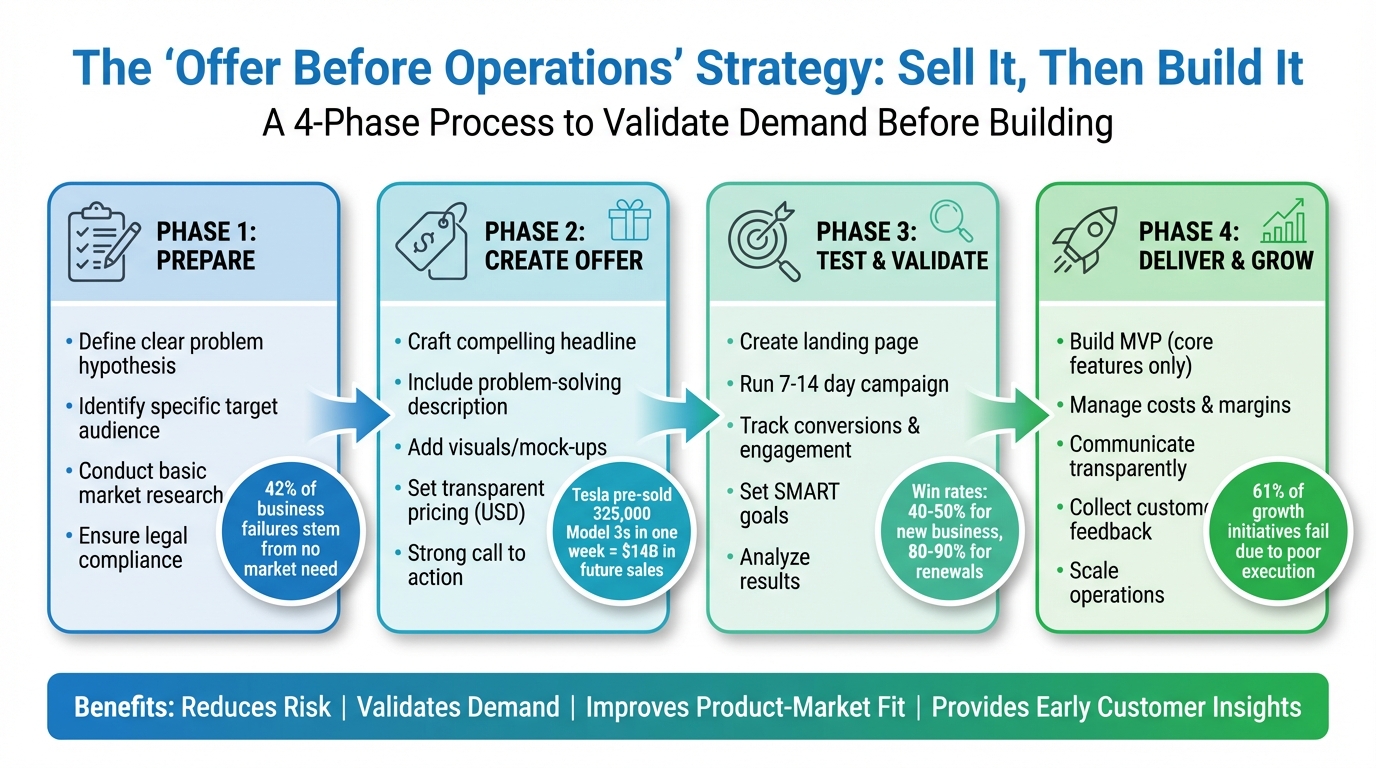
Offer Before Operations Strategy: 4-Phase Implementation Process
How To Make Money BEFORE Building Your Product!
What You Need Before Pre-Selling
Pre-selling isn’t something you can dive into without preparation - it requires a clear plan and the right conditions to succeed. You don’t need a finished product or a massive budget, but you do need a solid understanding of your idea, your audience, and the legal safeguards that protect both you and your customers.
When This Strategy Works
Pre-selling shines when you’re addressing a clear problem that people are eager to pay to solve. It’s particularly effective for:
- Digital products like online courses, e-books, or templates
- Service-based businesses such as consulting, coaching, or design work
- SaaS platforms that can launch with a limited feature set
- Physical goods offered as pre-orders with defined delivery timelines
The magic of pre-selling lies in reducing risk for everyone involved. Customers get to validate that your solution meets their needs, while you confirm there’s real demand before pouring significant resources into development. Research shows that companies with strong pre-sales processes often achieve win rates of 40–50% for new business and 80–90% for renewals.
However, this strategy isn’t a one-size-fits-all solution. It’s less effective for products requiring heavy upfront investment (like manufacturing equipment), those in tightly regulated industries, or ideas that solve vague or poorly defined problems. If potential customers can’t quickly grasp the issue you’re addressing, securing their commitment becomes much harder.
Once you’ve determined that pre-selling is a good fit, focus on preparing the essentials to set yourself up for success.
What to Prepare Before Pre-Selling
Before you start asking customers for payment, make sure you’ve nailed down three critical elements: a clear problem hypothesis, a deep understanding of your target audience, and basic market research. These aren’t optional - they’re the foundation of a successful pre-sale.
Start by defining the problem you’re solving. Who experiences it, and what’s the cost in terms of time, money, or frustration? Why aren’t current solutions cutting it? Tools like IdeaFloat’s Problem Validator can help you confirm whether your idea addresses a genuine need.
Next, zero in on your audience. Don’t settle for broad categories like "small business owners." Get specific. For example: "solo marketing consultants earning $75,000–$150,000 annually who struggle with creating client proposals." Dive into online forums or social media to see how your potential customers talk about their pain points.
Finally, conduct some basic market research. You don’t need an exhaustive report, but you should know who your competitors are, what they charge, and where the gaps are. For example, if the average time between a demo request and delivery is six days, you’ll know that speed could be a competitive advantage. Having this information on hand also helps you set pricing that makes sense.
Once you’ve nailed down these essentials, it’s time to ensure your pre-sale complies with legal and ethical standards.
Legal and Ethical Requirements
In the United States, pre-selling comes with specific legal and ethical responsibilities. Both you and your customers must be able to fulfill your obligations, and the agreement must be lawful.
Transparency is key. Federal consumer protection laws prohibit misleading practices. If you’re promoting features that aren’t built yet, clearly label them as “proposed” or provide a timeline for when they’ll be completed. If you’re offering lower pre-sale prices, make sure you have concrete development plans and a reasonable ability to deliver. Avoid using fine print or asterisks to contradict earlier claims or hide crucial details.
Your refund and cancellation policies need to be straightforward. If you promise a “guaranteed refund,” it must be unconditional. Customers should know exactly what happens if there are delays or if the final product differs from what was initially described. Be upfront about possible changes - whether it’s design, materials, or features - between the pre-sale and delivery.
To protect customer funds, keep deposits in a separate account so they can be refunded if necessary. Always present pricing in proper USD format, like $49.99 or $1,250.00, to avoid confusion. For larger pre-sale campaigns, consider using written contracts. These provide clarity and protect both parties’ interests.
How to Create a Pre-Sale Offer
Your pre-sale offer is more than just a sales pitch - it's a way to test the waters and confirm market interest. A well-crafted offer clearly communicates value and is thoughtfully structured to resonate with potential buyers.
What to Include in Your Offer
Focus on what your customers want to achieve, not just the features of your product. For example, instead of emphasizing that your software has a dashboard with widgets, highlight how it saves time or solves a specific problem. Frame your offer around the transformation it delivers.
Your offer should include these five key elements:
- A compelling headline that instantly conveys the benefit.
- A clear problem-solving description that explains how your product addresses their needs.
- Visuals or mock-ups to help customers picture the product.
- Transparent pricing information to set expectations.
- A strong call to action that encourages immediate engagement.
Tesla serves as a prime example of this strategy. Before even unveiling the Model 3, they pre-sold over 325,000 vehicles in just one week, generating around $14 billion in future sales.
When choosing your format, think about your product's stage. A beta program is ideal if you need feedback to refine your product, while a pre-order works better when your concept is already well-defined. Beta programs often offer discounted pricing in exchange for early feedback and a willingness to tolerate imperfections. Pre-orders, on the other hand, should include clear delivery timelines, formatted in the U.S. style (e.g., 06/15/2026).
Be upfront about what's ready and what’s still in development. If you’re showcasing features that aren’t built yet, label them as “planned” or “proposed for Q2 2026.” Transparency not only builds trust but also sets realistic expectations with your early customers.
Pricing and Timing for U.S. Customers
Pre-sale pricing should strike a balance between rewarding early adopters for their risk and covering your costs. Offer discounts compared to your planned retail price, and clearly display all amounts in USD. For instance:
- $49.99 for consumer products
- $1,250.00 for business services
- $15,000.00 for enterprise solutions
Create a sense of urgency, but keep it genuine. Limited spots or time-sensitive offers work because they reflect real constraints. Be specific, like stating, “Only 50 founding member spots available” or “Early bird pricing ends 03/31/2026 at 11:59 PM EST.”
Testing tiered pricing can also provide valuable insights. Offer a basic option, a premium package, and a VIP tier with extra perks like personalized onboarding. This approach not only helps you gauge demand at different price points but also reveals what features customers value most.
Finally, consider using AI tools to fine-tune your offer and pricing strategy.
Using IdeaFloat to Improve Your Offer
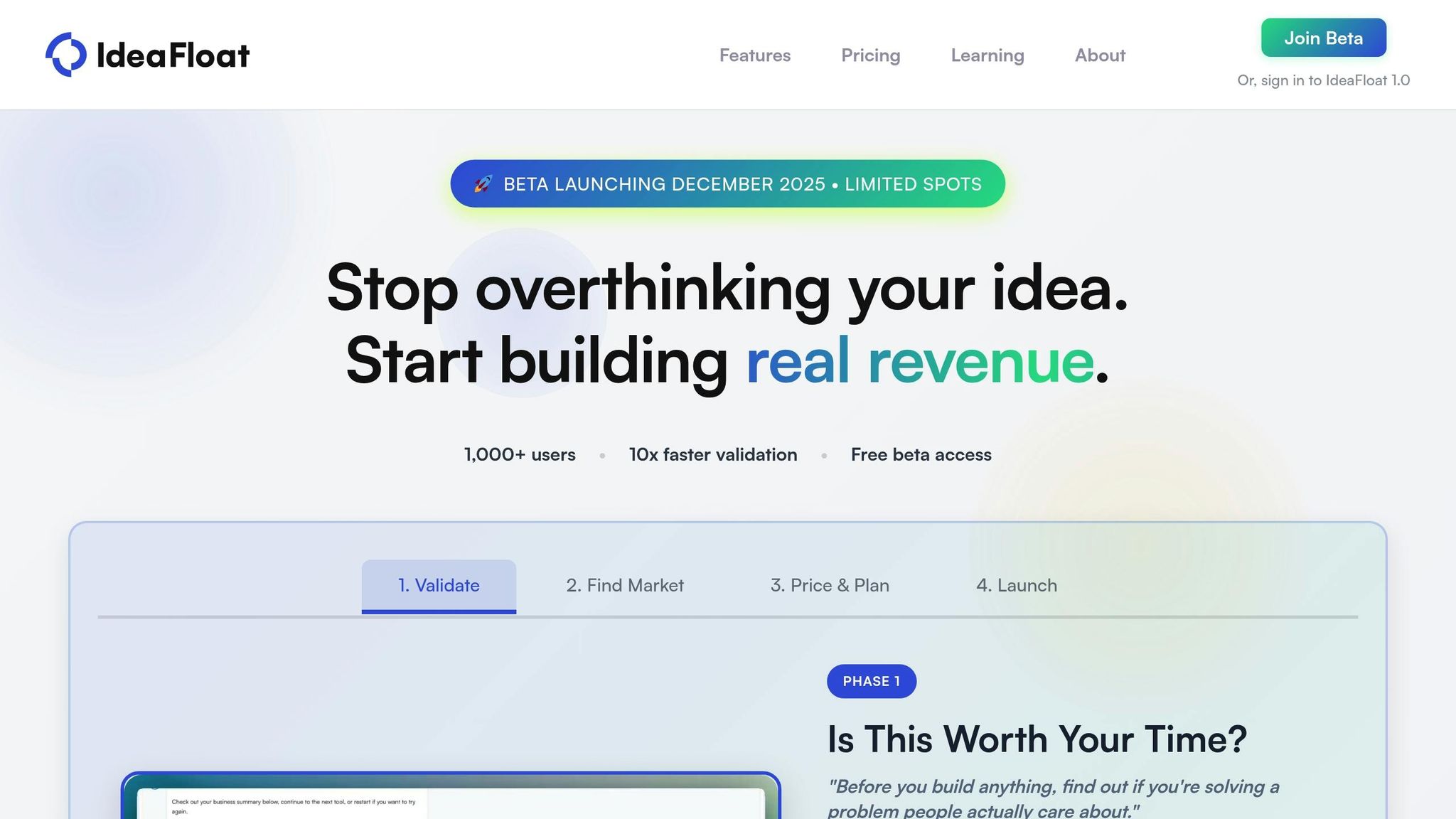
IdeaFloat offers tools to sharpen your messaging and pricing. The Unique Value Proposition tool helps you craft a pitch that resonates, providing a complete framework with a one-liner, brand positioning, and language designed to convert prospects into buyers.
For pricing, the Advanced Pricing Research tool eliminates guesswork. It analyzes competitor pricing, market trends, and your profit margins to recommend optimal pricing strategies. As IdeaFloat explains:
What competitors charge, what customers actually pay, what your margins need to be. Science, not hope.
Before finalizing your offer, use the Problem Validator to confirm that your product addresses a meaningful issue people are willing to pay for. Remember, 80% of new products fail due to poor validation. The Consumer Insights tool goes a step further, analyzing real customer conversations online to uncover the exact words your audience uses when discussing their challenges. Incorporate this language into your offer to build trust and create a sense of connection.
How to Test Your Pre-Sale Offer
Testing your pre-sale offer isn’t about achieving perfection - it’s about learning quickly. You’ve already put in the effort to craft your offer and set your pricing. Now comes the moment of truth: seeing if real people are willing to commit. This phase is all about validating the offer you’ve worked hard to create.
Steps to Validate Your Offer
First, create a landing page that highlights your offer. Keep it simple but impactful. Include a compelling headline, a clear explanation of the problem your product solves, engaging visuals, pricing in USD, and a strong call to action. This call to action should encourage visitors to either provide their email or place a pre-order deposit.
Next, identify where your target audience spends time online. Focus on two or three platforms where they’re most active - this could be LinkedIn groups, Reddit communities, Facebook pages, or niche forums. Choose spaces where your audience is already engaged and likely to notice your offer.
Run a targeted campaign for 7 to 14 days within these communities. Instead of simply promoting your offer, post content that invites discussion and interaction. Track everything - visitor numbers, email sign-ups, and pre-order conversions. Keep in mind that validation doesn’t stop after your first launch. If you’re using tools like IdeaFloat’s Community Launch Map, you’ll get tailored recommendations for communities to target and even pre-written posts to help drive traffic to your offer.
Once you start gathering responses, it’s time to define what success looks like and use that data to guide your next steps.
Setting Success Metrics
Before you launch, establish clear goals using the SMART framework: Specific, Measurable, Achievable, Relevant, and Time-bound goals. For example, you might aim for 50 email sign-ups and 10 paid pre-orders at $49.99 each by January 31, 2026.
Pay attention to leading indicators like conversion rates (how many visitors sign up), pre-order deposits collected, and engagement metrics such as the amount of time visitors spend on your landing page. For context, e-commerce typically experiences a 70% cart abandonment rate, so if your rate is better than that, you’re doing well. For pre-order campaigns, aim to keep cancellation rates under 7%.
Avoid getting distracted by vanity metrics - those numbers that might look impressive but don’t directly impact revenue. Instead, focus on metrics that clearly show whether your offer is resonating and driving real results.
What to Do with Your Results
After your test period, evaluate the outcomes. If you’ve met or exceeded your targets, you’re ready to move forward with confidence. Your market has given you the green light.
If you’re close but not quite there, dig into customer feedback. For instance, if visitors are dropping off at the pricing page, it might mean your price needs adjustment or your call to action isn’t strong enough. Use these insights to refine your offer. Staying aligned with the 'Offer Before Operations' approach, relaunch for another round of testing.
If your results fall significantly short, it’s time to revisit your idea. Tools like IdeaFloat’s Problem Validator can help you pinpoint and address uncertainties before investing more resources. Falling short isn’t a failure - it’s an opportunity to avoid building something people don’t want. The goal is to reduce uncertainty to a manageable level before making major commitments.
Ultimately, real validation happens when customers take action - they share their email, schedule a call, commit their time, or, most importantly, pay money.
sbb-itb-08dd11e
Moving from Pre-Sale to Delivery
Once your pre-sale validation is complete, the next step is delivering on your promises. You've confirmed your offer and secured pre-orders, but now comes the real challenge: fulfilling those commitments. This phase is where trust is either solidified or lost. The key? Clear communication and delivering exactly what your customers paid for - nothing more, nothing less.
Building the Minimum Viable Product
Stick to the essentials. Focus on delivering the core features you promised during pre-sale and resist the urge to add extras that could inflate costs, delay timelines, or disappoint customers if they fall short.
Start by listing every benefit you promoted on your landing page or in your marketing materials. These promises, validated during pre-sale, now become your roadmap. For example, if you offered a productivity app with task management and deadline reminders, prioritize delivering those features first. Save additional functionalities, like calendar integration or team collaboration, for future updates. Early identification of technical and resource limitations is critical to staying on schedule.
To stay on track, break your delivery process into weekly milestones with clear, measurable goals. For a physical product, this might mean locking in a supplier by week one, approving samples by week three, and shipping to customers by week eight. For a service, outline each step of the onboarding process and how you’ll deliver on your promises.
Managing Costs and Profit Margins
Pre-sale revenue provides essential working capital, but it can disappear quickly without careful oversight. Every dollar spent should be accounted for to protect your profit margins. Tools like IdeaFloat's Cost Analysis can help you track expenses in USD, covering everything from raw materials and software subscriptions to shipping and payment processing fees.
To calculate your profit margin, subtract your total delivery costs from the revenue generated during pre-sale. For instance, if you earned $2,499.00 from 50 customers paying $49.99 each, and your production costs amounted to $1,800.00, your profit margin would be $699.00 - about 28%. This margin not only cushions unexpected expenses but also supports future growth. Using financial modeling tools can help you project these figures and refine your pricing strategy to ensure long-term sustainability.
Don’t overlook hidden costs like payment processor fees (typically 2.9% plus $0.30 per transaction), variable shipping rates (e.g., $8.50 for USPS Priority Mail for a 2 lb. package), customer support time, and refund reserves (usually 5–7% for pre-orders). Keeping a close eye on these details ensures your margins stay intact and validates your initial market assumptions. Update your cost model weekly as real expenses come in to stay on top of your financials.
Reducing Delivery Risks
Transparent communication is your best tool for avoiding delivery issues. Within 48 hours of closing your pre-sale campaign, send customers a detailed timeline broken into specific milestones with realistic dates. Instead of vague promises like "delivery in March 2026", provide specifics such as "production starts February 3, 2026, with shipping beginning March 10, 2026".
Keep customers informed with biweekly updates, even if there’s nothing major to report. A short email like, "We’re on track with manufacturing and will update you again on January 24, 2026", goes a long way in maintaining trust. If delays happen, communicate immediately with a revised timeline and a clear explanation. Customers typically prefer early transparency over unexpected surprises.
Set realistic expectations by building in buffers. For example, if your supplier estimates a four-week production time, let customers know to expect delivery in six weeks. This extra time accounts for potential delays like shipping issues or quality checks. Finally, establish clear communication channels so customers know how to reach you with questions or concerns. A dedicated email address with a 24-hour response time on business days can make a big difference. Consistent updates now will pave the way for satisfied customers and future growth.
Growing After Your First Sales
After those first successful sales, the next challenge is turning those early wins into steady, long-term growth. The feedback and data from your initial customers are incredibly valuable - they highlight what’s working, what needs tweaking, and where your focus should go next. In fact, 61% of corporate strategists identify poor strategy execution as the main reason new growth initiatives fail.
Collecting and Using Customer Feedback
Customer feedback is your guide to improvement. Within a week of delivery, send your customers a short survey with three to five targeted questions about their experience. Ask them what they loved, what caused frustration, and what additional features or services they’d like to see. Keep the survey quick - it shouldn’t take more than two minutes to complete.
Pay attention to support tickets and social media for unfiltered insights into customer pain points. To stay organized, set up a spreadsheet to track recurring issues. If you notice the same problem cropping up repeatedly, it’s a clear signal that it needs to be addressed. Using CRM tools can make it easier to track and analyze these trends.
Act on feedback within 30 days. Focus on changes that will make the biggest impact, whether that’s fixing a common frustration or enhancing features that customers love. Keep tabs on customer-focused metrics like Net Promoter Score (NPS), retention rates, and satisfaction scores to measure the effectiveness of your changes. Use what you learn to sharpen your offer and improve your processes.
Improving Your Offer and Operations
Take the feedback you’ve gathered and use it to refine your products or services. This builds on the validation you achieved during pre-sales. Tools like IdeaFloat’s Product & Service Creator can help you experiment with new tiers or add-ons based on what customers are asking for. For instance, if there’s demand for a premium version with extra features, it might be worth developing. On the other hand, if a basic option isn’t gaining traction, it may be time to simplify your lineup.
Streamline your operations by identifying bottlenecks. Look at each step of the process - from order placement to delivery - and ask where things slowed down or costs spiked. Approaches like Kaizen, which focuses on small, continuous improvements, can help your team identify inefficiencies without requiring a complete overhaul.
To grow your reach, start testing new ways to acquire customers. IdeaFloat’s Go-to-Market Strategy tool can help you figure out where your target audience spends their time and calculate the cost of reaching them. If your first sales came from a specific community, try applying the same tactics to similar groups.
Planning for Growth
Scaling up means preparing for higher demand before it arrives. Use IdeaFloat’s Financial Projections & Breakeven Analysis to explore different growth scenarios. For example, if you’re currently selling 50 units a month, think about what it would take to scale to 100 or even 500 units. Would you need more staff, better tools, or larger inventory reserves?
Build in capacity buffers to handle unexpected costs. As you scale, you may need to adjust your profit margins to account for higher customer acquisition costs and the added complexity of larger operations. Keep a close eye on your numbers - track them weekly and make adjustments quickly if things aren’t going as planned. Invest in tools with automation and real-time analytics to make data-driven decisions.
Sustainable growth is about more than just selling more - it’s about building systems that last. Continuously integrate feedback from your customers to refine your operations. Regularly review your workflows, resources, and customer interactions to find ways to work smarter. The goal is to create scalable systems that can support your business as it grows.
Conclusion
The Offer Before Operations strategy flips the traditional approach on its head. Instead of building first, it encourages selling first to test demand, learn quickly, and use resources wisely. As researchers from the MIT Sloan School of Management explain, entrepreneurs should "first figure out the relevant customer(s) and worry about operations capabilities later". This method keeps your focus on validating your value proposition before scaling up.
Why does this matter? It reduces financial risk by allowing you to test ideas before making large investments. Early customer feedback gives you clear insights, helping you avoid sinking resources into building systems for a product no one wants. The strategy highlights "rapid product prototyping, iterations, and experimentation" to create a value proposition that benefits everyone in your value chain.
AI tools can make this process even smoother. Platforms like IdeaFloat offer features such as the Problem Validator, Waitlist Landing Page, and Financial Projections. These tools help you validate ideas, test pricing, and prepare for launch without wasting time or money. With real data guiding your decisions, you can move forward confidently.
What’s the takeaway? Every dollar saved through early validation extends your runway and provides more opportunities to refine your business. Stay open to change, keep improving, and focus on proving your value proposition before perfecting your operations.
FAQs
How can I tell if my product is a good fit for pre-selling?
Before diving into pre-selling, it's essential to validate demand for your product. This can be done through strategies like offering pre-orders, conducting surveys, or running small-scale soft launches. Pay attention to clear indicators of interest, such as customers showing a readiness to pay or actually placing pre-orders.
Also, ensure your target market is big enough to support growth and that your product addresses a real problem or meets a specific need. Taking these steps helps reduce risks and confirms that you're creating something people genuinely want before committing to a major investment.
What legal steps should I take before pre-selling a product or service?
When pre-selling in the United States, it’s crucial to adhere to consumer protection laws at both federal and state levels. Make sure your refund and return policies are crystal clear and shared with customers upfront. Depending on what you’re selling, you might also need specific licenses or permits to operate legally.
Steer clear of false advertising - every claim you make about your product or service should be accurate and backed up by facts. To safeguard your business, it’s a good idea to draft contracts that protect your intellectual property and limit your liability. These steps not only keep you compliant with the law but also help establish trust with your customers.
How can I test if my pre-sale offer will succeed before launching?
To test your pre-sale offer, start with a straightforward landing page that highlights your product or service in clear, simple terms. Make sure to include options like a pre-order button, a waitlist sign-up form, or a strong call-to-action that encourages potential buyers to take the next step. Then, use tools like targeted ads, email marketing, or social media posts to drive traffic and gauge interest.
The best way to confirm demand is by securing actual pre-sales or small deposits. These not only show genuine interest but also indicate how committed your potential customers are. Plus, by collecting direct feedback and tracking engagement, you can fine-tune your offer to better align with what the market wants - long before making a big investment in development.
Related Blog Posts
- IdeaFloat: The 15-Minute Business Plan Solution
- What Sharks Look for Before Investing (Real Examples)
- Validate Your Idea Before Wasting Money
- Idea to First Customer in 14 Days: Scripts, Templates, Checklist