
Your first 10 customers are critical - they prove your service works, provide feedback to refine it, and can become your strongest advocates. Here's how to get them:
- Step 1: Validate Your Service
Ensure your service solves a real problem people will pay for. Talk to potential customers, ask open-ended questions, and confirm demand. Craft a clear value proposition that directly addresses their pain points. - Step 2: Create an Offer
Design tiered pricing with options for different budgets. Focus on delivering immediate results and highlight how your service addresses urgent needs. For example, start with a low-risk "Discovery Session" and scale up to a "Premium Partnership." - Step 3: Use Your Personal Network
Begin with people you know. Reach out with personalized LinkedIn messages or emails, referencing their challenges and offering a quick call to discuss solutions. Follow up consistently. - Step 4: Engage Online Communities
Join LinkedIn groups, Reddit forums, or Slack channels where your audience is active. Share helpful insights and transition to direct conversations. Offer free consultations to showcase your expertise. - Step 5: Leverage Ads and Referrals
Run small-budget ads targeting your audience on platforms like Facebook or LinkedIn. Encourage satisfied customers to refer others by offering incentives, like discounts or free services.
Avoid common mistakes like impersonal outreach or underpricing. Charge for your service, even at a discount, to ensure customers see its value. Personalize every interaction and refine your approach as you grow.
Securing your first 10 customers isn’t just about revenue - it’s about building trust, gathering feedback, and setting the foundation for long-term success.
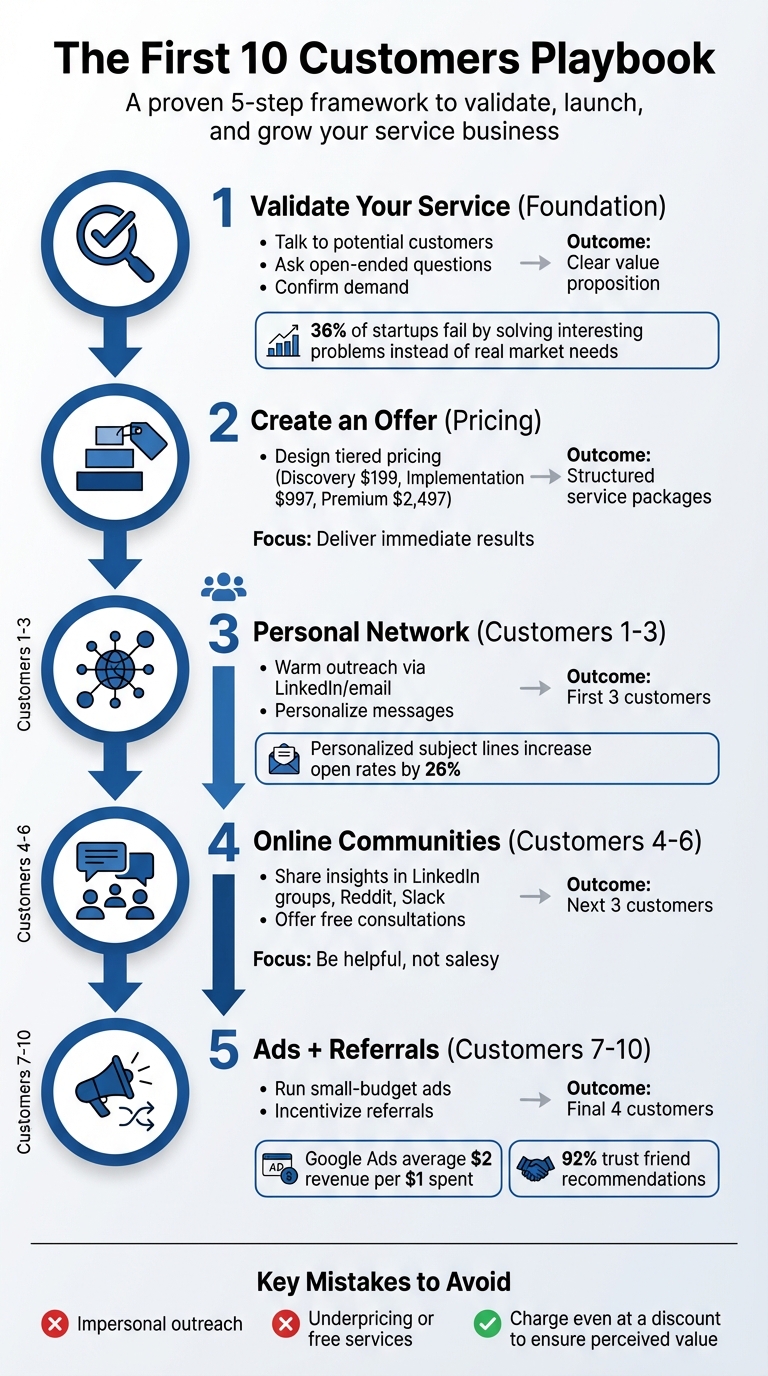
5-Step Process to Acquire Your First 10 Service Customers
4 Ways To Get Your First 10 Customers (41mins Full Class)
Step 1: Validate Your Service and Define Your Position
Make sure your service solves a real problem that people are willing to pay for - this is the bedrock of any successful business. Did you know that nearly 36% of startups fail because they focus on solving problems that are interesting rather than addressing actual market needs? You don’t want to spend months creating something nobody wants.
Confirm Market Demand Through Problem Validation
Start by talking to potential customers. These conversations are critical to understanding whether the problem you aim to solve is worth their time and money. Ask open-ended questions about their challenges, what they’ve tried before, and what their ideal solution looks like. Stay away from yes-or-no questions - they won’t give you the depth you need. Dig into the details to uncover their biggest frustrations.
Tools like IdeaFloat's Problem Validator can help you confirm demand and identify subtle signs of urgency. Combine this with Consumer Insights to analyze real conversations from online forums and communities. This will help you capture the exact words your customers use to describe their pain points - a goldmine for shaping your outreach and messaging.
Once you’ve confirmed there’s clear demand, the next step is to define what makes your service stand out.
Create a Clear Value Proposition
After validating the problem, focus on crafting a value proposition that clearly communicates how your service solves it. Industry experts suggest working with early adopters to gather feedback and refine your offering. Your value proposition should be a short, straightforward statement that explains how your service tackles your customers’ specific challenges and highlights the benefits.
Use the same language your customers do. For instance, if they describe their frustration as “wasting hours on manual report generation,” your message should be, “We eliminate time wasted on manual reports.” Avoid vague claims - be precise about the benefits your service delivers. This kind of customer-focused language ensures your message hits home. Tools like IdeaFloat's Unique Value Proposition tool can help you craft a sharp, compelling statement that resonates with your audience.
Step 2: Create an Offer That Attracts Early Customers
Once you've nailed down your value proposition, the next move is to craft an offer that grabs the attention of early adopters and convinces them to take the leap.
The key? Your offer shouldn't just list what you're providing - it needs to show how your service can genuinely transform their situation. Early adopters aren't interested in small, incremental improvements. As Warren Schirtzinger from High-Tech Strategies points out:
Visionaries are not looking for gradual improvement, they are looking for a fundamental breakthrough.
These early adopters are often willing to pay a premium and accept risks if they see your service as a game-changer that delivers a competitive edge, enhances their reputation, or solves an urgent problem. This transformative promise is also the foundation of a strong pricing strategy.
Structure Your Pricing and Deliverables in Tiers
Tiered pricing is effective because it caters to different customer budgets while safeguarding your profitability. By offering multiple price points tied to varying service levels, you encourage higher-value purchases while keeping options open for those with tighter budgets. A three-tier structure - such as Essentials, Standard, and Premium - works particularly well, giving customers clear choices without overwhelming them.
For your first 10 customers, focus on designing each tier to deliver immediate, noticeable results. Early adopters appreciate being part of the process, so include opportunities for them to provide feedback and help shape your service. You might also consider offering premium features upfront. Toggl, a time-tracking tool, does this brilliantly by giving all new users access to its premium features for 30 days, no matter which plan they select. This "reverse trial" allows early adopters to experience the full value before making a long-term commitment.
Example Service Tiers With Pricing and Benefits
Here's an example of how you can structure your tiers to balance affordability with value, while emphasizing transformation over just added features:
| Tier | Price | Inclusions | Best For |
|---|---|---|---|
| Discovery Session | $199 | 90-minute strategy call, personalized action plan, 1 week of email support | Those wanting to test your service with minimal risk |
| Implementation Package | $997 | Everything in Discovery, plus 4 weekly coaching sessions, custom templates, priority support, and feedback sessions | Customers ready to tackle urgent challenges with hands-on guidance |
| Premium Partnership | $2,497 | Everything in Implementation, plus 8 weeks of unlimited support, monthly strategy reviews, early access to new features, and direct input on service development | Visionaries looking for a competitive edge and opportunities to lead the market |
When setting your prices, focus on the value customers perceive, not just your costs. Value-based pricing often leads to higher profits because it aligns with what customers believe your service is worth. For example, 70% of Shopify stores use strategic discounts to build their customer base. Early adopters are willing to pay for transformation, exclusivity, and the chance to be ahead of the curve. Make sure your pricing reflects the breakthrough your service offers.
Step 3: Get Customers 1-3 From Your Personal Network
Tap into your personal network to find your first few customers. Start with trusted contacts who already know your work and are open to trying new solutions. Not everyone in your network will be the right fit, so focus on "early adopters" - people who have used similar services before and are comfortable exploring fresh ideas. Look for individuals with straightforward decision-making processes, where one person can give the go-ahead without needing group approval. Professionals like lawyers, accountants, and consultants are often more accessible since being easy to reach is part of their job.
To stay organized, create a spreadsheet to map out your network. Include key details like their business, recent achievements, and how well they align with your service. This will help you craft messages that feel personal and relevant, making it easier to connect.
Warm Outreach Scripts You Can Use Right Away
When reaching out, personalize your messages by mentioning mutual connections, recent accomplishments, or something specific they've shared. Keep it short - under 150 words - and focus on offering value before making any requests.
LinkedIn DM Script:
"Hi [Name], I noticed your post about [specific challenge] last week, and it really struck a chord. I've been helping [similar companies/roles] tackle this issue with [brief service description]. I'd love to share a quick insight that could be useful to you. Would you be open to a 15-minute call this week?"
Email Script:
"Hi [Name], I recall you mentioning [specific challenge]. I’ve recently launched a service to help [target audience] achieve [specific outcome], and I think it could be a great fit for you. I’d be happy to send over a quick resource or hop on a call if you’re interested. Are you free for 20 minutes on Tuesday or Thursday?"
Using personalized subject lines can increase email open rates by 26%, and simply including the recipient's name makes them 2.6% more likely to open it.
Stay Consistent With Daily Outreach Goals
Once your scripts are ready, set daily outreach targets to keep the momentum going. Consistency is key - most prospects need several touchpoints before responding. Follow up within 24–48 hours of your initial message, and then space out future follow-ups. Use a mix of communication channels, like LinkedIn, text messages, or even handwritten notes when appropriate.
Adding value in your follow-ups can make a big difference. Share a relevant article, offer an introduction, or provide a quick business insight. Keep your call to action clear and specific, such as, "Are you available for a 20-minute call on Wednesday at 2:00 PM?" - this works better than a vague "Let me know if you'd like to chat."
These focused efforts within your personal network will help you build a strong foundation for expanding your outreach in the next steps.
sbb-itb-08dd11e
Step 4: Get Customers 4-6 Through Online Communities
Once you've tapped into your personal network, it's time to expand your reach by engaging with online communities. These spaces are filled with people actively discussing problems that your services can solve. The trick? Show up as a knowledgeable resource, not as someone aggressively pitching services. This shift from familiar contacts to broader groups builds on the trust you've already established.
Share Useful Insights in Relevant Groups
Start by figuring out where your target audience hangs out online. Look for communities of practice - groups where members focus on specific skills or goals. These are goldmines because the people there are already working on areas where your expertise can make a difference. For example, Headspace grew its meditation app by leveraging a community of individuals committed to building meditation habits.
You’ll find these communities on platforms like LinkedIn groups, Reddit forums, Slack channels, Facebook groups, or even niche industry forums. Seek out groups that align with your service by industry, role, or shared interests. Once you join three to five relevant groups, take a few days to observe the discussions. Pay attention to recurring questions and the language people use.
Offer actionable resources. Share something simple yet valuable, like a checklist, a one-page guide, or a quick tip that addresses a common issue. For instance, if you provide bookkeeping services, you could post something like "5 Tax Deductions Most Freelancers Overlook" in a freelancer group. Keep in mind that people are more likely to share content that resonates with their values or identity - not something that feels overly promotional. Building trust this way opens the door to more meaningful interactions.
Transition to Personal Conversations
After establishing yourself as a helpful contributor, steer the conversation toward a one-on-one setting. When someone engages with your post or asks a follow-up question, send them a direct message offering tailored assistance. For example, you could say, "I saw your question about [specific issue]. How about we schedule a quick 15-minute call to explore a solution?"
Consider offering a free consultation or audit to showcase your expertise. This could be a brief website review, a process audit, or a strategy session - something that delivers immediate value while highlighting your skills. Aim to schedule these calls around 3:00 PM, a time statistically linked to lower no-show rates. During the call, focus on understanding their challenges and goals. This approach not only helps you assess whether they’re a good fit but also naturally leads into discussing how your paid services can further assist them.
Step 5: Get Customers 7-10 With Paid Ads and Referrals
You've gained traction through your network and online communities. Now it's time to broaden your reach using two tried-and-true strategies: small-budget paid advertising and referral programs. These methods will help you secure your next wave of customers while setting the stage for future growth.
Run Small-Budget Ads to Test Your Reach
Start with a modest advertising budget and clear goals in mind. On average, Google Ads deliver $2 in revenue for every $1 spent, but your success will depend on how well you target and optimize your campaigns.
Focus on platforms where your ideal customers spend their time. For B2C services, Facebook and Instagram ads often perform well, while LinkedIn is a strong choice for B2B audiences. Pair your ads with a simple landing page featuring a booking form or waitlist signup. Your ad should highlight a specific pain point your service addresses. For example, if you offer virtual assistant services, you might use a line like: "Drowning in admin work? Reclaim 5 hours of your week - schedule a free consultation today."
Keep a close eye on your campaigns, monitoring metrics like Cost Per Acquisition (CPA) to ensure profitability. If your CPA is too high, tweak your targeting, refine your ad copy, or experiment with different audience segments. Small adjustments can make a big difference, especially when working with a limited budget.
Once your campaigns are optimized, you can build on this momentum by encouraging satisfied customers to spread the word.
Ask Satisfied Customers for Referrals
Referrals are powerful - 92% of people trust recommendations from friends and family over any other form of advertising. Plus, referred customers often convert faster and stick around longer. The secret is to make the referral process effortless for your happy clients.
The best time to ask for a referral is when a customer is thrilled with your service - right after a successful outcome or during a positive check-in. For example, you could say: "I'm so glad you're happy with the results! Do you know anyone else who might benefit? If they book a session, you'll receive a special thank-you gift."
Offer incentives that reward both the referrer and the new customer. Dropbox famously grew its user base by offering extra storage space to both parties when a referral led to a new account. For service-based businesses, you might provide a discount on future services, a gift card, or even a free add-on. For example, Two Sisters Maid to Clean offers referring customers a free maintenance cleaning and gives new recurring customers a $50 gift card.
Keep your referral program simple and deliver rewards quickly. Promote it everywhere - include it in email signatures, invoices, social media posts, and follow-up conversations. The more visible the program, the greater its impact.
Common Mistakes and How to Fix Them
Starting out, entrepreneurs often hit roadblocks when trying to land their first customers. Two common missteps stand out: sending impersonal outreach messages and setting prices without fully understanding your costs. Here’s how to sidestep these pitfalls.
Personalize Your Outreach Messages
Nothing kills your chances faster than a cookie-cutter message. To stand out, make every outreach personal. Dig into your prospect's world - review their company updates, recent accomplishments, or even presentations they’ve given. Mention something specific in your message, like a key takeaway from their talk or a recent achievement. This shows you’ve done your research and helps build trust.
If possible, use warm introductions through colleagues, investors, or mutual connections instead of cold outreach. While structured scripts can guide your approach, don’t rely on them too heavily. Add your own voice and adapt your pitch to make it more relevant to each person. Personalization isn’t just about grabbing attention - it’s also about fostering meaningful connections, which is essential for early growth.
Verify Your Pricing Covers Costs
Mispricing your services can sink your business before it takes off. Many entrepreneurs focus solely on bringing in revenue, often at the expense of long-term viability. This can lead to attracting customers who demand heavy customization, draining your time and resources. Early on, your focus should be on learning and building strong, referenceable relationships - not just chasing profits.
Always charge something for your services, even if it’s a discounted rate. Amy Saper, Partner at Uncork Capital, emphasizes the importance of this approach:
Because of this, I am more in favor of a beta discount, rather than a completely free beta product. If the customer never has any intention of converting to paid, or the person you're speaking with has no budget authority, you'd rather find that out sooner rather than later!
Charging a fee ensures that your offering holds real value in the eyes of your customers.
Instead of offering free trials, think about alternatives like money-back guarantees or exceptional onboarding support. These can reduce hesitation while still securing a level of commitment. Don’t shy away from experimenting with your pricing and service structure to find what resonates with your audience. For example, software priced under $500 per month typically works well with low-touch sales, while services exceeding $5,000 annually often demand a more hands-on sales approach. Securing real buy-in from customers now will set the stage for trust-based, scalable growth.
Conclusion: Your Plan for Getting Your First 10 Customers
Landing your first 10 customers takes a structured approach. Begin by validating your service - talk to potential customers to ensure you’re addressing a real need. Once that’s clear, design a simple, tiered offer that’s hard for early adopters to resist. Your personal network is the best place to start for customers 1-3.
From there, expand your efforts. For customers 4-6, engage with online communities where your target audience gathers. Then, for customers 7-10, experiment with small-budget paid ads and encourage referrals. By the time you’ve reached 10 satisfied customers, you’ll have proven your concept and gathered valuable feedback to improve your service.
The secret to success lies in consistency and personalization. Set daily outreach goals, customize each message, and don’t give up after one follow-up - people are often just busy, not uninterested. And remember, avoid offering your service for free. Even a discounted rate ensures your customers are invested and see the value in what you’re offering.
FAQs
How can I make sure my service solves a real problem for customers?
If you want your service to tackle a real problem, start by having direct conversations with potential customers. Discovery calls are a great way to dig into their challenges and confirm whether your solution addresses a genuine need. Focus on solving one clear pain point, and don’t hesitate to ask for feedback to fine-tune your offering.
When you align your service with what matters most to your audience and show them the value it brings, you’ll not only earn their trust but also boost the likelihood of early adoption. Plus, engaging with customers from the start ensures your solution truly connects with their needs.
How can I effectively connect with and engage online communities?
To genuinely connect with online communities, start by prioritizing real relationships. This means actively listening to what people are saying and contributing in ways that are helpful and relevant. Jump into discussions, answer questions thoughtfully, and share insights that solve problems or address the community’s interests. When you show you're genuinely interested, you build trust and open the door to meaningful conversations.
It’s also important to make your responses feel personal. Take the time to tailor your comments to match the tone and preferences of the group. Consistency in how you engage not only builds trust but also establishes your credibility. And remember, authenticity matters - when people feel valued and understood, those interactions can evolve into deeper connections or even loyal customers over time.
How can I set the right pricing for my first customers?
When setting prices for your first customers, think about offering special introductory rates or even a free trial. This can help encourage early adoption and give you the chance to collect meaningful feedback. Make it clear that these initial prices are temporary and part of a collaborative effort where their input helps refine your service. In exchange, you might ask for testimonials or permission to showcase their logo as a client.
You could also design flexible pricing tiers based on usage or features. These should reflect the value your service provides while being mindful of your business's early stage. This flexibility can cater to different customer needs and build trust and loyalty over time. The key is finding a middle ground - attract early adopters without undervaluing what you’re offering.
Related Blog Posts
- Profitable Business Ideas You Can Start This Weekend
- Zero to $10k: First Month Business Strategy
- Launch Weekend: How to Get Your First 100 Customers in 48 Hours
- Idea to First Customer in 14 Days: Scripts, Templates, Checklist