
Starting your business without proper legal documents can lead to payment issues, client conflicts, and even losing ownership of your work. Here's what you need to secure your first five clients and protect your business:
- Contracts: Clearly define deliverables, payment terms, ownership rights, and dispute resolution. Invest in a professional template ($800–$1,000) and customize it for your services.
- Invoices: Use detailed, professional invoices with clear payment terms, itemized charges, and "Pay Now" options for faster processing.
- Intellectual Property (IP): Protect your work with copyrights, trademarks, and IP agreements. Register your IP to secure your rights and avoid disputes.
These steps ensure smoother client relationships, timely payments, and ownership of your creations. Keep reading for a complete guide to setting up contracts, invoices, and IP protections tailored to your business.
Business Lawyer Explains 9 Things to Look for in Every Contract 📜
Client Contracts: What You Need to Know
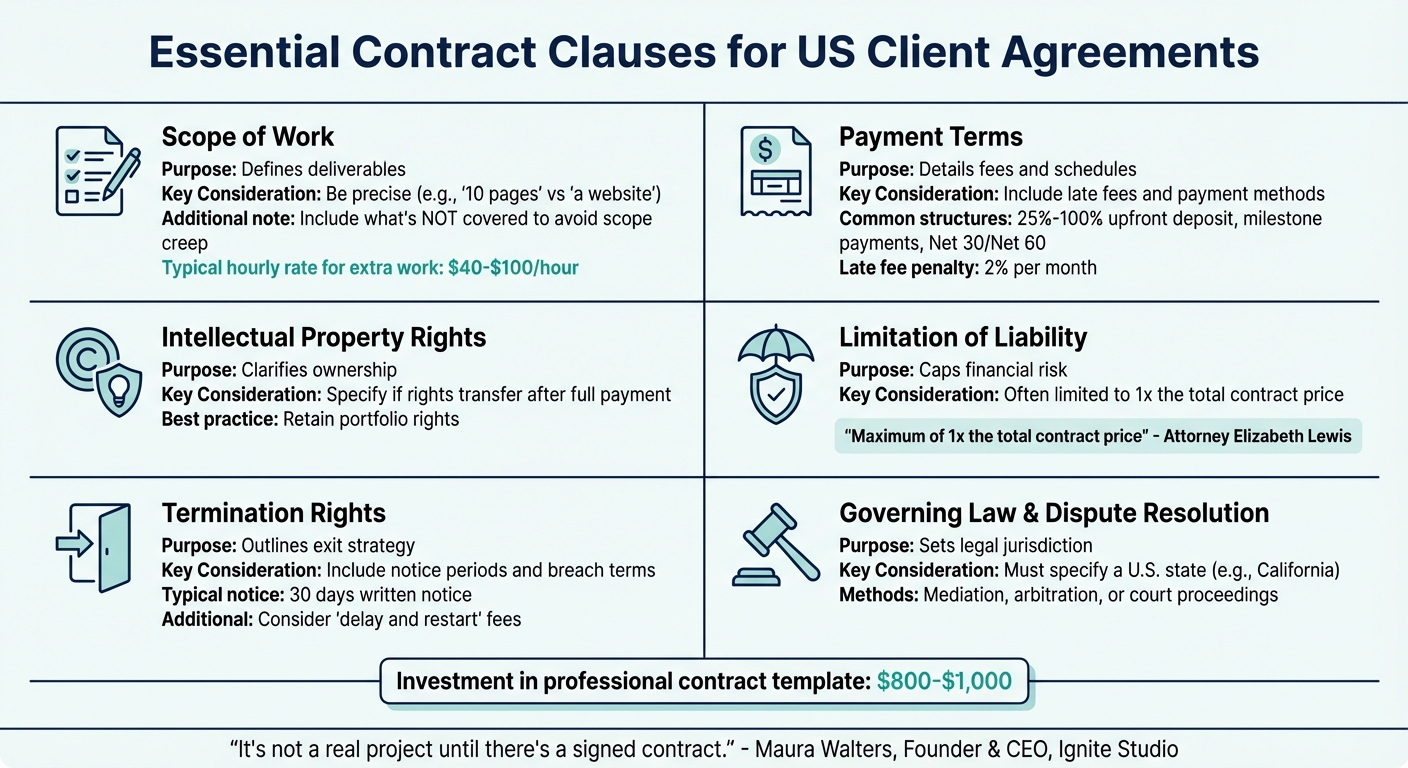
Essential Contract Clauses for US Client Agreements: 6 Key Elements
Client contracts are the backbone of professional agreements. Without one, verbal promises can easily lead to misunderstandings or disputes. As Maura Walters, Founder and CEO of Ignite Studio, aptly says:
"It's not a real project until there's a signed contract."
For a contract to hold up in U.S. courts, it needs three key elements: an offer (the services you’ll provide), acceptance (the client agrees to your terms), and consideration (something of value is exchanged). Beyond these basics, your contract should spell out deliverables, payment terms, and ownership.
One common pitfall for new entrepreneurs is being too vague. For instance, saying you’ll "design a website" isn’t enough - does that mean five pages or 50? Lack of clarity can lead to disputes and even third-party mediation.
Investing $800 to $1,000 in a professionally drafted contract template is a smart move. Even if you start with a template, you’ll need to customize it to fit your specific services and industry requirements. Make sure it includes clauses that comply with U.S. law.
Required Clauses for US Client Contracts
Every client contract should include six essential clauses to safeguard both you and your client. Start with the scope of work, which outlines exactly what you’re delivering. Be detailed - don’t just say "marketing services." Instead, specify something like "creation of 4 social media posts per week for Instagram and Facebook, plus one monthly email newsletter." It’s also wise to include what’s not covered to avoid scope creep. Many entrepreneurs include a clause stating that extra work outside the initial agreement will be billed at an hourly rate, often between $40 and $100 per hour.
Payment terms should detail your total fee, when payments are due, and what happens if payments are late. Common payment structures include upfront deposits (ranging from 25% to 100% of the project cost), milestone-based payments, or Net 30/Net 60 terms. To encourage timely payments, consider adding a late fee penalty - typically 2% per month. Always require at least a partial deposit before starting work to ensure the client’s commitment.
The intellectual property (IP) clause is another critical piece. It defines who owns the work you create. To avoid disputes, many service providers transfer IP rights to the client only after full payment is received, while retaining the right to showcase the work in their portfolio.
Liability limitations are equally important, as they cap the damages you could be held responsible for if something goes wrong. A common approach is to limit liability to no more than the total contract price. Attorney Elizabeth Lewis explains:
"The parties agree and acknowledge the limitation of liability of either party is at a maximum of 1x the total contract price."
Your contract should also include termination rights, which clarify how either party can end the agreement. Typically, this involves providing 30 days’ written notice. Some entrepreneurs also include "delay and restart" fees to account for lost time if a client becomes unresponsive and then re-engages later.
Lastly, specify governing law and dispute resolution. This clause determines which state’s laws apply and how disputes will be handled - whether through mediation, arbitration, or court proceedings. Be cautious when using generic clauses from online templates, as they might inadvertently require you to litigate in another state. If your industry has specific licensing or permit requirements, make sure these are reflected in the contract.
| Clause Type | Purpose | Key Consideration |
|---|---|---|
| Scope of Work | Defines deliverables | Be precise (e.g., "10 pages" vs "a website") |
| Payment Terms | Details fees and schedules | Include late fees and payment methods |
| Limitation of Liability | Caps financial risk | Often limited to 1x the total contract price |
| IP Rights | Clarifies ownership | Specify if rights transfer after full payment |
| Governing Law | Sets legal jurisdiction | Must specify a U.S. state (e.g., California) |
| Termination | Outlines exit strategy | Include notice periods and breach terms |
How to Customize Contracts for Your Services
Once you’ve covered the basics, it’s time to tailor your contract to fit your specific services and processes. Generic templates won’t account for the unique aspects of your business.
Clearly define deliverables and include a change order process. This outlines how changes will be proposed, reviewed, approved, and priced. Without it, clients might expect unlimited revisions at no extra cost.
Set an acceptance period, usually 20 to 30 days, during which the client can review the work and flag any issues. After this period, the deliverable is considered accepted, which prevents clients from requesting changes long after the project is completed.
If you’re using IdeaFloat to develop business strategies, make sure your contract reflects the specific outputs you’re delivering. For example, specify whether you’re providing a validated unique value proposition (UVP), a go-to-market (GTM) plan, or customer research findings. Clearly describe the format of these deliverables, such as a 15-page PDF report, a 60-minute presentation, or access to a shared online workspace.
For tax purposes, include a clause identifying yourself as an independent contractor - not an employee - and state that you’re responsible for your own federal and state income taxes.
To protect yourself from "ghosting" clients, add provisions that outline what happens if a client becomes unresponsive or if you’re unable to complete the work. As Maura Walters wisely advises:
"Don't be so grateful for work that you forget to protect yourself."
How to Create Professional Invoices
An invoice isn’t just a piece of paper; it’s a legal document that reflects your professionalism and helps ensure you get paid on time. A polished, well-structured invoice sends a message that you’re serious about your business, while a messy or incomplete one can lead to delays or even harm your reputation. If you’re just starting out, nailing this process with your first few clients sets a solid foundation for your business relationships.
Whether you stick with a basic Word template or opt for automated invoicing software, the goal is the same: keep it clear and consistent. According to Stripe, invoices paid through their platform often see payments within 24 hours, and customers using digital wallets pay three times faster on average.
Invoice Requirements and US Formatting Standards
Creating a professional invoice that complies with U.S. standards means including all the essential details in a clear and organized way. Here’s what every invoice should have:
- A clear header: Label it as "Invoice" and consider adding your company logo and brand colors to reinforce your identity.
- Your business information: Include your name, address, phone number, and email. Add your client’s details in the same format to avoid any confusion.
- Unique invoice number: Use a sequential numbering system, like "2025-001" or "#0500", to make tracking and record-keeping easier.
- Dates: Add both the invoice date and the due date, formatted as MM/DD/YYYY. Common terms include "Due upon receipt", "Net 30" (due in 30 days), or "Net 60" (due in 60 days).
- Itemized list of charges: Break down each service or product on separate lines. Be specific. For example, instead of "Consulting services: $2,000", use "Strategic planning consultation (8 hours @ $250/hour): $2,000."
- Payment methods: Clearly state how clients can pay - whether by ACH transfer, credit card, check, or digital wallet - and include any necessary account details or payment links.
- Total amount due: Highlight this in bold, using commas for thousand separators (e.g., $5,000.00). If applicable, list taxes or fees separately.
For corporate clients, don’t forget to include the Purchase Order (PO) number, if required. And always save your invoice as a PDF to preserve its formatting.
As Stripe points out:
"A clear and comprehensive invoice reduces the likelihood of misunderstandings or queries from your customers, which are often reasons for payment delays."
Manual vs. Automated Invoicing
Your invoicing method depends on how complex and frequent your billing needs are. Both manual and automated options have their pros and cons.
Manual invoicing involves using tools like Word, Excel, or Google Docs to create templates, save them as PDFs, and email them to clients. It’s a good fit for low-volume billing but can be time-consuming and prone to mistakes.
Automated invoicing, on the other hand, uses software like Square, Stripe, or QuickBooks to handle the heavy lifting. These platforms often include features like recurring billing, "Pay Now" buttons, and automatic reminders. While there’s usually a transaction fee (for example, Square charges 3.3% plus $0.30 per paid invoice), the time saved and increased accuracy can make it worthwhile.
Here’s a quick comparison:
| Feature | Manual Invoicing (Templates/PDFs) | Automated Invoicing (Software) |
|---|---|---|
| Time Investment | High; each invoice is created individually. | Low; templates and recurring billing save time. |
| Accuracy | Prone to human error in calculations. | Automated calculations reduce errors. |
| Payment Speed | Slower; relies on manual transfers or checks. | Faster; includes direct "Pay Now" links. |
| Tracking | Requires manual logs or folders. | Real-time dashboards track invoice status. |
| Follow-ups | Manual reminders for late payments. | Automatic reminders can be scheduled. |
| Scalability | Difficult as client volume grows. | Easily handles a large volume of invoices. |
If you’re just starting out, a professional manual template can work without adding extra costs. But as your client base grows - or if you deal with recurring billing - switching to an automated system can save time and reduce errors, allowing you to focus more on your business.
sbb-itb-08dd11e
How to Protect Your Intellectual Property
Your intellectual property (IP) is a cornerstone of your business - whether it's a branding guide, software code, or a unique process you've developed. Protecting it ensures you maintain ownership and can take legal action if someone misuses it.
IP Basics for Entrepreneurs
There are three main types of IP to focus on: copyrights, trademarks, and trade secrets. Each serves a distinct purpose in safeguarding your business.
- Copyrights automatically protect original creative works as soon as they're in a tangible form. This includes website content, blog posts, marketing materials, or software code. Copyright protection for works created after January 1, 1978, lasts for your lifetime plus 70 years.
- Trademarks safeguard your brand identifiers - like your business name, logo, or slogan. While rights begin when you use the mark commercially, registering it with the USPTO provides stronger legal protection. Trademark rights can last indefinitely, provided they're actively used and renewed.
- Trade secrets cover confidential information that gives your business a competitive edge, such as customer lists, proprietary formulas, or business strategies. These aren't registered but are instead protected through Non-Disclosure Agreements (NDAs) and strict access controls. Protection lasts as long as the information remains secret.
Here’s a quick summary:
| IP Type | Coverage | Registration Body | Duration |
|---|---|---|---|
| Copyright | Creative works (text, designs, code) | U.S. Copyright Office | Life + 70 years |
| Trademark | Brand identifiers (names, logos, slogans) | USPTO | Indefinite (with renewal) |
| Trade Secret | Confidential business info | None (protected via contracts) | As long as it stays secret |
Warren Tuttle, Co-Chair of the Creator Committee at USIPA, emphasizes the importance of IP protection:
"With [IP], you have now purchased… the right to defend yourself, [but] it can also be expensive. You really have to be committed to it."
Understanding these IP types is the first step toward securing your rights.
How to Register IP in the US
When it comes to protecting your IP, registration is key. Without it, you cannot file an infringement lawsuit in federal court. Timely registration is especially important for business assets, including AI-generated content.
- Copyrights: To register, visit the U.S. Copyright Office website and complete an online application. The process costs around $55 and typically takes four months. If you register within three months of publication, you gain additional benefits, such as eligibility for statutory damages and attorney's fees in case of infringement. While not legally required, including the copyright symbol (©), the year, and your name on your work can help counter "innocent infringement" claims.
- Trademarks: File through the USPTO's Trademark Electronic Application System (TEAS). The standard application fee is about $275 per class of goods or services. Before filing, search the USPTO database to ensure your mark isn’t already in use. Once registered, use the ® symbol to indicate federal registration. If your trademark is still in the process of registration, you can use the ™ symbol to assert your claim.
If you're unsure which IP protections apply to your assets, the USPTO offers a free tool called the IP Identifier. This tool asks a series of questions about your business assets - whether it’s a logo, invention, or content - and recommends the appropriate type of protection.
For businesses working with contractors or employees, it's crucial to use Intellectual Property Assignment Agreements. Without a "work-for-hire" agreement, contractors may retain ownership of the work they create for you. This can lead to costly disputes, especially when you're just starting to build client relationships.
Client Onboarding Checklist for Your First 5 Clients
Once you’ve got your legal framework in place, it’s time to focus on onboarding your clients effectively. A well-organized onboarding process not only makes things run smoothly but can also reduce client churn by 20% and boost satisfaction by 30%. The trick is to complete key steps within 24 to 48 hours of the client’s commitment.
5-Step Onboarding Process
Step 1: Run a Conflict Check
Start by reviewing your internal records to ensure there are no legal or ethical conflicts with the new client engagement [33,34]. This step is especially critical if you’ve worked with competitors or have clients in the same industry. Once you’ve cleared any potential conflicts and finalized the project scope, move quickly to formalize the agreement.
Step 2: Send a Tailored Contract for Signature
Draft an engagement letter that clearly outlines the scope of work, responsibilities, termination clauses, and payment terms. Be specific about your billing structure - whether it’s hourly, flat fee, or retainer - and include policies for late payments (commonly 1.5%–2% monthly). Using an e-signature platform can make contract execution faster and easier. A quick legal review at this stage can save you from potential headaches later.
Step 3: Issue a Professional Invoice Upon Contract Execution
As soon as the contract is signed, send out your first invoice. This ensures there are no surprises for the client. Confirm key details like the client’s payment contact, preferred payment method (ACH, credit card, or check), and standard terms (typically Net 30). Always send invoices in PDF format to avoid unauthorized changes. For new clients or long-term projects, consider requesting an upfront deposit - anywhere from 25% to 100% of the project cost - to cover initial expenses and establish trust.
Step 4: Deliver IP-Protected Assets According to the Agreement
Before starting any work, make sure all contractors and employees sign IP Assignment Agreements [2,5]. This legally transfers ownership of the work to your company. If you’re licensing intellectual property (IP) to the client instead of transferring ownership, your contract should clearly define the license’s scope, duration, territory, and exclusivity. Be sure to differentiate between "Background IP" (what you owned prior to the project) and "Foreground IP" (created during the project) to safeguard your original tools and methods. This step builds on earlier IP strategies to secure your work.
Step 5: Keep Comprehensive Client Records
Organize a dedicated file for each client, including signed contracts, invoices, IP agreements, and NDAs [33,37]. If your business is incorporated in Delaware but operates elsewhere, remember to file for foreign qualification to avoid penalties. Additionally, founders with restricted stock should file an 83(b) election with the IRS within 30 days to sidestep hefty tax consequences.
Conclusion
A strong legal foundation does more than just protect your business - it builds trust, secures your assets, and supports profitability. Written contracts help avoid scope creep and ensure you get paid on time. Clear, detailed invoices - especially when paired with digital payment methods - can lead to quicker payments. Intellectual property (IP) assignments not only protect your work but also signal to investors that you're ready for serious business.
"Having these essential contracts signed and executed appropriately is not just a best practice, it is a necessity. It gives your business relationship with your clients and other associates a clear framework and protects your interests." - Subhashinee P, Product Marketer, Zoho Sign
Skipping critical legal steps, like filing an 83(b) election, can result in tens of thousands of dollars in unnecessary taxes. In short, having thorough legal documentation isn’t just about protection; it’s about creating a foundation for smoother, faster growth.
Taking care of your legal essentials now also sets the stage for strategic market success. That’s where IdeaFloat comes in. This platform is designed to help you validate your business idea and establish real customer relationships. Whether you’re testing if your problem is worth solving or crafting a go-to-market strategy to attract paying clients, IdeaFloat equips you to move from concept to revenue more efficiently. Once your idea is validated and you've secured your first five clients, having a complete legal toolkit ensures those relationships remain secure, professional, and profitable.
"Protecting everything you've worked so hard to build shouldn't be on your 'someday list.'" - Amy, Small Business Attorney, Artful Contracts
FAQs
What steps should I take to create a legally binding and comprehensive client contract?
To make sure your client contracts are legally binding and comprehensive, start with a well-written agreement that clearly outlines all the key aspects of your working relationship. This should cover the services or deliverables you’ll provide, timelines, payment details (such as amounts, due dates, and accepted payment methods), and any penalties for late payments. Don’t forget to include critical clauses addressing confidentiality, intellectual property ownership, termination rights, and how disputes will be resolved (e.g., through arbitration or under the laws of a specific state). These components not only safeguard your business but also set clear expectations for both parties.
While using a reliable contract template can be a helpful starting point, it’s essential to adapt it to your business needs and the laws in your jurisdiction. Be precise when describing the scope of work to avoid any ambiguity that could lead to disputes. Once you’ve tailored the contract, have it reviewed by a qualified attorney to ensure it meets legal standards. Finally, make sure both you and your client sign the agreement - whether electronically or with a physical signature. A valid signature is a must for the contract to hold up in U.S. courts.
By combining clear terms, essential legal clauses, professional review, and proper signatures, you can protect your business while building strong, professional relationships with your clients.
Why should I use automated invoicing software instead of handling invoices manually?
Automated invoicing software simplifies billing by letting you send invoices and accept payments online. This not only saves time but also helps minimize mistakes, making your workflow smoother. Instead of manually creating invoices or keeping tabs on due dates, the software handles these repetitive tasks, freeing you up to concentrate on growing your business.
It also comes with handy financial management tools. You can track payments, generate reports, and keep your records organized - all in one convenient platform. The result? A more polished and efficient experience for your clients.
What type of intellectual property protection does my business need?
To pick the right type of intellectual property (IP) protection, start by figuring out what you need to protect. If you’ve developed a technical invention - like a new gadget, process, or piece of software - a patent is likely your best bet. It grants exclusive rights for up to 20 years. For branding elements such as names, logos, or slogans, a trademark ensures you have exclusive rights in commerce, helping to prevent customer confusion. On the other hand, creative works - like code, artwork, or marketing materials - are automatically covered by copyright once they’re in a fixed form. However, formal registration can make enforcement easier. If your business relies on confidential information like formulas, strategies, or client lists, you might consider a trade secret approach, which is supported by nondisclosure agreements and robust security practices.
When making your decision, think about three key factors:
- Nature of the asset: Is it an invention, a brand element, a creative work, or confidential information?
- Duration of protection: Patents and trademarks can last for decades, copyrights extend for the life of the author plus 70 years, and trade secrets can last indefinitely as long as secrecy is maintained.
- Costs and timelines: Patents tend to be expensive and time-consuming, while trademarks and copyrights are quicker and more affordable to secure.
For tailored advice, it’s a smart move to consult an IP attorney. They can help align your protection strategy with your business goals and budget, ensuring you safeguard the unique aspects of your startup effectively.
Related Blog Posts
- How to Start a Bookkeeping Business With No Experience
- How to Start a Cleaning Business: From First Client to Full Schedule
- How to Start a Consulting Business (2025): Niches, Pricing, Leads
- How to Start a Bookkeeping Business With No Experience