
Starting a digital marketing agency in 2026 is a massive opportunity, with U.S. digital ad spending projected to exceed $340 billion this year. But here's the catch: success isn't just about knowing how to run ads or optimize SEO. It's about building systems that scale.
This guide breaks down the three essential pillars for building a thriving agency:
- Service Offerings: Specialize in high-demand niches like SEO, PPC, or email marketing. Niche-focused agencies command higher rates and grow faster.
- SOPs (Standard Operating Procedures): Create step-by-step workflows for consistency and efficiency. SOPs reduce errors and improve quality.
- Fulfillment Systems: Develop clear processes for delivering results, from onboarding to optimization, ensuring deadlines are met and clients stay happy.
The key to scaling is combining these systems with tools like ClickUp, Notion, and Zapier to simplify operations. Whether you're starting fresh or refining your agency, this approach ensures growth without burnout.
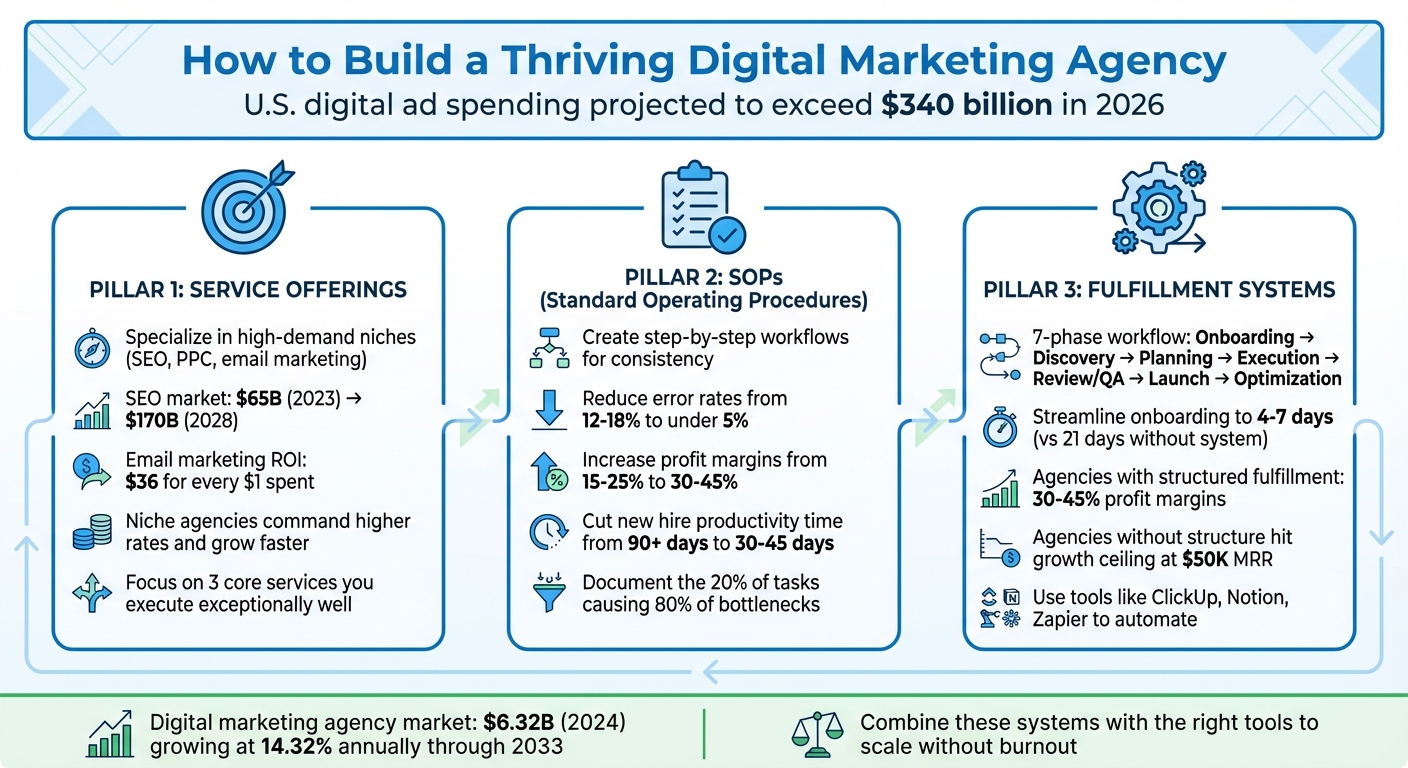
Three Essential Pillars for Building a Scalable Digital Marketing Agency
How To Start a Digital Marketing Agency in 2026 (step-by-step)
sbb-itb-08dd11e
Defining Your Service Offerings
The first big step in building your agency is deciding which services to offer - and just as importantly, which ones to avoid. The global digital marketing agency market is booming, projected to reach $6.32 billion in 2024 and grow at an annual rate of 14.32% through 2033. But here’s the catch: success often hinges on specialization. Agencies that focus on specific niches tend to command higher rates and grow faster.
To start, pick three core services that you can execute exceptionally well. Some of the most sought-after services include SEO (a $65 billion market in 2023, expected to hit $170 billion by 2028), PPC advertising (offering clients quick ROI), social media marketing (fueled by platforms like TikTok and Instagram), and email marketing (delivering an average return of $36 for every $1 spent). Web design and content marketing are also in demand, but the real game-changer is specialization. Instead of being a general "digital marketing agency", position yourself as something like "PPC for Personal Injury Law Firms" or "SEO for B2B SaaS companies." This "Combined Niche" strategy is the key to standing out in 2026. Before finalizing your focus, validate your service ideas with data-driven insights to ensure you're meeting market demand.
Researching High-Demand Services
Before locking in your service offerings, it’s crucial to back your decisions with real data. Tools like IdeaFloat’s Problem Validator and Consumer Insights can help uncover what your target audience is actively searching for and willing to invest in.
"Make sure that you spend some time identifying the keywords that your ideal clients are actually searching for online!" - Jessica Tappana, Founder of Simplified SEO Consulting
Research consistently shows that specialized agencies generate more revenue per employee and maintain a leaner, more manageable client base. For example, the US social media advertising market alone is valued at $76.4 million as of 2024. By digging into market trends and identifying gaps, you can tailor your services to meet those unfulfilled needs and carve out your niche.
Structuring Service Packages and Pricing
Once you’ve pinpointed high-demand services, the next step is to package them in a way that maximizes profitability. Clear, tiered service packages with defined deliverables are the way to go. Avoid hourly billing for ongoing work - it limits your earning potential and complicates budgeting for clients. Instead, consider offering "Quick-Win" packages (30–60 day sprints for PPC or social media campaigns) alongside "Long-Term Growth" programs (like SEO or content strategy) that lock in monthly retainers.
Generalist agencies typically charge $25–$49 per hour, while specialists in areas like SEO, social media, and content marketing can command $100–$149 per hour. On average, project contracts range from $10,000 to $49,999. Niche agencies, with their focused expertise, can achieve profit margins between 45% and 75%. Use tools like IdeaFloat’s Advanced Pricing Research and Financial Model to benchmark your rates against competitors and ensure your packages deliver a solid 40–55% gross margin. Here’s a telling stat: 52% of specialist consultants charge $10,000+ per project, compared to just 18% of generalists.
Creating Your Value Proposition
With your service packages in place, it’s time to craft a compelling value proposition. This is where you define what you do and who you do it for. Saying "we do digital marketing" isn’t enough - you need to clearly communicate the ROI you deliver to a specific audience. For example, if you’re targeting B2B SaaS companies for SEO, your pitch should address their unique challenges: long sales cycles, high customer acquisition costs, and the need for scalable lead generation.
Leverage IdeaFloat’s messaging framework to refine your positioning and ensure it resonates with your target clients.
"Find that one thing you can do better than everyone else and focus your energy on that. Use that solution to get new clients who have that specific need." - Dennis Consorte, Consorte Marketing
The transition from being just a "service provider" to becoming a "consultancy" is a critical shift. Clients are willing to pay premium rates for strategic expertise, not just task execution. Decide whether your edge is speed, affordability, or deep expertise in a niche, and make sure every interaction with your clients reflects that promise.
Creating Standard Operating Procedures (SOPs)
Once you've clearly defined your services, creating solid Standard Operating Procedures (SOPs) becomes essential for maintaining consistency and scaling effectively. Research highlights the impact of SOPs: agencies lacking them often experience a 15% to 25% fluctuation in service quality across teams. By implementing SOPs, error rates can drop from 12–18% to under 5%, and profit margins can jump from 15–25% to 30–45%.
"SOPs are the mechanism that transforms repeatable, profitable products."
– Pyrsonalize
SOPs act as the backbone of your agency's operations. They outline how tasks - from client onboarding to PPC campaigns and monthly reporting - are completed. Instead of documenting every minor detail, focus on the 20% of tasks that create 80% of operational challenges. Below are the key elements that make SOPs effective and actionable.
Core Elements of Effective SOPs
A well-crafted SOP should serve as a clear, step-by-step guide that any team member can follow without needing clarification. Here are the essential components:
- Document Control and Meta Information: Include details like a title, document ID, revision number, date, and page numbers to keep everything organized.
- Purpose and Objective: Clearly define the goal of the procedure. For instance, an onboarding SOP might aim to ensure every new client has a seamless experience within 4–7 days.
- Scope: Specify who is responsible for the procedure and what activities are included or excluded.
- Roles and Responsibilities: Outline team members' responsibilities. A RACI matrix (Responsible, Accountable, Consulted, Informed) can help eliminate any confusion.
- Step-by-Step Instructions: Provide clear, sequential actions that even a new hire could follow without difficulty.
- Tools and Resources: List all necessary tools, templates, or credentials, such as ClickUp for task management or Google Analytics for data collection.
- KPIs and Success Metrics: Define measurable outcomes to assess task completion, avoiding vague or ambiguous instructions.
- Definition of Done: Conclude with a checklist to ensure the task meets quality standards. For example, before launching a PPC campaign, confirm budgets are allocated, tracking pixels are installed, and client approval is obtained.
SOP Examples for Agencies
Here are some practical examples of SOPs commonly used in agencies, along with the steps, tools, and roles involved:
| SOP Type | Key Steps | Recommended Tools | Key Roles |
|---|---|---|---|
| Client Onboarding | Welcome email, kickoff meeting, dashboard access, 30-day timeline | Function Point, Google Docs | Account Manager |
| Content Creation | Ideation, drafting, graphic design, client approval, publishing | Adobe Illustrator, Hootsuite | Content Writer, Editor |
| Reporting | Data gathering, KPI comparison, visual summary, review meeting | Google Analytics, HubSpot | Analyst, Account Manager |
| PPC Management | Planning, budget allocation, monitoring, optimization | Google Ads, ChatGPT | Media Buyer |
For example, a well-documented client onboarding SOP can reduce setup time from an inconsistent 14–21 days to a reliable 4–7 days. This predictability not only boosts client satisfaction but also allows your team to scale efficiently. Similarly, adding brand voice guidelines and mandatory approval steps to content creation SOPs ensures that every piece aligns with the client's messaging.
"SOPs are the backbone of well-structured agencies. They tell you how tasks should be completed and create consistency across all teams."
– Function Point
Involving team members who perform these tasks daily is critical. Their insights can help identify gaps and refine the SOPs to ensure they are both practical and thorough.
Using Tools to Streamline Workflows
The effectiveness of SOPs often depends on the tools you use to implement and maintain them. Here are some recommendations for integrating SOPs into your workflows:
- Centralized Knowledge Bases: Platforms like Notion, Trainual, or Confluence allow you to store all SOPs in one easily searchable hub. Ideally, any SOP should be accessible within three clicks.
- Project Management Tools: Use tools like ClickUp, Monday.com, or Asana to link SOPs directly to tasks, ensuring instructions are readily available when needed.
- Automation Platforms: Automate repetitive tasks, such as sending follow-up emails or syncing data, using tools like Zapier or Make.com to trigger SOP-related actions.
- AI-Assisted Drafting: Leverage AI tools like ChatGPT to create initial drafts of SOPs, then refine them with input from your team.
- Visual Documentation: Enhance text instructions with screenshots, GIFs, or short videos using tools like Loom to simplify complex processes.
In 2024, ClickUp saw an 85% increase in website traffic within a year after implementing a standardized, AI-guided content strategy and SEO performance SOP. This example underscores how well-documented processes, paired with the right tools, can deliver impressive results.
To keep your SOPs relevant, schedule quarterly reviews and updates as tools and industry trends evolve. Assign an SOP Owner to each document to ensure accountability and continuous improvement.
"An SOP is worthless if it is not followed. Leverage project management tools to enforce adherence and measure the impact of standardization."
– Ahmed Ezat, Co-Founder of Pyrsonalize
With effective SOPs in place, your agency is better positioned to develop scalable fulfillment strategies and achieve consistent, high-quality results.
Building Fulfillment Strategies
Once your SOPs are in place, the next step is to create a fulfillment process that consistently delivers results. Fulfillment is where all the planning turns into action - it’s about meeting deadlines, producing quality work, and keeping clients happy. In essence, it’s how your strategies come to life and translate into measurable outcomes for your clients.
Agencies that lack a structured fulfillment process often hit a growth ceiling at around $50,000 in monthly recurring revenue (MRR). At this stage, every project starts to feel like starting from scratch, which makes scaling a challenge. The answer isn’t to work harder - it’s to create a system that grows with you. By building on your SOPs, you can develop a fulfillment process that ensures your agency reliably meets its commitments.
Designing a Scalable Fulfillment Process
A scalable fulfillment process breaks down service delivery into clear, manageable stages. Many successful agencies follow a seven-phase workflow: Client Onboarding, Discovery/Strategy, Planning/Resource Allocation, Creative Execution, Review/QA, Launch, and Monitoring/Optimization. Each phase has defined tasks, deliverables, and timelines to keep projects on track and eliminate confusion.
Here’s a breakdown of the typical phases:
| Phase | Key Tasks | Deliverables | Typical Timeline |
|---|---|---|---|
| Onboarding | Kickoff meeting, gather access | Signed contract, project dashboard | 4–7 days |
| Discovery | Research, competitor analysis, audit | Strategy document, KPI definitions | 7–10 days |
| Planning | Allocate resources, map timelines | Project plan, content calendar | 3–5 days |
| Execution | Create content, design, technical setup | Drafts, campaign assets | 14–21 days |
| Review/QA | QA checks, client feedback | Approved deliverables | 3–5 days |
| Launch | Deploy campaign, go live | Live campaign/website | 1–2 days |
| Optimization | Track performance, A/B testing | Monthly reports, adjustments | Ongoing |
Streamlining onboarding to just 4–7 days (instead of up to 21 days without a system) sets a professional tone for the client relationship.
The Review/QA phase is especially critical. Adding a mandatory quality assurance checkpoint ensures that every deliverable meets your agency’s standards before it reaches the client. This simple measure can cut project error rates from 12%–18% to less than 5%, leading to happier clients and stronger retention.
To keep things running smoothly, use your RACI framework to assign responsibilities. For instance, during the Execution phase, your Content Writer might be Responsible for drafting, the Editor Accountable for final approval, the Account Manager Consulted for brand alignment, and the client Informed of progress. This avoids miscommunication and keeps everyone on the same page.
Using Tools for Fulfillment Management
The right tools can turn your fulfillment process from a time-consuming grind into a streamlined system. Project management platforms like Asana, ClickUp, Monday.com, or Notion help centralize tasks, deadlines, and communication. These tools let you visualize timelines, assign responsibilities, and track progress - all without drowning in email threads.
Take Slam Media Lab, for example. This San Francisco-based agency scaled to $2 million in revenue by using Notion to organize client accounts, timelines, and meeting notes. Having everything in one searchable location allowed the team to maintain quality as their client base grew.
Automation tools like Zapier and Make.com can also save time by connecting your apps and handling repetitive tasks. For instance, you can set up workflows that automatically create new projects in your task tracker when a client signs a contract or sync form submissions directly into your CRM. This frees up your team to focus on strategy rather than admin work.
Communication tools like Slack or Discord keep team conversations organized, while Loom is perfect for sharing quick video updates with clients. Instead of scheduling a lengthy call to explain a design revision, you can send a two-minute Loom video walking the client through the changes.
For design and creative work, tools like Figma and Adobe Creative Cloud allow real-time collaboration on assets. This minimizes version control issues and lets multiple team members work on the same project simultaneously.
Don’t overlook financial tools. Stripe simplifies recurring billing, while platforms like QuickBooks or Xero handle accounting and reporting. These tools help you keep a close eye on your margins and profitability, which is crucial for sustainable growth.
"A well-documented agency process turns chaos into clarity, letting your team focus on what they do best: delivering outstanding work."
– Shripad Deshmukh, Founder, Agency Simplifier
Store all your SOPs and project documentation in a centralized knowledge base like Confluence or Trainual. If your team can’t find an SOP within three clicks, they won’t use it. Make sure processes are easy to search and link directly to tasks in your project management tool.
While tools can streamline your workflows, building the right team structure is key to scaling effectively.
Scaling with Team Roles and Outsourcing
To grow your agency sustainably, you’ll need to structure your team and use outsourcing strategically. Most agencies follow a typical hiring sequence: start by bringing on freelancers for additional capacity, then hire a Project Manager to handle client communication, and finally add Service Specialists to take over technical work.
When your team reaches five or more members or your MRR hits approximately $70,000, it’s time to hire an Operations Lead or COO. This person focuses on optimizing workflows, managing the team, and ensuring quality control, freeing you up to focus on sales and growth.
Successful fulfillment relies on five key pillars: documented processes, clear roles, centralized tools, financial visibility, and quality control. Agencies without these foundations often experience a 15% to 25% variance in service quality across different account managers.
Outsourcing can be a game-changer, especially for specialized tasks like graphic design, video editing, or technical SEO. Platforms like Upwork or Fiverr can help you handle overflow work while you maintain control over strategy. The key is to have clear SOPs and quality checks so the outsourced work aligns with your standards.
When documenting processes, focus on the 80/20 principle: prioritize the 20% of tasks that cause 80% of operational bottlenecks. Addressing these pain points first will have the biggest impact on your fulfillment efficiency.
As you scale, reducing new hire time-to-productivity becomes essential. Agencies with strong SOPs can cut this time from 90+ days to 30–45 days, allowing new team members to contribute more quickly.
Finally, conduct quarterly reviews of your fulfillment processes. Client needs, tools, and industry trends change rapidly, and regular audits ensure your workflows stay efficient. Assign someone to keep each major SOP updated and train the team on any changes.
Agencies with structured fulfillment strategies enjoy average profit margins of 30%–45%, compared to just 15%–25% for those without. Investing in systems, tools, and team development not only boosts profitability but also reduces stress for everyone involved.
Launching and Growing Your Agency
Your systems are in place, and now it’s time to validate your business model, establish a strong brand, and launch with confidence. These steps will help ensure your agency not only meets market demand but is also set up for growth and profitability.
Validating Your Agency Model
Before signing on clients, make sure your model is solid. Start by calculating your market opportunity using a structured approach. Determine your Total Addressable Market (TAM), Serviceable Available Market (SAM), and Serviceable Obtainable Market (SOM). For a new agency, a realistic SOM target is 0.1–0.5% of the SAM in the first year. For example, if your focus is local e-commerce businesses in a mid-sized city, and your SAM is 500 businesses, your first-year SOM might be around 2–5 clients.
Tools like IdeaFloat’s Smart Market Sizing can simplify these calculations, showing how many potential clients exist in your niche and what percentage is realistic to capture. This data is especially useful if you’re seeking investors or need to justify your pricing strategy.
Next, conduct a competitor gap analysis. Examine 10–15 competitors to pinpoint pricing gaps, slow service times, or areas where they fall short. These weaknesses can become your strengths. IdeaFloat’s Competitor Analysis tool can automate this process, scanning the web to identify opportunities for you to stand out.
Finally, run financial projections to ensure your numbers add up. On average, a new agency’s Customer Acquisition Cost (CAC) is about $850, with a long-term goal of reducing it to $650 through client retention and referrals. Agencies typically aim to reach operational breakeven within 8 months of launch. Tools like IdeaFloat’s Financial Projections can help track revenue, expenses, and breakeven timelines.
Once your market data and financials are in place, the next step is building a brand that stands out.
Building Your Brand Identity
Your brand is more than just a logo - it’s the way clients perceive your expertise and professionalism. Start by defining your niche. Specializing in a specific sector (like e-commerce, healthcare, or SaaS) makes it easier to stand out, build trust, and create tailored strategies. Generalist agencies often struggle to differentiate themselves, while niche experts can charge premium fees.
"Choose a niche and focus intensely on serving it. Position yourself as THE expert in that niche." – Josh Nelson, Founder, Seven Figure Agency
Choose a memorable name that reflects your mission, and make sure the domain is available for a consistent online presence. Next, establish your Unique Selling Point (USP) - what sets you apart? Whether it’s specialized expertise, faster results, or affordable solutions for startups, your USP should be clear in all your marketing efforts.
IdeaFloat’s branding tools can help you design a professional logo and create a detailed brand guide. Their Branding Guide tool provides a complete playbook, including your voice, visuals, and messaging framework. This ensures consistency across all your client-facing materials.
A professional website is essential. At a minimum, include an "About" page, detailed service descriptions, case studies, and clear contact details. If you’re just starting and don’t have case studies yet, consider creating mock projects or offering discounted pilot services to build a portfolio and collect testimonials. Focus your social media efforts on one or two platforms (like LinkedIn or Instagram) that align with your target audience, sharing expertise and behind-the-scenes content.
With your brand in place, the next step is to plan and execute your launch.
Executing Your Launch
Before opening your doors, build a waitlist to ensure you have immediate prospects once you launch. IdeaFloat’s Waitlist Landing Page tool can help you create an eye-catching page with persuasive copy to capture emails and generate excitement. This way, you’ll have a list of interested leads ready to go.
Set up your business legally by forming an LLC, obtaining an EIN, and opening a dedicated business account to separate personal and business finances. This not only protects you but also simplifies tax preparation.
Use IdeaFloat’s Launch Checklist to organize your efforts. This tool consolidates everything - your brand, website, and waitlist - into a personalized roadmap with daily tasks for maximum impact.
For client acquisition, combine inbound strategies like SEO and content marketing with proactive outbound efforts. Tap into your existing network to secure initial leads. IdeaFloat’s Community Launch Map can identify online spaces where your target audience spends time and even provide pre-written posts to help you engage with them effectively.
The digital marketing landscape is growing rapidly. Global digital ad spending is expected to exceed $750 billion by 2025, and the agency sector is projected to grow at a 14.32% CAGR from 2025 to 2033. To succeed, focus on niche specialization and operational readiness. Avoid trying to be everything to everyone - specialized services not only help you stand out but also allow you to charge more.
Lastly, work on increasing the Lifetime Value (LTV) of your clients by scaling services as they grow. This helps offset the high initial costs of acquiring new clients. Aim for a billable utilization rate above 65%, which ensures you can comfortably cover staff and overhead expenses. With a structured approach, the right tools, and a solid launch plan, you’ll be well on your way to profitability and sustainable growth.
Conclusion
Running a thriving digital marketing agency boils down to three core elements: clearly defined services, repeatable SOPs (standard operating procedures), and strong fulfillment systems. Together, these pillars create a foundation that allows your business to scale effectively. Considering the SEO services market alone is expected to hit $170 billion by 2028, the potential for growth is immense.
Each of these pillars plays a vital role. Specializing in niche services not only helps you stand out but also allows you to charge higher rates. Well-documented SOPs ensure your team delivers consistent results as your agency grows. And efficient fulfillment processes free you from constant micromanagement, giving you more time to focus on strategy and acquiring new clients.
The digital marketing landscape is expanding rapidly, but success comes down to execution. When you focus on what you do best, streamline your processes, and consistently deliver results, your agency is positioned to thrive.
To support this journey, tools like IdeaFloat can help validate and refine your agency model. Use features like Smart Market Sizing, Competitor Analysis, Financial Projections, Launch Checklists, and the Branding Guide to lay the groundwork for a strong and scalable business.
The opportunities are out there. By building a structured approach and leveraging systems that handle the heavy lifting, you can set your agency up for sustainable growth and long-term profitability.
FAQs
Why should a digital marketing agency focus on a specific niche?
Focusing on a niche can give your digital marketing agency a real edge by helping you craft services and messages that resonate with a specific audience. This approach makes it easier to connect with your ideal clients, establish trust, and stand out as an authority in that industry. The result? Opportunities for higher-value contracts and the ability to charge premium rates.
Specializing doesn’t just benefit your clients - it also boosts your agency’s efficiency. A narrower focus allows you to develop repeatable processes, simplify workflows, and consistently deliver quality results. Over time, your team hones its expertise, which means smoother project execution and healthier profit margins. Ultimately, choosing a niche can strengthen client relationships, improve scalability, and set your agency up for long-term success.
How do SOPs help improve efficiency and ensure quality in a digital marketing agency?
Standard Operating Procedures (SOPs) play a key role in keeping a digital marketing agency running smoothly. They provide clear, step-by-step instructions for essential tasks like client onboarding, campaign setup, and reporting. This not only ensures consistency but also helps reduce mistakes. SOPs are especially helpful for new team members, allowing them to get acclimated faster. Plus, they prevent repetitive work, saving time by eliminating the need to start from scratch for recurring tasks.
By enforcing best practices across activities such as keyword research and ad creation, SOPs also improve the quality of your agency's deliverables. This consistency leads to better results for clients, improved retention rates, and a business model that's easier to scale. In essence, SOPs turn your agency into a well-oiled machine that consistently delivers outstanding results.
What are the key tools for managing fulfillment in a digital marketing agency?
Managing fulfillment in a digital marketing agency calls for the right tools to keep operations running smoothly and deliver top-notch client work.
A white-label fulfillment platform is a great way to provide services like SEO, PPC, and content creation without needing to hire an in-house team. These platforms let you rebrand their services as your own, while also offering tools to manage tasks and monitor progress effectively. Equally important are reporting tools, which help you create polished, branded reports by pulling data from various marketing platforms and automating the reporting process.
To ensure your team stays on the same page, invest in project management and communication tools. These tools make it easy to assign tasks, set deadlines, and collaborate efficiently. On the financial side, billing and automation tools take the hassle out of invoicing, payment collection, and workflow management. By automating these processes, you can save time and reduce errors.
Together, these tools create a streamlined system that keeps your agency professional and efficient.
Related Blog Posts
- How to Start a Successful Dog Walking Business From Scratch
- How to Start a Cleaning Business: From First Client to Full Schedule
- Build a Business That Runs Without You: Systems, SOPs, Delegation
- From Service to Productized Service in 30 Days (Playbook)