
Want to start a business in just 30 days? This guide outlines how to turn your idea into a revenue-generating business using AI. With only 30–60 minutes a day, you’ll validate your idea, build an MVP, launch marketing, and close sales. Each step includes AI prompts, tools, and workflows to simplify the process.
Key Steps:
- Validate Your Idea: Use AI to identify customer pain points, estimate market size, and test demand with landing pages.
- Build an MVP: Focus on solving one specific problem with a minimal feature set.
- Launch Marketing: Create targeted campaigns and gather leads using AI insights.
- Close Sales: Automate customer outreach, refine pricing, and set up payment systems.
Why It Works:
AI handles time-consuming tasks like market research, copywriting, and financial modeling, so you can focus on decision-making and customer interaction. The goal? Launch quickly, gather feedback, and iterate.
Start today. Commit to daily progress, and by Day 30, you’ll have a functional business ready to grow.
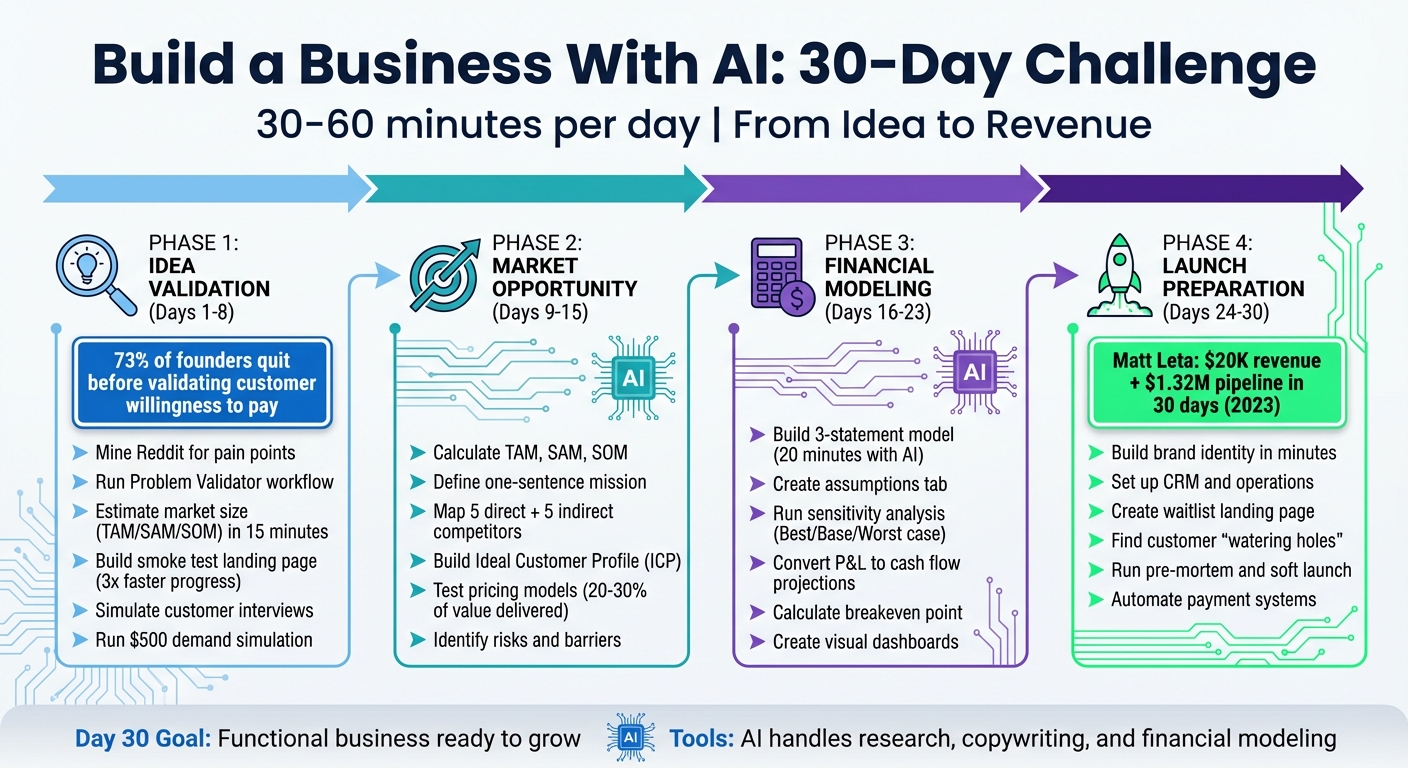
30-Day AI Business Launch Challenge: Step-by-Step Timeline
$215M AI CEO: How I’d Build a Profitable AI Startup in 30 Days (2026 Playbook)
1. Idea Validation
Before diving into development or spending money on marketing, you need to address one vital question: Will people actually pay for this? Here's a sobering fact: 73% of founders give up before confirming whether customers are willing to pay for their solution. This validation phase is critical to avoid becoming part of that statistic. Each step here strengthens your idea’s foundation, preparing you to explore market opportunities in the next section.
1. Mine Reddit for Pain Points
Platforms like Reddit are goldmines for identifying real problems. Tools such as Gummy Search can scan niche communities and pinpoint recurring complaints. With AI, you can analyze thousands of Reddit threads in minutes, uncovering subtle but consistent signs of demand. Pay attention to issues that are mentioned repeatedly - these often signal genuine opportunities.
2. Run the Problem Validator Workflow
Use IdeaFloat’s Problem Validator to confirm that the problem you’ve identified is worth solving. Ideas with clear, specific problem statements tend to move forward faster than vague ones. Ask yourself: Is this solving a pressing pain point, or is it just a "nice-to-have"?
3. Estimate Your Market Size With AI
AI tools can help you quickly calculate your Total Addressable Market (TAM), Serviceable Available Market (SAM), and Serviceable Obtainable Market (SOM) in just 15 minutes using reliable data. These numbers not only guide your decision-making but also provide data that investors trust. This step ensures you're targeting an opportunity that’s worth pursuing.
4. Build a Smoke Test Landing Page
A simple landing page can validate your idea before you even build a product. Tools like Base44 or Google Forms make it easy to create a single-page site to collect email signups. Founders who transition from ideation to testing with a landing page tend to progress three times faster. For instance, in 2025, Jennifer L. used an AI-powered tool to identify 23 niche online communities, which led to 50 signups for her SaaS product within two weeks.
5. Simulate Customer Interviews With AI
AI-simulated interviews can help you refine your pitch and identify objections early on. This approach allows you to address potential deal-breakers and strengthen your messaging before reaching out to a broader audience.
6. Test Founder-Problem Fit
Validation isn’t just about the market - it’s about you, too. Do you have personal experience or unique insights into the industry you’re targeting? These "unfair insights" can help you develop solutions that feel more authentic and effective.
7. Run a $500 Demand Simulation
Using ChatGPT, you can simulate key metrics like click-through rates (CTR), conversion rates, and customer acquisition costs (CAC) based on industry benchmarks. This allows you to test whether a $500 ad spend could realistically lead to sales.
8. Define Your Minimum Feature Set
Use AI prompts to distill your product down to its core value. Your first version should focus on solving one problem exceptionally well. As Andrew Wood from AI Prompt Hackers puts it:
"Your first version should make you mildly embarrassed when you show it to people. If it doesn't, you've built too much."
Take the example of Marcus T., an e-commerce entrepreneur who, in 2025, used AI validation tools to complete market research and pricing in just two hours. This effort, which would have taken months manually, helped him generate $5,000 in revenue during the first month of his side hustle.
2. Market Opportunity
Now that you've confirmed your idea addresses a genuine problem, it's time to assess its market potential. This step determines whether your idea can generate meaningful revenue or if profitability will be a challenge.
1. Calculate Your TAM, SAM, and SOM
Understanding your market begins with defining three key metrics: Total Addressable Market (TAM), Serviceable Available Market (SAM), and Serviceable Obtainable Market (SOM). These metrics help quantify the size of your opportunity:
- TAM: The total revenue opportunity if you captured 100% of the market.
- SAM: The portion of TAM that aligns with your specific product and target geography.
- SOM: The realistic share of SAM you can secure in the first 1-3 years.
AI tools like IdeaFloat's Smart Market Sizing can calculate these figures in just 15 minutes, providing reliable data that investors trust.
2. Define Your One-Sentence Mission
Craft a concise mission statement that clearly defines your market position. Use this format:
"We help [audience] achieve [outcome] through [unique AI approach] without [main pain point]."
This forces you to focus on your audience and what sets your solution apart.
"The riches are in the niches"
Max Anh, Founder of AI Fire, emphasizes the importance of specificity. For example, "AI-powered scheduling for dental practices" is far more effective than a broad statement like "AI for healthcare".
3. Map Competitive Gaps
Analyze at least five direct and five indirect competitors to uncover weaknesses in their customer service, pricing, or features. AI tools can help you dig into real customer feedback on platforms like Reddit, industry forums, and review sites. Pay attention to recurring complaints - these gaps signal opportunities for your AI solution to stand out with better, faster, or more affordable options.
4. Build Your Ideal Customer Profile (ICP)
Move beyond basic demographics to create a detailed Ideal Customer Profile (ICP). Use AI-powered profiling tools to explore psychographics, behavioral trends, pain points, and even where your target customers spend time online. Knowing these details will help you refine your targeting strategy.
5. Measure Problem Urgency and Severity
Assess whether the problem you're solving is both widespread and urgent enough to support a business. AI tools can scan the web for "weak signals" of demand, such as mentions, complaints, or discussions that indicate people are actively seeking a solution. If the issue isn't pressing, potential customers may deprioritize paying for it.
6. Test Pricing Models Against the Market
Experiment with pricing structures like subscriptions, freemium models, or usage-based fees, while benchmarking against competitors. A useful guideline is to price your service at 20-30% of the value it delivers. For instance, if your AI tool saves a business $10,000 per month, a $2,000 monthly fee is not just reasonable - it’s a win-win.
"Sell them the destination, not the airplane. Your clients do not care about your complex machine learning algorithms; they care about saving time, reducing costs, and growing their revenue"
Max Anh advises focusing on the outcomes your product delivers rather than its technical intricacies.
7. Identify Risks and Barriers
Anticipate challenges by categorizing risks into market, operational, financial, and regulatory/legal categories. Assign likelihood and impact scores to each risk. This proactive approach not only helps you address potential roadblocks early but also shows investors you’ve thoroughly considered the obstacles ahead.
sbb-itb-08dd11e
3. Financial Modeling
Your market opportunity is solid. Now, it’s time to translate that into a financial model that shows profitability. This step turns strategic ideas into concrete, actionable numbers. Thanks to AI, what used to take weeks of manual effort in spreadsheets can now be done in just a few hours.
1. Build Your Three-Statement Model
Start with the basics that every investor expects: the Income Statement, Balance Sheet, and Cash Flow Statement. AI tools such as ChatGPT, Claude, or Gemini can create these frameworks in about 20 minutes using your initial business assumptions. Work through each statement step-by-step - revenue, COGS, and operating expenses - to make troubleshooting easier.
2. Create a Dedicated Assumptions Tab
Instead of hard-coding numbers directly into your calculations, keep a separate "Assumptions" tab in your spreadsheet. This is where you’ll store variables like pricing, growth rates, customer acquisition costs, and churn rates. This setup not only makes your model easier to update but also simplifies audits. AI can help you structure this tab and link it to your calculations seamlessly.
"Treat ChatGPT not as the final decision-maker, but as an efficient analyst. It's brilliant at tasks that follow established patterns, but it lacks the contextual understanding of your specific business." – Spencer Lanoue, Product Builder
3. Generate Complex Formulas Instantly
AI can save you time by generating formulas for metrics like MRR, lifetime value, and churn. All you need to do is describe your requirements in plain English, such as: “Calculate MRR growth based on new customers, upgrades, downgrades, and cancellations.”
4. Run Sensitivity Analysis on Key Variables
Test how changes in your key assumptions impact outcomes. AI can quickly create Best Case, Base Case, and Worst Case scenarios, helping you identify which variables have the biggest influence on your results. For example, explore what happens if your customer acquisition cost rises by 25% or if revenue growth slows by 50%. This analysis highlights areas where you should focus on reducing risks.
5. Convert P&L to Cash Flow Projections
Profitability on paper doesn’t always mean smooth sailing. Cash flow is critical to survival. Use AI to turn your profit and loss forecasts into cash flow projections that reflect real-world factors like 45-day payment cycles or upfront inventory costs. This ensures you avoid the “profitable bankruptcy” scenario, where you run out of cash while waiting for receivables.
6. Validate Against Industry Benchmarks
Make sure your projections align with industry norms. AI can help you compare your numbers to relevant benchmarks. For instance, if your model predicts 300% year-over-year growth with no increase in headcount, it’s worth revisiting your assumptions unless you have strong evidence to back up those figures.
7. Calculate Your Breakeven Point
Tools like IdeaFloat’s Financial Projections & Breakeven Analysis can help you pinpoint when your revenue will surpass your costs on a month-by-month basis. This insight is invaluable for understanding your runway, funding needs, and timeline to profitability. Interactive graphs also make it easier to present your financial path to investors.
8. Create Visual Dashboards for Stakeholders
Numbers are important, but visuals often tell a better story. Use AI tools to turn your spreadsheet data into clear, easy-to-understand dashboards. Investors and partners prefer seeing a concise visual representation of your financial trajectory rather than digging through endless rows of data. These dashboards ensure your financial story is both clear and impactful.
A well-constructed financial model not only guides your decisions but also builds trust with investors and partners. It’s your roadmap to turning opportunity into measurable success.
4. Launch Preparation
Your financial model is ready, and now it’s time to move quickly. With AI, you can get your Minimum Viable Service (MVS) in front of real customers in just days. These steps build directly on your validated idea and financial groundwork, helping you launch with confidence.
1. Build Your Brand Identity in Minutes
As you gear up for launch, tools like Canva or Figma can help you create a professional logo and define a cohesive color scheme. For an even faster option, try IdeaFloat's Logo Generator to explore multiple logo designs and establish brand guidelines. A consistent visual identity helps build trust right from the start.
2. Set Up Your Operational Backbone
Start with a reliable CRM like HubSpot’s free tier and use AI to craft personalized follow-ups for your customers. Pair this with project management tools such as Notion AI (around $8–$10 per member per month) or Asana to keep your operations streamlined. Integrating these tools ensures you remain organized and adaptable as you scale beyond the initial validation stage.
3. Create Your Waitlist Landing Page
A simple one-page website is a great way to capture early interest and feedback before your official launch. Tools like IdeaFloat's Waitlist Landing Page can help you generate persuasive copy and collect emails effectively. Focus on the benefits your service provides - like saving time or cutting costs - rather than just highlighting the technology behind it.
4. Find Your Customers' "Watering Holes"
AI can help you pinpoint online communities where your target audience spends time. Use IdeaFloat's Community Launch Map to craft posts tailored to each platform, ensuring your messaging resonates with the specific audience you’re trying to reach.
5. Run a "Pre-Mortem" and Soft Launch
Before going public, use AI to identify the top 10 potential objections your customers might have and prepare value-driven responses. Then, do a soft launch with your warm network - friends, former colleagues, and LinkedIn connections. Aim to spark 3–5 meaningful conversations and collect early testimonials to build credibility.
"The market will give you the feedback you need to improve. You cannot learn and iterate on a product that doesn't exist. Get in the arena." – Max Anh, AI Fire
6. Automate Your Financial Backend
Set up payment systems like Stripe or PayPal to start accepting payments immediately. Use a "Good, Better, Best" pricing model and price your service based on the value delivered - typically 20–30% of the value you provide - rather than charging hourly rates.
In May 2023, entrepreneur Matt Leta completed a 30-day "AI-Assisted Startup" challenge with GPT-4 as his partner. By Day 30, his company, Future Works, had built a $1.32 million sales pipeline and generated $20,000 in revenue. Leta used AI to craft the brand, narrative, and pitch decks in just 9 days, helping one client raise over $10 million. During the challenge, his venture also gained 23,900 new social media followers.
The goal isn’t to have everything perfect before launch - it’s to get started and learn from real customer feedback.
Conclusion
You now have a clear, step-by-step guide to launch a business using AI in just 30 days. This challenge is all about cutting through delays and getting your idea in front of paying customers as fast as possible. Back in 2024, Paul Cheek showcased this approach by building a fully functional AI-powered business in just 30 minutes. Using tools like Gummy Search for identifying problems and NotebookLM for organizing knowledge, he created a validated business plan, a brand identity, and even a working product prototype.
With the groundwork laid, it’s time to turn that foundation into real momentum. The framework you’ve followed - covering idea validation, market research, financial planning, and launch preparation - removes the guesswork that often derails most business ideas before they even see the light of day. AI isn’t replacing your decision-making; it’s amplifying your ability to analyze data and create content, freeing you to focus on strategy, building connections, and understanding your audience. As Paul Cheek aptly says:
"Speed is the new unfair advantage. The cycle time from idea to execution has collapsed".
The aim isn’t perfection before launch - it’s about starting, learning, and iterating based on real customer feedback. Now, it’s time to commit.
With your idea validated, market-sized, and financially modeled, the next step is straightforward: set aside 30–60 minutes a day and stick to the challenge. Resist the temptation to chase every shiny new AI tool or change direction halfway through. Success comes to those who follow the system, prioritize progress over perfection, and get their Minimum Viable Service into the hands of customers quickly. It’s worth noting that 73% of founders quit before they even find out if customers are willing to pay for their idea.
Max Anh from AI Fire puts it best:
"Information without action is just entertainment".
Your 30-day journey begins now. Take that first step, trust the process, and let AI take care of the heavy lifting as you bring your business to life.
FAQs
How can AI help validate a business idea quickly and effectively?
AI can speed up the process of validating a business idea by offering data-backed insights that would otherwise take weeks or months to compile manually. With the help of AI tools, entrepreneurs can analyze market trends, pinpoint customer needs, and assess the competition with just a few targeted prompts. This allows for quicker, more informed decision-making.
On top of that, AI can handle tasks like conducting a SWOT analysis or checking financial feasibility in a matter of minutes. These tools provide a detailed look at potential strengths, weaknesses, opportunities, and risks, all while using real-time data. This approach not only saves time but also improves accuracy, making the entire process more dependable.
By leveraging AI, entrepreneurs can test ideas, gauge market demand, and fine-tune their strategies in just a few days. This minimizes the need for lengthy research and increases the likelihood of success right from the beginning.
What are the best AI tools to help create an MVP?
To create a Minimum Viable Product (MVP) quickly and efficiently, several AI tools can take the hassle out of key development stages. For market research and idea validation, tools like ChatGPT and Claude are great for brainstorming product concepts, gathering insights, and understanding customer pain points. Moving on to design, platforms like Canva and Beautiful.ai make it simple to craft professional visuals and pitch decks in just a few hours. For coding and UI development, solutions like Replit AI, Builder.io, and V0.dev allow founders to build functional prototypes with minimal coding effort.
By using these tools, entrepreneurs can streamline the MVP process - validating, designing, and launching their ideas in as little as 30 days.
How can AI make financial modeling easier for startups?
AI simplifies financial modeling for startups by automating intricate calculations and delivering fast, data-driven insights. It can handle tasks like generating financial projections, estimating costs, forecasting revenues, and simulating different scenarios - all without the need for extensive manual input or advanced financial skills.
These tools also pull in real-time market and competitor data, enabling startups to fine-tune their assumptions and adjust their models on the fly. This dynamic approach helps entrepreneurs validate their strategies, pinpoint potential risks, and allocate resources more effectively. By minimizing errors and saving valuable time, AI makes financial planning more straightforward, allowing startups to create accurate and dependable models with less effort.
Related Blog Posts
- How to Create a Compelling Business Plan in 24 Hours
- I Validated My Business Idea in 24 Hours - Here's The Exact Process
- Idea to First Customer in 14 Days: Scripts, Templates, Checklist
- Validate Any Business Idea With ChatGPT: 12 Prompts That Don’t Suck