Want to earn $5,000 a month with minimal startup costs? Starting a mobile car detailing business is a low-cost, high-profit opportunity. With just $400–$600 for basic equipment and your personal vehicle, you can tap into a $14.74 billion industry growing at 2.1% annually. This business model avoids expensive overhead, offers flexible hours, and serves a growing demand for convenient, premium services.
Key Takeaways:
- Startup Costs: $400–$600 for basic tools.
- Earnings Potential: $5,000–$15,000/month; top earners make $147,000/year.
- Profit Margins: 60%–70% due to low overhead.
- Service Pricing: $150–$400 per job.
- Demand Drivers: Convenience, quality, and growing vehicle ownership.
Learn car detailing skills, set up your business legally, and market smartly to build a loyal customer base. Start small, stay consistent, and scale with premium services like ceramic coatings. This guide breaks down every step to help you launch and grow your business.
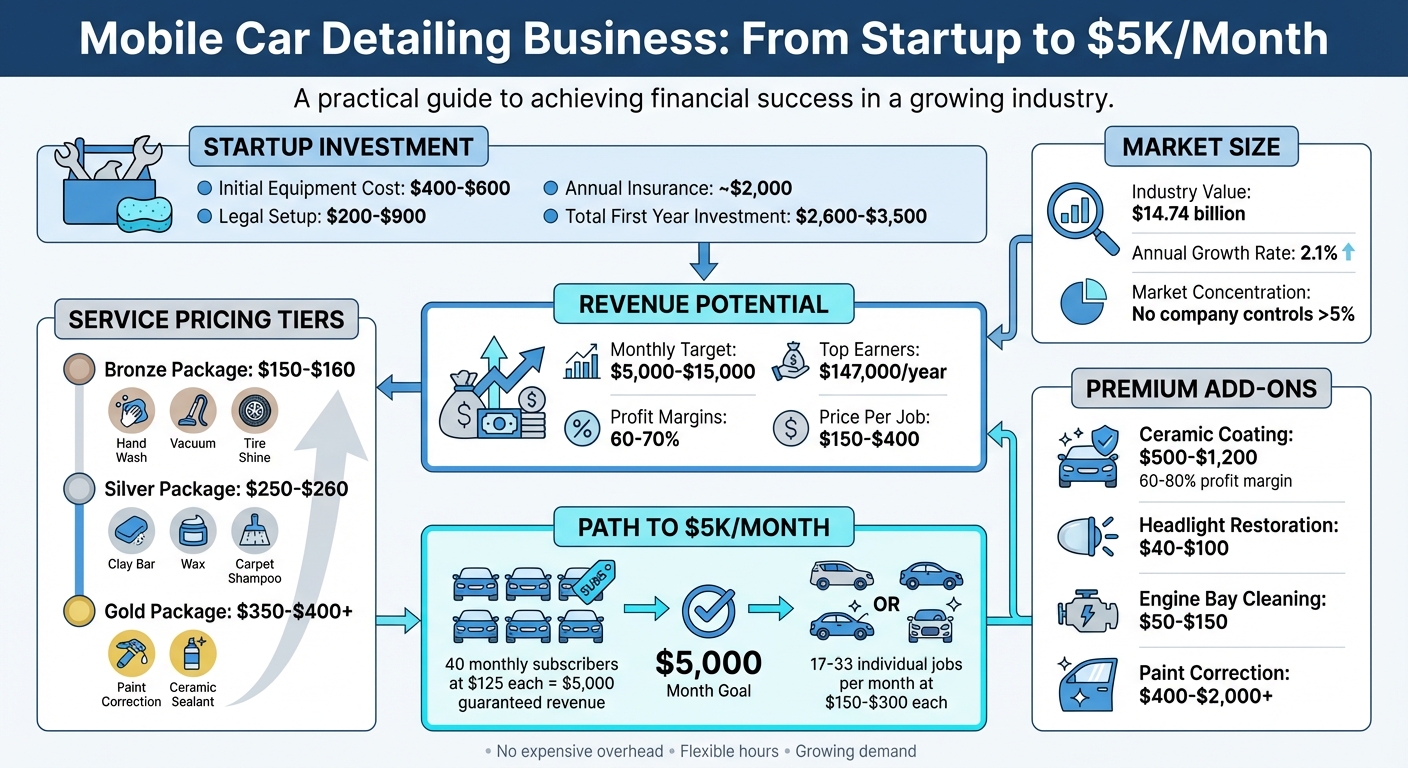
Mobile Car Detailing Business Startup Costs and Revenue Potential
How to Start a Mobile Car Detailing Business with ONLY $600 in 2025 (Step-by-Step)
sbb-itb-08dd11e
Step 1: Learn Car Detailing Skills
If you're aiming to earn $5,000 a month through car detailing, mastering professional skills is where it all begins. Customers expect more than a basic car wash - they’re paying for precision and quality. As Oleksandr Bratkov, founder of Fresh Layer Mobile Detailing, explains:
The real difference between mobile detailing and a regular car wash? Quality and attention to detail. You're spending 2-4 hours per vehicle instead of 15 minutes, and customers notice.
To meet these expectations, you need to develop both technique and muscle memory. Start by focusing on the fundamentals to consistently deliver top-tier results.
Learn Core Detailing Methods
A strong foundation in core detailing methods is essential. Begin with the two-bucket method - one bucket for soap and one for rinsing - to reduce the risk of scratches. Next, learn clay bar decontamination to remove contaminants that regular washing can't handle. For interiors, focus on vacuuming techniques, steam cleaning upholstery, and leather conditioning.
As you progress, advanced techniques like paint correction using a dual-action (DA) polisher can help remove swirls and scratches, while applying ceramic coatings can boost your profits compared to traditional waxing.
Not sure where to start? Free YouTube channels like AMMONYC, Pan The Organizer, and Chicago Auto Pros offer step-by-step tutorials with visual demonstrations. If you want to further boost your credibility, consider certification through the International Detailing Association (IDA). While optional, it can justify higher pricing down the line.
Practice on Personal Vehicles First
Before working on paying customers' cars, practice is key. Your own car - or those of friends and family - can serve as your training ground. Aim to complete 10-20 "pilot jobs" for free or at discounted rates. This not only sharpens your skills but also builds your portfolio and earns you valuable feedback and reviews.
For advanced techniques like paint correction, practice on scrap body panels from a junkyard before touching a customer's car. Skipping this step could lead to costly mistakes, as James, a detailing student, learned the hard way: "I wasted two months when I could've been making money". Always take high-quality before-and-after photos of your work to showcase your progress on social media.
Get Familiar with Tools and Products
The right tools make all the difference. Start with essentials like:
- Microfiber towels (color-coded to avoid cross-contamination)
- A shop-grade wet/dry vacuum (4-6 HP)
- Wash buckets with grit guards
- pH-neutral car soap
- All-purpose cleaner and glass cleaner
For exterior work, a pressure washer (1,200-1,500 PSI for paint safety) and a foam cannon can make washing more efficient. Invest in a dual-action polisher ($150-$400), which is beginner-friendly compared to rotary buffers.
You can assemble a basic kit for $300-$600, upgrading only after you start earning revenue. Once you find your favorite products, buy in bulk to save money. Also, learn rinseless wash techniques using products like Optimum No Rinse, which use just 1-3 gallons of water per car. This is especially important when working in areas with water restrictions or where runoff is an issue, such as apartment complexes or office parks.
Step 2: Set Up Your Business Legally
Once you've mastered your detailing skills, it's time to take the next step: making your business official. A proper legal setup not only protects your personal assets but also establishes credibility with potential customers. Plus, it ensures you're operating within the law. The process typically takes 2–6 weeks and costs anywhere from $200 to $900 upfront.
Pick a Business Structure and Register
The first step is choosing a legal structure for your business. If you want a simple and low-cost option, you could operate as a sole proprietorship. However, this setup leaves your personal assets - like your home or car - at risk if your business faces legal issues. For better protection, many mobile detailers choose to form an LLC (Limited Liability Company). While setting up an LLC generally costs between $100 and $500, it provides stronger liability protection.
As BusinessGuru.co puts it:
One of the most important legal decisions is choosing the right business structure... For small mobile service businesses, the LLC provides liability protection without over-complicating finances and taxes.
Once you've selected your structure, you'll need to obtain an IRS Employer Identification Number (EIN). This number, which you can get online in about 10 minutes for free, is essential for opening a business bank account. You'll also need to register for a sales tax permit through your state's Department of Revenue website. This allows you to legally collect and remit sales tax, which typically ranges from 2% to 7% depending on your location.
Next, secure a general business license. Costs vary by location but typically range from $50 to $400. If you're in a state with strict environmental regulations, like California, you might also need a water discharge permit. To avoid potential compliance issues, research local water laws before buying equipment. In some cases, using rinseless wash systems can help you sidestep additional permit requirements.
With your legal setup complete, it's time to lay the groundwork for your business strategy.
Write a Basic Business Plan
A business plan doesn’t have to be overly detailed, but having one can significantly improve your chances of success - by as much as 30%. Start by identifying your target customers, such as professionals with tight schedules, luxury car owners, or fleet managers. Then, outline the services you'll offer, whether it's basic washes, interior detailing, or more advanced options like paint correction. Set clear financial goals, such as earning $5,000 per month.
Your plan should also include a simple financial projection. Estimate your startup costs, monthly expenses (like insurance, supplies, and fuel), and expected income. Additionally, map out operational details such as your service area, hours of operation, and how you'll handle scheduling. This plan will serve as a roadmap for your business and can be a useful tool if you ever need to secure funding.
Once your plan is ready, the next step is to safeguard your business with the right insurance.
Get Business Insurance
Insurance is a must for protecting your business from unexpected issues. General liability insurance, which covers property damage or injuries, typically costs $50 to $100 per month (or $500 to $1,200 annually). For additional protection, you'll need garagekeepers insurance - also known as bailee coverage - to safeguard customers' vehicles while they’re in your care.
Because you'll be driving to clients, commercial auto insurance is another requirement. Personal auto insurance policies won’t cover business-related use, and commercial coverage usually costs between $600 and $1,800 annually. A comprehensive insurance package covering all these areas will likely run around $2,000 per year.
Oleksandr Bratkov, founder of Fresh Layer Mobile Detailing, shares his experience:
I pay about $2,000 annually for comprehensive coverage through a business insurance package. It's saved me once when a customer claimed I scratched their paint (I didn't - the camera I installed proved it).
Keep a copy of your insurance certificate handy. It not only helps build trust with your clients but also reinforces your professionalism.
Step 3: Launch with Little to No Money
With your legal groundwork set, it’s time to start serving customers - even on a tight budget. Believe it or not, you can kick off a mobile detailing business with just $300 to $600 for basic equipment. The trick? Focus on the essentials and upgrade as your revenue grows.
Buy Used or Discounted Equipment
The first step is gathering the key tools to deliver quality results. Start with a portable wet/dry vacuum - models like the 4-gallon RIDGID range from $40 to $100. For washing, a basic pressure washer costs $100 to $170. Alternatively, you can use rinseless wash products like Optimum No Rinse (ONR), priced at $20 to $40. ONR is a great option because it only requires 1 to 3 gallons of water per car, compared to the 20 to 60 gallons needed for traditional washing.
Stock up on microfiber towels (50+ for $30 to $50), along with buckets, grit guards, all-purpose cleaner, and brushes for interiors and wheels. Big-box retailers like Home Depot often have budget-friendly options for buckets and spray bottles. To stay organized and avoid cross-contamination, consider color-coding your towels - for example, one color for glass, another for paint, and a third for interiors.
As Oleksandr Bratkov, founder of Fresh Layer Mobile Detailing, explains:
Your first few customers won't care if you have the fanciest gear - they care about results.
For transportation, your personal vehicle will work just fine. Keep it clean and organized to maintain a professional image.
Start with Your Personal Vehicle
Whether you drive a sedan, SUV, or small truck, your own vehicle is a great starting point. The key is to keep it tidy and well-organized when showing up at a client’s location - it’s all about projecting professionalism.
Use plastic bins or totes to organize your supplies and prevent leaks in your trunk. A foldable table can help you display your products neatly at the job site, rather than working out of a disorganized vehicle. Carry a 100-foot extension cord and a garden hose to easily access your client’s power and water sources. In the beginning, you can simply ask clients to let you use their home outlets and spigots. This eliminates the need to invest in expensive equipment like a $600+ generator or a $400+ water tank.
Waterless wash methods are especially handy when working from a personal vehicle. These require minimal equipment, making them ideal for locations like apartment complexes or office lots where water runoff is restricted.
Once your setup is ready, shift your focus to attracting customers through cost-effective marketing strategies.
Market Your Business for Free
When you’re ready to find clients, free marketing channels can be a game-changer. Start by creating a Google Business Profile. This tool is essential for local lead generation and can account for around 40% of new customers. Be sure to include your service area, hours, contact info, and high-quality photos.
To build trust and credibility, offer 3 to 5 free or heavily discounted details to friends and family before officially launching. The goal here isn’t to make money - it’s to gather strong before-and-after photos and secure your first 5-star reviews.
Social media platforms like Instagram, TikTok, and Facebook are perfect for showcasing your work. Post before-and-after shots, time-lapse videos, or even quick tips to engage your audience. You can also join local community groups or list your services on Facebook Marketplace to reach nearby customers.
For hyper-local outreach, try a "cloverleaf" strategy: after finishing a job, spend 10 to 15 minutes distributing flyers or door hangers to 10 to 15 homes around your client’s location. Basic business cards and flyers are affordable, costing around $15 to $50. You might also collaborate with local businesses - offer a free detail to a gym owner, barber, or realtor in exchange for displaying your flyers or signs.
To keep things professional, set up a free Google Voice number for business calls and voicemails. Even without vehicle branding, wearing a branded polo or t-shirt adds a polished touch. After completing a job, send customers a direct link to leave a Google review while their satisfaction is fresh.
Take inspiration from Alan Tursunbaev, the 22-year-old founder of GoDetail. In 2022, he scaled his business to $75,000 in monthly revenue, starting with just $500 for supplies while transitioning from high school to college.
Following these steps can help you build a solid customer base and work toward your $5K/month goal.
Step 4: Create Your Brand and Website
Once you've landed your first few clients, it's time to focus on building a professional brand and online presence. These are key to growing your customer base and increasing revenue.
Pick a Name and Design a Logo
Your business name is a huge part of your marketing strategy, so choose it carefully. Research shows that 88% of customers prefer brands with original names. Avoid overly playful or pun-based names like "Suds 'n' Shine" or "Wash Wizards." While they might sound fun, they can come across as less professional and make it harder for customers to find you online.
A smart approach is the "Location + Service" formula - names like "Austin Mobile Auto Detailing" or "Denver Mobile Detailing." This strategy can capture 60-70% of local search traffic and help your business rank 2-3x higher in local search results. For example, a business named "Fort Worth Mobile Detailing" ranked #1 for its local search term and generated over 2,000 monthly website visits and 50-100 inquiries without spending on ads.
If you're targeting premium clients, consider adding terms like "Elite", "Luxury", or "Premium" to your name to reflect higher-end services. This can allow you to charge 20-40% more than standard rates. But keep the name simple and easy to spell - using alternative spellings like "Kleen" instead of "Clean" can lead to 30-40% fewer customers finding you online.
"Save creativity for your tagline, not your business name." - Fresh Layer Mobile Detailing
Before finalizing your name, check that the .com domain is available, social media handles are open, and the name isn’t already trademarked on USPTO.gov. If the .com is taken, try adding words like "Mobile", "Detail", or your city initials (e.g., FreshLayerSD.com). Avoid less professional domain extensions like .biz or .xyz.
Once you've chosen a name, design a simple and professional logo. A clean, high-contrast logo works best - it should be easy to spot from a distance, whether on your vehicle, business cards, or uniforms. You can use free online logo makers or hire a freelancer for $100 to $500 to create a polished design. Display the logo across all your touchpoints to create a "mobile billboard" effect.
Set Up Your Google Business Profile
A Google Business Profile (GBP) is one of the best free tools to attract local customers. It helps your business appear in "near me" searches and can drive up to 40% of new customers. Setting it up is simple: claim your listing, then fill out every field - service area, hours, contact info, and a detailed description of your services.
Add high-quality photos of your work, like before-and-after shots, your vehicle, and your equipment. Visual proof builds trust and makes your business stand out. To boost your profile, send a direct Google review link to customers right after finishing a job. Positive reviews are essential for building credibility and improving your local search ranking.
"Reviews are everything in this business." - Josh Belk, Founder, Belk Mobile Detailing
Ensure your business name is consistent across your GBP, website, and social media. This consistency strengthens your brand and makes it easier for customers to find you.
Build a Simple Website
A basic, mobile-friendly website is crucial for establishing trust and making it easy for customers to book your services. With over 50% of web traffic coming from mobile devices, your site must work seamlessly on phones. A simple one-page website is often enough for a startup.
Use platforms like Wix, Squarespace, or WordPress to build your site for $20 to $40 per month. These platforms often include a free domain for the first year. If you choose WordPress, consider using Bluehost for affordable hosting and purchasing a professional theme for around $50.
Your website should include:
| Essential Website Information | Description |
|---|---|
| Business Name & Location | Clearly state your name and the areas you serve. |
| Contact Information | Provide a phone number, email, and a functional contact form. |
| Service Packages | List tiers like "Maintenance Wash" or "Full Detail" with pricing. |
| Hours of Operation | Specify when customers can book your services. |
| Call to Action (CTA) | Add a clear "Book Now" or "Get a Quote" button. |
| Social Proof | Include before-and-after photos and links to reviews. |
| Trust Signals | Highlight that your business is licensed and insured. |
Avoid design pitfalls like auto-playing videos or poor readability. For example, if you use white text over a background photo, add a dark overlay to make the text stand out. Use a domain-based email (e.g., info@yourbusiness.com) instead of a generic Gmail or Hotmail account to appear more professional.
To make booking easy, integrate a contact form or scheduling tool like Square or Jobber. For SEO, optimize your site with keywords like "mobile detailing [City Name]" in meta descriptions and headers to improve your local search ranking.
For extra help, you can hire freelancers on platforms like Upwork or Fiverr for $80 to $400. A strong brand and online presence will position your business to attract more customers and grow efficiently.
Step 5: Get and Keep Customers
Once your brand and online presence are in place, the next step is to focus on attracting and retaining customers. Hitting $5,000 a month requires smart pricing strategies, referrals, and repeat business.
Set Competitive Prices and Service Packages
Pricing is everything. Set your rates too low, and you’ll end up working harder for less. Set them too high without offering enough value, and customers may look elsewhere. Hillary Walters of Jobber puts it this way:
"Setting the right prices for car detailing can be the difference between running a profitable business or struggling to make ends meet."
To determine your pricing, consider labor, materials, overhead, and your desired markup. For beginners, aim for an effective hourly rate (EHR) of $60 to $90 - or $100 to $150 in pricier cities if you have advanced skills. Materials like chemicals and towels usually make up less than 10–15% of the total service cost.
Mobile services often justify charging 15–25% more than fixed-location shops due to added convenience and travel costs. A tiered pricing model - such as Bronze, Silver, and Gold packages - makes it easier for customers to choose while nudging them toward mid-tier options. For example:
- Bronze Package: Hand wash, vacuum, and tire shine for $150–$160
- Gold Package: Includes paint correction and ceramic sealant, priced at $350–$400+
Always list prices as "starting from" to allow flexibility for factors like excessive pet hair or stubborn stains. Also, inspect the vehicle with the client beforehand to set clear expectations.
Josh Belk of Belk Mobile Detailing started by charging $30 for a two-hour full detail to build his portfolio and gain reviews. As his reputation grew, he raised his rates to $140 per full detail, achieving an hourly rate of $40–$50. This approach helped him hit $6,000 in monthly revenue while still in college.
"The detailer charging $99 for full details is working twice as hard for half the money. Don't be that person." - Oleksandr Bratkov, Fresh Layer
Boost your average ticket by bundling services - combine interior and exterior detailing at a slight discount - or offering add-ons like headlight restoration ($40–$100) or engine bay cleaning ($50–$150). Efficient mobile operations can even achieve profit margins of 60–70%, compared to the typical 15–35% for detailing businesses.
| Package Tier | Services | Price (Sedan) |
|---|---|---|
| Basic/Bronze | Hand wash, tire shine, interior vacuum, dash wipe-down | $150–$160 |
| Deluxe/Silver | Basic plus clay bar, wax, carpet shampoo, leather conditioning | $250–$260 |
| Premium/Gold | Deluxe plus paint correction, steam cleaning, engine bay, ceramic sealant | $350–$400+ |
Once your pricing is solid, use satisfied customers to grow your referral network.
Use Word-of-Mouth Referrals
Referrals are one of the most affordable ways to expand your customer base. Start by offering discounted or free services to friends and family. These early jobs help you collect before-and-after photos and positive reviews.
Online reviews are critical - 87% of people check reviews for local businesses before making a decision. Encourage 5-star reviews by offering small incentives, like 10% off their next service, for leaving feedback.
You can also offer referral discounts, such as $20–$25 off the next service, to encourage repeat business while lowering your customer acquisition costs. Companies with strong referral programs enjoy customer retention rates that are 37% higher.
Josh Belk successfully ran a Mother’s Day Facebook ad campaign in May 2021 for Belk Mobile Detailing, spending just $67. The result? $2,200 in gift card sales in one week. He designed the gift cards using Canva and emailed printable versions to buyers, which doubled as a lead generation tool.
Another effective tactic is offering a "neighbor discount." After finishing a job, leave flyers on nearby cars or offer discounts to neighbors. Seeing your work firsthand often inspires others to book.
Partnerships with local businesses can also drive referrals. For example, realtors may need clean cars for client presentations. Offering them a free initial detail could lead to valuable long-term referrals. And since 80% of consumers research local businesses online before buying, make sure your Google Business Profile and website are always up-to-date.
Keep Customers Coming Back
Retaining customers is far cheaper than finding new ones, so focus on building loyalty. One way to do this is by offering maintenance subscriptions. These recurring plans (e.g., every four weeks) often come with a 15% discount, creating predictable revenue.
Oleksandr Bratkov, founder of Fresh Layer Mobile Detailing, built a loyal base of 40 monthly subscribers, generating over $5,000 in guaranteed revenue before taking on additional jobs. Maintenance plans typically cost $89 to $129 per month, depending on vehicle size.
Automated tools like Square or Jobber can help reduce no-shows by sending appointment confirmations, "on-the-way" texts, and follow-up messages - cutting no-show rates by 20–30%. Email marketing also works well, delivering an average return of $42 for every $1 spent.
Tracking customer preferences with a CRM or even a simple spreadsheet can make your service feel more personal. Remembering small details - like their favorite air freshener scent - can go a long way. Little touches, such as leaving behind a branded air freshener or a care card with maintenance tips, help keep your business top-of-mind.
Seasonal promotions are another way to encourage repeat bookings. For instance, market interior deep cleans in the spring or exterior wax treatments before winter. By segmenting your email list based on past services, you can send more targeted offers.
"Building relationships with potential repeat customers is more important than making a profit on day 1." - Nick Loper, Side Hustle Expert
Step 6: Grow Your Business
Once you’re consistently bringing in $5,000 a month, it’s time to think bigger. Scaling your business doesn’t mean working harder - it means working smarter. By refining your schedule, offering higher-margin services, and hiring help when needed, you can set yourself up for steady growth.
Improve Scheduling and Routes
Inefficient routes eat into both your time and profits. Instead, organize appointments by region to cut down on travel time and fuel costs. For example, dedicate specific days to particular neighborhoods, office parks, or apartment complexes. This approach not only saves money but also allows you to squeeze more jobs into your day.
Another smart move? Target businesses with multiple vehicles. Servicing several cars in one location - like a real estate office or small dealership - can significantly boost your hourly earnings since you’re not wasting time driving between stops. You could even set up “Office Park Days” by coordinating with property managers. Offer a small discount to residents or employees and host a monthly detailing event.
To streamline operations further, consider using business management apps like Housecall Pro, Jobber, or Mobile Tech RX. These tools can handle scheduling, dispatching, and route planning for you. One detailing business saw a 44% revenue increase after implementing such software, and many professionals report revenue boosts of over 35% within their first year of using these tools.
While you’re out in the field, don’t miss opportunities to market yourself. Hand out flyers or door hangers to nearby homes - 10 to 15 is a good number. This simple tactic helps you build a denser customer base in specific areas, making future routes even more efficient. And for jobs outside your main service area, don’t hesitate to charge a travel fee.
Once your schedule is running like clockwork, it’s time to focus on offering services that bring in higher profits.
Add Higher-Priced Services
If you want to hit $10,000 a month, basic washes won’t cut it. The key is offering premium services like ceramic coating and paint correction. These jobs can range from $400 to over $2,000, with chemical costs typically accounting for just 5–15% of the service price.
Upselling is your best friend here. During the initial walk-around, point out any swirl marks, oxidation, or pet hair, and suggest an upgrade on the spot. Services like headlight restoration, engine bay cleaning, and paint correction not only enhance your offerings but also come with excellent profit margins. For instance, ceramic coating - often priced between $500 and $1,200 - can deliver profit margins of 60–80%. Plus, many professionals are happy to pay $200 or more for the convenience of having their vehicle detailed at their office.
"The detailer charging $99 for full details is working twice as hard for half the money. Don't be that person." - Oleksandr Bratkov, Founder, Fresh Layer Mobile Detailing
Bundling these add-ons with existing packages can also help boost your average ticket size. For example, a $250 full detail could easily grow to $425 if the customer adds headlight restoration and engine bay cleaning. Over time, these upsells can become a significant source of revenue.
Hire Part-Time Help
When your schedule is booked two weeks out or you’re turning down jobs, it’s time to bring in help. Hiring an assistant detailer can free you up to focus on high-value services while they handle basic tasks. Take Marcus, a mobile detailing business owner in Jacksonville, as an example. He earns $8,000–$10,000 a month and, after expenses, takes home $4,000–$5,000 in profit while employing two part-time workers.
To ensure quality, create written Standard Operating Procedures (SOPs) and use laminated checklists for each job. Start new hires with simple tasks like wheels and tires, then gradually move them to interiors, exterior washes, and polishing. Short training videos recorded on your phone can also be a great way to teach techniques.
You can also offload customer service and payment processing by using online payment systems or hiring a Virtual Assistant to handle scheduling and minimize no-shows. For tracking hours and job site presence, time-tracking apps with GPS features are very helpful.
"When your schedule is routinely full two weeks out, it's time to consider help." - Wealthanize
Finally, digital payroll services like Gusto or Paychex can help you stay organized as your team grows. With the right systems in place, you can scale your business to $10,000 or more per month - without sacrificing quality or working yourself into the ground.
Conclusion
This guide has laid out a straightforward, low-cost approach to starting a profitable mobile car detailing business. With just $400–$600 in supplies and your personal vehicle, you could potentially earn $5,000 per month while avoiding the burden of high overhead costs. The car wash and detailing industry in the U.S. is worth $10 billion, and with no single company controlling more than 5% of the market, there’s plenty of room for new entrepreneurs to step in.
The key is mastering the basics, setting up your business legally, starting lean, building an online presence, and collecting positive customer reviews. As Josh Belk wisely says:
Consistency always wins.
– Josh Belk
This consistency can lead to strong profit margins - 60% to 70% of your revenue could be yours since you won’t be paying for rent or utilities. Over time, you can expand into premium services like ceramic coatings (which can range from $500 to $1,200+) and build a loyal base of monthly maintenance subscribers for steady income. Once you’re consistently booked out two weeks in advance, it might be time to hire part-time help so you can focus on higher-value services.
The demand for mobile detailing is only increasing, as more people hold on to their cars longer and prioritize convenience over price. Take the first step - set up your Google Business Profile, grab your essential supplies, and start booking jobs this week. Customers care about the results you deliver, not the tools you use.
Don’t wait. Start small, stay consistent, and let your work speak for itself.
FAQs
Do I need a water tank or generator to start?
You don’t need to invest in a water tank or generator to kick off your mobile car detailing business. Plenty of budget-friendly setups work just fine without them, especially if you opt for waterless or low-water-use products. By starting small and using these efficient alternatives, you can keep your startup costs low while still delivering excellent service.
What should I do if a customer says I damaged their car?
If a customer accuses you of damaging their car, it’s essential to stay calm and professional. Start by carefully listening to their concerns without interrupting. Then, assess the damage and compare it to any photos or documentation of the car’s condition before and after the service. If further inspection is required, conduct it thoroughly.
If you determine the damage is your responsibility, own up to it. Offer a fair resolution - this could mean covering repair costs or providing a refund. Also, review your liability insurance to understand what’s covered, and make sure to document the incident in detail for your records. This can be helpful for future reference or similar situations.
How can I get repeat customers fast?
To attract repeat customers in your mobile car detailing business, prioritize outstanding customer service and deliver dependable, top-notch results every time. Make scheduling easy and flexible to accommodate busy clients, and think about introducing loyalty perks or discounts to keep them coming back. A simple follow-up, like a thank-you message or a friendly reminder for their next detailing, can go a long way in showing your appreciation and professionalism. Earning trust and proving reliability can transform one-time customers into loyal clients, enhancing both your income and your reputation.
Related Blog Posts
- How to Start a Pressure Washing Business With Under $1,000
- How to Start a Mobile Car Detailing Business: Complete Guide
- How to Start a Mobile Car Detailing Business: From $0 to $5K/Month
- Mobile Detailing Startup Costs: Packages, Pricing, Profit