
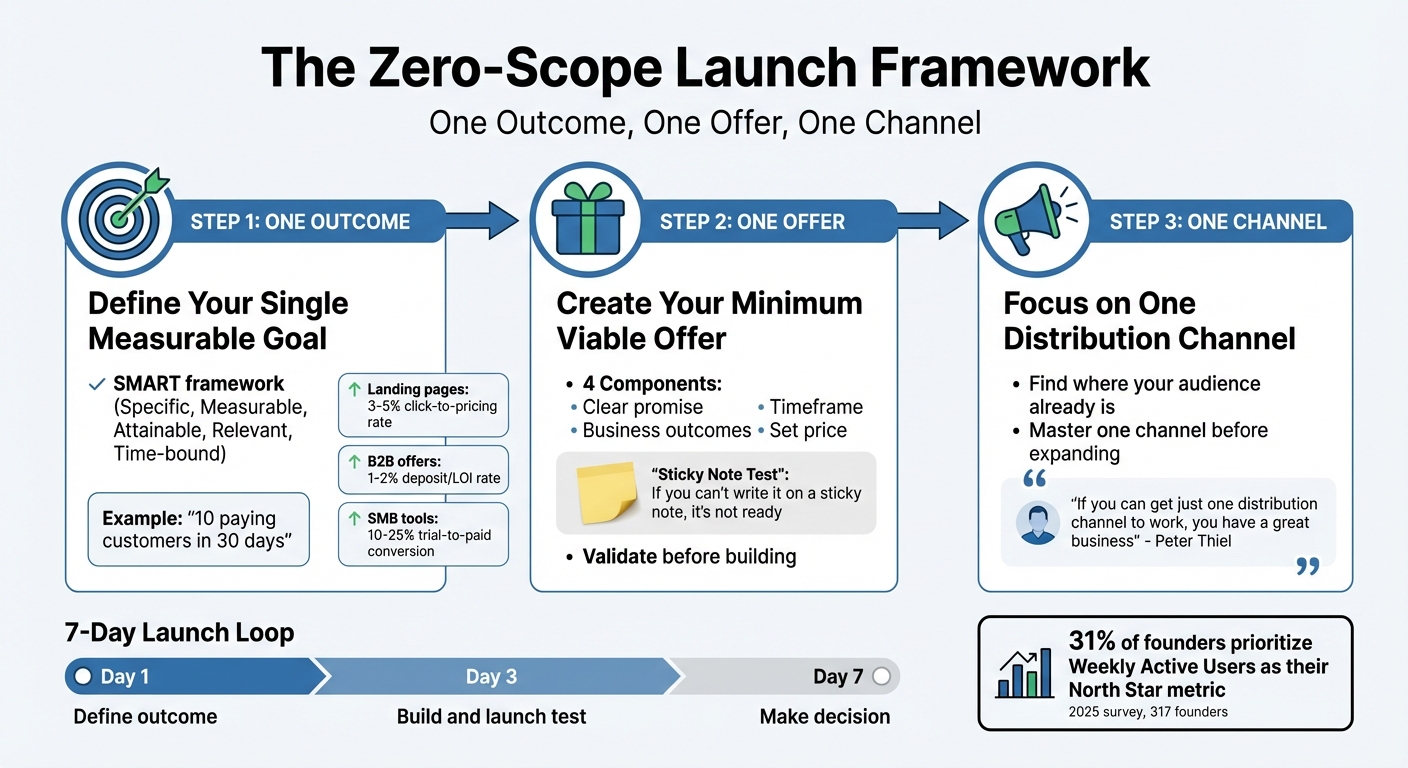
The Zero-Scope Launch simplifies launching a new business or product by focusing on three things: one measurable goal, one clear offer, and one primary channel. Instead of spreading resources thin across multiple areas, this approach allows you to test and validate ideas quickly - sometimes in just hours. Here’s the core idea:
- One Outcome: Define a single, measurable goal (e.g., 10 paying customers in 30 days).
- One Offer: Create a simple, clear solution to a specific problem.
- One Channel: Use one platform where your target audience already spends time.
This method reduces risk, saves time, and ensures you’re building something people will pay for. Tools like landing pages, customer discovery calls, and pre-orders help validate demand before investing heavily. By staying focused, you can learn from the market and refine your offer faster than traditional methods.
The strategy is about starting small, testing quickly, and using data to guide your next steps.
Zero-Scope Launch Framework: 3-Step Process to Validate Your Business Idea
Validate Startup Ideas Fast: 3 Principles for the AI Era
sbb-itb-08dd11e
Step 1: Define Your One Outcome
Before spending a single dollar, you need to clearly define what success looks like for your launch. This isn’t about vague aspirations like “grow my business” or “get more customers.” Instead, focus on a single, measurable outcome that you can prove as true or false within a set timeframe.
Using the SMART framework - Specific, Measurable, Attainable, Relevant, and Time-bound - craft a goal that leaves no room for ambiguity. For example, instead of saying, “I want to make money,” aim for something like: “I will generate $5,000 in revenue from 10 paying customers in 30 days.”
Frame your outcome as a falsifiable hypothesis: “We believe [specific customer segment] will [action] within [timeframe]. Success equals [metric threshold]”. For instance: “We believe freelance designers will purchase a $99 template bundle within 14 days. Success equals 15 sales.” This level of precision ensures every decision you make is supported by data.
"Clarity at this step multiplies everything that follows." - Alex Robb, Founder, Launching Next
Set a Measurable Goal
Focus on metrics that are verifiable and tied directly to your goal. Metrics like revenue, signups, deposits, or conversions are actionable. On the other hand, metrics like pageviews or social media followers are often just vanity stats - they don’t prove anyone is willing to pay for your product.
Here are some benchmarks to guide your expectations:
- Landing pages (early-stage): Aim for a 3-5% click-to-pricing rate on qualified traffic.
- B2B offers: Look for a 1-2% deposit or Letter of Intent (LOI) rate.
- SMB tools with clear utility: Target a 10-25% trial-to-paid conversion rate.
Real-world examples show the power of setting clear outcomes. In October 2025, Sarah K., a SaaS founder, used IdeaFloat’s landing page tools to validate her idea. By zeroing in on a single goal, she achieved 50 signups in Week 2 and converted 3 paying beta customers by Week 3 - without writing a single line of code. Similarly, Marcus T., an e-commerce entrepreneur, leveraged IdeaFloat’s validation tools to launch a side hustle that generated $5,000 in revenue in just one month.
Choose one primary metric - your "North Star" - to guide your efforts. A 2025 survey of 317 founders revealed that 31% prioritized Weekly Active Users, while 28% focused on Trial-to-Paid conversions. Tracking too many metrics at once can scatter your focus and lead to “gaming” the numbers.
It’s also crucial to test early for customer commitment. A waitlist with a deposit or pre-order page gives you a clear signal of intent. If no one is willing to pay upfront, you haven’t validated demand yet.
Tools for Defining Outcomes
IdeaFloat offers several tools to help you define and refine your goals with precision. The Financial Projections tool, for example, allows you to calculate your breakeven point and map out a path to profitability before investing significant time or money. This approach ensures your revenue targets are grounded in actual data, not guesswork.
"Hope is not a revenue model. You need numbers." - IdeaFloat
Another useful resource is IdeaFloat’s Lean Canvas, which helps you create a one-page business summary. This tool aligns your outcome with your unique value proposition and target customer segments. David L., a serial founder, used IdeaFloat’s community finder and positioning tools to identify 23+ online communities. With a clear focus, he secured 30 paying customers within the first month of his venture.
The Problem Validator tool is another game-changer. It allows you to test demand by setting up simple experiments, like a landing page with pricing options, to gauge whether your target audience takes action within your defined timeframe. This not only speeds up decision-making but also provides a clear “go or no-go” signal.
| SMART Component | Description for Launch Outcomes |
|---|---|
| Specific | Focus on a narrow customer segment and a single “job to be done.” |
| Measurable | Use actionable metrics like revenue, signups, or deposits. |
| Attainable | Base your targets on industry benchmarks (e.g., 1-2% B2B conversion). |
| Relevant | Align the goal with long-term profitability and market needs. |
| Time-bound | Set a clear timeframe, such as “within the first 30 days.” |
To maintain momentum, follow a 7-day loop: define your outcome on Day 1, build and launch your test by Day 3, and make a decision by Day 7. This tight schedule forces you to focus on what matters most, cutting through distractions and delays.
With a well-defined outcome, you’re ready to create an offer that delivers real results.
Step 2: Create Your One Offer
Once you've defined a clear outcome, the next step is to design a single offer that drives measurable business results, a core focus of our entrepreneurship blog. Start with a Minimum Viable Offer (MVO) - the simplest version of your solution that delivers a clear and impactful result.
Your offer should include four key elements: a clear promise, specific business outcomes, a defined timeframe, and a set price. For instance, instead of offering something vague like "Marketing Consulting Services", you could present "Launch Your First Profitable Offer in 7 Days". This approach tells customers exactly what they can expect, when they’ll get it, and how success is defined.
Define Your "Lighthouse Client"
Your offer should resonate with a highly specific audience. Instead of targeting broad groups like "small business owners", narrow it down to something like "independent real estate agents in suburban markets". This level of precision allows you to address their pain points directly, using language they relate to. Interestingly, a survey of 317 founders in October 2025 revealed that 31% were still working on identifying the core customer problem. Skipping this step often leads to offers that fail to connect.
"If you can't write the offer on a sticky note, it's not ready." - JD Meier
This is where the "Sticky Note Test" comes in. If you can’t summarize your offer in a few sentences, it’s probably too complicated.
Validate Your Offer
Before investing time and energy into building your offer, confirm that people are willing to pay for it. Validation isn’t about proving your idea is good - it’s about proving people will spend money on it. This can be done by asking for deposits, booking calls, or gauging interest through detailed questions.
"Validation isn't about whether your idea is good. It's about whether people will pay for it." - Ken Yarmosh
Tools like IdeaFloat’s Problem Validator can help you test demand. For example, you could create a simple landing page outlining your offer and price, then measure whether your audience takes action. For B2B offers, a 1-2% deposit or Letter of Intent (LOI) rate is a strong indicator of demand. For landing pages, aim for a 3-5% click-to-pricing rate from qualified traffic.
The "Job to be Done" (JTBD) framework is another way to shape your offer. Frame it like this: "When a user faces a [trigger], they want an [outcome] so they can achieve a [result]". For example: "When a freelance designer needs to quickly create a professional portfolio, they want a ready-to-use template so they can secure higher-paying clients without wasting weeks on design."
Another effective tactic is the 10-Call Rule: conduct at least 10 customer discovery calls. Ask questions like: When was the last time they tried to solve this problem? What tools or services did they use? Where did they encounter friction? What would success look like for them? These insights help you refine your offer and ensure it addresses a problem people are actively trying to solve.
IdeaFloat’s Unique Value Proposition tool can also assist in crafting messaging that resonates with your audience. This tool guides you through creating a one-liner pitch, brand positioning, and strategies for standing out.
Keep It Simple
A zero-scope offer focuses on one core feature or outcome, while a full-scope offer attempts to tackle everything at once. The difference in execution speed and risk is massive:
| Feature | Full-Scope Offer | Zero-Scope Offer |
|---|---|---|
| Core Focus | Comprehensive platform/service | Single core feature or outcome |
| Decision Points | Multiple complex variables | One clear "Yes/No" decision |
| Time to Market | Months of development | 7 to 14 days |
| Execution Speed | Slow (due to infrastructure needs) | Fast (focused on transformation) |
| Risk Level | High (risk of market indifference) | Low (validated before building) |
By stripping your offer down to its essentials, you make it easier for customers to decide: "Does this solve my problem? Yes or no?"
Use the MoSCoW Method to prioritize what goes into your offer: Must have, Should have, Could have, and Will not have (for this iteration). Focus on the "Must have" elements that deliver the main transformation and leave everything else for later.
When testing your offer, isolate variables. Adjust only one factor at a time - such as price, promise, or target audience - so you can clearly identify what’s working. Changing multiple factors simultaneously makes it impossible to pinpoint the cause of any results.
Price Your Offer
Set your price based on the value of the transformation you’re offering. Avoid pricing based on hours worked or the length of your course. Instead, focus on the outcome your customers will achieve.
"The market doesn't care about your idea. It cares about your impact." - JD Meier
Start with a price that tests market willingness. If you’re solving a pressing problem, customers may be willing to pay more than you expect - but you won’t know until you test.
IdeaFloat’s Advanced Pricing Research tool can help with this. It analyzes competitor pricing, applies proven pricing strategies, and helps you find the sweet spot for maximum profit. You can let AI handle the optimization or adjust manually based on competitor insights.
Introduce your price early in the validation process. This filters out unqualified leads and ensures you’re only engaging with serious buyers. If someone clicks away after seeing the price, they weren’t a good fit. But if they stay to learn more or book a call, you’ve validated genuine interest.
For B2B offers, deposits or Letters of Intent (LOI) can confirm willingness to pay before building the full solution. For SMB tools, aim for a 10-25% trial-to-paid conversion rate. These benchmarks help you gauge whether your pricing aligns with customer expectations.
Finally, use IdeaFloat’s Financial Projections tool to ensure your pricing supports a sustainable business model. This tool provides month-by-month revenue and cost projections, helping you confirm profitability before launching.
Once your offer is validated and priced, the next step is choosing the right channel to connect with your target audience.
Step 3: Choose Your One Channel
When starting out, focusing on a single channel to reach your first customers is key. Just as narrowing down your offer and goal simplifies your launch, committing to one channel ensures you can dive deep and make a meaningful impact without spreading your efforts too thin.
Find the Best Channel for Your Audience
The first step is figuring out where your audience already spends their time. Are they scrolling LinkedIn for professional insights, browsing niche subreddits, or tuning into industry podcasts? Targeting these platforms gives you a direct line to your potential customers.
To refine your options, try the Bullseye Framework: brainstorm 20 potential channels, then narrow it down to 3–6 based on where your audience is most active. From there, apply the ICE Framework to score each channel on Impact (potential results), Confidence (likelihood of success), and Ease (resources and cost).
Here are six attributes to consider when evaluating a channel:
- Targeting depth: Can you reach your audience precisely?
- Cost: What are the upfront and ongoing expenses?
- Setup time: How quickly can you start experimenting?
- Time-to-results: How long before you see outcomes?
- Control: Can you easily scale up or pause activity?
- Scale: What’s the potential reach?
For instance, if you're working with a tight two-week launch window, prioritize channels like search engine marketing that deliver quick results. That’s exactly what Boundless did, leveraging Google AdWords for its precise targeting and fast feedback loop.
"Most businesses get zero distribution channels to work… If you can get just one distribution channel to work, you have a great business. If you try for several but don't nail one, you're finished." – Peter Thiel, Author of Zero to One
Your chosen channel should also play to your strengths. Jumping into a platform you don’t understand can lead to weak engagement and a lack of authenticity in your messaging.
"It is better to be one of the top three creators on this topic on Threads than to be the 200th biggest creator on LinkedIn, even though LinkedIn has many more people." – Jason Cohen, Founder of WP Engine
If you're unsure where to start, tools like IdeaFloat’s Community Launch Map can pinpoint where your audience hangs out online. It even provides tailored posts to spark conversations and drive traffic.
Focus Your Resources on One Channel
Once you’ve selected a channel, commit to it fully. Successful startups often find one channel that works and maximize it before exploring others. This focus speeds up testing, learning, and scaling.
Different channels yield different returns over time. For example:
- Paid ads and SEO often require significant upfront investment before delivering results.
- Partnering with newsletters, podcasts, or blogs can provide steadier, consistent returns early on.
Instead of building an audience from scratch, tap into existing communities or influencers who already engage your target market. For example, between August 2023 and February 2024, Retain International combined LinkedIn ads, community building, and direct outreach. Their efforts generated over 150 MQLs and a 193% ROI in just six months.
To make an informed decision, create a channel matrix. Compare options side-by-side using "Low", "Med", or "High" values for cost, scale, and targeting. Tools like Google Keyword Planner (for search volume), Meta Ads Library (to study competitor ads), and Ahrefs (for SEO difficulty) can provide valuable insights. If competitors are running paid ads on a platform, it’s often a good sign the channel works for your industry.
Finally, define your primary goal - whether it’s learning, volume, or cost-efficiency. Trying to achieve all three at once can dilute your efforts. If time is tight, focus on channels with fast results. If budget is limited, prioritize those with low upfront costs.
Step 4: Execute with IdeaFloat Tools
You've outlined your goals, crafted your offer, and chosen the best channel. Now it's time to transform your strategy into real, actionable assets. This is where IdeaFloat's Phase 4 tools come into play, helping you move from validation to polished execution. These tools align seamlessly with your defined goals, refined offer, and selected channel.
Build Your Brand
First impressions matter, and creating a cohesive visual identity is key. With IdeaFloat's Logo Generator, you can design a professional logo and complete brand guidelines in seconds. This ensures that your early tests and landing pages look polished, not like rough drafts. Next, the Branding Guide helps solidify your brand voice and messaging framework, providing a clear playbook to maintain consistency across social posts, emails, and landing pages.
For example, an e-commerce entrepreneur managed to complete their branding in less than two hours, setting the stage for quick revenue generation. When your logo, messaging, and tone are aligned from the beginning, customers are more likely to see your business as established - even if you're just starting out.
Create Your Landing Page
Your landing page is the centerpiece of your launch. IdeaFloat's Waitlist Landing Page tool leverages AI to create a high-conversion page in about five minutes. This page is designed to capture emails and generate buzz before your official launch.
Take Sarah K., a SaaS founder, as an example. In just the second week of her three-week journey with IdeaFloat, she built an AI-powered waitlist page that secured 50 signups before her product was even finalized. By Week 3, three of those signups had converted into paying beta customers. A winning landing page should focus on solving customer pain points, present a clear value proposition, and feature a single, compelling call-to-action - whether that's joining a waitlist or pre-ordering.
To drive traffic to your page, use the Community Launch Map. This tool pinpoints over 23 online communities where your target audience spends time. Jennifer L., another SaaS founder, used this feature to uncover niche communities she wouldn't have found otherwise, helping her secure her first 50 signups in just 14 days.
Use the Launch Checklist
With your branding in place and your landing page live, the next step is to organize your launch activities. The Launch Checklist offers a detailed, step-by-step roadmap to keep your efforts on track. It synchronizes all your assets - branding, landing pages, and community outreach - so everything happens at the right time. Since 34% of founders cite "access to target users" as their main challenge during a launch, having a structured plan ensures you stay focused and avoid getting stuck in endless planning.
"IdeaFloat walks you through a step-by-step plan to discover, validate and launch your business." – Lachlan Nicolson, Business Coach, Leader Guide
When your brand is polished, your landing page is capturing leads, and your checklist is guiding your daily tasks, you're executing a Zero-Scope Launch with precision and purpose.
Measure Results and Improve
To refine your strategy, tracking performance and making data-driven adjustments is essential. The Zero-Scope approach doesn't stop at execution; its strength lies in continuous measurement and iteration.
Track Your Key Metrics
Start by creating a one-page scorecard that highlights your most critical metrics. Focus on key indicators like activation rate, time to value, and 30-day retention.
For successful launches, aim for an activation rate of 40–60% in the first week. Exceptional cases might even hit 70% or higher. If activation rates fall below 40%, it signals that users aren't experiencing the promised value. Similarly, keep an eye on your customer acquisition cost (CAC). If it exceeds one-third of your customer lifetime value, it's time to reassess your channel strategy. A healthy CAC-to-LTV ratio is 3:1.
"If a metric does not change what you do next, it does not belong in your launch dashboard." - CommerceCentric
Monitor these metrics in real-time to understand where your revenue comes from and where it’s spent. Break down conversion rates by traffic source - organic, paid, or social - to identify which channels bring in the highest-quality leads and assess your market size. If fewer than 30–40% of your pre-launch email list opens or clicks your launch emails, it could mean your positioning or targeting needs work before scaling.
Use Data to Improve Your Launch
After 4–8 weeks of collecting data, analyze what’s working and what needs adjustment. Beyond metrics, pay attention to user feedback, especially from "somewhat disappointed" users - those who see value in your product but encounter specific barriers. These users are at a tipping point and could become loyal advocates if their concerns are addressed.
Take inspiration from Superhuman CEO Rahul Vohra, who used this approach to boost their product-market fit score from 22% to 58% in just three quarters. By surveying users and asking how they'd feel if they could no longer use the product, Vohra pinpointed that the absence of a mobile app was frustrating "somewhat disappointed" users. He split his roadmap: half focused on enhancing what "very disappointed" users loved (speed and shortcuts), while the other half tackled the mobile app issue. This dual focus led to a significant jump in user satisfaction and retention.
"If you only double down on what users love, your product-market fit score won't increase. If you only address what holds users back, your competition will likely overtake you." - Rahul Vohra, Founder and CEO, Superhuman
Prioritize big wins - look for 2x or 3x improvements in key metrics within specific user segments, rather than chasing minor 5% gains. For example, if your time to value is too high, simplify onboarding with in-app guides or product tours. If retention drops after Day 7, it might indicate a mismatch between your launch promise and the actual user experience. Use these insights to tweak your offer, refine messaging, or streamline the user journey before scaling to new channels.
Research from Bain & Company shows that increasing customer retention rates by just 5% can boost profits by 29% to 95%. This makes post-launch analysis a critical step for growth. Establish data-driven rules to decide when to scale, pivot, or pause before expanding. This disciplined approach ensures you're building on proven successes rather than relying on guesswork, reinforcing the Zero-Scope Launch strategy's focus on consistent validation and optimization.
Conclusion: Start Small, Build Fast
The Zero-Scope Launch strategy minimizes risk by testing your offer with a small, focused audience before scaling it further. Instead of spending months developing a product without validation, this method helps you confirm demand, gather insights, and refine your offer. The result? You gain a speed advantage, moving from idea to a live product in record time.
Momentum beats perfection. Innovation expert Stephen Shapiro highlights how launching quickly - sometimes within hours - can generate valuable lessons without sacrificing quality. Real-world success stories back this up. For instance, entrepreneur Tom Morkes earned $41,000 in revenue by pre-selling the concept of his incubator program before building it.
Your first launch isn’t about going big - it’s about finding the right signal. Keep it simple: one goal, one offer, and one channel. Tools like IdeaFloat can help you create your brand, design your landing page, and follow a clear launch checklist. Once you’ve validated your concept with 5–10 ideal customers, you’ll have the foundation to launch and scale up your business.
Start small, move fast, and let data shape your decisions - the market rewards action over hesitation. This approach captures the essence of the Zero-Scope philosophy: rapid learning, smart adjustments, and confident growth.
FAQs
How do I pick the right one outcome?
Start by identifying a goal that directly supports your business objectives and speaks to your target audience. Think about the main issue your product addresses and make sure the result connects with what your customers care about most. Choose something you can measure - like early sales numbers, user activity, or customer feedback - and confirm it’s realistic given your current resources. Having a focused, well-defined goal not only streamlines your launch but also boosts your likelihood of success.
What should my minimum viable offer include?
Your minimum viable offer should present a straightforward and targeted solution that meets a specific need or achieves a single desired result. The goal is to provide enough value to test your idea and draw in early customers, all while keeping the approach focused and effective.
How do I choose my best one channel?
To find the right channel for your launch, start by pinpointing where your target audience spends the most time and interacts the most. Are they scrolling through social media, checking their email, or engaging on niche industry platforms? Once you’ve identified their go-to spots, test your messaging and pricing on those platforms. The best channel will be the one where your audience is both attentive and open to your value, allowing you to clearly communicate and confirm your offering.
Related Blog Posts
- IdeaFloat: The 15-Minute Business Plan Solution
- Launch Weekend: How to Get Your First 100 Customers in 48 Hours
- The 5-Day Business Validation Challenge That Actually Works
- Idea to Website: The 1-Page Site That Converts Without Social Media