Pool cleaning is a thriving $8.8 billion industry projected to grow steadily by 2026. With over 78,000 businesses nationwide, it's a prime opportunity for small operators to earn $80,000–$100,000 annually while managing 40–50 accounts. Success hinges on three key areas:
- Efficient Routes: Group clients geographically, use tools like OptimoRoute or Zeo Route Planner, and aim for 12–18 pools/day. This can cut drive time by 35% and save $140/month in fuel costs.
- Smart Pricing: Calculate costs per visit, include profit margins (12–25%), and offer tiered packages (e.g., Basic, Partial, Full Service).
- Safety Protocols: Proper chemical handling, protective gear, and liability insurance protect employees, clients, and your business.
How To Start a Pool Service Business ($277K/year)
sbb-itb-08dd11e
How to Plan Efficient Service Routes
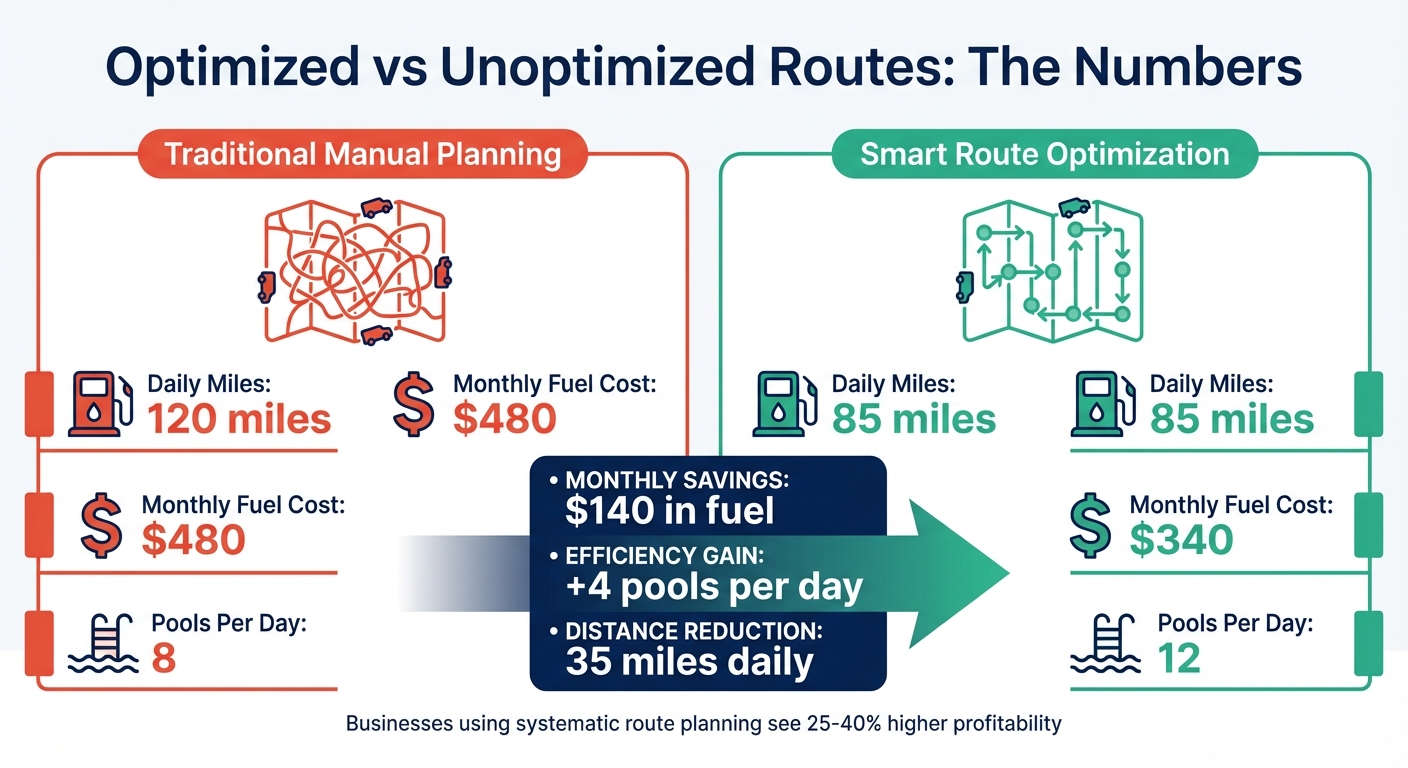
Optimized vs Unoptimized Pool Cleaning Routes: Cost and Efficiency Comparison
Wasting hours on inefficient routes isn't just frustrating - it directly cuts into your team's productivity. The key? Smart scheduling and grouping clients by location to maximize time spent on billable work.
Group Clients by Location
Start by dividing your service area into clear geographic zones. For example, focus on the North Zone on Monday, the East Zone on Tuesday, and so on. This approach naturally clusters clients and trims travel time significantly [7, 14]. Aim to centralize each cluster with 3–4 clients within a 2-mile radius. Use natural boundaries like highways, rivers, or city limits to avoid technicians crossing high-traffic areas unnecessarily.
For clients in remote areas, consider batching multiple visits in one trip or applying a 20–30% premium to offset extra travel costs. Another tip: group similar job types - like chemical-only visits versus full maintenance - so technicians carry only the tools and supplies they need, avoiding extra trips back to the office [13, 14]. When scheduling, start with the furthest client and work your way back toward the office. This strategy helps avoid peak traffic (4:30–6:30 PM) and school zone delays (2:30–3:30 PM) [7, 14].
Once your clusters are set, use technology to streamline your planning even further.
Route Optimization Tools and Software
Planning routes manually can be tedious and often leads to inefficiencies. Modern software eliminates the guesswork, adjusting schedules in real-time based on traffic and other variables. For instance, Gallagher Pools and Spas in Westminster, Maryland, used OptimoRoute to cut planning time in half and save each technician up to an hour of driving daily.
Mike Chen of AquaCare Pool Services scaled his team from 2 to 8 technicians in 2025 by using Zeo Route Planner. This AI-powered tool helped him restructure service areas, cutting drive time by 35% and enabling each technician to service 3–4 additional pools daily. The result? A 180% revenue boost in just six months.
Other tools like PoolBrain simplify routing with a single "Optimize Route" button powered by Google's API, allowing custom start points such as a technician's home. PoolOps offers a free starter plan (up to 5 customers) and an affordable Pro plan at $29.99/month for unlimited clients. Skimmer takes a visual approach, using colored pins to highlight route overlaps during quarterly audits.
Balance Schedule Capacity and Service Quality
Efficient routing isn’t just about squeezing in more stops - it’s about maintaining quality. Overloading schedules leads to rushed jobs and unhappy customers. Ideally, travel time should account for no more than 25–30% of a technician’s workday. With residential pool cleanings typically taking 20–30 minutes, a well-planned route allows for 12–18 stops per day.
To keep things running smoothly, schedule 2-hour service windows and include a 1-hour daily buffer for emergencies or delays [7, 14]. Structure the day by job type: handle regular maintenance (30–45 minutes) in the morning, quick chemical checks (15–20 minutes) midday, and special repairs in the afternoon. Keep a standby list of clients for last-minute cancellations to make the most of any unexpected gaps [7, 14].
| Route Type | Daily Miles | Monthly Fuel Cost | Pools Per Day |
|---|---|---|---|
| Unoptimized | 120 miles | $480 | 8 |
| Optimized | 85 miles | $340 | 12 |
| Savings/Gain | 35 miles | $140 | +4 pools |
Optimized routes not only save on fuel costs but also allow for up to 4 additional pool visits daily [7, 14].
To ensure long-term success, track metrics like "miles driven per pool" and "revenue per mile" to identify areas for improvement [7, 10]. Businesses that adopt systematic route planning often see 25–40% higher profitability compared to those relying on manual methods. Efficient routing doesn’t just increase daily productivity - it lays the groundwork for scaling your operations in a competitive market.
How to Set Competitive and Profitable Prices
Just like efficient operations and safety protocols are essential to running your business, a solid pricing strategy is the backbone of profitability. Setting your prices isn’t just about guessing what customers will pay - it’s about knowing your costs and ensuring every job contributes to your bottom line. By calculating your expenses, creating service tiers, and researching local pricing trends, you can strike the right balance between competitiveness and profitability.
Calculate Your Cost Per Visit
Start by figuring out the true cost of each visit. This includes:
- Labor costs: Multiply the time spent on the job (including travel) by the technician’s wage.
- Material costs: Factor in chemicals, filter media, and wear on tools.
- Overhead: Include insurance, fuel, vehicle maintenance, software, licensing, and rent.
Divide these total expenses by the number of visits to determine your break-even cost. From there, add a profit margin - typically 12–25% - to ensure your business remains sustainable.
For example, if your monthly expenses total $6,000 and you handle 200 visits, your break-even cost is $30 per visit. Adding a profit margin ensures you stay ahead financially.
One common mistake is underestimating job times. To avoid this, use a stopwatch or tracking app to monitor how long tasks actually take. Adjust pricing for different filter types, too. Diatomaceous earth filters, for instance, can cost between $500 and $1,000 for installation or major servicing, while cartridge filters are less expensive. Additionally, consider location-based fees to cover fuel and travel time for clients farther away.
Once you’ve nailed down your baseline costs, you can move on to designing service packages that cater to a variety of customer needs.
Create Tiered Service Packages
Offering just one flat rate can limit your ability to attract different types of customers. Instead, create clear service tiers, such as:
- Basic: Chemical balancing and equipment checks.
- Partial: Adds skimming, basket cleaning, and chemical treatments.
- Full Service: Includes vacuuming, brushing, netting, filter cleaning, and chemicals.
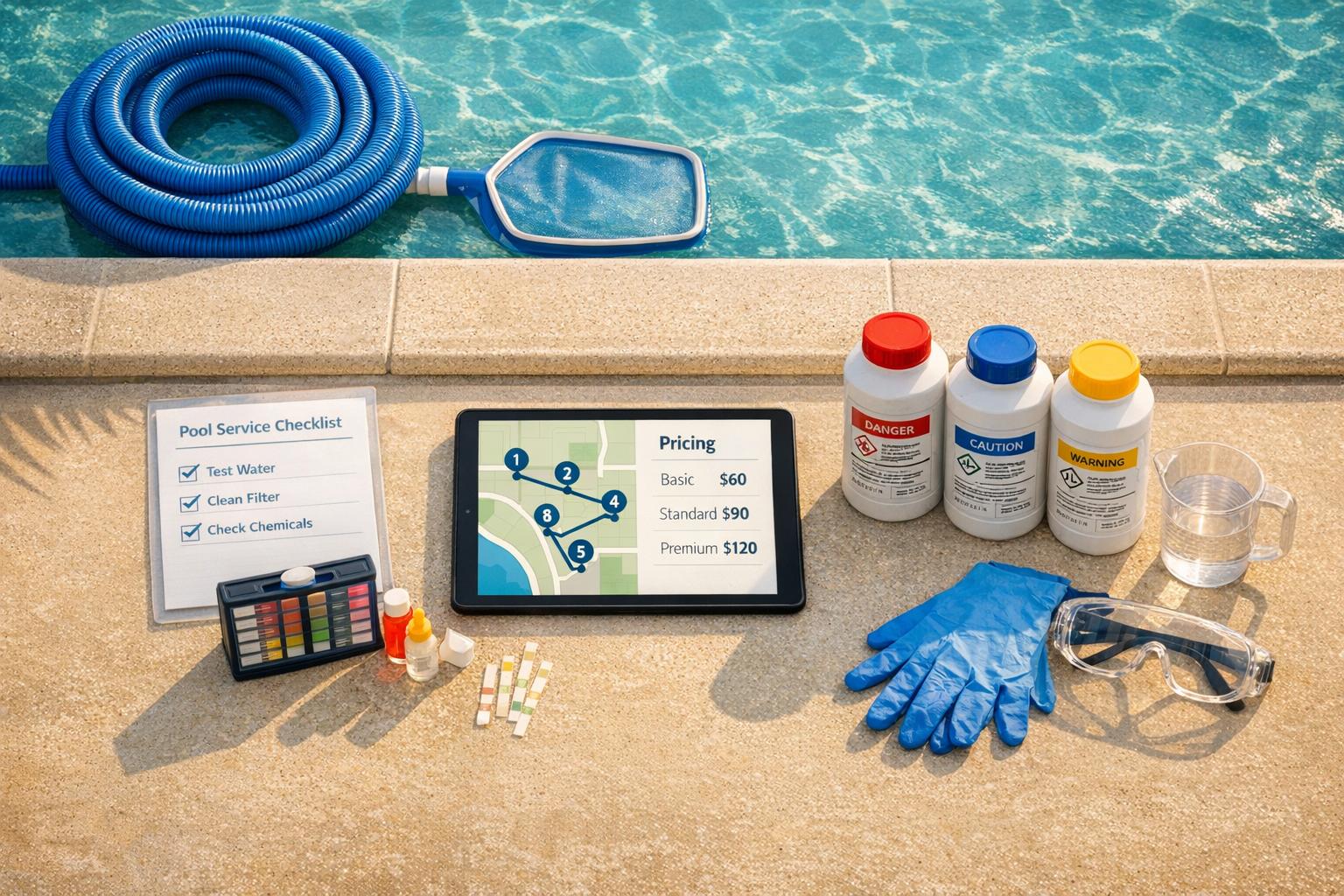
To protect your margins, consider a "Plus Chems" model. For example, a Full Service package might cost $120 per month plus the cost of chemicals, while a Basic package could be $60 per month plus chemicals. Be clear about what’s excluded in lower-tier packages - like deep cleaning or equipment repairs - to avoid misunderstandings.
You can also offer a la carte options for specialized services like filter cleaning, heater troubleshooting, or green-to-clean treatments. Seasonal jobs, such as spring openings or winterizations, are another way to boost revenue. Weekly maintenance might range from $50 to $150 per visit, monthly services from $150 to $300, and one-time deep cleans could go from $250 to over $600.
Once your packages are set, it’s time to compare your pricing with competitors.
Research Competitor Pricing
Knowing what your competitors charge is crucial for positioning your services. Research local pool service providers and record their service offerings, base prices, fees, and any promotions in a spreadsheet. If pricing isn’t listed online, you might need to call them or request their price list directly.
Reading competitor reviews can also give you an edge. For instance, if customers complain about hidden chemical charges, you can emphasize your transparent "Plus Chems" model. Networking with pool service professionals in other areas can also help you refine your pricing approach.
Before finalizing your rates, always calculate your break-even costs and aim for a profit margin of 12–25%, adjusting for local market conditions. Rather than trying to be the cheapest option, focus on showcasing value - whether it’s your expertise in saltwater systems, eco-friendly practices, or faster response times.
With the U.S. pool cleaning industry valued at $7.2 billion in 2024 and fewer than 80,000 businesses nationwide, there’s plenty of room to stand out by delivering quality instead of just competing on price.
Safety Protocols for Pool Cleaning
Safety is the backbone of a successful pool cleaning business. Each year, around 4,500 people visit emergency rooms due to pool chemical injuries, with at least 33% of those cases involving individuals under 18. Following strict safety measures not only protects your employees and clients but also shields your business from potential liabilities. Below, you'll find key safety practices for handling chemicals, using protective gear, and minimizing risks to clients and your business.
Chemical Handling and Storage
Proper storage and handling of chemicals are critical. Always keep chemicals in a cool, dry, and well-ventilated space, maintaining temperatures below 95°F (35°C). Store them in their original, clearly labeled containers, and avoid stacking to reduce the risk of accidental reactions. Secondary containment systems are essential to prevent spills from mixing, and storage areas should be locked to restrict access by unauthorized individuals, children, or animals.
"Always add a pool chemical to water. Never add water to a pool chemical." - New York State Department of Health
This rule is crucial because adding water to concentrated chemicals can cause hazardous reactions or release toxic fumes. Use separate, clean, and dry tools for each chemical to avoid cross-contamination - residual traces on a scoop can lead to dangerous reactions when mixed. Flush chlorine feed tubing with water before performing acid cleaning, and install alarms to detect pump shutdowns. Additionally, devices that stop chemical feed pumps during low-flow conditions can prevent concentrated chemicals from entering the pool.
Required Protective Equipment
Even with careful chemical management, proper protective gear is non-negotiable for your team. Equip technicians with safety goggles, chemical-resistant gloves, long-sleeved shirts, long pants, and closed-toe shoes. Review the Safety Data Sheets (SDS) for each chemical to determine specific glove and respirator requirements. Keep personal protective equipment (PPE) and updated SDSs near chemical storage and pump rooms, with a backup set stored elsewhere for emergencies.
Safety showers and eye wash stations should be installed near chemical handling areas. For indoor pools, ensure the air handling system for chemical storage and pump rooms operates separately from the building’s main HVAC system. In the event of a chemical release, immediately shut off shared ventilation to prevent fumes from spreading. When adding chemicals to water, always face away from containers to minimize exposure to vapors or splashes.
Client Safety and Liability Protection
To protect clients, temporarily close pools during maintenance. After restarting chlorine or pH feed systems, allow the water to circulate for at least five minutes before reopening the pool. Secure chemical controllers and storage areas with locks to prevent unauthorized access by children or animals.
Safeguard your business with general liability, workers' compensation, and commercial auto insurance. For HOA or commercial contracts, many states also require a surety bond of at least $10,000. Pursuing a Certified Pool & Spa Operator (CPO) credential through the Pool & Hot Tub Alliance can further demonstrate your dedication to safety and proper water chemistry, reducing liability risks. Use digital tools to document chemical usage and maintenance, providing clients with clear records of compliance and service.
How to Scale Your Pool Cleaning Business
Once you’ve established efficient routes and solid safety measures, it’s time to focus on scaling your pool cleaning business. This involves growing your team strategically and using technology to maintain quality as you expand. With the U.S. pool cleaning market valued at nearly $8 billion and a projected 5% job growth for pool technicians between 2022 and 2032, the opportunity is clear. However, losing even one technician can cost you thousands in productivity, training, and customer trust. Here’s how to plan for sustainable growth.
Hire and Train New Technicians
If customer demand consistently outpaces your capacity, it’s time to hire. Before bringing anyone on board, secure an Employer Identification Number (EIN) from the IRS. You can find potential hires through vendor and employee referrals, niche job boards, social media groups like Facebook, and trade schools.
Use a two-step hiring process: start with a phone pre-screen, then conduct an in-person interview to gauge technical skills and reliability. The rule of thumb? Hire for attitude, train for skill. While technical skills like filter maintenance can be taught, traits like dependability and good communication are harder to develop. Skilled and reliable technicians are essential to delivering consistent, high-quality service. Aim to keep technician salaries and related overhead between 15–30% of your total sales.
For training, combine 14–16 hours of Certified Pool Operator (CPO) certification with a 6–12-month apprenticeship under a licensed lead technician. Digital checklists and Standard Operating Procedures (SOPs) can help maintain consistent service standards across all routes. Track performance metrics like "Services Per Day" (aim for 12–18 residential pools) and "First-Pass Completion Rates" to identify areas for improvement. To retain your team, offer above-average pay, performance bonuses, and clear career advancement opportunities.
Manage Multiple Routes and Teams
To scale effectively, divide your service area into clear geographic zones - such as North, East, and Central. This reduces overlap and keeps technicians within a 15–20 minute radius of each job. Assign specific zones to specific days, ensuring efficient scheduling and minimizing drive time, which should ideally account for no more than 25–30% of a technician’s hours.
Utilize real-time GPS tracking to provide accurate ETAs and allow for dynamic rescheduling when needed. Require technicians to document their work with before-and-after photos and digital signatures, which can help resolve billing disputes. Automated notifications - like SMS or email updates with live tracking links and detailed service reports - can reduce calls from customers wondering where their technician is. Additionally, schedule a one-hour daily buffer to handle emergencies, weather delays, or last-minute service requests.
Technology Tools for Business Growth
Technology can do more than just streamline your routes - it can also simplify team management and boost profitability. Route optimization software like OptimoRoute and Zeo Route Planner can cut scheduling time by up to 95% and reduce fuel costs by as much as 30%.
"With OptimoRoute, planning is 2x faster and mileage is way down – now, every employee is doing up to 1 hour less driving a day." - Randy G., Owner, Gallagher Pools and Spas
Field service management apps like SwimTech, PoolOps, and Aquatechy offer tools to track chemical readings, log service history, and manage technicians all in one place. For instance, PoolOps provides a free Starter plan for up to five customers and a Pro plan for unlimited customers at $29.99 per month. You can also use digital Langelier Saturation Index (LSI) calculators during every visit to ensure precise water balance. Finally, monitor metrics like "Revenue per Mile Driven" to identify routes that may be busy but aren’t profitable.
Conclusion
Maximizing profits in pool cleaning comes down to mastering route planning, pricing strategies, and safety measures. Streamlining routes by grouping service areas and leveraging smart tools can reduce drive time by up to 35%, increase daily pool coverage by 25%, and save approximately $250 per vehicle each month. These efficiencies play a key role in achieving profit margins between 45–65%.
Setting accurate pricing is just as critical. Calculating break-even points and offering tiered service packages - such as the "Plus Chems" model - helps maintain financial stability, even during periods of fluctuating costs. Prioritizing value-based pricing over sheer volume ensures your business remains resilient in a competitive market.
While pricing secures your bottom line, enforcing strict safety protocols safeguards both your team and your reputation. Comprehensive safety measures reduce the risk of workplace accidents and legal issues, while digital tools like checklists and before-and-after photos enhance service transparency. These practices not only protect your employees but also build trust with clients and help avoid billing disputes.
The industry itself also offers substantial growth potential. With fewer than 80,000 pool cleaning businesses across the country, there’s plenty of room for entrepreneurs willing to adopt systematic approaches to routes, pricing, and safety. Tracking key metrics, such as miles driven per pool each month, can help refine your operations as you expand.
FAQs
How many pools can a technician service per day?
A pool service technician usually manages 15 to 20 pools per day, though this can vary. Factors like how efficiently the route is planned, the type of services each pool requires, and local traffic conditions all play a role. Careful route optimization and planning are essential to getting the most done in a day.
How do I price a route to stay profitable?
To set profitable prices for a route, start by calculating all associated costs. This includes labor, materials, vehicle expenses, and overhead - these figures will serve as your baseline. From there, use pricing calculators to adjust rates, factoring in your costs and desired profit margins.
Be sure to account for market demand and competitor pricing to remain competitive. During periods of high demand, charging a premium can help maximize earnings. Lastly, make it a habit to regularly review the profitability of your routes. This will help you refine your pricing strategy and maintain steady profits over time.
What insurance does a pool service need?
A pool service business needs general liability insurance to handle situations like chemical spills or injuries caused by equipment. This type of coverage helps protect against unexpected accidents that could lead to costly claims.
Beyond that, consider workers' compensation insurance to cover employee injuries on the job. Other useful policies might include commercial insurance for issues like pollution cleanup, water damage, or safeguarding expensive equipment.
For added security, optional coverage such as auto insurance for service vehicles or umbrella insurance can provide broader protection. These measures not only help keep your business safe but also ensure compliance with legal standards.
Related Blog Posts
- How to Start a Profitable Lawn Care Business: Complete Guide
- Laundry Service (Pickup & Delivery): Bags, Routes, Profit
- Mobile Detailing Startup Costs: Packages, Pricing, Profit
- Pressure Washing Startup Costs: Gear, Licences, ROI