
You can turn a business idea into a launch-ready offer in just two days using ChatGPT. Here's how:
- Saturday Morning: Validate your idea by identifying flaws, analyzing competitors, and creating detailed customer personas.
- Saturday Afternoon: Build a clear value proposition, refine your messaging, and find gaps in competitor offerings.
- Sunday Morning: Assess market potential with TAM, SAM, and SOM calculations, and develop a pricing strategy.
- Sunday Afternoon: Package your product, create pitch materials, and outline a launch plan.
This approach helps you test your idea, refine key components, and prepare to launch - all in a single weekend. With ChatGPT, you can save time, focus on what matters, and make data-driven decisions.
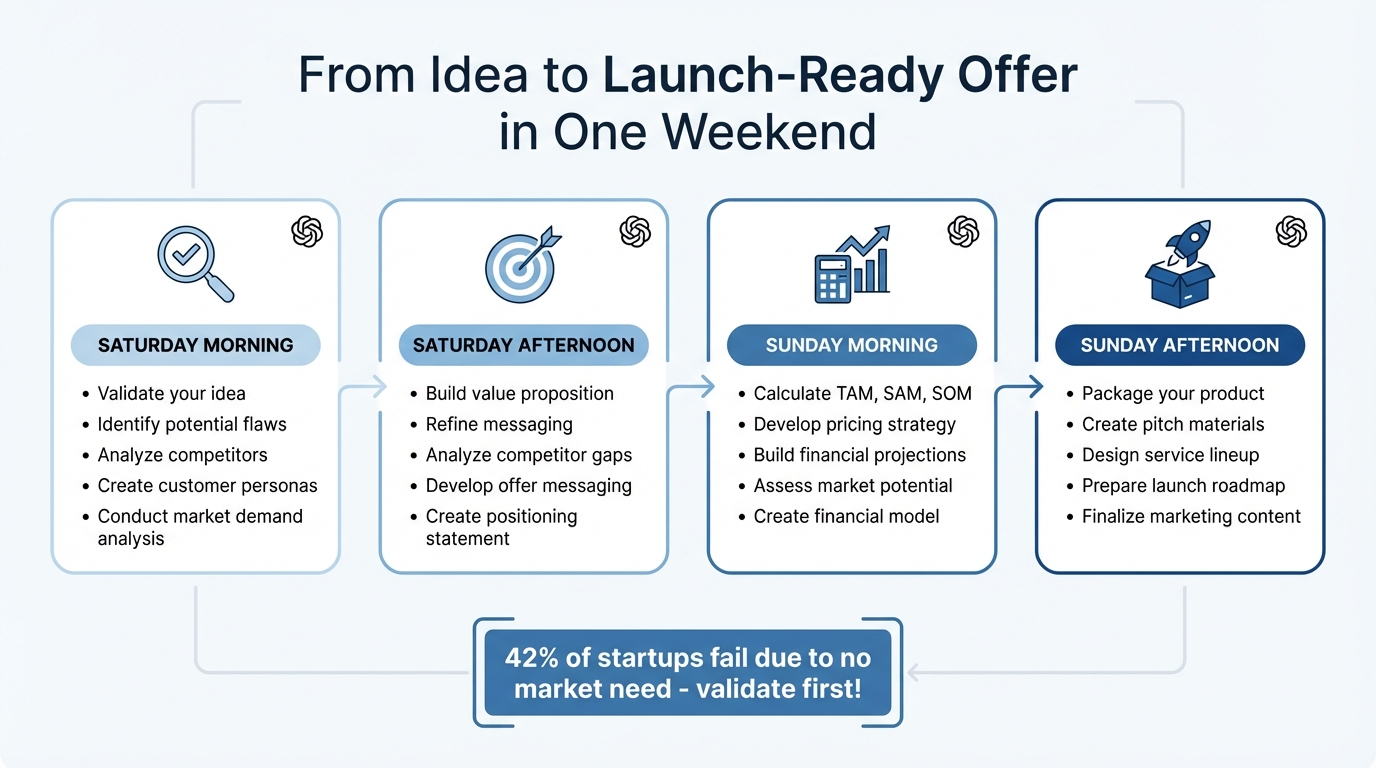
Weekend Business Launch Timeline: From Idea to Offer in 48 Hours
How to validate your online business idea with chatGPT
sbb-itb-08dd11e
Saturday Morning: Validate and Refine Your Business Idea
Your first step is to figure out if your idea truly addresses a meaningful problem. This isn’t about convincing yourself that it’s brilliant - it’s about spotting potential flaws before you commit time or money.
Use ChatGPT for Problem Validation
ChatGPT can act as a tough critic. Instead of asking, "Is this a good idea?", try something like:
"Act as a brutally honest startup advisor. What are the top three reasons this idea might fail?"
This forces the AI to identify potential deal-breakers - issues that could sink your idea if left unchecked.
Make sure the problem you're solving is serious enough to matter. It should cause significant frustration, affect people who are willing to spend money, and have clear demand. Essentially, your audience should be eager for a solution, already spending in this area, and actively looking for help. If no one is investing time or money - whether on tools, consulting, or workarounds - your idea might not address a pressing need.
You can also use ChatGPT to analyze competitor reviews. Look at 1-3 star ratings on platforms like G2 or Capterra, and ask ChatGPT to extract common complaints or gaps in features. This can highlight where existing solutions fall short and where your idea might shine.
Generate Customer Personas with ChatGPT
Once you’ve confirmed the problem is worth solving, it’s time to identify who’s affected. Avoid broad demographics - what you need are detailed customer personas that reveal daily habits, fears, and previous failed attempts to fix the issue.
Start by asking:
"Who are the most engaged customers for [your business] in [your area]? List the customer segments that spend the most and show the highest interest in this field."
Once you’ve pinpointed a promising segment, dig deeper with a prompt like:
"Create a detailed customer avatar for this niche. Include their daily routine, goals, fears, frustrations, and what they’ve already tried that didn’t work. What would make them trust me instantly?"
If you have access to real customer feedback, integrate it into your queries for even more accurate personas. For example, you can role-play with ChatGPT by saying:
"Let’s roleplay! Assume the role of [Name]. From now on, answer as [Name]. Stay in character and don’t mention that you’re an AI."
This approach lets you test your messaging and better understand your audience’s perspective.
Once you’ve got a clear picture of your ideal customer, you’re ready to analyze market demand.
Conduct Market Demand Analysis
Validation isn’t complete until you’ve confirmed there’s real interest in solving the problem. ChatGPT can save you hours of research by analyzing online trends, forums, and community discussions.
For example, ask ChatGPT to extract the exact phrases people use to describe their struggles from forums like Reddit or niche communities. This gives you authentic language that resonates with your audience - free of industry jargon.
You can also use ChatGPT to interpret Google Trends data. Compare competitor names and ask the AI to evaluate whether the market is growing, saturated, or shrinking based on search interest. Set clear benchmarks before diving in - like finding evidence of at least 10 people complaining about the problem in the past month. If you can’t meet your criteria, it might be time to rethink your approach.
Saturday Afternoon: Build Your Value Proposition and Messaging
With the groundwork laid in the morning - validated problems and detailed customer personas - it's time to focus on what makes your solution stand out.
Create a Value Proposition
A value proposition isn't about listing features. It's about clearly defining the result your customer will experience and why your approach delivers that result better than anyone else.
Here’s a useful way to start: have ChatGPT interview you. Use this prompt:
"Ask me 10 targeted questions to help clarify my business's core value proposition. Focus on the specific problem I solve, the urgency of that problem, and the desired result my customers want."
Answer the questions naturally to provide detailed insights. Once you’ve shared enough context, ask ChatGPT to create a positioning statement using this structure:
"I help [target audience] solve [specific problem] by [unique method] so that they can [desired result]."
In November 2023, Alastair McDermott of HumanSpark.AI used this approach with ChatGPT to refine his positioning in just 15 minutes. His focus on "authority-building" for consultants helped one of his clients secure an additional $11,000 in monthly recurring revenue after a single session.
The goal is to shift from selling "information" to selling "transformation." For example, instead of offering "a guide to productivity", position it as "a system that saves 10 hours a week." Customers care more about outcomes than the format.
Once you’ve nailed down your core statement, ask ChatGPT to adapt it for different platforms - LinkedIn headlines, website banners, email signatures - while keeping the core promise intact.
Analyze Competitors with ChatGPT
Now that you’ve defined your value, it’s time to analyze competitors and uncover messaging opportunities.
This isn’t about mimicking their strategies. Instead, focus on identifying gaps that competitors have overlooked. Use ChatGPT to summarize customer pain points from competitor reviews and identify "deal-breakers" - those critical frustrations that drive customers away.
For instance, if reviews frequently mention that a product is "too complicated for small teams", you can position your offering around simplicity and ease of use. Additionally, ask ChatGPT to look for "switching signals", such as phrases like "I moved from X to Y because...", which reveal what motivates customers to change providers.
The goal here is to pinpoint the unique problem your solution solves, not to find a market with zero competition.
Develop Your Offer Messaging
Now it’s time to craft messaging that truly connects with your audience.
Start by pulling key phrases from the competitor reviews and forums you analyzed earlier. Ask ChatGPT to highlight language like "I spend hours every week manually..." or "I wish someone would build..." - phrases that reflect how your customers talk about their challenges. Using this language ensures your messaging feels relatable and authentic.
Keep it simple. If your audience talks about "wasting time on admin", avoid technical jargon like "optimizing operational efficiency." Speak their language.
To refine your messaging further, ask ChatGPT to act as a skeptical customer. Use this prompt:
"Act as someone who finds reasons NOT to buy this offer. What objections would you raise? What would make you stick with my current solution instead?"
This exercise can surface hidden barriers - like trust issues, switching costs, or apathy - that you’ll need to address in your copy.
Finally, create a one-pager that includes your positioning statement, key differentiators, and responses to common objections. This document will serve as a go-to resource for all your future messaging efforts.
Sunday Morning: Financial Modeling and Market Sizing
On Sunday morning, after shaping your idea and refining your messaging the day before, it's time to dig into the numbers. This step is all about determining whether your idea has the potential to generate revenue. Skipping this analysis is a common reason startups fail.
Calculate Market Size (TAM, SAM, SOM)
To understand the potential of your idea, you’ll need to calculate three key metrics: Total Addressable Market (TAM), Serviceable Available Market (SAM), and Serviceable Obtainable Market (SOM).
- TAM represents the total revenue opportunity if every potential customer bought your product.
- SAM narrows it down to the segment your product realistically serves.
- SOM is the portion of that market you can realistically capture within the first few years.
If you need help pulling recent industry data, ChatGPT’s Deep Research mode can assist. Provide details like your business idea, target customers, location, and pricing. For example, you might prompt: "Act as a market research analyst and estimate the TAM, SAM, and SOM for [your idea] in [your industry]. Include data points, trends, and growth projections from 2020–2025. Present the results in a table."
"ChatGPT is a partner in research, not a substitute for it." - Kaylee Philbrick-Theuerkauf, Author at Upmetrics
As a solo founder, aim for a market that supports at least $1 million in annual recurring revenue. If your SOM only supports $50,000, you’re likely working on a freelance project rather than a scalable business. You can also ask ChatGPT to identify potential "kill shots" - factors that could make your market too small or too challenging to enter.
Once you’ve quantified the market opportunity, the next step is to figure out your pricing strategy.
Develop a Pricing Strategy
Pricing is more than just picking a number - it’s a key lever for revenue. In fact, a 10% improvement in pricing can have a greater impact on revenue than a 10% improvement in customer acquisition, retention, or product quality.
Start by analyzing competitor pricing. Ask ChatGPT to strip away the fluff and normalize pricing data so you can compare plans directly - monthly vs. annual, per-seat vs. usage-based. Then, identify your value metric - the unit you charge for, such as per user, per transaction, or a flat fee. Make sure this metric scales with the value your customers receive; otherwise, they may feel overcharged.
From there, explore different pricing models. ChatGPT can generate examples like flat rates, tiered pricing, usage-based plans, or hybrids. Don’t rush to decide - test customer willingness to pay using tools like the Van Westendorp Price Sensitivity Meter, which asks four key questions:
- At what price does it feel "too cheap"?
- At what price is it a "bargain"?
- At what price does it start to feel "expensive"?
- At what price is it "too expensive"?
For even more reliable feedback, try a "digital façade" test. Create a landing page with a "Buy" button at a specific price and track how many people click. Actions speak louder than survey responses.
With pricing in place, you’re ready to tie everything together in a financial model.
Build Financial Projections
A financial model helps you validate your assumptions and understand the financial mechanics of your business. Think of ChatGPT as your "hyper-efficient junior analyst" that can handle repetitive tasks like structuring formulas, while you focus on strategy.
"Treat ChatGPT not as the final decision-maker, but as a hyper-efficient junior analyst. It's brilliant at tasks that follow established patterns, but it lacks the contextual understanding of your specific business and market." - Spencer Lanoue, The Bricks
Start by creating an Assumptions tab in your spreadsheet. This is where all your key variables - like subscription price, customer acquisition cost, churn rate, and operating expenses - live. Avoid hard-coding numbers directly into formulas, as this makes updates difficult later.
ChatGPT can even generate ready-to-use Excel or Google Sheets formulas. For example, to calculate revenue growth, use =B2*(1+$F$2), where $F$2 is your fixed growth rate. The dollar signs lock cell references, making it easier to drag formulas across rows or columns. Build your model step by step: forecast revenue, estimate costs, and integrate everything into a complete financial picture.
For early-stage SaaS businesses, use these benchmarks as a starting point:
- 15% annual customer churn
- 20% cost of goods sold
- 40% of revenue allocated to sales and marketing
Once your model is built, ask ChatGPT to perform a sanity check. It can help identify your breakeven point and highlight the key drivers of profitability, ensuring your numbers line up with reality.
Sunday Afternoon: Package Your Offer and Prepare to Launch
By Sunday afternoon, you’ve done the groundwork - your idea is validated, and your financial model is ready. Now it’s time to package your product, craft your pitch materials, and map out a launch plan. Let’s dive into how ChatGPT can help you pull it all together.
Design Your Product or Service Lineup
First, clearly define what you’re offering. Ask yourself (or ChatGPT) three key questions: What are you selling? Who is it for? Why should they care? Use everything you’ve learned over the weekend - customer personas, pain points, and market gaps - to shape a product lineup that meets your audience’s needs.
A great way to refine this is through competitor gap analysis. Feed ChatGPT negative reviews (1–3 stars) from your competitors. It can help identify recurring complaints or overlooked customer needs, giving you ideas for features or services to include. For instance, if your pricing jumps from a $200 starter kit to a $20,000 premium service, ChatGPT might suggest a mid-tier option in the $2,000–$5,000 range to attract customers who aren’t ready for the high-end package yet.
When describing your offer, focus on outcomes, not technical details. Instead of saying “AI prompts,” frame it as “a plug-and-play system to create 30 days of content in just 2 hours.” You can even ask ChatGPT to turn your service details into three customer-focused benefits to make your messaging more compelling.
"AI is an accelerator, not an answer. I never take the output as 'done.' I poke, prod, and layer in my preferences until it resembles something useful." - Stephen Shapiro, Innovation Expert
Before you finalize your lineup, use ChatGPT as a “brutally honest advisor” to identify any weak points or gaps. This step ensures your product lineup is laser-focused on solving real customer problems.
Create Pitch Materials and Marketing Content
Once your product lineup is set, it’s time to create marketing materials that showcase its value. ChatGPT can help you draft pitch decks, landing page copy, email sequences, and executive summaries. To get the best results, provide context like your mission, target audience, value proposition, and market insights.
A strong pitch deck should cover the essentials: the problem you’re solving, your solution, your unique value proposition, market opportunity (TAM, SAM, SOM), business model, financial projections, and key milestones. ChatGPT can help you craft concise, impactful slides tailored to your audience - whether you’re pitching to investors, partners, or early customers.
For marketing copy, focus on translating features into benefits. Instead of saying “6 modules,” say something like “Learn how to land your first 5 clients.” You can also feed ChatGPT discussions from online communities to ensure your messaging resonates with the language your audience uses.
AI-assisted pitch decks have been shown to improve engagement and conversion rates. However, always double-check any market analysis or financial figures generated by ChatGPT to ensure accuracy before presenting your materials.
Prepare a Launch Roadmap
Finally, it’s time to map out your launch. ChatGPT can help you break this process into manageable steps, just like it did for your idea validation and financial modeling. Ask it to structure your launch into clear phases - Pre-launch, Launch, and Post-launch - with weekly milestones and task dependencies. For example, you might prompt: “Act as a product launch strategist and create a 4-week launch roadmap for [your product]. Include milestones, task dependencies, and buffer time for delays.”
ChatGPT can also generate tools like GANTT charts, meeting agendas, and detailed task lists for key elements like lead magnets, email sequences, and landing pages. If you’re working solo, you can even ask ChatGPT to simulate an “AI Board of Directors,” offering input from a marketing expert, a financial analyst, and a skeptical critic to stress-test your plan.
"Momentum matters more than perfection. The faster you can get something into the world, the faster you can learn from it." - Stephen Shapiro, Innovation Expert
Speed is crucial. Use ChatGPT to create quick drafts - like landing page copy, email templates, or basic HTML/CSS code - to get your offer out there fast. Then, refine based on real customer feedback. The sooner you launch, the sooner you’ll know if you’ve hit on a product people are willing to pay for.
Conclusion
You now have a complete weekend playbook - from testing a raw idea on Saturday morning to crafting a launch-ready offer by Sunday afternoon. Tools like ChatGPT don’t replace your creativity; they help streamline your efforts. Instead of spending months on logos and lean canvases, you can focus on testing your riskiest assumptions in just 24 hours and gathering feedback from real people. This approach turns uncertainty into actionable insights.
The key difference between a hobby and a business often lies in speed and validation. Consider this: 42% of startups fail because there’s no real market need. Using AI to identify potential deal-breakers early saves you from wasting time on ideas that won’t work. And when you uncover a promising opportunity, you could turn it into revenue over the course of a single weekend.
"Validation is the fastest path to building. Not because it removes risk - it doesn't, entirely - but because it tells you where the riskiest assumptions are." – AI Shortcut Lab Editorial Team
What’s even better? Most validation tools are either free or cost as little as $20 per month. The process is repeatable, but the real challenge is taking action. Pick an idea, dedicate your weekend, and by Sunday night, you’ll know whether to build or move on with confidence.
"Action produces information." – Stormy AI
This simple truth is the foundation of the entire validation process.
FAQs
What should I do if ChatGPT says my idea will fail?
If ChatGPT suggests your idea might not succeed, take a closer look at the reasons it gives - whether it’s market obstacles, financial risks, or other concerns. Use this feedback as a chance to fine-tune your idea, tackle potential issues, or even shift to a different strategy. Rather than viewing these predictions as definitive, treat them as tools to help you make smarter choices and build a stronger foundation for your business concept.
How can I estimate TAM, SAM, and SOM without guessing?
To calculate TAM (Total Addressable Market), SAM (Serviceable Available Market), and SOM (Serviceable Obtainable Market) effectively, it's essential to follow a structured, data-driven method. Start by collecting customer data, industry reports, and market surveys - these resources provide the foundation for accurate estimations.
AI tools, like ChatGPT, can be incredibly helpful in this process. They can analyze market demand, highlight customer pain points, and assess the competitive landscape. By leveraging these tools, you can cut down on guesswork and base your calculations on solid, reliable data instead of assumptions.
What’s the fastest way to test pricing before building?
To test pricing quickly, you can leverage AI tools like ChatGPT to gauge customer willingness to pay, rank your assumptions, and craft structured experiments. AI also simplifies gathering real customer feedback through surveys, analyzing social media conversations, and conducting market research. Using this method allows you to validate pricing effectively while minimizing risks before committing to product development.
Related Blog Posts
- IdeaFloat Turned My Napkin Idea Into a Funded Business in 72 Hours
- Idea to First Customer in 14 Days: Scripts, Templates, Checklist
- Validate Any Business Idea With ChatGPT: 12 Prompts That Don’t Suck
- Build a Business With AI: 30-Day Challenge (Prompts, SOPs, Tools)