Launching a business doesn’t have to take months or cost thousands. In just 48 hours, you can validate your idea and secure your first 10 paying customers. This approach focuses on testing demand, not building a perfect product. Here's the process:
- Friday Night to Saturday Morning: Validate your idea by interviewing potential customers and identifying a clear problem they’ll pay to solve.
- Saturday Afternoon: Create a simple landing page with tools like Carrd to test interest. Add a clear call-to-action and set up payment options like Stripe or PayPal.
- Saturday Evening: Use the "5-payment rule" to measure demand. If at least five people pay, move forward. If not, refine or pivot.
- Sunday: Drive traffic through direct outreach on platforms like LinkedIn, Reddit, or niche communities. Secure your first 10 sales using personal engagement and urgency tactics.
This method saves time and money while focusing on what matters: real payments from real customers. Start Friday, and by Sunday, you'll know if your idea is worth pursuing.
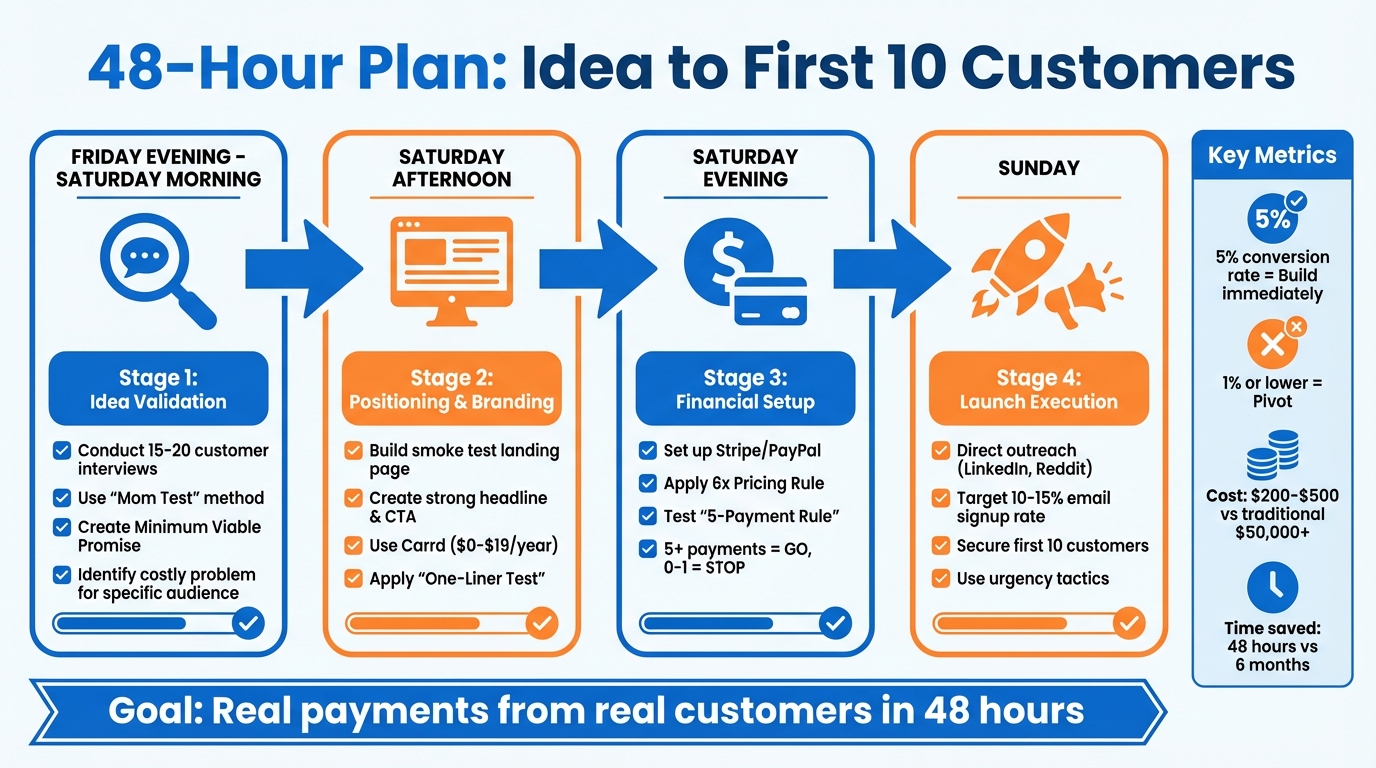
48-Hour Business Launch Timeline: Friday to Sunday Action Plan
How To Start A Business In 48 Hours - Noah Kagan
sbb-itb-08dd11e
48-Hour Plan Overview
This plan is designed to take you from an idea to landing paying customers in just two days. The core concept? Test if people will pay for your solution before you invest time and money into building something complex. The goal isn’t perfection - it’s proof that your idea solves a problem worth paying for. Each stage builds on the last, creating a logical path from idea validation to acquiring your first customers.
Stage 1: Idea Validation (Friday evening through Saturday morning) is all about pinpointing a costly problem for a specific audience. You’ll conduct 15–20 customer discovery interviews using the "Mom Test" method. Instead of pitching your idea, you’ll focus on uncovering past behaviors and the actual costs people associate with their problem. By the end of this stage, you’ll have a validated pain point and a concise "Minimum Viable Promise" - a one-sentence statement that defines who you help, the result you deliver, and the pain you solve.
Stage 2: Positioning and Branding (Saturday afternoon) involves creating a basic digital presence to test demand. You’ll build a simple "smoke test" landing page with a strong headline, a brief description of your solution, and a clear call to action to capture interest. This isn’t about making it perfect - it’s about functionality. Tools like Carrd can help you set this up for as little as $0–$19 per year.
Stage 3: Financial Setup (Saturday evening) focuses on setting up payment systems like Stripe or PayPal and pricing your offer. The "6x Pricing Rule" suggests pricing your solution at six times the average retail price to emphasize the value you’re providing. A great example is Justin Mares, who used this strategy for Kettle & Fire in 2014. By pricing bone broth at $29.99, he achieved a 30% conversion rate and generated nearly $500 in revenue from just $250 in ad spend within two weeks.
Stage 4: Launch Execution (Sunday) is all about driving traffic and making sales. This involves direct engagement with niche communities on platforms like Reddit, LinkedIn, and Twitter. Your mission is to secure your first 10 customers or pre-orders. If you’re seeing a 10–15% email signup rate from cold traffic, it’s a solid indicator that your idea has traction.
1. Idea Validation
Test Your Idea with a Simple "Minimum Viable Test"
Before diving into building your product, find out if customers are willing to pay for it. A Minimum Viable Test (MVT) asks one crucial question: "Will users click a button to buy this?". Here’s how it works: create a basic landing page featuring a "Buy Now" or "Join Waitlist" button. Then, spend $20 on targeted Facebook ads to drive traffic to the page over 48 hours.
The results are straightforward:
- 5% or higher conversion rate: Start building your product immediately.
- 1% or lower conversion rate: Scrap the idea and move on.
This quick test costs under $100 and can save you from wasting time and money on unvalidated ideas.
Use AI to Pinpoint Real Customer Problems Fast
AI tools like Perplexity can help you uncover customer frustrations and market gaps in minutes. For example, you could ask: "What are the biggest frustrations [specific audience] has with [problem] in 2026?". By analyzing over 10 sets of interview notes, AI can identify recurring themes and emotional triggers - those moments when people feel frustrated or relieved.
Take this insight and rewrite your landing page using the exact words your audience uses. Speaking their language can significantly boost your conversion rates. While traditional validation methods take months and cost upwards of $50,000, this approach delivers actionable insights in just 48 hours for $200–$500.
The "5-Payment Rule" for Deciding Whether to Move Forward
Interest is nice, but payment is the ultimate proof of demand. That’s where the "5-payment rule" comes in. Once you’ve validated interest through clicks and AI insights, test if people are willing to pay.
Here’s the benchmark:
- 5+ payments within 48 hours: Move forward with your idea.
- 2–4 payments: Consider refining or pivoting.
- 0–1 payments: It’s time to let the idea go.
As Nisha Gandhi, RN MBA, explains:
"The most valuable signal isn't interest...it's payment".
This method eliminates guesswork and ensures you’re building something people are ready to pay for. It’s a critical step, especially since 90% of entrepreneurs fail before launch because they skip testing real demand.
2. Customer Acquisition
In just 48 hours, these strategies can help you turn interest into your first paying customers.
Deploy AI to Handle Your First Customer Conversations
Once you've confirmed demand, the next step is to capture leads before they slip away. AI-powered tools like chatbots and voice receptionists can respond to inquiries instantly - something that's critical when time is tight. For example, in August 2025, Live 360 Marketing used AI automation to slash its lead response time from 48 hours to just 30 seconds, boosting ROI by 70%. Similarly, Elite Web Professionals' AI Voice Receptionist managed 1,017 inbound calls, capturing 778 qualified leads with a 76% conversion rate.
To get started, consider tools like HubSpot Chatflows or Intercom to set up an AI chatbot on your landing page. These tools can handle FAQs, gather contact details, and even schedule calls - all while you're busy or asleep. As Brendan King, CEO of Vendasta, aptly said:
"Conversations are the new clicks".
The goal here isn't to automate everything but to make sure no lead goes cold while you're focused on other tasks. Once AI tools handle the initial contact, you can focus on personal outreach to turn those leads into paying customers.
Use the "Hand-to-Hand Combat" Approach for Your First 10
Securing your first 10 customers requires a direct, personal touch. This might mean messaging potential clients on LinkedIn, making cold calls, or even meeting people in person. Choose one channel - LinkedIn, Twitter, or email - and start by addressing their problem, not pitching your product. For instance, if you're targeting small business owners struggling with bookkeeping, you might say: "I noticed you're hiring a bookkeeper. I can simplify your bookkeeping by this weekend."
A great way to break the ice is the "Job Interview Hack." Tell prospects you're gathering feedback for a project and need to talk to 10 people. This approach lowers their defenses and often leads to honest, valuable conversations. Once you’re in, present your Minimum Viable Promise - a clear outcome they’ll achieve within a specific timeframe, minus their current hassle. If they agree, secure payment right away using tools like Stripe or PayPal. The goal is simple: turn direct outreach into immediate sales.
Leverage High-Traffic Platforms to Shortcut Distribution
Once you've started personal outreach, broaden your reach by tapping into established online platforms where your target audience is already active. Building your own audience takes time, but you can fast-track this by going where the crowd is. For example, if you're launching an AI tool, you can use platforms like Fractal MCP to list your product on the ChatGPT Store, which has over 800 million weekly active users. For more traditional products, explore niche communities on Reddit or join Discord servers where people are already discussing the problems your solution addresses.
Look for posts with phrases like "I wish someone would build" or "I've been doing this manually for years." These are often goldmines for identifying potential customers. When you find these discussions, engage genuinely - don’t spam your product link. Share your journey, ask thoughtful questions, and mention your solution only when it feels natural. The focus should be on starting 10 meaningful conversations, not blasting a generic pitch to 1,000 strangers. With this targeted approach, you can land your first paying customers within 48 hours - all without spending a dime on advertising.
3. Positioning and Branding
A clear and compelling brand message is critical to ensure potential customers understand what you’re offering. Ankit Goyal emphasizes the importance of simplicity in branding with what he calls the "One-Liner Test":
"If you can't explain your idea in one sentence that makes someone nod, it's not ready".
Craft Your One-Sentence Promise
Here’s a simple formula to create a powerful one-liner: "I help [target] achieve [result] in [time] without [pain]". For instance, instead of describing your product as an "AI-powered productivity platform", you could say, "I help freelance designers send client invoices in 5 minutes without spreadsheet headaches." This kind of clarity makes your value immediately obvious and helps convert casual visitors into paying customers. Once your message is refined, ensure your visual branding aligns with your promise.
Build a Brand System in 15 Minutes Using AI
You don’t need to spend a fortune to create a professional-looking brand. Michael Xeus demonstrated how you can develop a complete brand system in just 15 minutes using AI - a process that traditionally cost anywhere from $8,000 to $60,000. Start by defining your brand’s vibe in just 3 minutes. Choose a signature style and a power word that encapsulates your brand’s essence. Then, use affordable AI tools like ChatGPT, Midjourney, and Figma (around $30/month) to create a cohesive brand palette, select two fonts, and design a minimalist logo. As Xeus points out:
"Your brand doesn't need to be perfect. It needs to exist. It needs to appear professional so users trust your offer".
To maintain consistency, document your brand elements on a simple Notion page. This will serve as your go-to resource as your company grows.
Lead with the Problem, Not the Product
Once your promise is clear, your landing page should immediately address the problem you’re solving. Start with a bold headline that highlights the specific issue your product tackles. For example, instead of a vague tagline, say something like, "Stop losing customers to slow response times". This approach works because 42% of startups fail due to building products people don’t need.
Structure your landing page in three simple parts:
- A problem-focused headline
- 2-3 sentences explaining your solution
- A clear call to action
The Foundra.ai team found that:
"Ugly but clear beats beautiful but confusing every time at this stage".
Concentrate on the top three benefits your customers will gain, rather than listing every feature. If your value isn’t immediately clear within 15 seconds, your message might be too complicated for a fast launch. By simplifying your branding and focusing on clarity, you can build trust and drive conversions more effectively.
4. Launch Execution
Now that you’ve got a validated offer and a clear brand message, it’s time to make things happen. In this final stage of your 48-hour plan, every second matters - act swiftly to start generating sales.
Once your brand is defined, the next step is to launch and sell. Set up your landing page using tools like Vercel, Netlify, or Carrd (which costs as little as $0 to $19 per year) to get your offer live and accessible. Don’t wait for perfection - launch your Minimum Viable Product (MVP) quickly and refine it as you go. As SloppyBuilder wisely puts it:
"A working MVP in 48 hours beats a perfect plan in 3 months. Ship it ugly, then make it better".
Add a "Buy Now" button that links to a waitlist or pre-order page. This "Fake Door" test helps gauge actual purchase intent rather than just interest. Justin Mares successfully used this approach when testing Kettle & Fire. He spent $250 on Bing Ads to direct traffic to an Unbounce landing page with a simple checkout flow. The "Order Now" button redirected users to his personal PayPal. Despite its simplicity and a high price of $29.99 (six times the average $5 retail price), the test achieved a 30% conversion rate, generating nearly $500 in revenue in just two weeks. Mares then emailed buyers, offering either a full refund or a 50% discount if they waited for the first batch. Most chose to wait, giving him a validated customer base while he spent the next eight months building the supply chain. While a solid landing page is essential, your focus should also be on creating urgency and actively reaching out to drive those first sales.
Early sales often come from personal outreach, not automated systems. One effective method is the Job Interview Hack: tell your network you’re in a job interview and need 10 people to provide feedback to help you land the job. Framing it this way makes people more likely to assist you as a "candidate" rather than seeing you as a "salesperson". For traffic, tap into high-potential free platforms like Reddit, Product Hunt discussions, Indie Hackers, and Hacker News. If your product is technical, posting a "Show HN" on Hacker News can drive hundreds of visitors in just a few hours.
To boost conversions after your initial outreach, try urgency tactics. Use countdown timers on your landing page and emphasize scarcity with phrases like "Only 10 spots available this weekend". Marcus Taylor demonstrated the impact of urgency when he ran an A/B test on MusicLawContracts.com - adding "now" and a countdown timer increased conversions by 147%. Just make sure your timer is legitimate; resetting it when it expires can hurt your credibility. You can also display live purchase notifications or show how many people have already signed up to create FOMO (Fear of Missing Out) and social proof. These strategies not only encourage immediate action but also build momentum for your product.
Conclusion
You can validate your idea in just 48 hours - not months - by focusing on what truly matters: real revenue from real customers. The framework outlined here isn’t theoretical; it’s a practical, proven method designed to cut through distractions like logo design and endless business plans. Instead, it forces you to zero in on the one metric that counts: actual results from paying customers.
The numbers don’t lie. A quick $50–$150 smoke test this weekend could save you from joining the ranks of failed businesses. Rapid testing gives you a better shot at success than spending months on untested ideas. Take it from a founder who pivoted from a failed $500,000 sushi concept to a gaming league later acquired by Twitch:
"Your first business is your worst business - the most important thing is simply that you started and gained the momentum to not fear the next thing".
The 48-hour limit is more than just a deadline - it’s a filter. It keeps you from falling into traps like perfectionism, emotional attachment, or overcomplicating your idea. If your idea scores below 60/100 on the validation matrix or gets less than a 1% conversion rate on your landing page, that’s not failure - it’s progress. You’ve just saved yourself nearly six months of wasted time. If the results aren’t there, pivot and move to the next idea. Quick action leads to clarity.
By acting fast, positioning your idea clearly, and engaging directly with potential customers, you can avoid months of unnecessary work. This approach proves that deliberate, focused action delivers results. Pick one idea and start this Friday night. By Sunday, you’ll have real data - conversion rates, feedback, and a clear decision to move forward or pivot. The tools are affordable, the process is straightforward, and the only thing standing between you and your first customers is your decision to begin. Don’t wait for perfect conditions. As SloppyBuilder puts it:
"A working MVP in 48 hours beats a perfect plan in 3 months. Ship it ugly, then make it better".
FAQs
What should I sell if I don’t have a product yet?
If you’re still in the early stages and don’t have a product yet, start by pitching an idea or offering a stripped-down version to test the waters. This is called a Minimum Viable Offer (MVO) - a basic version that focuses on delivering the main result your audience is looking for.
To get started, create a simple landing page using tools like Carrd or Wix. Promote it through platforms such as Reddit or Facebook groups to drive traffic. Then, gauge interest by tracking sign-ups or pre-orders. This approach helps you confirm demand before committing to full-scale development.
How do I run the 5-payment test without harming trust?
To conduct a 5-payment test without compromising trust, focus on clear communication and honesty. Let customers know about the multiple charges right from the start - no surprises. Make sure the payment process is secure and user-friendly, and provide straightforward options for refunds or cancellations. By prioritizing security and reliability, you can create a smooth experience that keeps customer confidence intact.
What do I do if I get signups but no one pays?
If people are signing up but not making payments, it’s time to dig into the reasons why. Start by checking if your offer truly aligns with what your customers need. You can do this through customer interviews or by running smoke tests to pinpoint any weaknesses in your value proposition.
Take a closer look at your pricing strategy, too. Are you offering enough value for the price? Consider introducing early-bird discounts to encourage payments and create a sense of urgency.
To get a clearer picture of what’s holding customers back, reach out directly for feedback. This can help you uncover objections or concerns that might not be obvious. Use this input to fine-tune your product or adjust your messaging so it resonates better with your audience.
Related Blog Posts
- Profitable Business Ideas You Can Start This Weekend
- Launch Weekend: How to Get Your First 100 Customers in 48 Hours
- The 5-Day Business Validation Challenge That Actually Works
- From Idea to First Customer in 30 Days: The Exact Roadmap