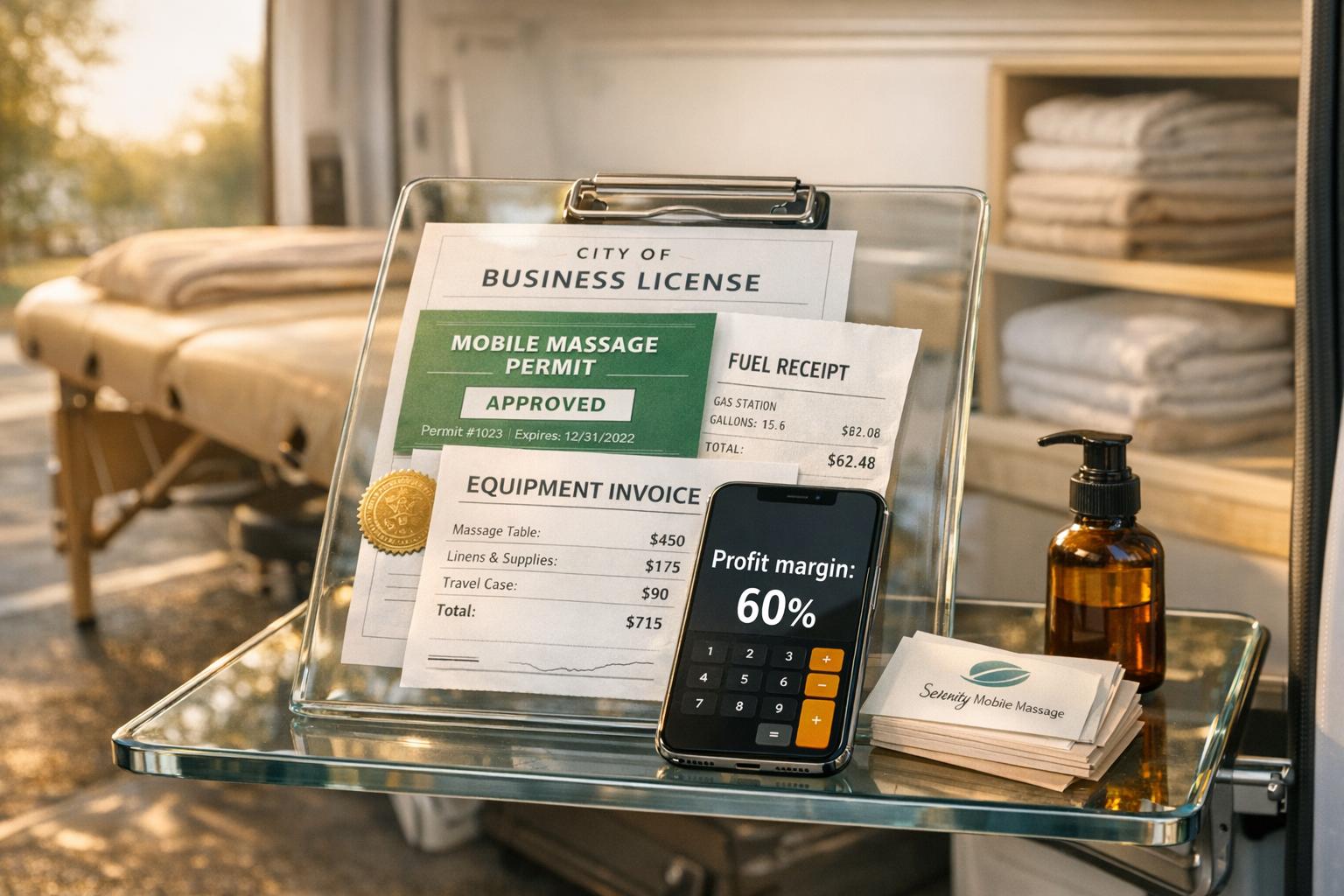
Starting a mobile massage business can be a cost-effective way to deliver wellness services directly to clients. Here's a quick breakdown:
- Startup Costs: Initial investment ranges from $1,890 to $7,839, covering equipment, transportation, marketing, and licenses. A portable massage table alone costs $300–$600, while a reliable vehicle may require $6,000 or more.
- Earnings Potential: Solo practitioners typically earn $40,000 to $80,000 annually, with many breaking even within 14 months.
- Licenses and Permits: Most states require 500–1,000 hours of training, passing the MBLEx exam ($195), and paying licensing fees ($32–$565). Additional permits may be needed for business registration and local compliance.
- Profit Margins: Businesses can achieve 50%–70% margins due to reduced overhead, like no studio rent.
- Ongoing Costs: Monthly expenses include fuel, insurance, supplies, and software, with transportation costs averaging $250–$600 per month.
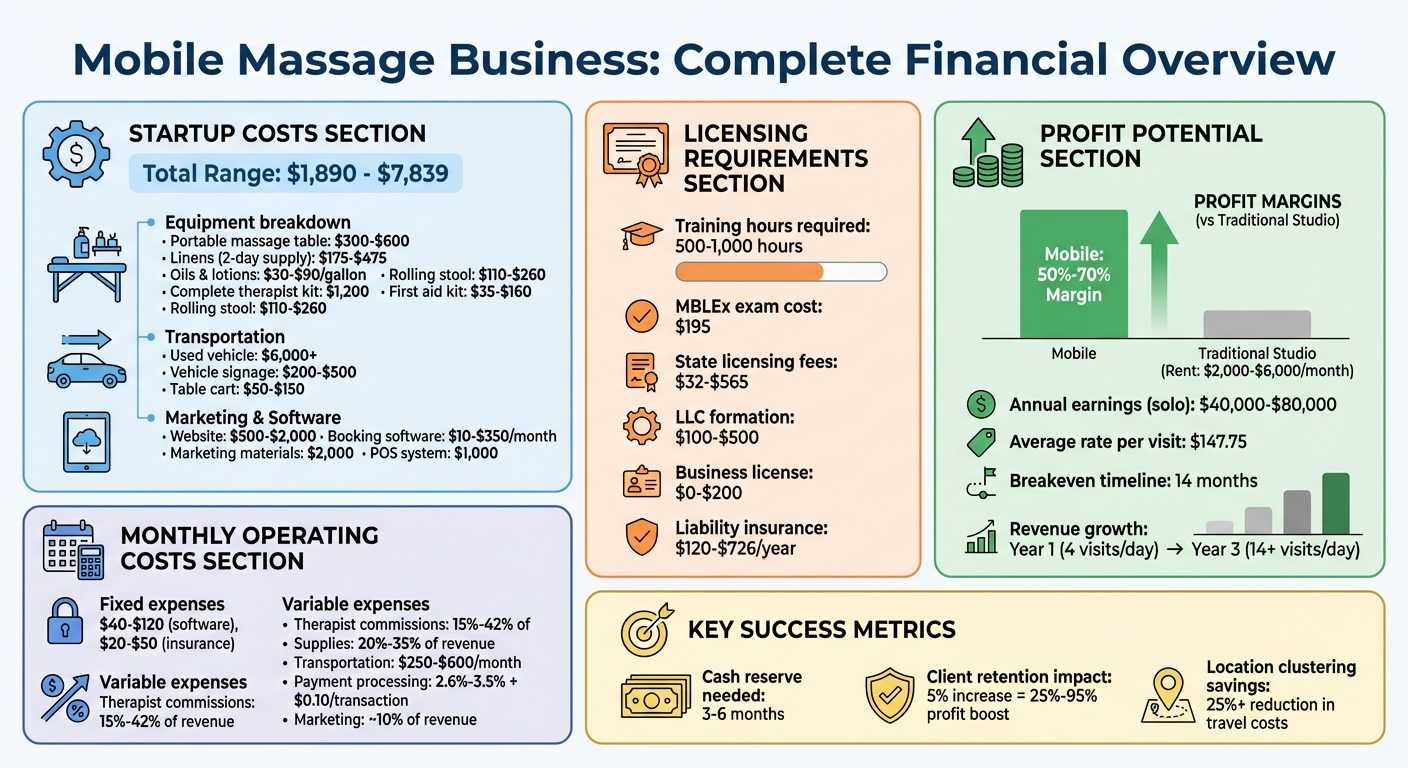
Mobile Massage Business Startup Costs and Profit Breakdown
How to Start a Mobile Massage Business (FULL GUIDE 2025) for Massage Therapists
sbb-itb-08dd11e
Startup Costs for a Mobile Massage Business
Starting a mobile massage business is often more affordable than opening a traditional spa. Without the need for a physical location, your focus shifts to portable equipment, transportation, and digital tools to manage bookings and attract clients.
Your initial investment will primarily fall into three categories: equipment and supplies, transportation, and marketing and software tools. Here's a closer look at what you'll need to budget for.
Equipment and Supplies
A portable massage table is a must-have. Prices for these tables range from $150 to $3,000, depending on features and durability. A mid-range option, costing between $300 and $600, is a solid choice, especially if it comes with a warranty of at least three years to withstand frequent use and transport.
You'll also need essential supplies such as linens, oils, and lotions. A two-day supply of linens (sheets, towels, and blankets) will cost between $175 and $475, reducing how often you’ll need to do laundry. For oils and lotions, expect to spend $30 to $90 per gallon when buying in bulk. A complete therapist kit, which includes professional-grade supplies, typically costs around $1,200 per therapist.
Additional items to consider include:
- Rolling stool: $110–$260
- First aid kit: $35–$160
- Storage solutions: For organizing and transporting supplies
Efficient transportation of your equipment is also key, which brings us to your next major expense.
Transportation and Vehicle Setup
A reliable vehicle is essential for getting to appointments and safely transporting your equipment. Many therapists use their personal car initially, but upgrading to a commercial auto insurance policy is crucial, as personal insurance often doesn’t cover business-related claims.
If you’re in the market for a vehicle, a dependable used car or van starts at around $6,000, while new professional vans can cost over $25,000. For those targeting a luxury clientele, custom vehicles range from $120,000 to $250,000, though these are rare for solo practitioners.
Additional transportation-related costs include:
- Vehicle signage: $200–$500
- Table cart: $50–$150
Marketing and Software Tools
Digital tools and marketing efforts will help you manage bookings and attract clients effectively. A professional website will cost between $500 and $2,000, while booking software ranges from $10 to $350 per month, depending on the features you need.
For marketing, allocate around $2,000 for materials and initial advertising. This budget can cover:
- Printed materials: $30–$350
- Logo design: $100–$300
- Social media ads: Starting at $50
- Referral programs: To encourage word-of-mouth
If you plan to accept payments on-site, a mobile POS system is another important investment. Reliable POS hardware typically costs around $1,000, enabling you to process credit card payments immediately after each session.
Permits and Licenses Required
To operate your massage therapy business legally, it's essential to follow state and local regulations. By 2026, 46 states, the District of Columbia, Puerto Rico, and the U.S. Virgin Islands will have massage therapy regulations in place. Only Kansas, Minnesota, Vermont, and Wyoming lack statewide licensing, though local jurisdictions in these states may still require permits.
Having the right licenses not only ensures compliance but also builds trust with your clients. Start by securing your professional license before tackling broader business requirements.
Massage Therapist License
A professional license is a must-have for massage therapists. Most states require between 500 and 1,000 hours of training from accredited massage therapy schools. For instance, states like Florida and California require 500 hours, while New York and Nebraska mandate 1,000 hours.
After completing your education, you’ll need to pass the Massage & Bodywork Licensing Examination (MBLEx), which costs $195. This 100-question exam, accepted by nearly all regulated states, tests your knowledge of anatomy, ethics, kinesiology, and therapeutic techniques.
State licensing fees vary widely, from $32 in Hawaii to $565 in Alaska. Additionally, at least 25 states require a criminal background check and fingerprinting as part of the application process. For example, Florida mandates electronic fingerprinting for all massage professionals.
"Your license is your professional passport. Guard it carefully and keep it current." - Sarah Mitchell, LMT, Good Hands Massage Therapy
Stay on top of renewal deadlines by setting reminders at 90, 60, and 30 days before expiration. Most states require renewal every one or two years, along with 12 to 24 hours of continuing education. Missing the deadline can lead to penalties or even a voided license - Florida, for example, considers licenses "Null & Void" if not renewed within six months of becoming delinquent.
| State | Education Hours | Initial Fee | Exam Requirement | Renewal Period |
|---|---|---|---|---|
| Alabama | 650 | $125 | MBLEx | 2 Years |
| Alaska | 625 | $565 | MBLEx | 2 Years |
| Arizona | 700 | $250 | MBLEx | 2 Years |
| California | 500 | $300 | None (Voluntary) | 2 Years |
| Florida | 500 | $100 | MBLEx | 2 Years |
| Nebraska | 1,000 | Varies | MBLEx | Varies |
| New York | 1,000 | Varies | State Exam | 3 Years |
In addition to a professional license, you’ll need to secure business registration and local permits.
Business Registration and Local Permits
After obtaining your massage therapist license, you’ll need to register your business. Forming an LLC is a smart choice for mobile massage businesses, as it provides liability protection. Filing fees for an LLC range from $100 in states like Louisiana and Georgia to $500 in Massachusetts.
Most cities and counties require a general business license or Business Tax Receipt (sometimes called an occupational license). These typically cost between $0 and $200, depending on your location. Check with your local tax collector to confirm specific requirements.
In states without statewide regulation, you might need separate permits for each city or county where you plan to work. For example, some California cities require mobile service permits, additional background checks, or have parking restrictions for outcall services.
To comply with state advertising rules, display your license number on all marketing materials, including your website, social media profiles, and business cards. If you’re operating under a business name that differs from your legal name, you’ll also need to register a "Doing Business As" (DBA) name with your state or county.
Once your licenses and permits are in place, it’s time to protect your practice with liability insurance.
Liability Insurance
Liability insurance is critical for safeguarding your business. It protects you against claims involving negligence, client injuries, or property damage during sessions. Standard policies typically offer $2 million per occurrence and $6 million aggregate coverage.
Annual premiums for professional liability insurance range from $120 to $726, with an average cost of around $200 per year. Many therapists obtain coverage through professional organizations like the American Massage Therapy Association (AMTA) or the Associated Bodywork & Massage Professionals (ABMP). Membership in these groups often includes insurance benefits.
Ensure your policy covers "off-site" or "outcall" work, as some policies only protect in-studio sessions. In fact, many states require proof of liability insurance before issuing a massage license.
"Liability insurance is essential to protect your business against the unexpected." - ClinicSense
If you plan to bill health insurance for your services, you’ll also need to secure a National Provider Identifier (NPI) number from the federal government.
Monthly Operating Costs and Budgeting
Keeping a close eye on your monthly expenses is essential for maintaining a healthy business. These costs generally fall into two categories: fixed expenses, which stay steady regardless of client volume, and variable expenses, which fluctuate based on your business activity.
Fixed and Variable Monthly Expenses
Fixed expenses are your baseline costs - the ones you’ll pay no matter how busy or slow the month is. For a solo mobile therapist, these include things like booking or CRM software (ranging from $40 to $120 per month), liability insurance ($20 to $50 per month), and equipment storage (up to $500 per month). If you’re running a larger operation with multiple therapists, your fixed costs can climb significantly, potentially reaching $11,467 per month when you factor in administrative payroll, fleet insurance, and rent for a headquarters.
Variable expenses, on the other hand, scale with how much business you’re doing. Therapist commissions typically eat up 15% to 42% of your revenue, while massage supplies like oils and linens can account for 20% to 35% of your gross sales. Transportation is another key variable cost - active therapists generally spend $250 to $600 per month on fuel and vehicle maintenance. To estimate travel expenses, you can use the IRS standard mileage rate, which is 65.5 cents per mile as of 2023. Additional costs include payment processing fees (2.6% to 3.5% of revenue, plus $0.10 per transaction) and marketing expenses, which often hover around 10% of revenue per visit.
"An expense is something you need that costs money. An investment is something you pay for that makes you money." - ClinicSense
This quote highlights a key distinction when budgeting. For example, a high-quality massage table or reliable booking software can generate income over time, making them investments. On the other hand, consumables like massage oils are pure expenses. To avoid letting your variable costs outpace your revenue, consider strategies like grouping appointments to reduce travel time or adjusting your fees to better cover expenses.
Tracking and Managing Expenses
Once you’ve identified your fixed and variable costs, the next step is to track them rigorously. Monitoring commissions and booking volumes daily can help prevent profit margins from shrinking. Weekly audits of consumables, like oils and linens, can reveal waste and opportunities to cut back. Automating tasks like scheduling and accounting can also save time and reduce administrative costs.
It’s wise to maintain a cash reserve equal to three months’ worth of variable expenses. Tools like IdeaFloat's Cost Analysis tool can help you monitor your expenses in real time, allowing you to spot trends and make adjustments before problems arise. If revenue takes a dip, consider freezing non-essential spending or renegotiating contracts to reduce costs.
Calculating and Maximizing Profit
Estimating profit potential begins with revenue modeling. Projections suggest growth from 4 daily visits in Year 1 to 14 or more by Year 3. With an average rate of $147.75 per visit, this growth could translate annual revenue from roughly $177,300 to $755,000. Many mobile massage businesses manage to break even within 14 months to 3 years.
Revenue Modeling and Breakeven Analysis
To figure out your breakeven point, start by identifying your monthly fixed costs - things like CRM software, insurance, and rent. Then, consider variable costs, including therapist pay (20%–42% of revenue), massage supplies (about 20%), and payment processing fees (around 15%). Keeping variable costs low is key to achieving higher contribution margins. Once you have your total monthly expenses, divide that number by your contribution margin to calculate the revenue needed to break even. High-performing mobile businesses often maintain contribution margins near 80.5% by controlling costs while charging premium rates. For example, if your monthly expenses are $3,000 and your contribution margin is 60%, you’d need $5,000 in revenue each month to break even.
Pricing Strategies and Margins
Getting your pricing right is crucial to achieving profit margins between 50% and 70%. Start by researching local rates for 60- and 90-minute sessions offered by mobile therapists. Then, adopt value-based pricing that reflects the convenience of in-home services, allowing you to charge 20%–35% more than traditional clinics. Tiered pricing models, such as "Basic", "Standard", and "Premium", can encourage clients to choose high-margin services. Add-ons like aromatherapy ($15–$20) or hot stone therapy ($25–$40) also boost revenue. For appointments outside your main service area, consider travel fees - either a flat rate (around $15) or a per-mile charge ($1–$2) - to protect your margins. Regularly review your rates to ensure they keep up with rising costs.
Scaling and Increasing Revenue
Once your pricing strategy is in place, focus on ways to scale and grow revenue. Corporate retainers, such as recurring contracts for on-site massages, can generate $5,000 or more monthly. On-site demos are an effective way to convert corporate leads into 30- to 90-day pilot contracts. Another option is offering subscription models, like two 15-minute sessions per month for $149, which helps secure predictable revenue and improves client retention. Boost appointment revenue by offering add-ons, such as CBD oil treatments or aromatherapy, which can increase order value by 20%–30%.
As demand grows, hiring more therapists and using dispatch software to cluster bookings geographically can help you reduce travel time while adding 3 to 4 extra billable sessions per week without increasing therapist hours. Dynamic pricing - charging 15%–25% more during peak times like evenings and weekends - can also help you capitalize on high-demand periods.
Key Takeaways
Running a mobile massage business requires careful planning to balance startup costs, legal requirements, and profitability. For solo practitioners, initial investments typically fall between $1,890 and $7,839, covering essentials like massage equipment, licenses, and insurance.
Legal compliance is critical. In 45 states, massage therapists must hold individual licenses, with training requirements ranging from 300 to 1,000 hours, depending on the state. Beyond personal licensure, you'll likely need additional permits, such as a massage establishment permit, a general business license, and possibly a home occupation permit if working from home. Always carry proof of licensure when visiting clients, and confirm your insurance covers off-site services.
The profit margins for mobile massage businesses are impressive, typically ranging from 50% to 70%, thanks to the absence of traditional studio rent, which can cost $2,000 to $6,000 per month. However, managing variable costs like therapist wages, supplies, and payment processing fees is essential for maintaining profitability.
Strategic planning is key to success. Keeping a 3- to 6-month cash reserve can help stabilize operations in the early stages. Additionally, grouping client appointments by location can cut fuel costs and travel time by over 25%. Retaining clients is equally important - boosting retention by just 5% can increase profits by 25% to 95%.
These insights highlight the importance of balancing smart investments, strict legal compliance, and efficient cost management. With its lower overhead, the mobile massage model allows for flexibility in pricing, service refinement, and sustainable business growth - all without the hefty fixed costs of a traditional spa setup.
FAQs
What insurance do I need for mobile massage?
To run a mobile massage business legally and safeguard yourself, you'll need a few key types of insurance. Liability insurance and professional liability insurance are essential to cover any claims tied to your services. Additionally, if you use a vehicle for your business, you may also need vehicle insurance to address transportation-related risks.
Can I legally work across multiple cities or counties?
Yes, it's possible to operate legally in multiple cities or counties, but you'll need to obtain the necessary licenses and permits for each location. These can include business licenses specific to the city or county, zoning approvals, and adherence to local health regulations. Make sure to review the specific requirements for every area where you plan to conduct business.
How should I set travel fees without losing clients?
To set travel fees effectively, it’s important to strike a balance between covering your costs and aligning with what clients are comfortable paying. A transparent pricing structure can help build trust. For example, you might use flat rates based on specific distances or zones, making it easy for clients to understand what they’re paying for.
Another option is tiered pricing or offering packages that include travel fees. These approaches can make charges feel more reasonable and predictable. However, avoid implementing sudden fee increases, as these can catch clients off guard. Instead, communicate any changes in advance and emphasize the value you provide - whether it’s the convenience you offer or the personalized care you deliver. Clear communication and demonstrating your service’s worth can go a long way in maintaining client loyalty.
Related Blog Posts
- How to Start a Mobile Car Detailing Business: Complete Guide
- Mobile Pet Grooming: 30-Day Launch Plan
- Mobile Detailing Startup Costs: Packages, Pricing, Profit
- Pressure Washing Startup Costs: Gear, Licences, ROI