
AI can help you test your business idea quickly and cost-effectively, replacing guesswork with data-driven insights. Here’s how:
- Validate Market Need: Use AI to analyze customer reviews, forums, and competitors to confirm if your idea solves a real problem.
- Estimate Market Size: AI calculates the potential audience (TAM, SAM, SOM) and identifies cost-effective customer acquisition channels.
- Test Financial Viability: AI creates detailed financial models, predicts costs, and refines pricing strategies.
- Prepare for Launch: AI assists with branding, landing pages, and crafting a launch plan to connect with your audience.
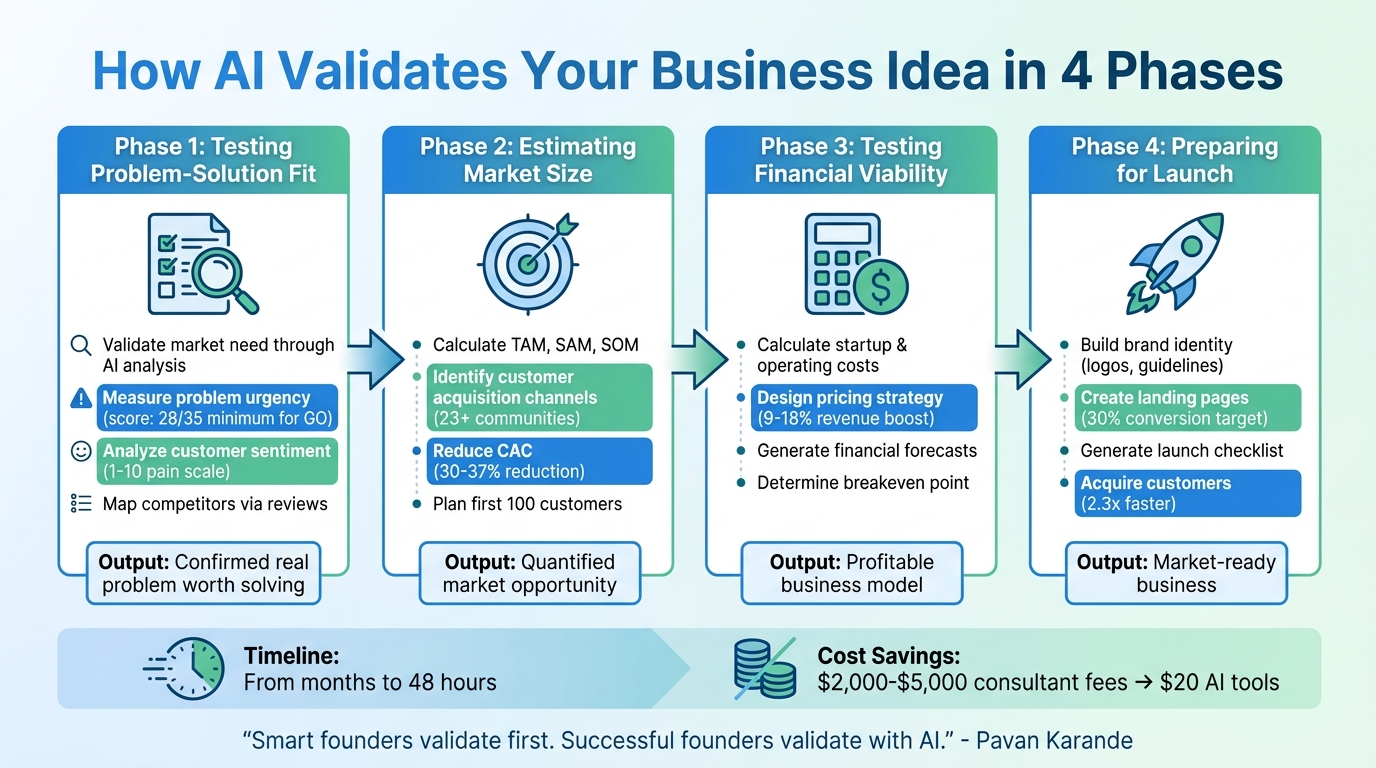
4-Phase AI Business Validation Framework: From Idea to Launch
How to Validate your Startup Idea With One AI Prompt (Beginner Friendly Guide)
sbb-itb-08dd11e
Phase 1: Testing If Your Idea Solves a Real Problem
The first challenge isn’t about building your product - it’s about making sure there’s a real need for it. AI can take what would normally take months of research and condense it into hours. By scanning customer reviews, forums, search trends, and competitor websites, it identifies patterns that manual research could easily miss.
The main goal here? To determine if the problem you’re solving is urgent enough that people are already spending money to address it. This phase focuses on how AI evaluates problem urgency, gauges customer sentiment, and maps out competitors to confirm there’s a genuine market need.
Measuring Problem Urgency with AI
Not all problems are created equal. Some are minor annoyances, while others push people to spend their money and time on solutions. Tools like IdeaFloat’s Problem Validator can measure how urgent a problem really is by identifying "weak signals" - early indicators that your idea might not be solving something significant enough to sustain a business.
This tool acts like an unbiased advisor, flagging potential "kill shots" that could save you from investing in an idea with no real demand. For instance, if AI finds no evidence of people paying for tools, consultants, or workarounds for the issue, that’s a major red flag. Importantly, the focus isn’t on whether people say they’d buy a solution. Instead, it’s about whether they’re already spending money to address the problem.
AI also provides a score for your idea, evaluating factors like problem severity and market size. A "GO" decision usually requires a score of at least 28 out of 35. If your idea doesn’t hit that mark, the AI highlights which assumptions need work - whether it’s proving the problem’s urgency, finding spending patterns, or identifying the most affected customer segments.
Analyzing Customer Sentiment to Confirm Demand
Once you’ve confirmed that a problem exists, the next step is understanding how customers talk about it. AI-powered Consumer Insights tools can scan platforms like Reddit, Discord, niche forums, and social media to capture how people describe their struggles. This analysis scores the intensity of the pain on a 1–10 scale and identifies "adjacent purchases" - products or services customers are already buying to address the issue.
For example, if you’re testing a project management tool for freelancers, AI might reveal that your audience is already paying for tools like Notion, Trello, or time-tracking software. It can even extract specific phrases customers use - like "I’m drowning in client emails" or "invoicing takes me 5 hours a week." You can use these exact words in your marketing to connect with your audience more effectively.
Mapping Competitors and Finding Your Position
Understanding your competition isn’t about copying them - it’s about spotting the gaps in their offerings. AI can automate this process by analyzing competitor websites, pricing pages, and customer reviews to build a clear picture of the competitive landscape. Interestingly, some of the most valuable insights come from negative reviews.
By feeding 10–15 one- or two-star reviews from platforms like G2, Capterra, or Trustpilot into an AI tool, you can uncover the most common complaints. These "pain clusters" highlight feature gaps or underserved customer needs. For example, if reviews frequently mention "terrible customer support" or "missing integrations with QuickBooks", you can use these insights to refine your product and positioning without starting from scratch.
AI also examines competitor strategies by analyzing their messaging, emotional appeals, and differentiation tactics. This helps you spot weaknesses, such as unclear positioning or overly broad targeting. Armed with this knowledge, you can craft a unique value proposition that makes your product the obvious choice for a specific audience segment.
Phase 2: Estimating Market Size and Opportunity
After confirming that a significant problem exists, the next step is to determine its scope. You've identified an issue worth solving, but now it's time to figure out how many people are affected and whether the market is large enough to support your business. AI tools can help quantify this by using real data to calculate market size and outline a clear customer acquisition plan. The goal here is to define your realistic potential: how many customers you can reach in the first year, the cost to acquire them, and the most effective channels to use.
Calculating TAM, SAM, and SOM with AI
Traditionally, market sizing relied on broad reports and assumptions, which often lacked precision. AI tools like IdeaFloat's Smart Market Sizing take a more data-driven, bottom-up approach to calculate your Total Addressable Market (TAM), Serviceable Available Market (SAM), and Serviceable Obtainable Market (SOM).
- TAM: Represents the total global or regional demand for your product or service.
- SAM: Focuses on the segment you can realistically serve, based on factors like geography, pricing, and customer profile.
- SOM: Estimates the portion of the market you can actually capture in your first year - your year-one potential.
Instead of relying on generic numbers, AI digs into specifics. For example, it might explore how many freelancers in the U.S. struggle with invoicing, what percentage would pay $29 per month for a solution, and how many you could realistically reach through platforms like Reddit or LinkedIn within 12 months.
"IdeaFloat saved us weeks of work by helping us explore demand for new products across different regions and took the guesswork out of finding gaps in the market." – Nick Sherwing, founder of woohoPets
With these detailed metrics, you can shift your focus to effectively reaching your target audience.
Building a Customer Acquisition Plan with AI
After understanding your market opportunity, the next challenge is connecting with your potential customers. AI doesn't just stop at market sizing - it also helps craft a tailored acquisition strategy. For instance, IdeaFloat's Go-to-Market Strategy pinpoints the platforms and communities your audience frequents. If you're launching a productivity tool for freelance designers, AI might identify over 23 relevant spaces, such as subreddits, Discord servers, and niche forums, where your target audience is already engaged. It even creates customized outreach scripts that align with the tone and language of these communities, ensuring your messaging feels natural.
AI also calculates your customer acquisition cost (CAC) for each channel. Companies using AI-driven strategies have seen their CAC drop by 30% to 37%. For context, the average B2B CAC is expected to range between $500 and $700 in 2025. By focusing on intent-based targeting - reaching customers actively searching for solutions - you can minimize wasted spending.
The end result? A comprehensive, step-by-step launch plan that outlines where to post, what to say, and how much it will cost to acquire your first 100 customers. This approach ensures your efforts are both efficient and impactful.
Phase 3: Testing Financial Viability and Profitability
You've identified demand and sized up your market. Now it's time to answer the big question: can your business actually turn a profit? Even the most promising idea won't succeed if the numbers don't add up. This is where AI steps in, offering detailed financial modeling that lays out launch costs, revenue predictions, and profitability timelines.
Calculating Startup and Operating Costs
One common pitfall for entrepreneurs is underestimating expenses. AI can act as your financial guide, helping you identify all potential costs and organize them into a professional spreadsheet. Unlike generic templates, AI uses industry-specific benchmarks tailored to your business. For example, if you're launching a SaaS product, it will factor in hosting fees, API charges, and customer support software - not just the basics like domain registration.
By separating fixed costs (like rent or software subscriptions) from variable costs (such as shipping or raw materials), you'll get a clear picture of your monthly burn rate. Hiring a professional consultant to create a detailed financial model can cost anywhere from $2,000 to $5,000, but AI tools can deliver similar results at a fraction of the price.
Pro tip: Add an "Assumptions" tab to your spreadsheet for key variables like growth rates and unit costs. With AI, you can set up formulas that reference these cells, so adjusting a single number updates your entire model automatically.
Setting Prices and Designing Product Offerings
Once your costs are mapped out, pricing becomes the next big challenge. Pricing isn't just about covering expenses - it's a key driver of profitability. AI can help you compare different pricing models, such as flat rates, tiered plans, or usage-based pricing, which ties costs to the value delivered. Usage-based pricing, for instance, has gained traction because it scales with customer benefits.
Tools like IdeaFloat's Advanced Pricing Research analyze market trends and use proven pricing theories to refine your approach. You can let AI suggest prices automatically or tweak them manually based on its data-driven insights. It also helps you identify the right value metric for your pricing - whether that's per user, per output, or per result - so your revenue grows as customers see greater value.
Avoid falling into the "cost-plus pricing" trap, where you simply add a markup to your expenses. Instead, focus on pricing based on value, such as the time saved or revenue generated for your customers. AI can even assist in designing pricing surveys using tools like the Van Westendorp Price Sensitivity Meter, which gauges customer perceptions by asking when a price feels too low, a bargain, expensive, or too high.
"Find your pricing sweet spot through friction, not spreadsheets. Start with a price. If customers say 'sold' immediately, you're too cheap." – Bessemer Venture Partners
Companies that conduct structured pricing experiments typically see a 9% to 18% boost in revenue compared to those that skip this step. AI makes these experiments more accessible, even if you don't have a dedicated data team.
Generating Financial Forecasts and Breakeven Points
With your costs and pricing figured out, AI can help you build month-by-month financial projections that highlight when your business will become profitable. Advanced tools can generate integrated profit and loss (P&L) statements, cash flow projections, and balance sheets using data specific to your industry. Even general-purpose AI tools like ChatGPT or Copilot can assist by creating spreadsheet layouts and complex formulas for custom financial models.
AI also performs sensitivity analyses to simulate "what-if" scenarios. This lets you test different outcomes, like changes in customer acquisition costs or conversion rates, so you can better understand risks and prepare for unexpected challenges.
For example, IdeaFloat's Financial Projections & Breakeven Analysis tool provides a clear timeline for profitability. It offers month-by-month revenue and cost projections, helping you decide how much capital to raise and when you'll hit your breakeven point. Interactive graphs make it easy to visualize your path to profitability, giving you a data-backed answer to the ultimate question: can your business make money?
With these financial insights in place, you're ready to focus on crafting your launch strategy.
Phase 4: Getting Ready to Launch
Once your idea is validated and your financials are in order, it’s time to shift gears and focus on execution. Phase 4 is all about using AI to seamlessly transition from planning to launching. This is where you make your first impression count and start connecting with real customers. AI takes on an active role here, helping you craft a professional brand, generate early interest, and organize your launch efficiently.
Building Your Brand Identity
First impressions are everything, especially when you're up against established competitors. AI tools can help you create a complete brand identity in no time - logos, color schemes, typography, and even brand guidelines. For instance, IdeaFloat's Logo Generator delivers multiple professional logo options along with detailed brand guidelines, ensuring your business looks polished right from the start.
But branding isn’t just about visuals. AI can also help define the heart of your business - your mission, values, and strategic narrative. It can analyze existing content to refine your brand voice and even generate promotional slogans and selling points tailored to your product.
"The most important element of your branding stack is not any AI tool. It is a clear, well-defined brand strategy that guides how you use every tool in the stack." – Mash Bonigala, Creative Director & Brand Strategist, Spellbrand
One thing to keep in mind: while AI is great for brainstorming and initial designs, always double-check technical details. For example, ensure that AI-generated logos are available in scalable formats like SVG, EPS, or PDF for professional use. Once your brand identity is locked in, it’s time to focus on building your online presence.
Creating Landing Pages and Reaching Your Audience
With your brand identity in place, the next step is creating a space to engage your audience. A well-designed landing page can capture early interest and build excitement. IdeaFloat’s Waitlist Landing Page tool makes this easy, generating a conversion-focused webpage complete with persuasive copy and integrated waitlist forms. This allows you to go live quickly and start building momentum.
IdeaFloat also offers a Community Launch Map, which identifies active communities within your target audience and even suggests tailored outreach drafts to help you connect effectively.
The real test of your idea comes when people take action. A great way to validate interest is by setting up a "smoke test." Drive traffic to your landing page and track key metrics like sign-ups or pre-orders. If you see a 30% conversion rate, that’s usually a strong indicator you’re on the right path. With IdeaFloat’s platform, you can easily integrate lead tracking to keep the process smooth and efficient. This digital groundwork sets you up for a well-organized launch.
Using Launch Checklists and Business Plan Generators
Launching can feel like juggling a million tasks at once. That’s where IdeaFloat’s Launch Checklist comes in handy. It ensures every detail - from final website updates to scheduling social media posts - is accounted for, so nothing gets missed.
If you're looking to secure funding or partnerships, having a polished business plan is essential. IdeaFloat’s Business Plan Generator can create professional-grade documents complete with visuals, financial projections, and revenue models in just a few clicks. For a more concise approach, their Lean Canvas tool condenses your business model onto a single page, which is perfect for sharing with mentors or investors.
What used to take weeks and cost a fortune can now be done in just a few hours for as little as $20. Businesses using AI for content creation and outreach report acquiring their first 100 customers 2.3 times faster than those relying solely on manual methods.
"IdeaFloat walks you through a step-by-step plan to discover, validate and launch your business." – Lachlan Nicolson, Business Coach, Leader Guide
With your brand established, your landing page live, and your launch plan ready, you’re well-equipped to move from preparation to execution. It’s time to turn interested visitors into loyal customers.
Conclusion
Starting a business used to demand months of planning, hefty consultancy fees, and draining your resources before even getting off the ground. Thanks to AI, those days are behind us. Now, launch timelines can shrink dramatically - from months to less than 48 hours. With AI, you can analyze market trends, evaluate opportunities, forecast financials, and shape your brand - all without overspending. This streamlined, data-driven approach integrates smoothly into every stage of your launch plan.
One of AI’s greatest strengths is its objectivity. It cuts through emotional bias and helps you identify potential issues before they snowball into costly mistakes. Early insights from AI can be the deciding factor between success and failure. It delivers the unfiltered truth, ensuring you don’t waste time building something the market doesn’t need.
"Smart founders validate first. Successful founders validate with AI." – Pavan Karande
The beauty of AI is that you don’t need a massive budget to harness its power. From conducting market research to projecting financial outcomes, AI enables you to fine-tune every decision. It lets you test your idea, validate demand, and start engaging with real customers faster than ever.
While AI doesn’t replace the hard work required to build a business, it complements your instincts by providing smarter, faster, data-driven insights from day one. Whether you’re exploring a side project or preparing to pitch to investors, AI helps you move from concept to execution with clarity and confidence. It’s this ability to turn challenges into actionable steps that separates those who dream from those who do.
FAQs
Which data sources should I use to validate demand with AI?
Validating demand is crucial before diving into a new business idea, and AI can make the process much smoother. By tapping into various data sources, you can get a clearer picture of market interest. Here are some effective ways to do it:
- Use search trends and industry reports: Platforms like Google Trends can help you identify what people are searching for and spot emerging patterns. Industry reports offer a broader view of market dynamics and potential opportunities.
- Leverage competitor analysis: Study your competitors to see what’s working for them. AI tools can help you assess their strategies and customer interactions.
- Analyze customer feedback: Forums, reviews, and social media platforms are goldmines for understanding customer needs. AI platforms like ChatGPT or Google Bard can process and summarize this information to reveal key insights.
- Estimate market size: Combine all these data points to gauge the potential size of your market. This step ensures you’re not targeting a niche that’s too small to sustain growth.
By pulling insights from these sources, you can confidently assess whether your idea has the market interest needed to succeed.
How accurate are AI-based TAM, SAM, and SOM estimates?
AI-driven TAM, SAM, and SOM estimates can achieve impressive accuracy when built on trustworthy data and detailed bottom-up calculations. That said, their precision is closely tied to the quality and relevance of the data sources. To get the best results, focus on using reliable and well-suited inputs.
What metrics should my landing page smoke test track?
When running a landing page smoke test, keeping an eye on the right metrics is crucial. Here are the key ones to monitor:
- Conversion rate: A strong indicator of interest in your offer. A rate between 3-5% suggests your idea has potential, while anything below 1% might mean it's time to reassess your approach.
- Traffic and visitor numbers: These show how much interest and demand your page is generating.
- Cost per acquisition (CPA): Keep track of how much you're spending on ads to get each sign-up. For testing purposes, a CPA in the range of $50-$100 is typical.
- Engagement metrics: Metrics like click-through rates and time spent on the page reveal how engaged visitors are with your content.
By analyzing these metrics, you can determine whether your idea has enough demand to justify further investment.
Related Blog Posts
- How IdeaFloat can save you time by building your business plan
- I Validated My Business Idea in 24 Hours - Here's The Exact Process
- The 3-Step Framework to Test If Your Business Idea Actually Makes Money
- Build a Business With AI: 30-Day Challenge (Prompts, SOPs, Tools)