Business plans in 2026 are concise, data-driven, and designed to evolve with your business. Long, static documents are out. Instead, investors expect focused, 12–18 page plans that highlight key metrics, financial viability, and actionable strategies. Here’s what you need to know:
- What to Include:
- Executive Summary: A sharp, 1–2 page overview with market gaps, solution, financial highlights, and funding needs.
- Market Analysis: Use live data and bottom-up research to clearly define your audience and potential revenue.
- Product Offering: Explain your solution, pricing model, and what sets you apart.
- Financials: Detailed projections with best/worst-case scenarios, burn rate, and clear assumptions.
- Go-to-Market Plan: Specific, measurable tactics for customer acquisition and retention.
- What to Skip:
- Long company histories and static appendices.
- Generic marketing plans with vague strategies.
- Overly detailed resumes or excessive supplemental materials.
Modern business plans are living tools updated quarterly, with AI tools making research faster and cheaper. Investors spend less than 4 minutes reviewing a plan, so clarity and precision are critical. Focus on solving real problems, showing traction, and presenting realistic financial logic to stand out.
How to Write a Business Plan Using a 3 Layer Concept in 2026
sbb-itb-08dd11e
What to Include in Your 2026 Business Plan
Your 2026 business plan should be a well-structured document that demonstrates your idea's feasibility, solid financial planning, and clear execution strategy.
Executive Summary: The Big Picture
This section is best written after completing the rest of your plan, as it should reflect your finalized research and financials. Think of it as your elevator pitch on paper - you have 90 seconds to two minutes to grab attention [3,5]. Studies show that 80% of venture capitalists reject proposals after just two pages.
Start with a compelling statistic that highlights a market gap. For instance, instead of saying "We're a cutting-edge SaaS platform", try: "70% of U.S. knowledge workers suffer from chronic back pain, costing employers $134 billion annually in lost productivity." This grabs attention and sets the stage for your solution.
Your executive summary should include six key elements:
- A hook, such as a startling statistic or acute pain point.
- A one-sentence solution, emphasizing your competitive edge.
- A clear market opportunity (use frameworks like TAM/SAM/SOM).
- Evidence of traction, such as MVP results or pre-sales.
- Financial highlights, including revenue projections and breakeven timelines.
- Your ask, specifying the funding amount and its intended use [3,12].
"The executive summary is written last but judged first; you have 90 seconds to grab a reader's attention." - Alliance Express
Keep it concise - 1–2 pages or about 400–600 words [3,11,12]. Make sure to mention that your projections cover multiple scenarios (best-case, worst-case, and most-likely outcomes) to show thorough planning. Highlight any unique advantages, like patented technology or exclusive agreements, to stand out [3,4].
Market Analysis with Live Data
Gone are the days when claiming "1% of a $12 billion market" would suffice. Investors now expect bottom-up research backed by logic and numbers [5,12]. They want to see how many potential customers exist, what they're willing to pay, and how you'll reach them.
AI tools can now streamline market research, pulling data from sources like the Census Bureau and Google Trends in under an hour [1,4]. These tools can even help structure your TAM/SAM/SOM breakdown. However, supplement this data with your own customer insights to make it more credible.
To calculate your SOM (Serviceable Obtainable Market), use this formula:
(Monthly website visitors) × (Conversion rate) × (Average order value) × (Purchase frequency) × 12
For example: If you anticipate 10,000 monthly visitors, a 2% conversion rate, a $50 average order value, and 1.5 purchases annually, your SOM would be:
10,000 × 0.02 × $50 × 1.5 × 12 = $180,000 annually.
Visualize your competitive landscape by mapping competitors on two axes, such as price versus quality or convenience versus customization. This approach can highlight market gaps your business can fill. Before finalizing your claims, validate demand with "smoke tests" like landing pages or waitlists.
"Investors have abandoned the 'growth at all costs' mentality of previous decades. They now demand 'defensible logic' over optimistic projections." - GrowthGrid.ai
With 42% of startups failing due to poor product-market fit, a thorough market analysis is essential to avoid becoming part of that statistic.
Product Offering and How You're Different
This section answers the all-important question: Why will customers choose you? Describe your product or service in clear terms, focusing on the value it provides, your pricing model, and how you stand out. Avoid unnecessary jargon unless it directly benefits the reader's understanding.
Start by defining what you're selling. If you offer multiple products or services, group them into categories or tiers. For each offering, explain the problem it solves and the measurable outcomes it delivers. For example, instead of saying "cloud-based project management software", explain how it "reduces remote team meeting time by 40% through automated task tracking and real-time updates."
Your differentiation must be specific and defensible. Avoid vague claims like "better quality" or "superior service." Instead, highlight tangible advantages, such as proprietary technology, unique partnerships, or an innovative business model [3,4].
Pricing strategy is another critical piece. Clearly explain your pricing model - whether it's subscription-based, freemium, or usage-based - and justify your approach. If your prices are higher than competitors, back it up with added value; if lower, show how you'll maintain profitability. AI tools can help analyze competitor pricing and suggest optimal pricing tiers.
AI-powered frameworks can also help outline your product structure, calculate monthly breakeven units, and recommend pricing strategies. However, it's essential to validate these suggestions with actual customer feedback to ensure they align with real-world needs.
Once you've established your product's value, the next step is to showcase its financial viability.
Financial Projections and Profit Metrics
This is a critical section, as 64% of business plans are rejected due to flawed financial logic. Investors can quickly spot inconsistencies, like projecting 25% sales growth without accounting for increased marketing spend or staffing needs.
Your financial projections should include three interconnected statements: Profit & Loss (P&L), Balance Sheet, and Cash Flow. These documents must align perfectly - any changes in one should automatically reflect in the others. For example, a 25% sales increase should show higher revenue in the P&L, increased accounts receivable on the Balance Sheet, and adjusted payment timing in the Cash Flow statement.
Provide detailed monthly projections for Year 1 and quarterly or annual projections for Years 2 and 3 [4,12]. Present three scenarios - Conservative, Base, and Optimistic - to show that you've considered potential risks and outcomes.
Focus on unit economics, such as Customer Acquisition Cost (CAC), Lifetime Value (LTV), contribution margin, and payback period. For example, if your CAC is $500 and your LTV is $600, identify the narrow margin and outline how you'll improve it. Investors appreciate clear, detailed math over broad promises.
Every projection should include the assumptions behind it, such as conversion rates, churn percentages, and inventory carrying costs [1,12]. For example, "We assume a 2.5% conversion rate based on industry benchmarks for e-commerce, with a 15% monthly churn rate typical for subscription services."
Calculate your burn rate and runway, ensuring at least 18 months of runway to account for market fluctuations. Include a 15% contingency fund for unexpected costs. Miscalculating your burn rate is a common reason why 60% of new businesses fail.
"A business plan is not a document you write once for investors and forget - it is a living framework that guides capital allocation." - ECOSIRE Research and Development Team
Leverage interactive financial tools to avoid errors and ensure your models remain accurate as assumptions change. AI-driven platforms can generate detailed, error-free projections in minutes [1,5].
With your financials in place, the next step is to detail how you'll reach and convert customers effectively.
Operations and Go-to-Market Strategy
Building on your validated financial assumptions, this section should outline your specific plans for acquiring and retaining customers. Be clear and detailed about the channels, tactics, timelines, and costs involved.
What to Skip in a 2026 Business Plan
The business plans of 2026 are leaner and more focused than ever. Investors now prefer concise documents - shrinking from 40–80 pages to just 12–18 pages. With investors deciding within 90 seconds whether to continue reading, every section must deliver clear, measurable value.
Long Company Descriptions
Gone are the days of lengthy company histories. If you can’t explain your business model in one paragraph, it’s a sign you need to refine your understanding. Traditional plans often included detailed founder stories or company timelines, but in today’s fast-paced environment, brevity is key.
The old structure - Executive Summary → Company Overview → Product - has been replaced by a sharper "Problem-Solution-Market-Traction" framework. Instead of recounting every milestone, focus on the specific problem your audience faces and how your solution addresses it [3,4]. A one-page Lean Canvas is a great tool for summarizing key elements like Problem, Solution, Unique Advantage, Key Metrics, and Challenges [3,13].
Long descriptions are now mostly used for institutional purposes, such as loan applications, rather than strategic planning. Companies that treat their business plan as a living document - updated every 90 days instead of sticking to rigid five-year projections - have a 37% higher survival rate beyond five years.
"Brevity is a signal of clarity. If you can't explain your business model in one paragraph, you don't understand it well enough." – DimeADozen.ai
Streamlining supplemental materials is another key step in keeping your plan concise.
Static Appendices and Resumes
Bulky appendices and resume dumps are unnecessary in modern business plans. Static documents quickly become outdated and fail to adapt to changing market conditions or consumer trends. Including full resumes often adds pages without clearly demonstrating why your team is the right fit for the challenge.
Instead, use clickable links to cloud-based folders for essential documents like licenses, permits, or technical specs. For team sections, skip exhaustive career histories. Instead, use a one-page summary to highlight key achievements that directly relate to solving the problem at hand.
If your plan is digital, ditch static PDFs in favor of collaborative platforms like Notion or Google Docs. These tools allow for ongoing updates, keeping your plan relevant and focused. This approach ensures your business plan remains agile and free from unnecessary clutter.
Marketing sections also need to evolve to stay relevant.
Generic Marketing Plans
Generic marketing strategies are a red flag for investors. Claims like capturing 1% of a market through vague social media tactics come across as unconvincing. Older plans treated products and markets as fixed, but in 2026, every marketing channel is a hypothesis to be tested.
Replace top-down assumptions with bottom-up calculations. Identify your real potential customers, estimate realistic pricing based on customer interviews, and define your target audience so clearly that you could reach out to them directly - say, via LinkedIn. Instead of broadly stating "we will use social media", get specific: "We believe Instagram is our primary channel. We’ll test this with a $500 ad spend and measure the Customer Acquisition Cost (CAC) within 30 days".
Focus on actionable tactics with clear milestones. For example: "Months 1–3: Optimize SEO for 10 keywords. Months 4–6: Launch TikTok campaigns targeting a $25 CPA".
Include metrics like CAC and Lifetime Value (LTV), aiming for a ratio above 3:1. Break down your budget by percentages - e.g., 40% for paid social, 30% for influencers, 20% for retention, and 10% for SEO. Add a "Risks & Mitigations" section to address potential challenges with underperforming channels.
Here’s a quick comparison of old and new marketing approaches:
| Feature | Old Marketing Plan | New Marketing Strategy |
|---|---|---|
| Market Sizing | Top-down (e.g., "Global market is $X billion") | Bottom-up (specific, reachable segments) |
| Customer Definition | Broad demographics (e.g., "Millennials") | Clearly defined personas (findable on LinkedIn) |
| Channel Approach | "We will use social media" | Hypothesis-driven testing with small budgets |
| Update Frequency | One-time draft for banks/investors | Quarterly reviews with monthly adjustments |
| Success Metric | Total reach/impressions | Measured CAC, LTV, and conversion data |
This streamlined, data-driven approach keeps your business plan sharp and focused, standing out in a competitive landscape.
Old vs. New Business Plans: A Comparison
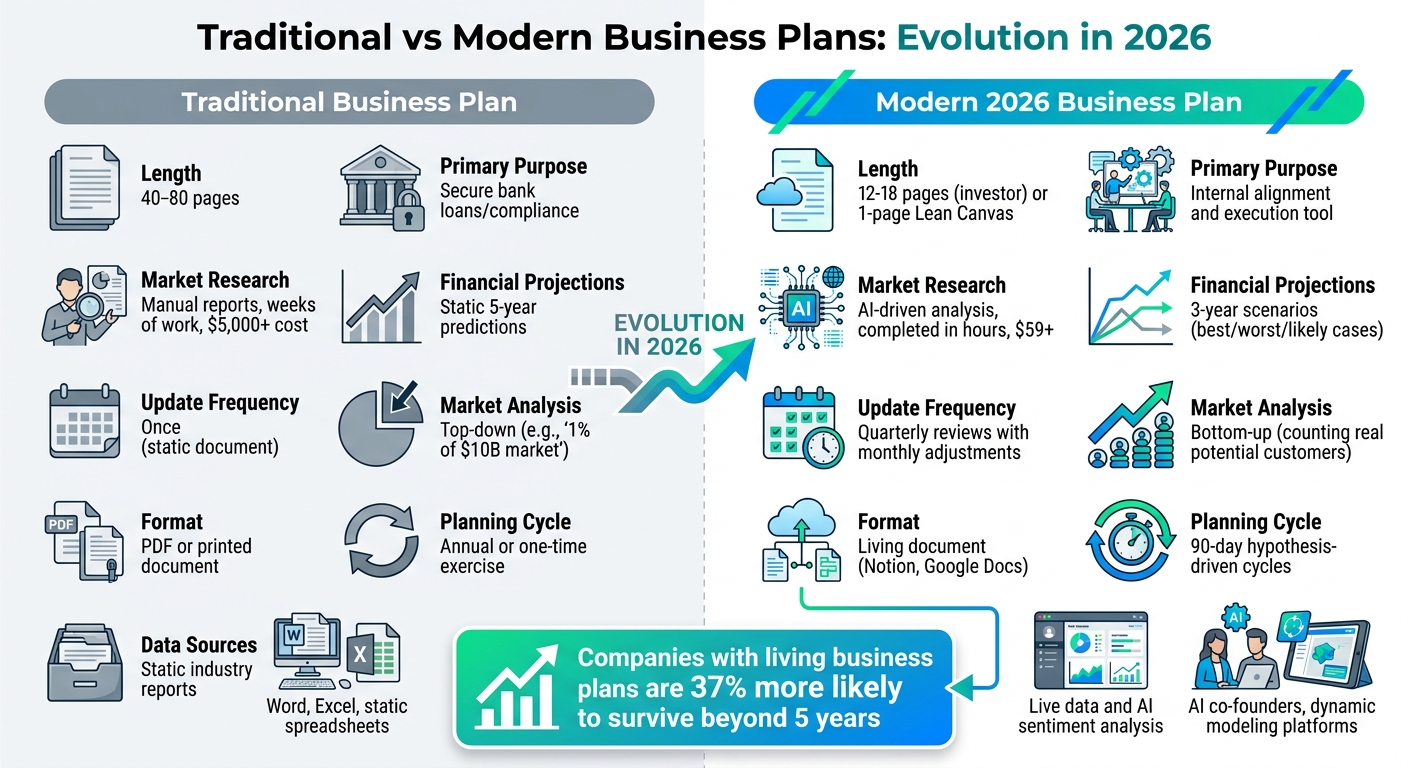
Traditional vs Modern Business Plans 2026: Key Differences
Business plans have evolved dramatically. What used to be 40–80 page, static documents that often collected dust on a shelf have transformed into concise, 12–18 page guides designed to steer daily business decisions. This shift reflects a major change in how entrepreneurs view planning - not as a one-time task, but as a continuous cycle of testing and refining assumptions.
Traditional plans were often heavy on company histories and five-year projections, which rarely aligned with reality. In contrast, modern plans focus on a problem-solution-market-traction framework that investors can grasp in just 90 seconds. Tasks that once required weeks of effort and cost over $5,000 can now be completed in a few hours using AI tools priced as low as $59.
"In 2026... a winning business plan isn't a document - it's a living, breathing operating system for your company." – Alliance-Express
The modern approach emphasizes flexibility, with quarterly updates replacing static projections. This is crucial in a world where 42% of startups fail due to a lack of product-market fit. Dynamic plans allow businesses to adapt quickly to changing markets, making them far more effective.
Comparison Table: Key Features
Here’s a quick look at how traditional business plans stack up against their modern counterparts:
| Feature | Traditional Business Plan | Modern 2026 Business Plan |
|---|---|---|
| Length | 40–80 pages | 12–18 pages (investor) or 1-page Lean Canvas |
| Primary Purpose | Secure bank loans/compliance | Internal alignment and execution tool |
| Market Research | Manual reports, weeks of work, $5,000+ cost | AI-driven analysis, completed in hours, $59+ |
| Financial Projections | Static 5-year predictions | 3-year scenarios (best/worst/likely cases) |
| Update Frequency | Once (static document) | Quarterly reviews with monthly adjustments |
| Market Analysis | Top-down (e.g., "1% of $10B market") | Bottom-up (counting real potential customers) |
| Format | PDF or printed document | Living document (Notion, Google Docs) |
| Planning Cycle | Annual or one-time exercise | 90-day hypothesis-driven cycles |
| Data Sources | Static industry reports | Live data and AI sentiment analysis |
| Tools Used | Word, Excel, static spreadsheets | AI co-founders, dynamic modeling platforms |
This table highlights the clear differences between the two approaches. The shift to concise, adaptable business plans is not just a trend - it's a necessity in today’s fast-paced market. Businesses that embrace this dynamic style of planning are better equipped to navigate challenges. After all, companies with any written plan are 16% more likely to succeed. In 2026, the key to success lies in treating your business plan as a flexible roadmap, not a rigid set of rules.
Conclusion: Building a Business Plan That Lasts
In 2026, the business plan has evolved into a practical, action-oriented tool that shapes daily decisions and keeps teams aligned. Gone are the days of sprawling 40–80 page documents. Instead, companies are opting for concise 12–18 page frameworks that cut out the fluff and focus on what truly drives success. Businesses that treat their plans as dynamic tools rather than static documents are 37% more likely to survive beyond five years. Even having any written plan at all increases the likelihood of success by 16%.
The key is to zero in on the essentials: a sharp executive summary, a bottom-up market analysis grounded in real customer data, financial projections with clear assumptions, and proof of traction. Thanks to AI tools, gathering market insights is now faster and more affordable - comprehensive analyses start at just $59. This allows entrepreneurs to spend less time collecting data and more time crafting thoughtful strategies. A modern business plan isn’t just a document; it’s a constantly evolving guide that adapts to market realities.
"The goal of a business plan is not to document your idea. It's to answer the one question every investor, lender, and serious co-founder is really asking: why will this work?" – DimeADozen.ai
To keep your plan relevant, treat it as a living document. Revisit and update it quarterly to incorporate real-world data and reflect changing business conditions. This isn’t just an exercise in maintenance - it’s a proactive way to avoid becoming one of the 42% of startups that fail due to poor product-market fit. By continuously refining your plan, you ensure it remains as flexible and responsive as the market itself.
This shift in approach represents the core of modern business planning: moving away from static, exhaustive documents and embracing agile, actionable blueprints. If your team isn’t using the plan to guide decisions, then it’s time to rethink how you approach it.
FAQs
What’s the fastest way to validate my market size in 2026?
The fastest way to confirm your market size for 2026 is to rely on proven market validation methods. Start by clearly identifying your target audience, testing for demand signals, and assessing their readiness to pay for your product or service. Use data and structured approaches, such as a demand testing framework, to back up your conclusions and guide your decisions.
Which financial metrics do investors care about most now?
When it comes to evaluating a business, investors focus on financial metrics that underline both market opportunity and growth potential. A standout metric is a Total Addressable Market (TAM) of at least $1 billion, paired with a realistic plan to secure 1–3% of that market. Beyond these figures, they seek clear evidence of what sets the business apart and its ability to deliver returns on a scale that matches venture capital expectations.
How often should I update my business plan, and what should change?
You should revisit and update your business plan every 3–6 months or at least once a year to keep it aligned with your goals and market realities. Focus on revising critical sections like the executive summary, go-to-market strategies, and financial forecasts, especially when there are significant shifts in market conditions, financial performance, or overall strategy. Regular updates not only make your plan a reliable decision-making tool but also show investors and stakeholders that you're proactive and prepared.
Related Blog Posts
- How To Write A Business Plan In 12 Steps (2025)
- Business Plan Template (2025)
- I Analyzed 1,000 Business Plans - Here's What The Successful Ones Had
- Business Plan Template (Free) for 2025: Fill-in-the-Blanks + Examples