
Many solo service businesses hit a ceiling when the founder runs out of hours to sell. The key to breaking through? Systems, tools, and processes that reduce reliance on the founder's time. Businesses that shift to productized services - offering fixed pricing and repeatable delivery - see higher revenues, better margins, and more efficient scaling.
Key takeaways include:
- Productized services (fixed scope and pricing) simplify operations and boost profitability.
- Documenting processes early allows for delegation and consistent quality.
- Recurring revenue models like retainers create predictable income for growth.
- Tools like automation and digital playbooks cut costs and save time.
- Scaling without systems often leads to shrinking profit margins.
How to Scale a Service Business | (The 4P Framework for Massive Growth)
sbb-itb-08dd11e
Service Businesses That Scale Well
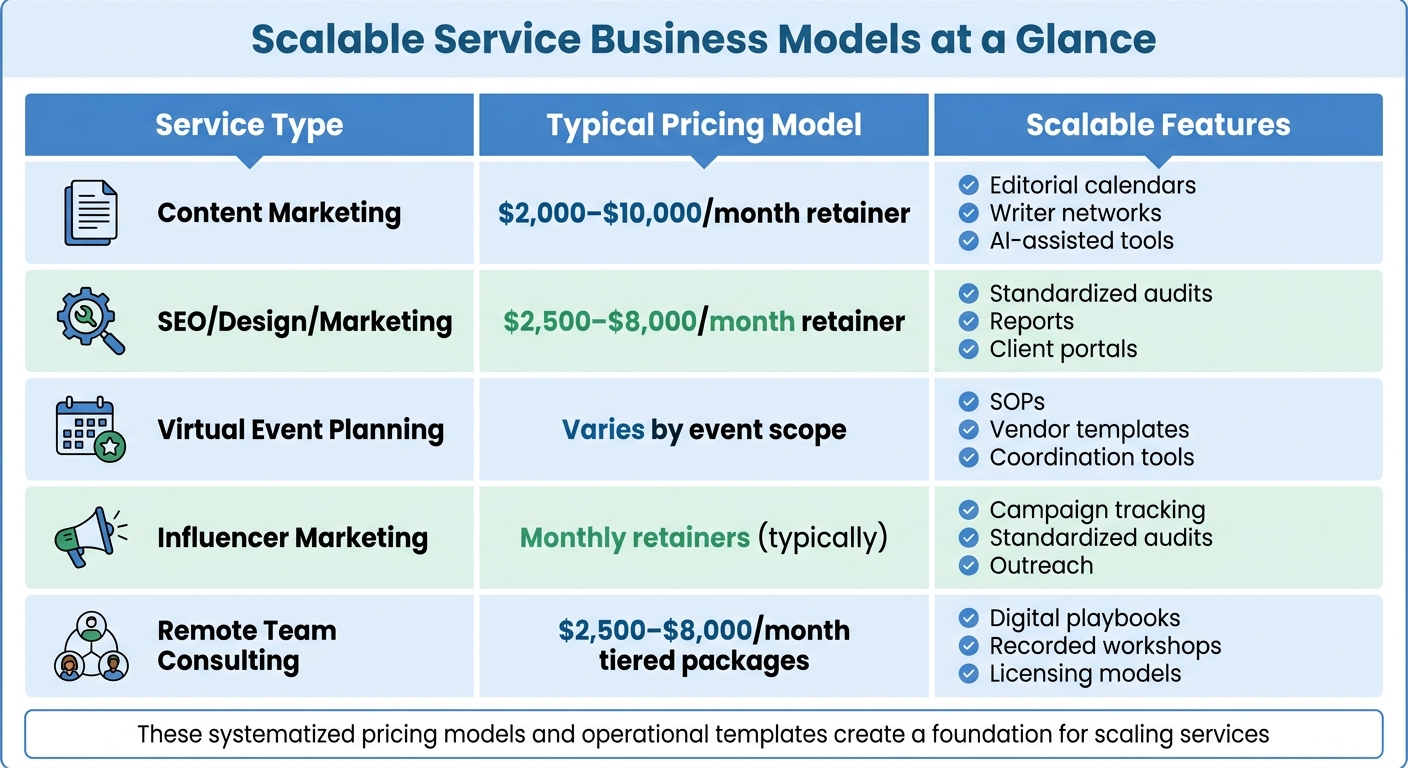
Scalable Service Business Models: Pricing and Features Comparison
Scalable service businesses rely on repeatable, well-documented processes that make delegation possible without sacrificing quality.
When processes are clearly outlined, it becomes easier to maintain consistency while scaling. Take content marketing agencies, for example. They thrive on structured workflows for tasks like writing, editing, and publishing. A solo content creator can hand off editing and proofreading duties while staying in charge of the overall strategy. Similarly, freelance agencies in SEO, design, or marketing often grow by offering fixed-price retainers - like monthly SEO audits for around $2,500 or graphic design subscriptions starting at $499. This reduces the need for custom proposals and streamlines operations.
Virtual event planning agencies also scale effectively with well-defined procedures. A solo planner can create toolkits and standard operating procedures (SOPs) for tasks such as coordinating vendors, managing attendees, and handling post-event follow-ups. Tools like Zoom, Hopin, and Trello help keep distributed teams organized and on track.
Influencer marketing agencies achieve scalability by forming small, focused teams. These teams handle tracking, outreach, and reporting using standardized audits and databases, ensuring consistent results without reinventing the wheel for every client.
Consultants, on the other hand, can scale by licensing digital playbooks or offering recorded workshops. Tiered pricing packages, ranging from $2,500 to $8,000 per month, allow them to serve a wider audience without increasing their workload.
Here’s a quick look at how these businesses structure their pricing and scale their services:
| Service Type | Typical Pricing Model | Scalable Features |
|---|---|---|
| Content Marketing | $2,000–$10,000/month retainer | Editorial calendars, writer networks, AI-assisted tools |
| SEO/Design/Marketing | $2,500–$8,000/month retainer | Standardized audits, reports, and client portals |
| Virtual Event Planning | Varies by event scope | SOPs, vendor templates, coordination tools |
| Influencer Marketing | Typically based on monthly retainers | Campaign tracking, standardized audits, outreach |
| Remote Team Consulting | $2,500–$8,000/month tiered packages | Digital playbooks, recorded workshops, licensing models |
These examples highlight how systematized pricing models and operational templates create a foundation for scaling services.
How to Scale Your Service Business
Scaling a service business without proper systems is like trying to build a house on sand - it’s bound to collapse under pressure. Service businesses that successfully grow from solo operations to small teams have one thing in common: they create repeatable processes before bringing in new hires. The key steps? Documenting systems, delegating tasks, and implementing strategic pricing models. Let’s break it down.
Building Systems and Optimizing Processes
Start by documenting the tasks you already do regularly. The goal isn’t to create an exhaustive manual that gathers dust. Instead, follow the 80% Rule: record a quick 2-minute video or jot down a 5-point checklist for any task you perform more than three times a month. This approach captures the essential steps while keeping it practical.
Automation can also be a game-changer. Tools like Calendly, QuickBooks, and Typeform can handle repetitive tasks like client onboarding, scheduling, invoicing, and lead qualification. This can reduce operational costs by 20–30% and free up time for activities that drive revenue.
Take Sarah, a salon owner in Austin, as an example. In March 2026, she took two weeks to create a "Color Mixing Guide" and set up daily 15-minute team huddles. These systems cut product waste by 22% and allowed her to open a second location without needing to oversee every detail. Her efforts even helped her secure $300,000 in funding for future growth.
"You do not rise to the level of your goals. You fall to the level of your systems." – James Clear
Streamlined documentation doesn’t just improve operations; it also speeds up onboarding. With clear systems, the time to get a new employee fully productive can shrink from 6.8 months to just 2.1 months. Once systems are in place, the next step is to delegate tasks and focus on growth.
Hiring and Delegating Tasks
With systems established, it’s time to offload routine work. Start by tracking your time for one week. You might discover that 30–40% of your hours go to administrative tasks like email, scheduling, or data entry - tasks that are perfect candidates for delegation.
If low-value tasks are eating up over 10 hours per week, consider hiring a virtual assistant or part-time admin. Rates typically range from $7 to $12 per hour for general admin work, $10 to $18 per hour for bookkeeping or social media tasks, and $10 to $20 per hour for content-related projects.
Don’t wait for everything to be perfect before delegating. Share processes that are 80% complete with junior team members - they can often deliver 90% of your quality at a fraction of the cost. This allows you to focus on the tasks that truly need your expertise.
As your team grows, introduce a Team Lead to manage daily operations and review quality. This can reduce your management time from 8 hours a week to just 2–3 hours. Look for team members who naturally take initiative or suggest workflow improvements - they often make the best leaders.
One standout example is Design Pickle, founded by Russ Perry in Scottsdale, Arizona. Between 2015 and 2021, they scaled from zero to $30 million in annual recurring revenue by offering unlimited graphic design at a flat monthly fee. Their standardized training allowed them to onboard designers in just three weeks, eventually growing to a team of over 700 serving 4,000+ subscribers.
Setting Up Pricing and Retainer Models
Hourly billing can limit your growth since there are only so many hours in a day. Switching to value-based pricing - charging for outcomes rather than time - can help break this ceiling.
Productized services, which offer fixed scope and pricing, are another way to scale. Standardized packages simplify the proposal process and ensure consistent delivery. For example, Dan Norris and Alex McClafferty grew WP Curve to $200,000 in monthly recurring revenue between 2013 and 2016 by offering unlimited WordPress fixes for $69 per month. This streamlined model allowed developers to complete 15–20 tasks daily with steady quality, ultimately leading to GoDaddy acquiring the company in 2016.
Monthly retainers also create predictable revenue, giving you the stability to plan for growth. Businesses with over 60% recurring revenue often sell for 3.7× their annual revenue, compared to just 1.2× for custom service models. Retainer-based models also tend to have higher proposal conversion rates - 34% versus 18% for custom proposals.
To sustain growth, aim for a gross margin of 50–60%. This provides the financial flexibility to hire managers and weather market changes. Keep an eye on your contribution margin per labor hour to ensure your team is generating more value than they cost.
When demand exceeds capacity, consider raising your rates by 10–20% to attract higher-value clients without overextending your team. Additionally, maintain a reserve of 3–6 months of operating expenses to navigate any potential downturns during expansion.
Using IdeaFloat to Validate and Scale Your Service Business

Growing a service business takes more than just operational know-how - it requires a clear understanding of your market and a solid financial strategy. Before expanding your team, it’s essential to validate your growth potential, and that’s where IdeaFloat comes in. This platform walks you through four key phases - Validation, Market Sizing, Financial Profitability, and Customer Acquisition - using live data and specialized APIs. With over 1,247 business ideas already validated on the platform, you can start for free without needing a credit card. By following this process, you can set the stage for focused growth and a smooth transition to scaling your team.
Validating Service Ideas with IdeaFloat
The journey starts with the Problem Validator, which ensures your service tackles a pressing, revenue-generating issue. This tool measures the urgency of the problem and identifies "weak signals" before you dive into hiring. Then, there’s Consumer Insights, which analyzes conversations from online communities to uncover the exact language your potential customers use, confirming demand.
The Competitor Analysis tool maps out your competition and highlights market gaps, helping you craft a unique value proposition. Did you know that 73% of founders give up before discovering if customers are willing to pay for their solution? Nick Sherwing, Founder of woohoPets, shared:
IdeaFloat saved us weeks of work by helping us explore demand for new products across different regions and took the guesswork out of finding gaps in the market. A must-have for entrepreneurs looking to scale.
Creating a Financial Plan for Growth
Once you’ve validated your idea, the next step is to quantify its growth potential. The Cost Analysis tool helps you calculate startup costs and monthly expenses, covering everything from software to payroll taxes . Meanwhile, the Product & Service Creator outlines your service offerings and shows how many units you need to sell to break even. This is essential for deciding if adding team members will enhance profitability or just increase costs.
To stay competitive, the Advanced Pricing Research tool analyzes market rates and competitor pricing, ensuring your pricing strategy covers additional team expenses while still appealing to customers. The Financial Projections & Breakeven Analysis then provides month-by-month revenue and cost forecasts. Interactive graphs even pinpoint the exact month you can afford to shift from working solo to building a small team. Bernie Fitzsimon, Managing Director at LighthouseHQ, noted:
Any existing business that is considering scaling up or changing direction should be using IdeaFloat. It is an incredibly powerful tool.
Preparing for Team Growth
With demand validated and financials in place, expanding your team becomes the logical next step. The Launch Checklist offers a step-by-step guide to help you transition from a solo operator to a structured team, with clear milestones along the way. Tools like the Branding Guide and Logo Generator ensure your messaging and visual identity stay consistent as your team grows. The Business Plan Generator even creates polished investor-ready plans in multiple formats, making it easier to secure funding or communicate your strategy.
Before hiring, the Smart Market Sizing tool helps you calculate TAM, SAM, and SOM, ensuring the market opportunity is large enough to justify scaling beyond a solo setup. This data can also strengthen your case with potential investors . Soba, owner of a Bar, Pilates, and Yoga Studio, shared:
IdeaFloat has been invaluable for expanding and franchising our business. It replaced months of research and Excel modelling with real-time data insights.
Common Challenges When Scaling
Transitioning from a solo operation to managing a small team can be thrilling, but it’s not without its hurdles. For instance, 42% of service businesses that double their revenue experience a drop in net profit margins by over 15%. Growth often brings added complexity, and without proper systems in place, you might end up working harder but earning less. The three main obstacles most face are maintaining service quality, managing cash flow, and ensuring productivity across the team. Let’s dig into these challenges and explore actionable solutions.
Keeping Service Quality Consistent
When you’re the one delivering services, quality is naturally consistent - it’s your expertise on display. But once you bring others on board, the focus shifts from doing the work to creating processes that ensure consistent results. New hires won’t have your experience or instincts right away, so your knowledge needs to be translated into repeatable systems.
The key is creating concise, clear documentation instead of overwhelming your team with long, dense manuals. Companies with well-defined Standard Operating Procedures (SOPs) outperform their competitors by 31%. A practical approach is the 80% Rule: record a short 2-minute Loom video and pair it with a simple 5-point checklist. This method is often far more effective than lengthy guides.
To further safeguard quality, implement a layered review system. For example:
- Self-reviews (5–10 minutes)
- Peer reviews (10–20 minutes)
- Managerial spot-checks (15–30 minutes)
Strong onboarding and training programs can also make a big difference. These systems can enhance employee productivity by 60% and boost retention by 52%. On the flip side, inconsistencies and rework can cost you 2–5% of your annual revenue. Building streamlined processes early on can save you major headaches later.
Managing Cash Flow
Hiring your first team member is a big financial step. You’re not just paying a salary - you’re also covering taxes, licenses, and training costs. A common mistake is assuming that doubling your team will double your revenue. In reality, a healthy net profit margin for a growing service business is around 20–30% after paying the founder a fair salary. To stay financially secure, aim to keep 3–6 months of operating expenses in cash reserves.
One way to smooth out cash flow is by shifting to recurring revenue models. Instead of starting each month at zero, subscriptions and retainers provide a predictable income stream. Take WP Curve as an example: founded in 2013, they offered WordPress fixes for $69/month. By standardizing tasks to under 30 minutes, they grew to $200,000 in monthly recurring revenue within 18 months and were eventually acquired by GoDaddy in 2016.
Tools like IdeaFloat’s Cost Analysis and Financial Projections can help you assess startup costs and monthly expenses, making it easier to determine the right time to hire. You’ll also want to monitor your Contribution Margin per Labor Hour to ensure new hires are adding to your bottom line, not just increasing expenses. Businesses with standardized service models also tend to sell for higher multiples - 3.7× revenue compared to 1.2× for custom services. Once your cash flow is stable, the next hurdle is ensuring your team works efficiently.
Distributing Work and Maintaining Productivity
When it’s just you, you have a clear handle on what needs to be done. But managing a team requires a shift in mindset - from “How do I do this?” to “How can this get done without me?”. Without clear systems, you risk micromanaging or becoming a bottleneck.
Start by breaking down each service into detailed steps. Define the input, output, responsible team member, quality standards, and timeline. Tracking time is also critical - specifically, the balance between billable and administrative hours. Struggling businesses often hover around 50% utilization, but scaling successfully usually means hitting 75–80%.
Consider Sarah, the owner of a high-end hair salon in Austin. In 2015, she took two weeks off from her day-to-day work to document her processes. She created a “Color Mixing Guide” that cut product waste by 22% and introduced 15-minute daily huddles. These changes allowed her to open a second, more profitable location without having to personally oversee every service.
Another example is Design Pickle, which shows how standardization can drive rapid growth. Daily team huddles help track progress and resolve bottlenecks. Building an "Operations Stack" - a system that integrates scheduling, billing, payroll, and project tracking - can also streamline workflows and keep your team on track.
Conclusion
Scaling a business isn’t about working harder - it’s about creating smarter systems. The key difference between businesses that thrive and those that struggle lies in their ability to shift focus: instead of doing all the work themselves, successful entrepreneurs design systems that handle the work efficiently. Growth fueled by strong systems leads to profitability, while growth without structure often adds unnecessary complexity.
Three principles form the backbone of scalable success. First, productization: streamline your offerings into consistent, repeatable packages that make selling and delivery easier. Second, process documentation: clearly outline methods and workflows so your team can operate independently without constant supervision. Third, financial discipline: aim for a gross margin of 50–60% and a net profit of 20–30% after paying yourself fairly. These financial benchmarks provide stability for strategic hiring and help you navigate economic fluctuations.
Delegating and automating are powerful ways to extend your reach. Look for repetitive tasks that can either be handed off to specialists or automated. For example, businesses that integrate AI automation often see operational cost reductions of 20–30%. The goal isn’t to replicate yourself but to create systems that operate smoothly without you becoming a bottleneck. Tools like IdeaFloat's Cost Analysis and Financial Projections can assist in evaluating expenses, optimizing timing, and crafting realistic growth strategies.
FAQs
When should I hire my first team member?
When your workload starts to feel overwhelming, you're constantly turning down opportunities, or you're teetering on the edge of burnout, it might be time to bring someone onto your team. Hiring your first team member can help you reclaim your focus by allowing you to delegate routine tasks. This way, you can concentrate on high-impact activities that drive growth and keep your business moving forward. Having a clear plan for what to delegate is key to making this transition smooth and effective.
How do I productize my service without lowering quality?
To turn your service into a product while keeping quality intact, start by standardizing your offerings. Define clear scopes, set fixed pricing, and document your processes. Create service packages with well-outlined deliverables to ensure everything stays consistent. Build workflows and systems that support quality control, and incorporate automation to simplify repetitive tasks. This method helps you grow your business efficiently without sacrificing the standards your customers expect.
What numbers tell me my business is ready to scale?
Your business might be ready for growth if you've reached a point of predictable revenue and have clearly defined service packages with fixed pricing and scope. Having documented workflows that ensure consistent delivery is another key sign of readiness.
If your systems can handle three to five times the current client volume without needing to hire more staff - thanks to automation and streamlined processes - it’s a strong indicator that scaling is within reach. Prioritize efficiency and repeatable systems to sustain and support this growth.
Related Blog Posts
- Build a Business That Runs Without You: Systems, SOPs, Delegation
- Which Small Business Is Most Profitable? Real Margins by Niche
- From Service to Productized Service in 30 Days (Playbook)
- Recession-Proof Service Businesses With Everyday Demand