Running a solo business in Australia has become more achievable and profitable than ever. With AI tools and digital platforms, individuals can now manage tasks that once required entire teams. Here are the top ideas for high-margin, low-cost ventures you can start with just a laptop and internet connection:
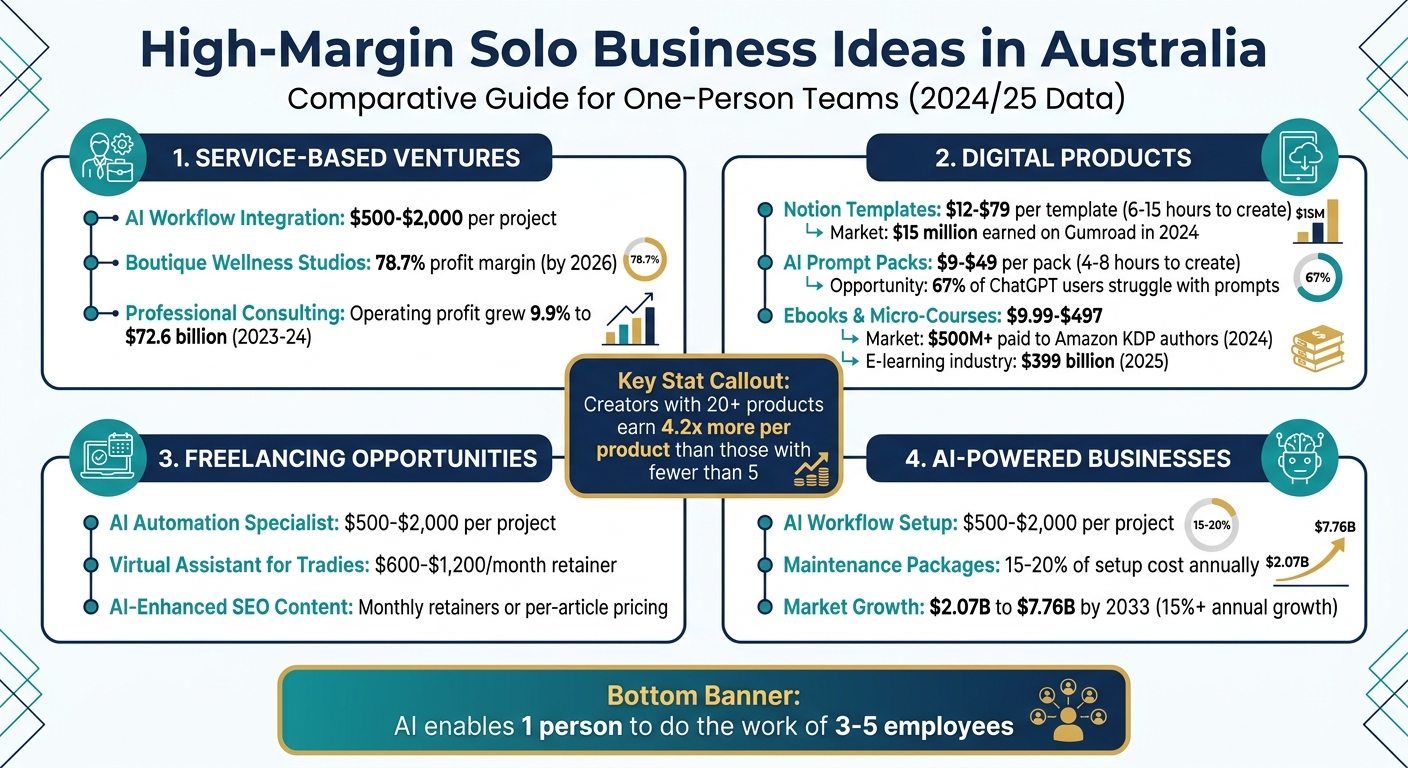
- AI Workflow Integration: Help small businesses automate processes like bookings or customer responses. Charge $500–$2,000 per project.
- Boutique Wellness Studios: Pilates and yoga studios can achieve profit margins of up to 78.7% by offering niche services.
- Professional Consulting: Turn your expertise into fixed-price consulting packages for higher efficiency and earnings.
- Digital Products: Create reusable products like Notion templates, AI prompt packs, or ebooks. These have low costs and high scalability.
- Freelancing: Roles like AI automation specialists, virtual assistants for tradies, or SEO content creators are in demand.
- AI-Powered Services: Offer tailored AI solutions to optimize small business operations, with ongoing maintenance for steady income.
The key is to focus on skills you already have, solve specific problems, and use tools to streamline your work. Whether through services, digital products, or freelancing, these ideas offer strong profit potential for solo entrepreneurs in Australia.
High-Margin Business Ideas for Solo Entrepreneurs in Australia: Revenue & Profit Comparison
10 Simple Businesses You Can Start for Under $100 in Australia
sbb-itb-08dd11e
1. Service-Based Ventures
Building on the idea of low-cost, high-margin opportunities, service-based ventures thrive by leveraging specialized skills to meet the unique needs of local markets.
AI Workflow Integration for Local Businesses
Businesses in Australia are increasingly looking for help to implement automation systems, and they’re willing to pay for effective solutions. You can charge between $500 and $2,000 per project to set up tools like booking systems, automated customer responses, or streamlined accounting for small businesses like cafés, gyms, or trade services. Many small business owners understand the value of automation but don’t know where to start, making this a valuable service.
The real trick? Develop reusable templates for common setups. Once you’ve created these, onboarding new clients becomes faster and easier, while your rates remain steady. This approach not only saves you time but also allows you to scale your services more effectively.
Boutique Wellness Studios
Pilates and yoga studios are poised to be highly profitable in Australia, with profit margins expected to hit 78.7% by 2026. A single-room studio in a busy area can bring in impressive revenue with relatively low operating costs. To stand out, focus on offering premium services rather than competing solely on price.
Before committing to a location, research foot traffic and potential demand. Then, carve out a niche - specialized offerings like prenatal Pilates, rehabilitation-focused classes, or corporate wellness programs can set you apart. By combining a strategic location with targeted services, you can keep expenses low while maximizing income.
Professional Consulting Services
If you have specialized expertise, turning it into a consulting business can be a profitable move. In fact, the Professional, Scientific, and Technical Services sector saw its operating profit grow by 9.9% to $72.6 billion in 2023-24, showing the demand for niche expertise.
One way to increase efficiency and earnings is to productize your services. Instead of billing hourly, package your knowledge into fixed-price offerings.
Chloe Sapienza, Founder of Telescope, shared: "Productizing the company's corporate gifting service helped it increase revenue by 200%".
This approach allows you to standardize your work, making it easier to serve more clients without adding to your workload. Over time, as your reputation grows, these standardized packages can command higher prices, boosting profitability while keeping operations manageable for a solo practitioner.
2. Digital Products
Digital products offer an incredible profit margin for solo entrepreneurs. Why? Because you create them once and sell them over and over again without worrying about production, shipping, or storage costs. Thanks to AI, the process of creating digital products has become faster and more accessible. What used to take a team can now be achieved by one person in just a few months.
"The highest-margin business model of 2026 costs $0 to produce, $0 to ship, and $0 to store. You build it once and sell it forever." – Sergei P., AI Business
The key to success lies in solving specific challenges for a niche audience. For example, a former nurse who creates shift management templates for healthcare workers is likely to see better results than someone selling a generic productivity planner. Interestingly, creators with a catalog of 20 or more products earn 4.2 times more per product than those with fewer than five, thanks to the ability to cross-sell and the sheer variety they offer.
This shift away from service-based models is opening exciting pathways for scalable income through digital products.
Notion Templates and Workflow Systems
The market for Notion templates is booming. In 2024 alone, creators earned around $15 million on Gumroad from selling these templates. Small businesses, especially in Australia, often need tools like client management dashboards, content calendars, and project trackers but don’t have the time to build them from scratch. This is where you can step in.
You could design customizable templates in as little as 6–15 hours and sell them for $12–$79 each. Focusing on industry-specific needs can make your templates even more appealing. For instance, you might create tools for tradies to manage quotes and invoices or for fitness coaches to track client progress. These tailored solutions often resonate more with buyers.
AI Prompt Packs for Specific Industries
Did you know that 67% of ChatGPT users feel they don’t know how to write effective prompts? This creates a golden opportunity to sell curated prompt packs tailored to specific professions. Instead of offering generic prompts, you could create niche collections like "100 Prompts for Australian Real Estate Agents" or "50 Client Communication Prompts for Personal Trainers."
These packs are quick to produce, taking only 4–8 hours to put together, and can be sold for $9–$49. They offer professionals ready-to-use tools to save time and boost efficiency.
Self-Published Guides and Micro-Courses
Self-publishing and online learning are thriving markets. In 2024, Amazon KDP paid out over $500 million to independent authors, while the global e-learning industry reached $399 billion in 2025. AI tools have made it much easier to create content like ebooks and courses. For example, a 20,000-word ebook that might have taken 100 hours to write traditionally can now be completed in just 20–30 hours with AI assistance.
The most successful products in this space are practical and skill-focused. Think of guides like "Setting Up Automated Invoicing for Australian Freelancers" or "Instagram Marketing for Local Cafés." You can price ebooks between $9.99 and $29.99, while more detailed courses can range from $29 to $497. Keep in mind, under Australian Consumer Law, you’re required to offer refunds for digital products that are faulty or don’t match their description.
These digital strategies can serve as a foundation for expanding into freelancing opportunities, which we’ll explore next.
3. Freelancing Opportunities
AI has made it possible for one person to handle tasks that used to require 3–5 employees. This shift means freelancers can now achieve higher margins by specializing in niche markets and leveraging AI to boost their productivity. Instead of charging hourly rates, many successful freelancers are moving toward outcome-based pricing or monthly retainers. These models not only stabilize income but also better reflect the value delivered to clients.
The key to profitability lies in blending AI's efficiency with your own expertise. Use AI to handle repetitive tasks, freeing up your time to focus on strategy and building strong client relationships. To operate legally, make sure to register for an ABN (Australian Business Number) and plan for GST registration once your annual turnover hits $75,000. Below are some freelancing roles that allow solo practitioners to make the most of AI.
AI Workflow Automation Specialist
Many small businesses in Australia still rely on manual processes that could easily be automated. As a freelance automation specialist, you can design outcome-focused packages for clients, offering scalable and reusable automation solutions. Target industries like cafes, gyms, or real estate agencies - businesses that need tech support but can't afford a full-time hire. Your services could include automating customer replies, booking systems, or accounting workflows. This role offers a straightforward way to achieve high margins while delivering measurable results for clients.
Virtual Assistant for Tradies
Tradespeople in Australia - such as plumbers, electricians, and builders - are skilled at their jobs but often struggle with the administrative side of things. By offering tailored virtual assistant services, you can help them simplify tasks like quoting, scheduling, and invoicing. Monthly retainers for these services typically range from $600 to $1,200. The key is to understand the specific needs of their industry and use easy-to-adopt tools that won’t overwhelm them. This role provides a practical and profitable way to assist busy tradies.
AI-Enhanced SEO Content Studio
Businesses across industries need high-quality SEO content but often lack the budget for large agencies. By combining AI's ability to draft content with your editorial skills to refine it, you can deliver polished, brand-specific material more efficiently. Offer your services through monthly retainers or per-article pricing, and consider focusing on niches like e-commerce, SaaS, or local services. Clients appreciate the speed AI brings, paired with the human touch needed to ensure the content aligns with their goals. This approach allows for consistent, scalable income while maintaining high standards.
4. AI-Powered Businesses
AI-powered businesses are taking traditional service-based models to a whole new level, offering both scalability and efficiency. In Australia, the AI market is on a steep upward trajectory, expected to grow from $2.07 billion to $7.76 billion by 2033, with an annual growth rate exceeding 15%. This rapid growth presents a golden opportunity for solo entrepreneurs to connect AI's capabilities with the real-world needs of local businesses. Many small businesses in Australia are eager to adopt AI but lack the technical expertise to make it happen on their own.
AI Workflow Setup Service
As an AI Workflow Setup specialist, you can provide customized AI solutions that help simplify and optimize specific tasks for businesses like tradies, cafés, gyms, and real estate agencies. These businesses often struggle with time-consuming manual processes and know AI could make a difference - they just don’t know where to begin. By introducing targeted AI tools, you can help them save significant time, improve efficiency, and reduce costs. The best part? This service requires minimal overhead, just your know-how and a laptop, allowing you to charge $500–$2,000 per project.
Take, for example, Joe Tomalin, a handyman in South Australia's Eyre Peninsula. In March 2026, he implemented AI to automate tasks like estimating, email drafting, and planning. This cut his weekly admin hours from 10 to just 2. Stories like Joe's demonstrate how practical AI solutions can transform day-to-day operations for small business owners.
"Australian businesses aren't looking for experimental AI that might work. They want reliable tools that fit their existing systems and actually deliver results." – VT Digital
To succeed in this field, focus on solving one key problem at a time. This not only builds trust but also encourages word-of-mouth referrals. Additionally, offering ongoing maintenance services can strengthen your client relationships. Maintenance packages, often priced at 15–20% of the initial setup cost annually, can provide a steady revenue stream. By addressing specific challenges and delivering dependable results, you position yourself as an essential partner in the growing AI landscape in Australia.
Conclusion
Launching a high-margin, solo business in Australia goes beyond just making money - it's about creating freedom and having choices. As Rebecca Hanifin from Financial Spectrum explains:
"Real wealth isn't about how impressive your income looks. It's about how much choice and freedom it creates".
The examples highlighted here prove that you don’t need a big team, fancy offices, or risky loans to succeed. By 2026, the Australian market is brimming with opportunities for solo entrepreneurs. Thanks to AI tools acting as productivity boosters, individuals can now handle workloads that used to require several employees. For instance, professional services saw their operating profit before tax rise by 9.9% to $72.6 billion in 2023–24, while health care services experienced a 6.6% growth in business numbers during 2024–25. The momentum is undeniable, and the timing couldn’t be better.
The strategies discussed earlier emphasize one core idea: focus on your strengths, test your ideas before committing resources, and use tools like IdeaFloat to design a clear revenue plan. Pricing strategies, cost analysis, and a solid financial foundation are critical from day one.
Turning an idea into a thriving business doesn’t have to be overwhelming. Start by identifying what you excel at, pick a business model that aligns with your skills, and take that first step. Whether it’s building AI workflows, selling digital products, or offering specialized freelance services, the chance to create something both meaningful and profitable is within reach. Australia is stepping into a promising era for lean, fast-growing micro-businesses.
The next step is yours - start small, stay focused, and build a business that offers both financial stability and personal freedom.
FAQs
Which idea fits my skills best?
To discover the right small business idea that matches your talents, start by identifying what you’re great at. If you’re strong in professional services - like accounting or consulting - you could build a specialized service-based business. Got a knack for digital skills? Businesses like setting up AI workflows or offering digital marketing services might be a perfect fit. For those with creative abilities, ventures such as content creation or online publishing could be the way to go. The key is to align your business idea with both your strengths and passions to set yourself up for success.
How do I get my first clients in Australia?
To land your first clients in Australia, focus on pinpointing your ideal audience and tapping into both digital and local networks. Platforms like social media, local directories, and community groups are excellent for promoting services like virtual assistance or social media management.
Attending local events can open doors to valuable connections, while using AI tools can help you customize your services to meet specific needs. This approach not only helps you meet demand but also builds referrals and attracts those all-important first customers.
What legal steps do I need (ABN, GST)?
To legally run a small business in Australia, you’ll need an Australian Business Number (ABN). This number is essential for identifying your business, issuing invoices, and dealing with government agencies. Additionally, if your annual turnover surpasses $75,000, registering for the Goods and Services Tax (GST) becomes mandatory. These are the primary legal steps for starting and operating a business as a sole trader.
Related Blog Posts
- 21 Low-Investment Business Ideas for Women in Australia
- Best Small Business Ideas in Australia Under $5,000
- Best Small Business Ideas in Australia Under $30,000
- The Cheapest Businesses to Start in Australia That Still Have Margin