
When the economy slows down, some businesses still manage to succeed. Why? They focus on solving daily problems, keeping costs low, and generating steady income. Here are 21 business ideas proven to work even in tough times. Each one targets services people need, offers low startup costs, and has potential for recurring revenue.
Key Ideas:
- Essential Services: Solar panel maintenance, end-of-lease cleaning, mobile tech repair, and more. These businesses address everyday needs and stay in demand.
- Financial Support: Services like virtual CFOs, bookkeeping, and tax planning help businesses manage money better during tighter times.
- Education & Training: Offering exam prep, workplace compliance training, or online upskilling can meet growing demand for learning new skills.
- Digital Solutions: Start a niche e-commerce store, AI consulting, or even a wellness platform to tap into Australia's growing online market.
Quick Summary Table:
| Category | Example Businesses | Startup Cost | Profit Margins |
|---|---|---|---|
| Essential Services | Solar panel maintenance, pet grooming | $1,000–$8,000 | 30%–80% |
| Financial Support | Virtual CFO, bookkeeping | $300–$8,000/month | Varies |
| Education & Training | STEM workshops, online courses | $2,000–$5,000 | Up to 97% |
| Digital Solutions | AI consulting, e-commerce, dropshipping | $500–$2,000 | High margins |
Pro Tip: Test your idea first. Tools like IdeaFloat can help you validate your idea and avoid wasting money. Focus on solving real problems, and you’ll increase your chances of success. You can also learn how to launch your business through our free entrepreneurship courses.
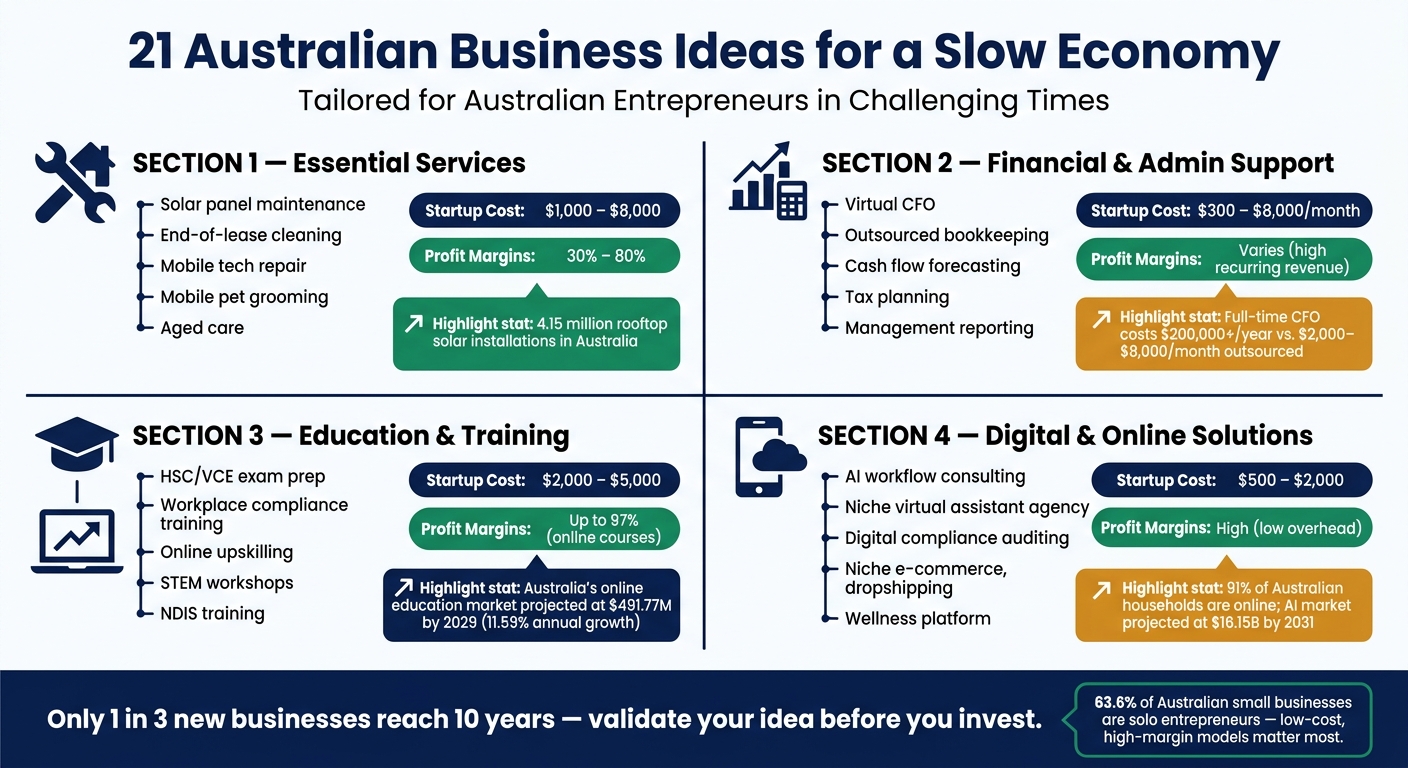
21 Australian Business Ideas That Work in a Slow Economy: Cost vs. Profit Breakdown
1. Essential Services
Essential services cater to pressing needs - like fixing a burst pipe, caring for seniors, or conducting property inspections - and remain in demand even during economic slowdowns. Here are five service ideas that focus on meeting everyday urgent needs.
- Solar Panel Maintenance
With 4.15 million rooftop solar installations in Australia, maintaining these panels is crucial as neglected systems can lose up to 25% of their efficiency. Starting this business requires an investment of $2,000–$5,000, offering profit margins of 60%–80%. As the energy transition continues, the demand for this service is expected to stay steady.
- End-of-Lease Cleaning
Real estate agencies often require properties to meet strict cleaning standards, usually within 48 hours, before releasing bonds. Collaborating directly with these agencies can secure consistent referrals. The commercial cleaning industry in Australia is worth $15.2 billion, and end-of-lease cleaning is one of its most stable niches. Start-up costs are around $2,000.
- Non-Medical Aged Care & Companion Services
"The 'Aged Care' tsunami: Australia has an aging population. By 2030, over 20% of the population will be over 65. Services for seniors are recession-proof." - True Wealth Management
Government initiatives like the NDIS and Support at Home ensure a constant need for daily assistance and companion care. In urban areas, private-pay hourly rates for non-medical care have surpassed $35 as of 2024. Starting this service requires an investment of under Starting this service requires an investment of under $1,000,000.
- Mobile Tech & Appliance Repair
When money is tight, people often choose to repair rather than replace their gadgets and appliances. A mobile repair service aligns perfectly with this trend. With start-up costs of about $8,000 and profit margins between 55% and 70%, this model benefits from low overhead since the service is delivered at the customer’s location.
- Mobile Pet Grooming
Pet care spending remains resilient even during economic downturns. Mobile grooming services, which bring care directly to the pet owner's doorstep, can charge about 30% more than traditional grooming salons. This business can generate approximately $120,000 in its first year, with profit margins ranging from 30% to 50%. It’s particularly appealing to busy pet owners and elderly pet lovers who value the convenience.
sbb-itb-08dd11e
2. Financial and Administrative Support
When business slows down, having a solid handle on finances becomes even more important for small business owners. The following services can provide the financial clarity and administrative support needed to navigate tighter revenue periods.
- Virtual CFO Services
Hiring a full-time CFO in Australia can cost upwards of $200,000 annually. For small businesses that need high-level financial expertise but can’t afford a full-time executive, virtual CFO services are a practical alternative. These services, priced between $2,000 and $8,000 per month, offer strategic financial leadership at a fraction of the cost.
"An outsourced CFO gives Australian startups and small-to-medium businesses access to senior-level financial leadership - without the overhead of a full-time executive hire." - Ram Vaidyanathan, Managing Director, Daintree Consulting
- Outsourced Bookkeeping & Payroll
On average, small business owners spend over six hours a week managing financial tasks. Outsourcing bookkeeping and payroll can save time and reduce stress. Services like bank reconciliations, Single Touch Payroll (STP) compliance, and superannuation management allow owners to focus on growth. Costs typically range from $300 to $1,500 per month.
- Cash Flow Forecasting
In challenging times, understanding cash flow is essential. A cash flow forecasting service provides rolling 13-week projections, offering visibility into liquidity and upcoming debt obligations. This level of insight can be critical when profit margins are under pressure.
- Strategic Tax Planning
Ignoring tax obligations can be costly, with late BAS penalties reaching $313 per period. Many small businesses wait until the end of the financial year to address taxes, but proactive tax planning can ensure compliance and reduce liabilities. Services like BAS preparation cost $150–$500 per quarter, while company tax returns range from $700 to $2,500.
- Management Reporting
Turning complex financial data into actionable insights can help identify profitable products, services, or clients. This type of reporting is especially useful for businesses undergoing restructuring or making key hiring decisions, providing the clarity needed to make informed choices.
3. Education and Training
Education and training businesses have a knack for staying steady, even when the economy slows down. Why? Because when times are tough, people often turn to learning new skills to improve their prospects. For example, Australia's online education market is expected to hit $491.77 million by 2029, growing at an annual rate of 11.59%. This growth opens the door for entrepreneurs who can pinpoint and cater to specific niches. Below are some niche ideas that mix low startup costs with consistent demand, making them a promising choice in uncertain times.
- Specialized Exam Prep: High-stakes exams like the HSC, VCE, and IB always keep the demand for tutoring alive. Zeroing in on a specific subject - like "Year 11–12 Methods exam preparation" - can simplify your marketing efforts and allow you to charge premium rates between $50 and $120 per hour.
"A clear niche makes your marketing easier and helps you design a service that clients understand quickly." - Sapna Goundan, Content Writer, Sprintlaw
- Workplace Compliance Training: Programs like First Aid, CPR, and asthma/anaphylaxis training are mandatory for many workplaces, schools, and sports organizations, regardless of economic conditions. Offering a blended approach - online theory paired with in-person practical sessions - can ensure steady, recurring revenue.
- Online Professional Upskilling: With nearly 40% of Australian employers expected to adopt AI by late 2025, reskilling is becoming essential. Digital courses covering skills like bookkeeping, software tools, or compliance training can be launched with an upfront investment of $2,000–$5,000. These courses can achieve gross margins as high as 97%. Testing your idea with a small beta group before fully committing can help refine your offering.
- STEM & Robotics Workshops: Community-based STEM workshops for kids are a smart choice because they avoid the overhead of fixed venues. In Australia, non-traditional tutoring is growing at 13.8% annually, with startup costs ranging from $2,000 to $5,000. Many businesses in this space can turn a profit within 2–3 months.
- NDIS Skills Training: The National Disability Insurance Scheme (NDIS) sector, valued at $46.3 billion, continues to experience a shortage of skilled support coordinators and plan managers. Tailored training courses can tap into this government-backed funding, offering a stable and lucrative opportunity.
"The NDIS business opportunity in Australia is one of the most underappreciated wealth-building paths available right now." - Noah Oloja, Founder, SyncSkills
4. Digital and Online Solutions
In today’s fast-paced market, digital models stand out because they offer scalability, low overhead, and the flexibility businesses need to adapt. With 91% of Australian households online and the local AI market expected to hit $16.15 billion by 2031, digital businesses can grow without requiring large teams or extensive resources.
Here’s how technology-driven approaches are reshaping traditional business models, making them more efficient and cost-effective:
- AI Workflow Consulting: Small businesses are eager to use AI to cut labor costs, but many lack the know-how to do it effectively. With 40% of Australian SMEs already adopting AI, there’s a clear demand for consultants who can bridge that gap. Startup costs are minimal - under $1,000 - and consultants often see profits within one to three months.
- Niche Virtual Assistant Agency: Focusing on specialized areas like legal billing or medical administration allows you to charge premium rates, typically between $45 and $85 per hour. This business can be launched for less than $500, and acquiring your first clients can happen within weeks.
- Digital Compliance Auditing: With new cybersecurity and workplace safety regulations, businesses face growing pressure to stay compliant. Considering the average cost of a cyber incident is $80,850 per business, there’s strong demand for digital compliance auditors. Startup costs are under $2,000, and profitability often follows within two to four months.
- Niche E-commerce Studio: Instead of selling a wide array of products, focus on a specific category you’re passionate about. This approach aligns with the rise of social commerce - 76% of Australian consumers now shop directly through social media posts. A specialized, platform-native store can tap into this growing trend.
- Digital Dropshipping (Licensed Assets): The digital product market - expected to be valued at $124 billion by 2025 - offers high-margin opportunities. Selling licensed assets like Canva templates, Lightroom presets, or code snippets eliminates the need for inventory or shipping, keeping operations simple.
- Psychosocial Wellness Platform: Workplace mental health is no longer optional. Since the introduction of new laws in 2026, wellness programs have become a compliance requirement, fueling a $61.83 billion market. Digital platforms offering curated wellness solutions can meet this need, often through subscription-based models aimed at HR teams.
The common theme across these strategies? They address pressing needs with minimal upfront investment, making them ideal for navigating tough economic conditions.
Before diving in, consider running a small pilot program or offering pre-sales to gauge interest and avoid unnecessary expenses. This way, you can refine your approach while conserving resources.
Conclusion
The 21 ideas shared here address ongoing needs, keep overhead costs manageable, and create opportunities for recurring revenue. But their success ultimately depends on one critical factor: proper validation before launch.
Statistics reveal a tough reality - only about one-third of new businesses make it to the 10-year mark, and around 22.4% don’t survive their first year. What sets successful ventures apart is effective and timely validation. Whether it’s engaging with potential customers, running a small pilot, or testing pre-sales, this step helps identify ideas with real potential versus those that merely spark casual interest.
"The 'best' business depends on timing, capital, and location." - True Wealth Management
Validation isn’t about endless research; it’s about quick, targeted testing. It’s the difference between hearing "That’s a nice idea" and someone actually committing their money to it.
This is where IdeaFloat comes in. Designed specifically for early-stage entrepreneurs, IdeaFloat offers tools to validate your idea before you invest heavily in branding or inventory. From problem validation and market sizing to competitor analysis and pricing, their platform uses live data to guide you. You can even create a waitlist landing page or build a financial model - all without needing a team or a large budget. For solo entrepreneurs - who now make up 63.6% of Australia’s small business sector - this kind of lean, structured approach can make a huge difference.
Australia’s economy rewards businesses that solve real problems efficiently. The models discussed above highlight the importance of efficiency and honest validation. Start with a clear idea, test it thoroughly, and build a business that lasts.
FAQs
Which idea fits my skills and budget best?
Start by selecting a business idea that aligns with your skills and interests. This helps reduce the time you’ll need to spend learning new things and allows you to hit the ground running. For example, if you’re tech-savvy, something like virtual assistance or freelance work might be a good fit.
Next, figure out your startup costs. Include everything - equipment, licenses, marketing expenses, and any other essentials. For many low-cost ventures, the initial investment can range between $500 and $3,500, making it manageable for most budgets.
Don’t skip researching local demand. Make sure there’s a real market for your services or products. This step ensures you’re not just passionate about your idea but that there are actual customers ready to pay for it.
Finally, choose something you’re genuinely excited about. Passion not only helps you deliver better quality but also makes it easier to grow your business into something sustainable over time.
How can I validate demand before I spend money?
To gauge demand without dipping into your wallet, start by looking for real evidence of past behavior. Free tools like Google Trends, social media insights, and online forums can help you track search patterns and ongoing discussions. Dive deeper by interviewing potential customers - find out how they've tackled the problem before and whether they've spent money on solutions. Another approach? Create a basic landing page or waitlist to test interest. Metrics like sign-ups or clicks can give you solid proof of demand.
Which ideas produce recurring monthly income fastest?
If you're looking to create a steady income stream each month, focus on business models that naturally come with built-in demand. One great approach is offering subscription-based services or retainers. These models often ensure predictable revenue and can be quick to set up.
Here are some examples:
- Service-Based Businesses: Options like commercial cleaning or property maintenance (think solar panel cleaning) are excellent choices. Many of these require relatively low startup costs, typically ranging between $6,000 and $18,000.
- Remote Professional Services: Skills like website maintenance or digital marketing can be turned into subscription-style services. These provide consistent income without the need for a physical location.
- Product Subscriptions: Offering curated gift boxes or digital products, like templates, allows you to scale your business while maintaining regular cash flow.
These models are not only practical but also adaptable to different industries, making them a smart choice for anyone aiming to build recurring income efficiently.
Related Blog Posts
- 21 Low-Investment Business Ideas for Women in Australia
- Best Small Business Ideas in Australia Under $30,000
- The Cheapest Businesses to Start in Australia That Still Have Margin
- 19 Low-Cost Business Ideas in Australia With High Profit Potential