Starting a mobile detailing business? Here’s what you need to know:
A mobile detailing business offers vehicle cleaning services at the customer’s location, making it a convenient and cost-effective alternative to traditional detailing shops. With startup costs ranging from $2,000 to $35,000, it’s an affordable way to enter the automotive service industry. But success hinges on a solid business plan.
Key Takeaways:
- Lower Costs: Mobile setups avoid high rent and utility expenses.
- Startup Costs: Begin with $15,000–$35,000 for a professional setup or less for smaller operations.
- Target Market: Focus on high-income areas and busy professionals who value convenience.
- Revenue Potential: First-year earnings typically range between $50,000 and $120,000.
- Legal Compliance: Secure proper insurance and follow water runoff regulations to avoid fines.
- Efficiency Tips: Stay within a 25-mile radius, group jobs geographically, and use a tiered pricing model.
This guide covers everything from setting up your business legally to creating service packages, pricing, and marketing strategies. Whether you’re starting small or aiming for rapid growth, a well-prepared plan can help you avoid pitfalls and maximize profits.
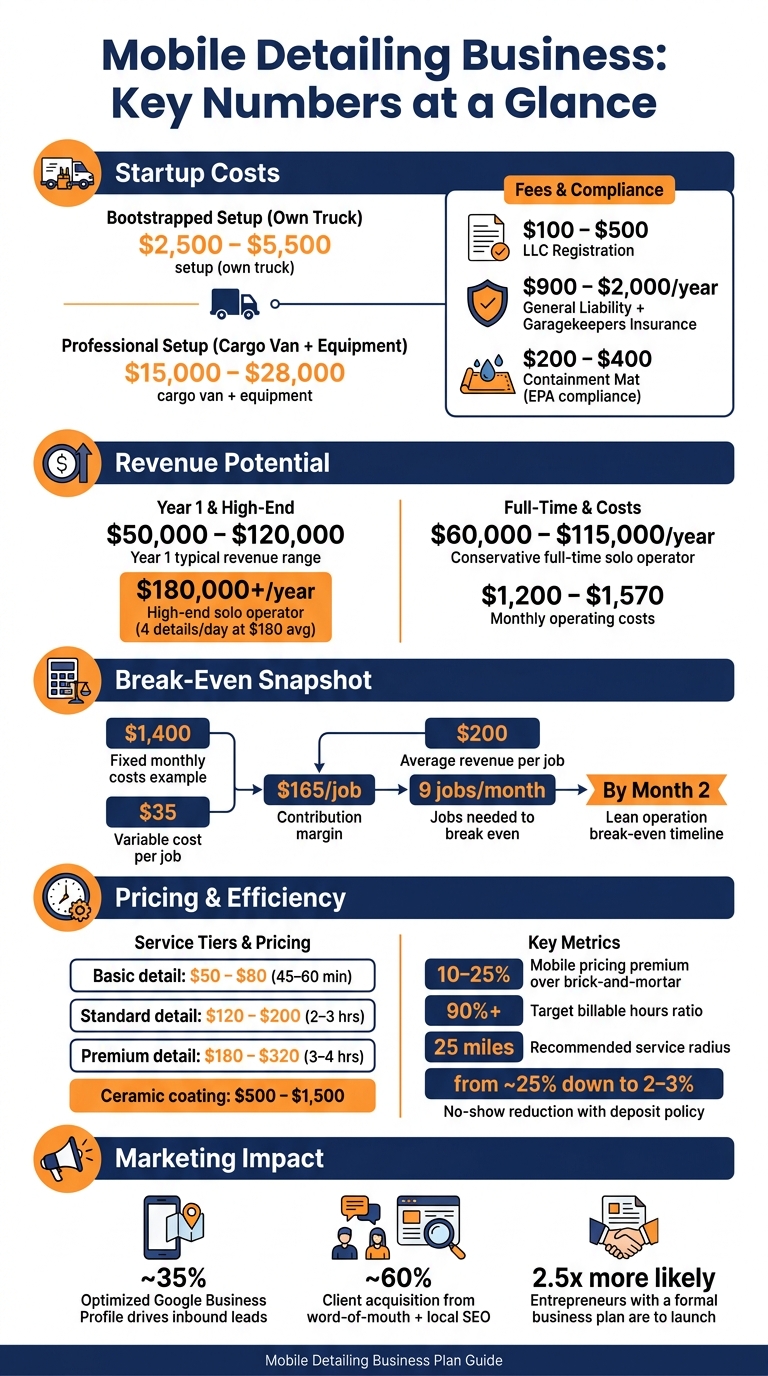
Mobile Detailing Business: Startup Costs, Revenue & Key Numbers at a Glance
Executive Summary and Business Overview
How to Write an Executive Summary
Save the executive summary for last. Once your entire plan is complete, you'll have all the details needed to summarize it effectively in one to two pages.
Keep your summary concise - ideally one page. Highlight your business name, location, services offered, target customers, financial projections, funding needs, and how you'll allocate those funds.
Example: "Shine & Go Mobile Detailing is an insured, eco-friendly mobile auto detailing service operating in the Dallas–Fort Worth metro area. We serve busy professionals and luxury vehicle owners with on-site interior and exterior detailing packages. We project $85,000 in Year 1 revenue and are seeking $20,000 in startup funding to fully equip our service vehicle and cover initial operating costs."
"A business plan is your roadmap. It helps you define your goals, understand your market, manage your finances, and make smart decisions from day one." - Mk Faizi
For mobile detailing businesses, Year 1 revenue typically falls between $50,000 and $120,000, while professional startup costs range from $5,000 to $15,000. Including realistic numbers in your summary helps establish credibility with potential investors or lenders.
Setting Your Mission, Vision, and Objectives
Clear mission, vision, and objectives are critical for long-term growth. Your mission statement should explain why your business exists and how it operates, while your vision statement outlines where you aim to be in five to ten years.
For example, a mission statement might read: "To deliver professional, convenient, and eco-friendly vehicle detailing directly to our customers - saving them time without compromising on quality." A complementary vision statement could be: "To become the most trusted mobile detailing brand in our region, operating a fleet of three vehicles by Year 3."
Set SMART objectives (Specific, Measurable, Achievable, Relevant, Time-bound) to guide your growth. For instance:
- Achieve $6,000 in monthly revenue within six months.
- Secure five recurring commercial fleet accounts within the first year.
- Add a second service vehicle by Month 18.
These concrete goals not only keep you focused but also make your business plan more compelling to stakeholders.
Choosing a Business Structure and Meeting Legal Requirements
Many solo mobile detailers start as sole proprietors, but this setup exposes personal assets - like savings, your car, or your home - to potential lawsuits or unpaid debts. Instead, forming an LLC (Limited Liability Company) creates a legal separation between you and your business, offering protection.
Here’s what you’ll need to get started:
- LLC Registration: Costs range from $100 to $500, depending on the state.
- EIN (Employer Identification Number): Free from the IRS and necessary for banking and taxes.
- Liability Insurance: Covers third-party injuries or damages ($500–$1,200/year).
- Garagekeeper’s Insurance: Protects against damage to customer vehicles ($400–$800/year).
- Containment Mat: Ensures compliance with EPA regulations on wastewater runoff ($200–$400).
| Legal/Compliance Step | Purpose | Estimated Cost |
|---|---|---|
| LLC Registration | Protects personal assets | $100 – $500 |
| EIN (IRS) | Required for banking and taxes | Free |
| General Liability Insurance | Covers third-party injury/damage | $500 – $1,200/yr |
| Garagekeeper's Insurance | Covers damage to customer vehicles | $400 – $800/yr |
| Containment Mat | EPA/wastewater runoff compliance | $200 – $400 |
Keep in mind, under the Clean Water Act, discharging soapy water into storm drains is illegal. States like California, Oregon, and Washington impose fines between $500 and $3,000 per violation.
Next, we’ll dive into market analysis to determine your service area and target audience.
sbb-itb-08dd11e
Market Analysis and Target Audience
How to Define Your Service Area
Your service area plays a huge role in determining how profitable your business can be. Most mobile detailers who succeed financially stick to a 25-mile radius from their base location. Extending beyond that range often means more time stuck in traffic and higher travel costs, which can quickly eat into your profits.
To maximize earnings, focus on zip codes where household incomes fall between $80,000 and $150,000. These areas are more likely to have late-model vehicles and residents who value convenience. Take Marcus T., for example. When he started CleanRide Mobile Detailing in Charlotte, NC, he specifically targeted South Charlotte and Ballantyne. Why? These neighborhoods had high household incomes and a dense population of newer vehicles. His strategy revolved around route efficiency, not just covering a large area.
The key is to group jobs geographically. By clustering jobs close together, you minimize travel time and make the most of your day. Once your service area is clearly defined, the next step is to break down your audience into distinct customer groups.
"A plan that doesn't model drive time between jobs in your specific service area is a fantasy." - IdeaJumpStart
How to Segment Your Target Audience
Breaking your audience into segments allows you to customize your services to meet their specific needs.
| Target Segment | Key Needs | Tailored Service |
|---|---|---|
| Busy Professionals | Convenience, time-saving | Office-park detailing during work hours |
| Luxury Car Owners | High-quality care, protection | Ceramic coatings and paint correction |
| Families | Interior sanitation, odor removal | Full interior vacuuming and steam cleaning |
| Fleet Managers | Predictability, volume pricing | Recurring maintenance subscriptions |
Among residential clients, the most profitable tend to be physicians, attorneys, and executives - people earning $150,000+ who prioritize saving time over saving money. On the commercial side, fleet managers for taxi companies, limousine services, and rental agencies offer reliable, high-volume business through regular contracts. For instance, MD Auto Detailing LLC in Atlanta built its first-year revenue projection of $382,000 by targeting a mix of high-income professionals within a 25-mile radius and fleet operators.
Once you’ve nailed down your target audience, the next step is to study your competition to refine your offerings.
How to Research Your Competitors
Start with a simple online search like "car detailing near me" or "mobile detailing [your city]". Check out the top five to seven results to get a sense of their services, pricing, customer reviews, and how long they’ve been in business.
Look for gaps in their offerings. Are they missing premium services? Do they avoid certain neighborhoods? Use this information to position yourself strategically. For mobile services, it’s common to price 10–25% higher than brick-and-mortar shops because you’re offering convenience.
"Mobile should price 10–25% above brick-and-mortar - you bring convenience, they bring scale." - Deelo Blog
To dig deeper, use platforms like Google Business Profiles, Nextdoor, Angi, and Thumbtack. These tools can help you understand what competitors charge and which areas have the most demand for premium services. This research is crucial for shaping your service packages and pricing, which we’ll dive into in the next section.
Service Packages, Pricing, and Day-to-Day Operations
How to Build Service Packages
When creating your service packages, simplicity is key. Start with three to four core options - this keeps things straightforward for customers and speeds up the sales process. A tiered approach works well, offering a clear progression of services and pricing.
Here’s an example of how you might structure your packages:
- Basic Tier: Includes an express wash and vacuum, priced at $50–$80 and completed in 45–60 minutes.
- Standard Tier: Covers a full interior and exterior detail, priced at $120–$200 and taking 2–3 hours.
- Premium Tier: Adds extras like paint sealant or wax protection, priced between $180–$320 and requiring 3–4 hours.
For more specialized services, you can offer standalone options like ceramic coatings, which range from $500 to $1,500, catering to luxury vehicle owners.
To maximize revenue, consider bundling services to account for travel costs. Add-ons like headlight restoration ($60–$100) or engine bay cleaning ($80–$120) are great for increasing your average ticket without adding another trip. Another smart move is introducing a monthly maintenance plan priced at $80–$120. This not only provides steady income but also helps retain your best customers.
Once your service menu is ready, focus on pricing strategies that ensure profitability while covering your costs.
How to Set Your Prices
Pricing can be tricky, especially for new detailers. A common mistake is setting prices too low in an effort to attract customers. But as Fortador's business guide warns:
"Clients who pay low prices are the hardest to satisfy, least loyal, and most likely to leave a negative review."
Instead, base your pricing on actual costs. Start by calculating your monthly expenses, such as:
- Vehicle payment: $400–$900
- Commercial insurance: $170–$200
- Chemicals and supplies: $250–$500
- Fuel: $300–$800
- Software: $40–$200
Divide these costs by your billable hours to determine your hourly rate. Your package prices should cover this rate plus a profit margin. Since you're offering the convenience of mobile service, your prices should be 10–25% higher than fixed-location competitors.
Adjust pricing based on vehicle size - SUVs and trucks should cost more than sedans - and charge a $30–$75 surcharge for heavily soiled interiors or excessive pet hair. To minimize no-shows, require a 25–50% non-refundable deposit at the time of booking. This simple policy can reduce no-show rates from around 25% to just 2–3%.
How to Run Mobile Operations Efficiently
Efficient operations are essential for a mobile detailing business. A key metric to watch is your billable hours ratio, which measures the percentage of your workday spent actively detailing versus driving or setting up. Aim for a ratio above 90% by grouping jobs geographically. For instance, scheduling all jobs in the North suburbs on Mondays forces customers to self-cluster, saving you travel time. Compare this:
- Two $300 jobs on opposite sides of town: ~75% billable ratio.
- One $300 job plus two $150 maintenance washes in the same neighborhood: ~92% billable ratio.
Having the right equipment also plays a big role in efficiency. Here are some essentials:
| Equipment Item | Purpose | Estimated Cost |
|---|---|---|
| Water tank (50–100 gal.) | Eliminates need for client's water supply | $120–$200 |
| Pressure washer (2,000–3,000 PSI) | Exterior cleaning | $180–$500 |
| Heated extractor | Deep carpet and upholstery cleaning | $800–$1,500 |
| Inverter generator | Quiet power in residential areas | $500–$1,100 |
| Containment mat | Captures runoff to comply with EPA rules | $200–$400 |
One critical legal requirement to keep in mind is water runoff. Federal law prohibits soapy water from entering storm drains, so investing in a containment mat is a must to avoid fines or cease-and-desist orders.
For insurance, standard general liability won’t cut it. Opt for Garage Keeper’s Liability (also called Care, Custody & Control coverage), which specifically protects you in case of damage to a customer’s vehicle while in your care. Additionally, always take photos of the vehicle before starting work to document any pre-existing damage, safeguarding yourself against false claims.
Starting a Mobile Car Detailing Business with $500
Financial Plan and Projections
A solid financial plan is key to validating your business strategy and ensuring your mobile detailing venture is set up for success.
Startup and Operating Costs Breakdown
Startup costs can vary widely depending on your approach. If you're bootstrapping and already own a truck, you might spend between $2,500 and $5,500. On the other hand, a more comprehensive setup - including a cargo van, hot-water pressure washer, and branded wrap - could cost between $15,000 and $28,000. These options reflect different levels of risk and growth potential.
Don't forget about smaller expenses that can add up quickly:
| Startup Expense | Estimated Cost |
|---|---|
| Business Registration & LLC | $100 – $700 |
| General Liability & Garagekeepers Insurance | $900 – $2,000/year |
| Chemical & Supply Inventory | $400 – $800 |
| Marketing (Website, Google Business Profile, Flyers) | $200 – $1,000 |
| Water Reclamation/Runoff System | $200 – $500 |
| Booking/CRM Software | $20 – $200/month |
Once your business is up and running, expect monthly operating costs of about $1,200–$1,570. These cover essentials like van payments, insurance, chemicals, fuel, and software.
With a clear understanding of costs, the next step is to project your revenue.
How to Project Your Revenue
Revenue projections start by estimating how many jobs you can complete weekly and multiplying that by your average ticket price. For example, a solo detailer completing 4 full details per day at an average price of $180 could generate over $180,000 annually before expenses. This figure represents a high-end scenario. A more conservative estimate for a full-time solo operator with a steady client base ranges from $60,000 to $115,000 per year.
Seasonality will impact your revenue. Demand typically peaks in spring and early summer but dips in winter, with potential revenue reductions of 20–30% during slower months. To offset this, consider securing fleet accounts or offering subscription maintenance plans for consistent income year-round. Add-on services like pet hair removal ($30–$60) or headlight restoration can also increase your average ticket without requiring additional trips.
Revenue estimates are a good starting point, but it's equally important to calculate how many jobs you need to cover your costs.
How to Calculate Your Break-Even Point
To find your break-even point, divide your total monthly fixed costs by your contribution margin - the revenue per job minus variable costs.
Here’s an example:
- Fixed monthly costs: $1,400
- Average revenue per job: $200
- Variable costs per job (e.g., chemicals, fuel): $35
Your contribution margin is $165 ($200 - $35). Dividing $1,400 by $165 means you need to complete 9 jobs per month to break even.
"Underpricing is not humility - it is self-sabotage. Your prices have to cover labor, materials, vehicle, insurance, taxes, and a profit margin." - Deelo Blog
A lean mobile operation can often break even by Month 2. However, more capital-intensive setups - like those involving fleet vehicles or custom app development - may take up to 15 months to reach this point. Knowing your numbers before you invest is critical to making informed decisions.
Marketing and Launch Plan
A well-thought-out marketing and launch plan is the bridge between careful preparation and actual success. It ensures every move aligns with your business goals. Once your financial plan is in place, the next step is attracting customers - and making sure they keep coming back.
Local Marketing Tactics That Work
One of the smartest moves you can make is setting up your Google Business Profile (GBP). Before you even take on your first job, upload at least 20 high-quality before-and-after photos and clearly outline your service areas. Why? Optimized GBP profiles and local SEO can drive around 35% of all inbound leads for new detailing businesses.
But don’t stop at Google. Platforms like Nextdoor and Facebook Community Groups are goldmines for connecting with homeowners in specific neighborhoods. Share a launch offer in these groups, and you might land your first few paying clients in just days. For steady income, pitch "sales-prep" detailing services to used car dealerships. Offering volume-based rates of $80–$120 per car can quickly build relationships and revenue.
"The question after every job isn't 'did I get paid' - it's 'how do I see this customer again in 30 days.'" - Deelo Blog
To keep customers coming back, pitch a monthly maintenance membership after completing a full detail. For instance, a Bronze membership at $69–$89/month could include one express service per month. This approach creates predictable recurring revenue. One mobile detailing operator scaled a single-truck operation to over $400,000 in annual bookings within three years by building a 60-person membership list, where clients pre-paid for services.
These local strategies lay the groundwork for building a strong presence online, amplifying your reach and impact.
Building an Online Presence
Your website should do more than look good - it should convert visitors into customers. Include clear service packages, transparent pricing, and an online booking tool integrated with a CRM like Jobber or Housecall Pro. These tools automate appointment reminders and send Google review links via text after each job. In March 2026, Roali Biten, founder of ROXO Hub, noted that detailers using automated review requests and professional booking pages saw a 30–40% bump in appointments in just one month. Also, consider implementing a deposit policy to reduce no-shows.
Social media is another powerful tool. Platforms like Instagram Reels and TikTok are ideal for sharing short before-and-after videos, which are huge drivers of organic reach in the detailing industry.
Once your online systems are in place, the next step is to plan a launch that turns initial interest into loyal customers.
How to Plan Your Launch
Start building momentum before you officially open. Create a simple landing page to collect email addresses, offering a "Grand Opening" discount for early sign-ups. Then, text at least 50 contacts to announce your launch, offering discounted rates in exchange for honest reviews. These reviews provide essential social proof.
On launch day, focus your marketing efforts within a tight geographic area. This approach minimizes travel time and fuel costs, maximizing your billable hours.
"The difference between a $30k/year mobile detailer and a $100k/year operation isn't the quality of the wax; it's the mastery of the route map and the clock." - IdeaJumpStart
After your initial weeks, shift your energy toward building a referral loop. Send each customer a text with a direct link to your Google review page, and include a "Give $25, Get $25" referral offer. Combining word-of-mouth referrals with local SEO is critical, as about 60% of client acquisition in mobile detailing comes from these channels.
Key Takeaways for Aspiring Mobile Detailing Business Owners
A well-thought-out business plan can be the difference between dreaming about starting a mobile detailing business and actually making it happen. Research shows that entrepreneurs who create a formal business plan are 2.5 times more likely to launch their business. It's a simple yet powerful step that separates planners from doers.
The essential building blocks of your plan are simple but critical: start with a clear executive summary that highlights your unique value proposition. Back it up with detailed market research, outline your service tiers and pricing, and include a financial plan that covers startup costs. Don’t forget a marketing strategy that combines local outreach with a strong online presence. Two often-overlooked factors can significantly impact your success: your billable hours ratio (how much time you spend detailing versus driving) and the ability to create recurring revenue through subscription-based services. These elements form the foundation for tackling the operational challenges that will ultimately define your business.
On the compliance side, make sure to secure Garagekeepers Liability insurance and check local regulations for water runoff permits to steer clear of expensive penalties.
"A business plan isn't a document for a loan officer; it forces you to address crucial operational metrics, like your billable hours ratio, early on." - IdeaJumpStart
Tools like IdeaFloat can save you time by generating localized financial projections, calculating break-even points, and identifying city-specific permits. Once your strategy is finalized, you can export your business plan in formats like PDF, Word, or PowerPoint, ready to share with potential investors.
FAQs
What should my first service packages be?
A tiered service model is a great way to cater to a range of customer needs and budgets. Here’s how you can structure it:
- Basic maintenance wash: A quick exterior clean that gets the job done, typically priced between $25 and $40.
- Full interior detail: A thorough interior cleaning service, usually costing around $120 to $180.
- Premium tier: High-end services such as paint correction or ceramic coating, with prices starting at $180 and going up to $350 or more.
You can also increase your earnings by offering add-ons like headlight restoration, waxing, or engine cleaning. These extras not only add value for your customers but also help grow your bottom line.
How do I price jobs so I actually profit?
Setting the right price is key to running a profitable business. Avoid the temptation to underprice just to attract customers. Instead, base your rates on local market standards and highlight the convenience and quality of your services rather than trying to compete with lower-cost options.
A smart approach is to create a tiered pricing menu that clearly defines your offerings. For example:
- Express: Basic, quick services for customers on the go.
- Full Detail: A more comprehensive package for those seeking thorough care.
- Premium: Top-tier services with additional perks or premium add-ons.
If you're looking to bring in new clients, offering a small first-time discount can help - but be cautious not to price yourself too low. Undervaluing your services can harm your brand image in the long run.
When your schedule is consistently full, it’s a clear sign to consider raising your rates. To aim for profitability, target profit margins in the range of 40–70%. This can be achieved by maintaining efficiency, charging appropriately for mobile convenience, and offering premium upgrades that customers are willing to pay for.
What permits and insurance do I need?
To legally operate a mobile detailing business, you'll need to establish a business structure, such as an LLC or sole proprietorship, and register it with your state. Make sure to secure a general business license, and depending on local regulations, you might also need a home occupation permit.
Insurance is a must-have. General liability insurance is crucial to safeguard your business, and you'll also want commercial auto insurance for your vehicle. For added protection, consider Garagekeepers coverage to protect customer vehicles and inland marine insurance for your equipment. To ensure you're meeting all legal and insurance requirements, consult your city clerk and an insurance broker for tailored guidance.
Related Blog Posts
- How to Start a Mobile Car Detailing Business: Complete Guide
- How to Start a Mobile Car Detailing Business: From $0 to $5K/Month
- Mobile Detailing Startup Costs: Packages, Pricing, Profit
- Mobile Car Detailing Startup Costs in the US vs Australia vs UK