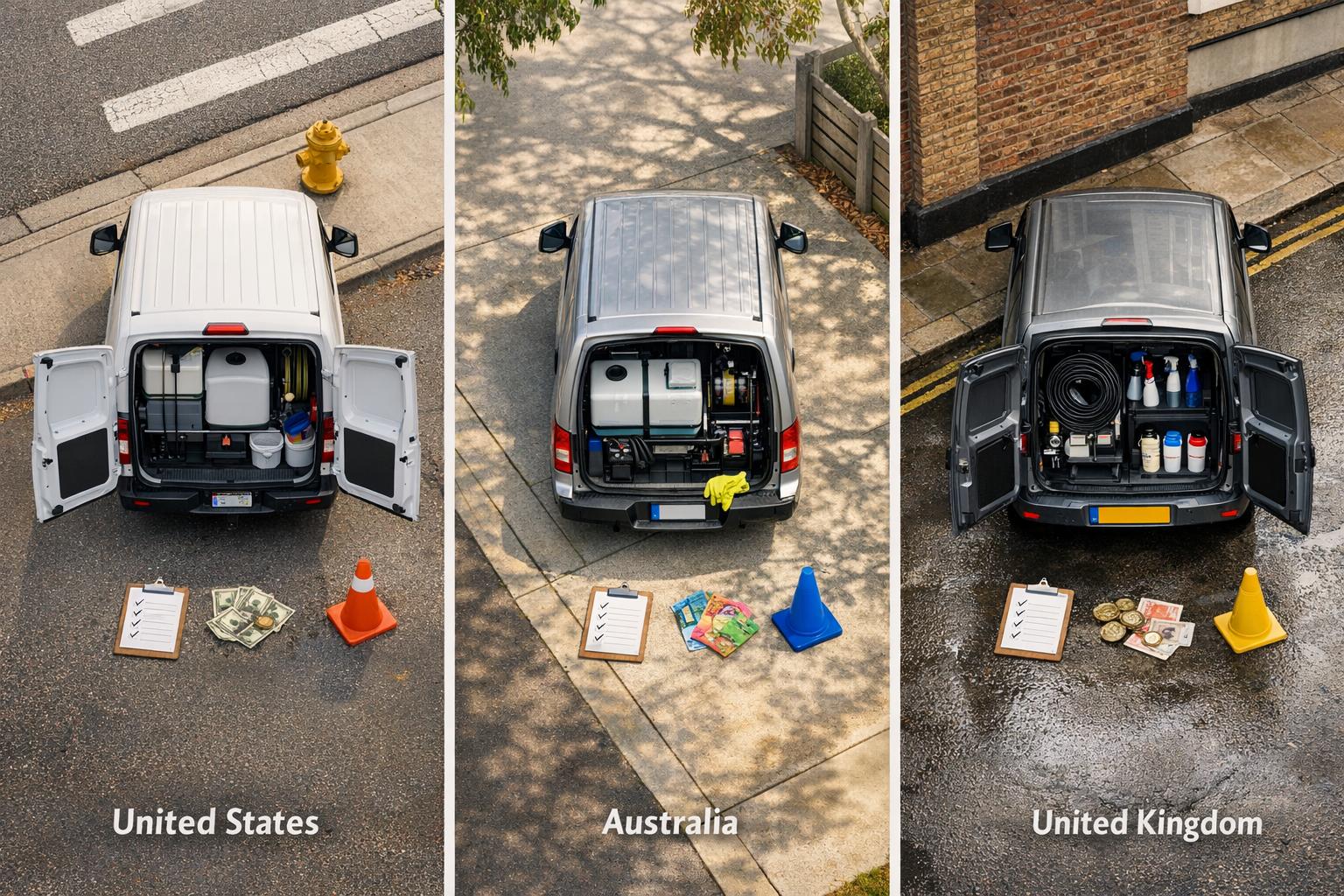
Starting a mobile car detailing business can be affordable, but costs vary significantly by region. Here's a quick breakdown:
- United States: Startup costs range from $3,000 to $25,000, with equipment, insurance, and marketing being major expenses. Advanced setups with tech can exceed $142,000.
- Australia: Costs are lower, starting at $1,200 to $3,000 USD for basic setups. Strict water-use regulations and weather challenges increase expenses for professional setups.
- United Kingdom: Entry-level costs are the lowest, between £250 and £400 ($315–$505 USD), but scaling up to professional operations can reach £8,000 ($10,100 USD).
Key factors include equipment, vehicle modifications, permits, insurance, and marketing. Each region has unique challenges like water regulations in Australia, damp weather in the UK, and high insurance costs in the US. Planning for these differences is critical for success.
Quick Comparison
| Region | Basic Setup Cost | Advanced Setup Cost | Key Challenges |
|---|---|---|---|
| United States | $3,000–$25,000 | $142,000+ | High insurance costs, strict regulations |
| Australia | $1,200–$3,000 USD | $94,280 USD | Water restrictions, weather issues |
| United Kingdom | £250–£400 ($315–$505 USD) | £8,000 ($10,100 USD) | Water access, smaller market size |
Understanding these costs and regional challenges will help you choose the right market and prepare effectively.
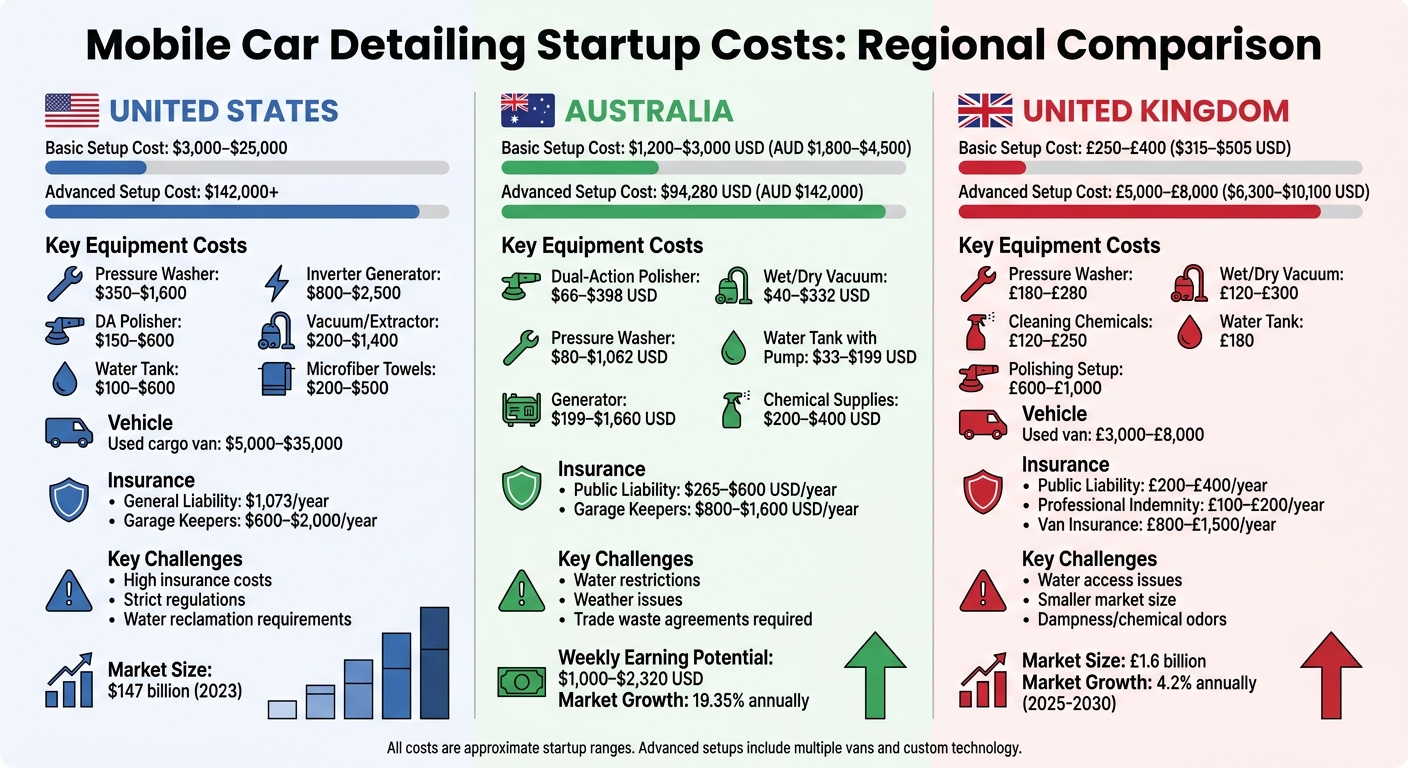
Mobile Car Detailing Startup Costs: US vs Australia vs UK Comparison
I Built a SUV Mobile Car Detailing Setup for $1500 (Full Tour)
sbb-itb-08dd11e
1. United States Startup Costs
Launching a mobile detailing business in the U.S. typically requires an investment ranging from $3,000 to $25,000, depending on the scale of operations. The auto detailing industry in the U.S. reached $1.52 billion in 2024 and is growing at an impressive 10.3% annually, outpacing the broader automotive sector. Below, we’ll break down the essential costs involved.
Equipment and Tools
Setting up a standard mobile detailing operation will cost between $2,100 and $8,600 for equipment alone. Here’s a closer look at the key tools you'll need:
- Pressure Washer: A unit rated at 1,000–1,500 PSI with 2.0+ GPM is ideal, costing $350 to $1,600. Higher GPM ensures effective rinsing without risking damage to vehicle paint.
- Inverter Generator: A 3,000W+ generator capable of powering multiple tools simultaneously will cost $800 to $2,500.
- DA Polisher: Plan to spend $150 to $600 for this essential tool.
- Vacuum or Extractor: Prices range from $200 to $1,400.
- Water Tank: Budget $100 to $600 for a tank to ensure portability.
- Microfiber Towels and Pads: Set aside $200 to $500 for these supplies.
- Chemical Stock: Buying in bulk (5-gallon drums) can cut chemical costs by 50% to 70% compared to smaller retail bottles.
These tools form the backbone of your operation, but having the right vehicle is just as important.
Vehicle Requirements
While you can start with a personal vehicle, investing in a cargo van offers better storage and enhances your business's professional image. Used cargo vans range in price from $5,000 to $35,000, with additional costs of $500 to $4,000 for branding and vehicle wrapping. To optimize the van for detailing, professional setups often include $4,000 worth of shelving and modifications to ensure it's ready for efficient operations.
Permits, Licenses, and Insurance
Getting your paperwork in order is crucial. Expect to pay:
- Business License: Costs range from $25 to $200.
- LLC or S-Corp Registration: Fees vary between $50 and $500.
- Sales Tax Permit and EIN: Both are free.
Environmental regulations also play a role. Under the federal Clean Water Act, you’ll need effluent containment mats to manage water runoff, especially in states like California and Florida, where water reclamation laws are stricter.
For insurance, General Liability coverage averages $1,073 per year, but it won’t protect you if you damage a customer’s vehicle. That’s where Garage Keepers Legal Liability insurance comes in, covering incidents like scratches or accidents with customer vehicles. This insurance costs between $600 and $2,000 annually. As StartCosts explains:
"Standard General Liability does NOT cover the vehicle you're working on. If you scratch, damage, or crash a customer's $80,000 car, GL won't pay." - StartCosts
Additionally, forming an LLC is a smart move to shield your personal assets from potential legal issues tied to auto-related work.
Marketing and Technology
Beyond equipment and legal requirements, investing in marketing and technology is key to growing your business. Basic marketing efforts and a website setup will cost between $250 and $1,000. Some businesses go further, allocating up to $33,000 for a custom mobile app ($25,000) and an integrated booking system ($8,000) to handle scheduling and payments.
Automated scheduling software can save you 5–10 hours of administrative work per week, streamlining your operations and giving you more time to focus on customers.
2. Australia Startup Costs
Launching a mobile detailing business in Australia can cost between $1,800 and $4,500 AUD ($1,200 to $3,000 USD) for a basic mobile setup, making it an appealing option for new entrepreneurs. The local car detailing industry is growing fast, with mobile and on-demand services increasing at an annual rate of 19.35%. Additionally, 79% of Australian drivers now use professional car washing and detailing services, a significant rise from just 50% in 1996. The business model closely resembles the U.S. approach but includes regional adjustments.
Equipment and Tools
Expect to spend $1,200 to $2,200 AUD ($800 to $1,460 USD) on essential equipment. Key items include:
- Dual-Action Polisher: $100 to $600 AUD
- Wet/Dry Vacuum or Extractor: $60 to $500 AUD
- Pressure Washer (1,000–1,500 PSI): $120 to $1,600 AUD
- Microfiber Towels: Stock of 40 to 60 pieces
You'll also need portable water and power solutions. A small water tank with a 12V pump costs $50 to $300 AUD, while an inverter-style generator ranges from $300 to $2,500 AUD for areas without customer-supplied power. Initial chemical supplies for two to three months will cost $300 to $600 AUD ($200 to $400 USD).
As detailing expert Gareth Westbrook explains:
"The money isn't in $40 quick washes; it's in packages that solve problems: pet hair, red dust, kids' spills, swirls, faded trims, and resale preps".
Vehicle Requirements
You can start with your personal vehicle, but make sure your insurance covers business use, as personal car insurance usually doesn’t apply during commercial operations. For a professional look and better storage, consider a used cargo van. In areas like Melbourne, where weather can change quickly, many operators carry pop-up canopies to handle rain or intense sun and avoid cancellations. Be sure your vehicle meets all legal and insurance requirements to keep your business running smoothly.
Permits, Licenses, and Insurance
To operate legally, you'll need to:
- Register an Australian Business Number (ABN) for free.
- Register your business name with ASIC for $39 AUD per year or $99 AUD for three years.
- Register for GST if your annual turnover exceeds $75,000 AUD ($49,800 USD).
Insurance is crucial. Public liability insurance for $5 million to $10 million coverage costs $400 to $900 AUD ($265 to $600 USD) annually. Additionally, Garage Keepers Liability insurance, which covers damage to customer vehicles, costs $1,200 to $2,400 AUD ($800 to $1,600 USD) per year. In New South Wales, you might need a Motor Vehicle Repairer License or Motor Vehicle Tradesperson Certificate, depending on the services you offer. Local councils may also enforce regulations on trade waste and water runoff, requiring containment mats to prevent chemicals from entering storm drains.
Marketing and Technology
Like in the U.S., branding and technology investments are vital. Basic branding, including website creation and uniforms, costs $300 to $800 AUD ($200 to $530 USD). Solo operators can earn $1,500 to $3,500 AUD ($1,000 to $2,320 USD) weekly. Professional setups range from $5,000 to $15,000 AUD ($3,320 to $9,960 USD), and larger enterprise models with multiple vans and custom apps can require over $142,000 AUD ($94,280 USD) in startup capital.
3. United Kingdom Startup Costs
The UK market for mobile car detailing has its own financial dynamics, offering opportunities for both budget-conscious entrepreneurs and those aiming for a more professional setup.
Startup costs in the UK range from £250 to £400 ($315–$505 USD) for a basic operation to £5,000 to £8,000 ($6,300–$10,100 USD) for a more advanced setup. The industry itself is valued at around £1.6 billion, with exterior detailing services contributing 64.4% of the revenue. Growth projections estimate an annual increase of 4.2% between 2025 and 2030.
Equipment and Tools
For a "Serious Starter" setup, UK operators generally spend between £800 and £1,200. Here's a breakdown of key investments:
- Pressure Washer: A Karcher K2 to K5 model costs £180 to £280.
- Wet/Dry Vacuum: Prices range from £120 to £300.
- Cleaning Chemicals Kit: Expect to pay £120 to £250.
- Water Tank with 12V Pump: A 100-liter tank costs around £180, providing mobile water independence.
- Polishing Setup: A dual-action polisher with pads and compounds will set you back £600 to £1,000.
"I started with about £400 and wished I'd had £1,500. I spent the first year gradually upgrading, buying cheap twice, and looking less professional than I wanted." - Ethan, Founder of ED AutoCare
Vehicle Requirements
Many UK detailers initially use their personal vehicles before transitioning to a used van, which typically costs between £3,000 and £8,000 ($3,787–$10,099 USD). Annual insurance for these vans ranges from £800 to £1,500 ($1,010–$1,893 USD).
For those needing to move customer vehicles, Motor Trade Insurance is essential, as standard policies won't cover commercial use.
Permits, Licenses, and Insurance
Getting set up legally in the UK involves a few key steps:
- Business Registration: Register as a sole trader for free or as a limited company for under £300 ($379 USD).
- Waste Carrier License: Required from the Environment Agency for handling and disposing of trade waste.
- Insurance: Public liability insurance costs £200 to £400 ($252–$505 USD) annually, and professional indemnity insurance adds another £100 to £200 ($126–$252 USD). Combined, total premiums can start at around £500 ($631 USD) annually, depending on coverage needs.
"The first time someone claims you damaged their car (even if you didn't), you'll wish you had cover." - Ethan, ED AutoCare
Marketing and Technology
Marketing efforts in the UK typically include:
- Facebook Ads: Costs range from £50 to £200 ($63–$252 USD) per month.
- Website Maintenance: Monthly fees are between £10 and £50 ($13–$63 USD).
Many operators also rely on local Facebook groups, leaflet drops, and hashtags like #CardetailingUK to attract customers. Sharing before-and-after photos on Instagram and leveraging word-of-mouth remain highly effective, low-cost strategies.
Advantages and Disadvantages by Region
Regional cost differences play a major role in shaping market opportunities. Each area comes with its own set of perks and obstacles.
The United States stands out for its massive market size, valued at over $147 billion in 2023, and the high profitability of ceramic coatings, which can yield margins exceeding 80%. However, operating in the U.S. comes with hefty insurance costs - Garagekeepers Liability alone can run between $100–$300 per month - and strict state regulations, such as mandatory water reclamation systems.
In Australia, there’s a strong appetite for services that solve specific problems. Solo mobile detailers can earn between $1,500–$3,500 weekly. According to Gareth Westbrook, profits are driven by offering specialized service bundles rather than quick, low-cost washes. Yet, operators must contend with unpredictable weather - especially in cities like Melbourne - and strict water restrictions that require trade waste agreements before starting operations.
The United Kingdom offers the easiest entry point, with startup costs as low as £300–£400 ($405–$540) for basic setups. The market is also growing at 4.2% annually through 2030, and mobile services enjoy high demand from residential customers. On the downside, water access is a significant challenge, often requiring onboard tanks (100 liters or more), which adds to both costs and logistical hurdles.
Here’s a quick comparison of the pros and cons across these regions:
| Region | Key Advantages | Key Disadvantages |
|---|---|---|
| United States | Massive market ($147B); high-margin ceramic coatings (>80% profit); strong luxury vehicle demand | High insurance costs ($100–$300/mo for Garagekeepers); strict regulations; limited daily job capacity |
| Australia | High earning potential ($1,500–$3,500/week); demand for specialized services; "keep it longer" car trend | Extreme weather challenges; strict water restrictions requiring trade waste licenses; GST registration above $75,000 turnover |
| United Kingdom | Low startup costs (£300–£400); steady market growth (4.2% annually); high residential demand for mobile services | Water access issues requiring onboard tanks; dampness and chemical odors in vehicles; smaller market size |
While each region comes with its own set of challenges, some hurdles are universal. Common issues like underpricing, solo operator fatigue, and overly complicated service menus can derail businesses. To navigate these, it’s recommended to have a 3–6 month working capital buffer for essentials like fuel, chemicals, and insurance before expecting steady revenue.
Conclusion
Planning a mobile car detailing business requires understanding how startup costs vary across regions. In the United States, a basic setup typically costs between $500 and $1,000, while professional-grade operations can require anywhere from $10,000 to $25,000. Additionally, registering your business usually costs $30 to $150, depending on the state.
In Australia, initial equipment expenses range from $1,800 to $4,500 AUD for basic setups, with fully equipped professional setups costing between $10,000 and $25,000 AUD. Australian operators must also comply with regulations, including ABN registration, adhering to strict water restrictions that may require trade waste agreements, and registering for GST if turnover exceeds $75,000 AUD.
The UK offers a different cost landscape. A "serious starter" setup costs around £800 to £1,100 (approximately $1,080–$1,485), while annual insurance costs for public liability and professional indemnity range from £300 to £800 (about $405–$1,080).
Given these regional variations, having a solid financial strategy is critical. Create a detailed plan to cover break-even points, uncover potential hidden costs, and align your setup with your business goals. Wherever you operate, ensure you maintain 3–6 months of working capital to cover essentials like fuel, chemicals, and insurance during the initial growth phase.
FAQs
What’s the most realistic all-in first-year budget by country?
Starting a mobile car detailing business comes with varying first-year costs depending on your location. In the U.S., you can expect to spend between $5,000 and $15,000. For those in Australia, the range is AUD 2,500–20,000 (around $1,800 to $14,500 USD). Meanwhile, in the UK, costs typically fall between £3,000 and £12,000 (approximately $3,700 to $14,800 USD).
Opting for a mobile setup is often the most budget-friendly choice, generally aligning with the lower end of these price ranges.
Do I really need water runoff containment to start?
Water runoff containment is an important consideration for any mobile car detailing business. Not only is it often recommended, but it’s also frequently required by local regulations to comply with environmental laws and water management standards. Before launching your business, make sure to review the specific rules in your area to ensure you're meeting all necessary requirements.
Which insurance policies cover customer car damage?
Commercial auto insurance often covers damage to customer vehicles. This policy can provide protection against property damage involving vehicles tied to your business, like your detailing truck or a customer's car. It's always a good idea to check directly with your insurer to understand the specific details of your coverage.
Related Blog Posts
- How to Start a Mobile Car Detailing Business: Complete Guide
- How to Start a Mobile Car Detailing Business: From $0 to $5K/Month
- Mobile Detailing Startup Costs: Packages, Pricing, Profit
- How to Start a Mobile Car Detailing Business: From $0 to $5K/Month