If I were looking at Australia in 2026, I would start where demand is already visible: care at home, solar service work, AI for small businesses, regional home support, and job-linked training. This is not about hype. It is about markets with clear pressure right now: 77% of aged care inquiries are medium or high urgency, Australia already has 4.2 million+ rooftop solar systems, and online retail reached A$82.6 billion in 2025.
Here’s the short version:
- Best demand now: in-home care, meal support, home modifications, and care coordination
- Best low-cost entry: AI workflow setup, training, pet products, and renovation scope reviews
- Best regional angle: mobile meal delivery, small home modifications, agritourism, and local services
- Best B2B angle: contract manufacturing, AI automation, and solar battery retrofit support
- Best if you want repeat revenue: solar monitoring, care services, digital subscriptions, and niche e-commerce
What stood out to me most is simple: the strongest ideas solve urgent, local problems. Families need help at home. Solar owners need repairs, upgrades, and battery add-ons. Small firms want admin work cut down. Regional areas still have supply gaps.
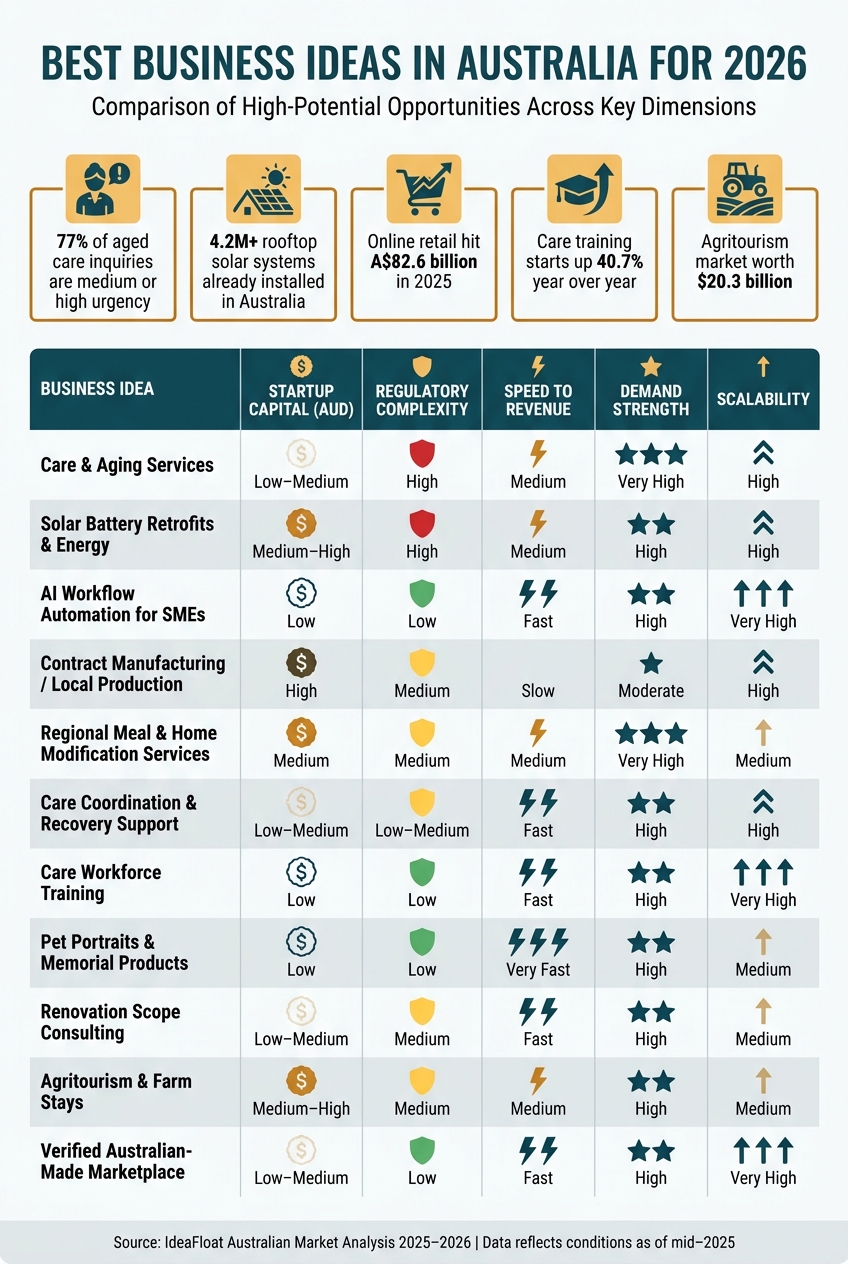
Best Business Ideas in Australia for 2026: Demand, Cost & Speed Compared
🇦🇺5 Small Business Ideas in Australia for 2026 | Australia New Small Business Ideas
sbb-itb-08dd11e
Quick comparison
| Idea | Demand signal | Cost to start | Rules/admin load | Time to first sales |
|---|---|---|---|---|
| Care and aging services | Very high | Low to medium | High | Medium |
| Solar battery retrofits and service | High | Medium to high | High | Medium |
| AI workflow automation for SMEs | High | Low | Low | Fast |
| Contract manufacturing / B2B supply | Medium | High | Medium | Slow |
| Regional meal and home modification services | Very high | Medium | Medium | Medium |
| Care coordination and recovery support | High | Low to medium | Low to medium | Fast |
| Care workforce training | High | Low | Low | Fast |
| Pet portraits and memorial products | High | Low | Low | Very fast |
| Renovation scope consulting | High | Low to medium | Medium | Fast |
| Agritourism and farm stays | High | Medium to high | Medium | Medium |
| Verified Australian-made marketplace | High | Low to medium | Low | Fast |
If I had to narrow the list fast, I’d focus on one test: where is demand already beating local supply in your area? That one question does more than broad national trends ever will.
Idea Validation for Australian Opportunities
Australia’s demand is concentrated, so local validation matters more than national averages. A lot of ideas only make sense in a handful of metro areas. Service demand and provider supply cluster hard in Sydney and Melbourne, while many regional areas are underserved. That creates a different kind of opening: steady demand, thinner competition.
Use that local picture to pressure-test each idea with four questions: pain intensity, current substitutes, local demand density, and licensing barriers. In aged care, formal registration, suitability checks, and governance rules make compliance a baseline.
The supply gap often shows up more clearly at the suburb level than at the national level. For example, New South Wales has 726 aged care providers and Victoria has 518, while the Northern Territory has just 33. That’s a big spread. Some regional hubs also show steady inquiry volume with far fewer local providers, which is exactly why mapping the gap before launch helps so much.
If you want to move faster, compare ideas side by side using the same filters. IdeaFloat can help you test urgency, customer language, local competition, and realistic market size, so you can spend time on opportunities that fit your geography and capacity.
Each idea below links to a visible demand signal you can test in your own market.
1. Care and Aging Services
In-Home Personal Care and Domestic Assistance
The best place to start is not broad elder care. It’s the day-to-day help families need right away.
Demand is strongest for practical, non-clinical support at home. Personal care appears in about 57% of aged care inquiries, which makes it the most requested service in this group. Domestic assistance came next, with 173 of 412 analyzed requests. The pattern gets even clearer when you look at supply and demand side by side: meal services had 92 inquiries but only 83 providers, while nursing care had 506 providers and just 18 inquiries.
That tells a pretty clear story. Families are looking for help with everyday living far more often than they’re looking for clinical care.
This gap matters because most people aren’t casually shopping around. They’re trying to fix a pressing problem. About 77% of inquiries are marked high or medium urgency, and those inquiries are split evenly between the older person and family members arranging care. So if you’re speaking to this market, your message needs to work for both groups: the person needing support and the relative trying to sort things out fast.
Policy is moving in the same direction. Australia is shifting to the Support at Home Program, which simplifies funding and supports aging at home. Starting October 1, 2026, services like personal care will move into a fully funded care category, which can make revenue more predictable for providers. At the same time, the bar gets higher on compliance. Registration under the new Aged Care Act becomes a basic requirement, not something providers can put off.
2. Energy and Electrification
Solar Battery Retrofitting and Ongoing System Management
Energy is another area where demand is already easy to see, especially where service is missing around systems people already own.
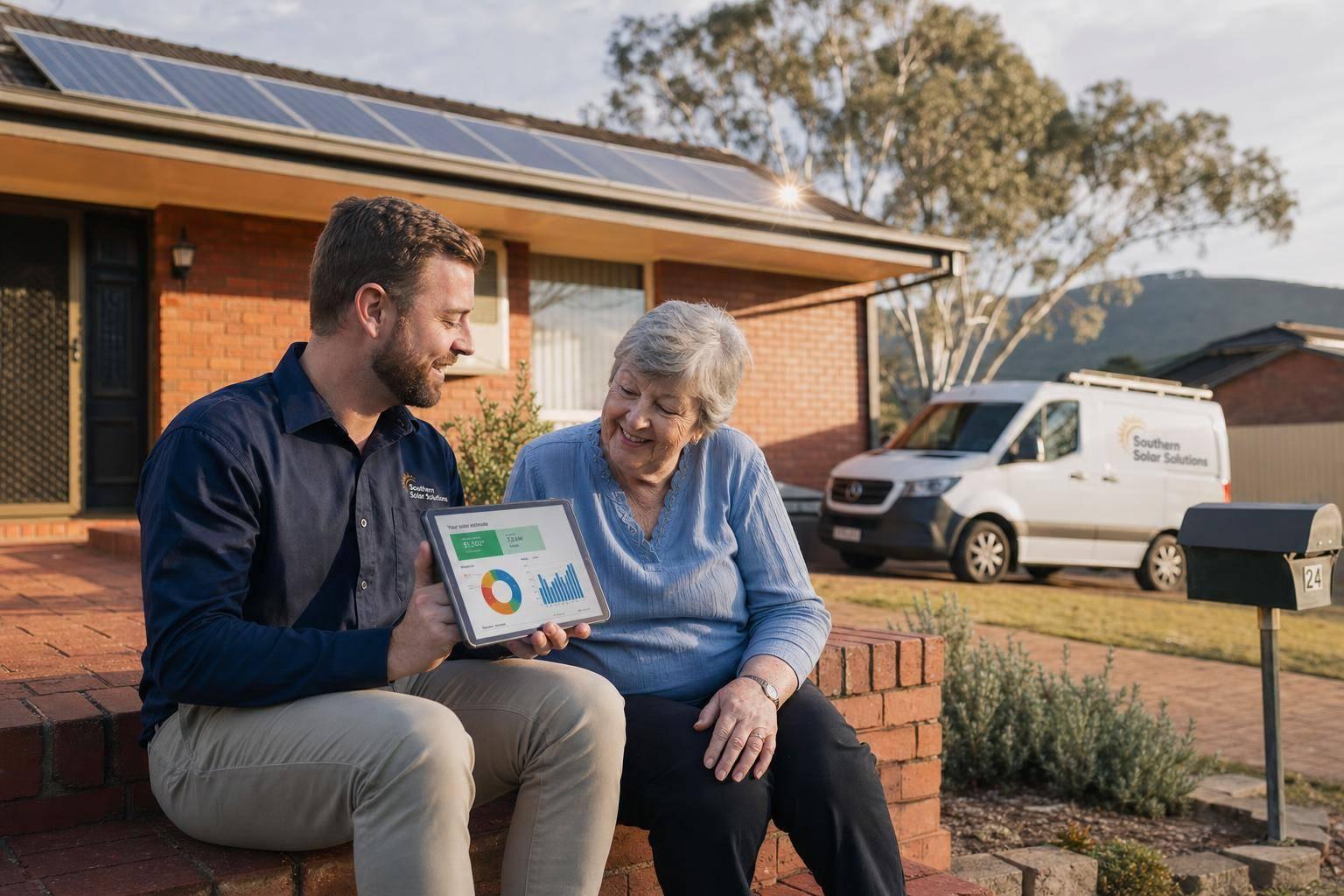
Australia had more than 4.2 million rooftop solar systems in place by mid-2025, adding up to over 26.8 GW of capacity. That means the 2026 opening isn’t just about selling new systems. A big part of the market is taking care of the installed base with batteries, maintenance, repairs, and upgrades. People who already have solar want lower power bills, backup power, and someone they can call when something stops working.
Nearly 58% of battery installations in 2024 were retrofits. That share is likely to stay high as STC value drops on January 1, 2026, and the battery rebate factor falls on May 1, 2026. Those changes cut certificate value by 16.6% - about $532 for a standard 6.6 kW system - and reduce rebate value by over $1,000 on a 13.5 kWh battery after the May date. When that happens, homeowners have a bigger reason to get decisions made sooner, and they also need help with fixes, add-ons, and system changes after installation.
Another steady source of work comes from orphaned solar systems. These are homes where the first installer has shut down, so the customer no longer has a go-to company for maintenance or upgrades. There’s also a rules-driven push coming: CSIP-AUS compliance becomes mandatory by mid-2026, and some inverters will need upgrades so they can meet grid-communication requirements.
The clearest setup here is a service-first model. That can include:
- System checks at around $250 per visit
- Monitoring subscriptions at around $10 per month
- Battery retrofits for homes that already have solar but no battery
That kind of recurring income gives the business more stability than depending only on new installs.
3. SME Digital Transformation
AI Workflow Automation for Small and Mid-Sized Businesses
Beyond physical operations, Australian SMEs are spending money to cut admin work too. Most Australian small businesses already use AI in some way, but only 15% have built it into day-to-day workflows.
The main problem is simple: admin overload.
That’s why demand is moving away from chatbot-style AI and toward automation that can deal with inboxes, invoices, and customer records. In plain English, businesses want systems that take repetitive tasks off people’s plates without someone having to step in each time.
One service model tied to this shift is the AI-focused managed service provider. Instead of waiting for IT issues and fixing them after the fact, these providers sell workflow automation. Right now, only 10% of these providers in Australia offer AI capabilities. That leaves a clear opening for firms that move early.
A good way in is a $2,500 to $5,000 fixed-price pilot built around one workflow. Email triage is a strong starting point. For a 100-user company, it can save $25,000 to $40,000 per year and hit ROI in 30 to 60 days.
That same pilot model can also work for:
- Bookkeeping
- Scheduling
- Quoting
- Customer follow-up
4. Local Production and Supply
Contract Manufacturing and B2B Supply Niches
As demand for software grows, physical supply chains are shifting too. In Australia, more buyers are moving production back onshore. A big reason is timing: global supply-chain lead times have jumped by as much as 40% compared with 2023, which is pushing businesses to work with local suppliers that can move faster and deliver with more consistency.
One of the clearest openings here isn't starting a consumer brand from zero. It's supplying other brands. That could mean operating as an ingredient blender, flavor manufacturer, contract packer, or assembly-on-demand partner. If other businesses rely on you to get products out the door, you're solving a direct problem.
Food and beverage is still Australia's biggest manufacturing sector, making up 26% of total manufacturing turnover as of 2025. Inside that market, the shift is clear: 65% of local manufacturers say they're moving toward custom or small-batch runs to support premium pricing. That matters because demand for Australian-made products gives local brands a reason to find domestic production partners instead of looking offshore.
For suppliers, this opens the door to a few practical service angles:
- Small production runs
- Fast turnarounds
- Custom packaging
For founders who want a lower-overhead way in, kitting and assembly-to-order are solid starting points. The model is simple: keep components in stock, then finish the product only when local orders come in. That can cut inventory waste by about 15%.
5. Regional Service Gaps
Mobile Meal and Home Modification Services for Regional Communities
Regional Australia represents 10 million consumers and $250 billion in annual spending power. That leaves plenty of room for services that still don't reach people well enough. The biggest openings tend to be the ones that depend on local presence and a fast response.
Two categories stand out in the June 2026 Support at Home data: meal services and home modifications. Meal services have 83 providers against 92 inquiries, while home modifications have 69 providers, far behind 845 providers for personal care. Put simply, coverage is thinnest in these two areas, which makes them strong targets.
This gap also gives mobile operators an edge. If you can serve several towns without paying for a shopfront, the model starts to make a lot of sense. That's especially true in regional postcodes, where people often need help close to home and can't wait long.
That makes mobile delivery and on-site service a strong fit for this market. Think:
- meal delivery
- grab-rail installs
- ramps
- other small home modifications
ABN registration data also shows a few regional pockets worth watching. Brookstead, QLD posted a 700% increase in new business registrations between 2024 and 2025, while Parndana, SA rose 400% over the same period. Pockets like these can give a first-mover local service model room to get established.
6. Health and Wellness Support
Care Coordination and Recovery Support
Demand isn't only growing for aged care. It's also growing for services that help people handle recovery, daily routines, and care coordination at home. That opens the door for businesses that make life easier for clients and families, not just businesses that provide hands-on support.
The pressure is happening now. The national average wait for in-home support is more than 12 months, and most inquiries come from families trying to fix a sudden gap, not map things out far in advance. That means the opening here is not clinical care itself. It's the coordination layer around it: scheduling, intake, follow-up, and recovery support for people who need help moving through the system fast.
The 2026 Support at Home Program has moved funding toward a person-centered model, which puts a higher compliance burden on registered providers. But nearby service models, like discharge planning support, recovery check-ins, and routine management, can often run with less regulatory pressure while still serving urgent demand.
The businesses that do well here make access easy, not just care delivery. Fast onboarding matters. Clear service agreements, quick screening, and simple scheduling line up with what families need right now in a way many stretched providers can't match.
7. Education and Skills Upskilling
Care Workforce Training
One step beyond care delivery itself, training is turning into a business lane of its own. Australia's care sector is short on workers, which makes training a direct business play in 2026. Training starts in aged care and disability care are up 40.7%. That jump is driven by the staffing shortage, and it ties straight to the labor bottleneck behind the service gaps covered in Sections 1 and 6.
One strong model is paid traineeships with care facilities that lead to a Certificate III in Individual Support. Another entry point is short courses for NDIS providers and people changing careers. The buyers are pretty clear here: care facilities, NDIS providers, and career changers who need job-linked credentials fast.
The same pull toward practical, job-linked training shows up in other skills markets too.
8. Pet and Animal Services
Premium Pet Portraits and Memorial Products
Not every 2026 opening sits in a big, process-heavy market. Some of the clearest ones are small, emotional niches where people buy with their hearts. In Australia, pet owners spend more than $33 billion per year on their pets. And a growing share of that money is going to higher-margin items where emotion drives repeat purchases.
One of the clearest ways in right now is custom pet portraits and memorial products. This is especially true for owners who want a lasting keepsake after a pet passes away.
The numbers make the appeal pretty clear. Hand-painted portraits sell for $500–$2,000. White-label digital portraits can be ready for a first sale in 1–7 days, with $19–$29 wholesale costs and $49–$99 retail pricing.
A simple way to get traction: partner with groomers and trainers. They already have pet photos, and pickup gives you a natural moment to offer an add-on.
9. Home and Property Services
Renovation Scope Consulting
More homeowners are staying put and spending more on the homes they already own. That shift has created a strong market for services that help people avoid bad calls before the work starts. In Australia, the 2026 home-renovation market is set to pass $50 billion, and property price-to-income ratios sit at about 9–10 times average income. So instead of moving, many households are fixing up what they have.
This is a high-intent market. People don't look for renovation help out of curiosity. They look because they're about to spend serious money and want fewer nasty surprises.
The biggest issue is scope creep. Hidden costs often add 10–25% to renovation budgets, with the usual trouble spots being waterproofing failures, electrical code upgrades, and plumbing relocations. A bathroom that starts as a cosmetic update at around $8,000 can drift toward $25,000 once plumbing or fixture locations change.
That's where pre-build budgeting and scope review can earn trust fast. The pitch is simple: help homeowners spot overrun risk before they sign a builder contract. Early scoping also matters before a builder is even hired. A pre-builder scope check can flag feasibility issues, site limits, and budget risk early, which is especially useful in the $500,000–$1,000,000 segment. These jobs are often too involved for a basic builder-led process, but not large enough to bring in a top-tier architecture firm.
There’s also a strong add-on here: heat-pump and battery upgrades. Federal rebates can cut net project costs by 15–35%, which makes those upgrades much easier to include during the consult. In practice, that puts budget control and upgrade planning right at the center of the offer.
10. Tourism and Experience Businesses
Agritourism and Farm-Stay Experiences
For regional operators, tourism tends to work best when it's tied to an asset you already have, not a brand-new build. That matters because Australia's agritourism market is worth $20.3 billion, and visitors in this space spend more than twice as much as the average traveler.
There’s also a clear location pattern. Three out of four agritourism trips happen in regional Australia, with strong demand in places that sit within a two- to three-hour drive of a major city. In plain terms, if a farm is close enough for a weekend trip, it already has a head start.
Farm stays, tastings, and hands-on activities line up well with what many visitors want: direct contact with producers and a closer look at how food is grown or made. That makes an active farm a good base for a small offer you can test without betting the whole property on tourism.
Tommerup's Dairy in Kerry Valley, QLD, shows the model can work when farm operations and guest stays stay tightly linked.
The catch is simple: the farm has to stay the center of the experience. If the visitor side starts to take over, the offer can lose the thing that made it interesting in the first place.
A smart way to test demand is to start small with things like:
- seasonal events
- pick-your-own fruit
- farm tours
That gives operators a way to validate interest before spending money on added infrastructure.
11. Digital-First Niche Brands
Verified Australian-Made Marketplace
A smaller but scalable play is a digital-first brand built on trust, provenance, and repeat purchases.
Australia's online retail market hit $82.6 billion in 2025, up 14% year over year. Marketplaces grew 13%, a bit below the market as a whole, which leaves room for owned channels and direct-to-consumer brands.
That still leaves a clear gap. Many buyers want Australian-made products, but verifying them isn't easy. That's where a verified Australian-made marketplace can stand out. Right now, finding goods that are genuinely made in Australia is still a fragmented search experience. A digital-first brand focused on verified local sourcing in areas like skincare or homewares can make that process much simpler and easier to trust. The idea works because people are already looking for local provenance, but the path to purchase is still messy.
Before launch, use category growth as the final demand check. Books, Stationery & Multimedia is the fastest-growing online retail category in Australia at +24.1%. Hobbies & Recreation comes next at +17.1%, followed by Health & Beauty at +15.1%. The last two also have strong repeat-purchase and subscription upside. Those figures show where demand is strongest, not just which categories are active.
Benchmark against your category, not the total market. If you're building in health and beauty, 15.1% growth is the baseline to match.
How to Prioritize Which Australian Idea to Pursue
The demand signals above are clear. This section narrows them down based on founder fit and launch friction.
Picking the right idea is about fit, not hype. It comes down to finding the option that lines up with your skills, your budget, your location, and how soon you need revenue.
Use the table below as a quick filter, not a final verdict.
| Idea Category | Startup Capital (AUD) | Regulatory Complexity | Speed to Revenue | Demand Strength | Scalability |
|---|---|---|---|---|---|
| 1. Care & Aging | Low–Medium | High | Medium | Very High | High |
| 2. Energy & Electrification | Medium–High | High | Medium | High | High |
| 3. SME Digital Transformation | Low | Low | Fast | High | Very High |
| 4. Local Production | High | Medium | Slow | Moderate | High |
| 5. Regional Service Gaps | Medium | Medium | Medium | Very High | Medium |
| 6. Health & Wellness | Low–Medium | Low–Medium | Fast | High | High |
| 7. Education & Skills | Low | Low | Fast | High | Very High |
| 8. Pet & Animal Services | Low | Low | Very Fast | High | Medium |
| 9. Home & Property | Low–Medium | Medium | Fast | High | Medium |
| 10. Tourism & Experience | Medium–High | Medium | Medium | High | Medium |
| 11. Digital-First Brands | Low–Medium | Low | Fast | High | Very High |
After demand, compliance is usually the fastest way to rule out a weak fit. One last filter helps: compliance readiness.
Care & Aging and Energy take more runway than Pet & Animal Services or SME Digital Transformation. NDIS registration, state licensing, and screening checks all take time, money, and admin work. If you don't have that runway yet, a faster-entry category can help you get to first revenue while you work toward something bigger.
Some of the strongest 2026–2027 plays sit where two sectors overlap. That's often where niche domain knowledge gives you a position that broad generalist services can't match.
Choose the idea with the strongest demand, the best founder fit, and the least compliance friction.
Conclusion
The pattern across all of these ideas is simple: follow visible demand, not guesswork. The signals are already there in aged care inquiries, renewable energy service demand, practical AI support for SMEs, and worker shortages across regional Australia.
Don’t chase the biggest trend. Go after the smallest unmet need. A subcategory with clear buyer demand can matter more than a large, crowded market. Focus on places where demand is outpacing supply, people need help now, and your skills or location give you an edge.
Once you’ve confirmed the demand, line the idea up with your budget and the way you want to run the business. Check demand at the suburb level before you commit. Then keep your focus tight: pick one or two ideas that fit your skills and available capital, and test them locally before you spend big.
Choose the idea with the strongest local demand, the best match for your background, and the least friction to getting that first sale.
FAQs
How do I validate demand in my area?
Start with local market signals and customer inquiries. They show what people in your area are already looking for.
Inquiry data can point to demand in specific suburbs, including services like aged care or home support. That matters because demand often isn't spread evenly across a whole city. One suburb may need one type of help, while the next one leans in a different direction.
You can back that up with direct research:
- Surveys
- Interviews
- An MVP
As you dig in, pay close attention to local pain points, preferences, behaviors, migration trends, and spending patterns. Those details help you figure out whether people just like the idea on paper or would actually pay for it.
Which idea is easiest to start on a small budget?
Starting as a sole trader is often the easiest path when money is tight. Setup costs can be as low as $500–$2,000, since registration, insurance, and basic equipment are usually fairly low-cost.
A lot of tradies also reinvest early profits as the business starts to grow.
What licenses or compliance checks should I expect?
Expect compliance checks tied to data privacy laws, such as Australia’s Privacy Act, for AI systems.
You may also need licenses or permits tied to your industry or service. That can include rules for digital services, health, or environmental matters.
Related Blog Posts
- 18 Low-Investment Business Ideas in Australia for 2026
- Best Small Business Ideas in Australia Under $30,000
- 19 Low-Cost Business Ideas in Australia With High Profit Potential
- 14 Recession-Resistant Business Ideas for Australia