
During tough economic times, some businesses thrive by meeting unavoidable needs. With consumer confidence in Australia at a historic low (47.6 in April 2026), opportunities exist in sectors tied to essentials, maintenance, health, and education. Australia's aging population, low housing vacancy rates, and government-funded programs like the $46.3 billion NDIS and $140 billion healthcare budget create steady demand in specific industries.
Here’s a quick look at recession-resistant business ideas:
- Essentials: Discount groceries, AI-driven bookkeeping, pet care, and financial coaching.
- Home/Vehicle Maintenance: Plumbing, appliance repair, pest control, and mobile mechanics.
- Health/Personal Care: Mobile health services, NDIS support, boutique fitness, and pet wellness.
- Education/Digital: Online STEM tutoring and NDIS plan management.
Each idea aligns with ongoing needs, helping businesses stay reliable even during economic challenges. Focus on services solving immediate problems, validate your idea, and start small to increase your chances of success.
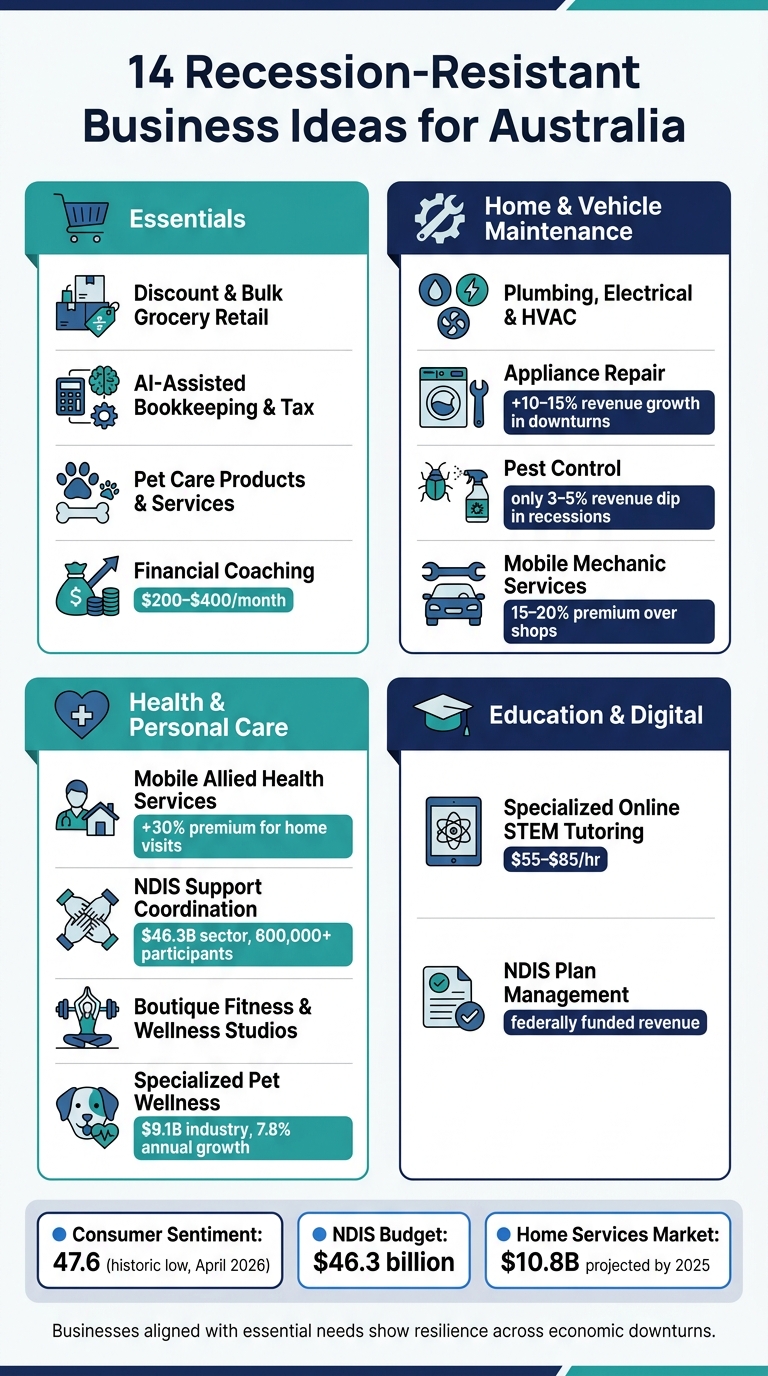
14 Recession-Resistant Business Ideas in Australia (2026)
Why THESE Businesses Could Be the Biggest Opportunity Right Now
1. Essential Goods and Services
Even when budgets are tight, certain expenses like food, bills, and pet care remain unavoidable. This steady demand creates opportunities for businesses that cater to these basic needs. Here are four areas where businesses can thrive by addressing Australia's essential requirements:
- Discount and Bulk Grocery Retail
Grocery store sales have seen significant spikes during economic shocks, with increases ranging from 20% to 50% in some regions. In Australia, this trend underscores the growing appetite for affordable, no-frills food options. A bulk-buy or private-label model, whether online or in-store, can help families cut down on their weekly food bills without sacrificing quality.
- AI-Assisted Bookkeeping and Tax Services
Tax filing is one of those responsibilities that doesn’t go away, even during tough times. For example, during the early days of the 2008 financial crisis, H&R Block's revenue grew by 11%. With small businesses making up 97.2% of all Australian enterprises, there's a constant demand for dependable bookkeeping services. AI tools can simplify tasks like categorization and reconciliation, enabling solo operators to serve multiple clients efficiently, charging between $500–$1,500 per month.
- Pet Care Products and Services
The pet industry has shown its resilience during economic downturns, growing by 5.1% in sales during the Great Recession. Pet owners’ strong emotional connections to their animals drive demand for niche services like breed-specific products, subscription pet food boxes, and mobile grooming services.
- Financial Coaching for Households
Economic challenges often push households to seek help with managing debt, cutting expenses, and building savings. Financial coaching, typically costing $200–$400 per month per client, provides practical guidance without requiring formal licensing. A subscription-based model not only ensures steady income but also fosters long-term client relationships.
2. Home and Vehicle Maintenance
When times get tough, repairs can't be ignored. Australia's home improvement services market is projected to reach $10.8 billion by 2025. Even during economic downturns, issues like a leaking roof or a malfunctioning HVAC system demand immediate attention. Here are four practical ideas to address these critical maintenance needs:
- Essential Home Repairs (Plumbing, Electrical, HVAC)
Some repairs simply can't wait. As the WorkZen Blog puts it:
"Water doesn't care about your mortgage payment. A burst pipe... [is an emergency]."
Even during the 2008 recession, plumbing repair businesses experienced only a 5–8% decline in revenue. With 40% of Australian homes built before 1990 and stricter regulations for smoke alarms and safety switches, licensed electricians and plumbers remain in steady demand. Offering annual maintenance plans, such as quarterly HVAC tune-ups or seasonal plumbing checks, can transform one-time jobs into a reliable source of monthly income.
- Appliance Repair Services
When appliances break, fixing them is often cheaper than replacing them. This cost-saving logic becomes even more appealing during tough times. Appliance repair businesses reported 10–15% revenue growth during previous economic downturns as consumers opted for repairs over replacements. A mobile appliance repair service can minimize overhead costs while catering to households that are keeping older appliances in use for longer periods.
- Pest Control
Pest control services are another area that stays relatively stable during recessions, with revenue dipping only 3–5%. Ignoring pests can lead to expensive structural damage or health risks, making treatment a priority for many. A subscription model offering quarterly inspections can provide customers with peace of mind while ensuring a steady, predictable income stream for the business.
- Mobile Mechanic Services
As vehicles age, keeping them in working order becomes essential.
"Australians are holding on to what they have, and for aftermarket workshops, that means the opportunity isn't arriving sometime in the future: it is already parked outside." - Cameron McLachlan, AAA Magazine
The average Australian passenger vehicle is now over 10.1 years old, and rising living costs mean more drivers are turning to independent mechanics instead of dealerships. A mobile mechanic service eliminates the need for a fixed location, reducing overhead costs. Plus, the convenience factor allows for a 15–20% premium over standard shop rates. By focusing on high-margin, no-hoist jobs like battery replacements, brake repairs, and pre-purchase inspections, mobile mechanics can run a lean and profitable operation.
Each of these services plays a role in extending the life of essential assets, which becomes especially important during economic challenges.
sbb-itb-08dd11e
3. Health and Personal Care
In tough economic times, people tend to focus their spending on essentials, and that includes health and personal care. These services, much like basic goods and necessary home repairs, remain crucial even during financial downturns.
- Mobile Allied Health Services
Mobile allied health services are becoming increasingly popular, especially among seniors. By offering home visits, professionals like physiotherapists, podiatrists, and occupational therapists can charge up to a 30% premium. This model is particularly appealing to elderly individuals who may struggle with mobility. The move away from traditional clinics to home-based care not only addresses a real need but also ensures a steady and reliable client base.
- NDIS Support Coordination
The National Disability Insurance Scheme (NDIS) represents a $46.3 billion industry with over 600,000 participants. This creates opportunities for Support Coordinators and Plan Managers who assist participants in managing their funding. Importantly, these roles don’t involve direct care but instead focus on helping individuals navigate their budgets. According to Noah Oloja, Founder of SyncSkills:
"The NDIS - the National Disability Insurance Scheme - is a $46.3 billion sector in Australia... The gap [in providers] is your opportunity."
Since the funding is government-backed, revenue in this sector tends to remain stable, even when consumer spending dips.
- Boutique Fitness and Wellness Studios
Small fitness and wellness studios thrive during economic downturns thanks to the "Lipstick Effect." This phenomenon describes how consumers cut back on big-ticket items but continue to spend on smaller indulgences that boost their mood. For instance, float therapy sessions, which cost around $80–$120 each, remain a popular choice. Lizzie Davey, a writer for Shopify Australia, explains:
"The Lipstick Effect shows that people continue investing in looking good during economic uncertainty."
In fact, during the 2008 recession, beauty salons in some regions saw growth of 14.4%, proving that personal care spending often holds steady even in challenging times.
- Specialized Pet Wellness
Australians are increasingly treating their pets like family, which has led to a growing market for specialized pet wellness products. The Australian pet industry is valued at $9.1 billion and is growing at a rate of 7.8% annually. Instead of opening a general pet store, focusing on a specific niche - like premium supplements or single-ingredient treats - can be a smarter strategy. This approach keeps inventory lean while also building a loyal customer base.
4. Education and Digital Solutions
Even during economic downturns, education remains a top priority for families, who continue to invest in skill development. This makes education and digital solutions particularly resilient in tough economic times.
- Specialized Online Tutoring (STEM & Test Prep)
Australian families spend an average of $1,200 to $2,400 annually on tutoring, with strong demand for STEM subjects and exam prep like ATAR and NAPLAN coaching. With approximately 2.1 million secondary students in the country, the market is not only large but also steady. Advanced math and STEM tutoring typically costs between $55 and $85 per hour, with test preparation services priced similarly.
Mubeen Masudi, Co-founder of Wise, highlights the importance of scaling efficiently:
"True scaling requires shifting your business model from selling personal hours to establishing a structured, systemized agency brand."
Technology plays a key role here. Tools like automated billing, scheduling, and AI-based transcription of session audio into progress reports can save up to 5 hours for every 20 sessions. This enables tutoring businesses to grow without being bogged down by administrative tasks.
Beyond education, digital solutions also have the potential to simplify operations in federally supported sectors.
- NDIS Plan Management
Plan Management is a digital-first business model within the National Disability Insurance Scheme (NDIS). Plan Managers handle financial tasks like processing claims, managing participant budgets, and reconciling invoices using specialized software. Revenue comes directly from federally funded NDIS participant plans, making this one of the most dependable cash flow models available.
Noah Oloja, Founder of SyncSkills, explains the advantage:
"You're not chasing invoices from small business clients. You're billing against approved participant plans, backed by federal funding."
For those starting out, operating as an unregistered provider allows you to familiarize yourself with the system while keeping compliance requirements manageable.
Conclusion
The business ideas outlined here thrive because they address needs people simply can’t avoid, even during tough times. Whether it’s food, healthcare, home repairs, education, or financial support, these industries remain steady when others falter. For example, in April 2026, Australian consumer sentiment hit a historic low of 47.6. Yet, businesses centered around essential services continued to perform reliably - a trend seen across multiple economic downturns.
The key to choosing the right business idea lies in three factors: your skills, your budget, and local demand. Aligning these elements with the right opportunity can determine how quickly you generate revenue and how well your business grows. For instance, a financial coach with a $500 startup cost might secure their first client in just two weeks. On the other hand, a mobile pet groomer may need around $45,000 and 60 days before seeing income. With only 40.8% of Australian businesses surviving beyond three years, validating your idea early is far more critical than rushing to launch. Industry veterans echo this sentiment:
"Downturns are not the enemy of new companies. They are often the catalyst." - Grace Hawkins, Contributor, Grey Journal
Validation is the next step. Before investing significant resources, test your idea by engaging with potential customers and identifying unmet needs. Tools like IdeaFloat can help you gather live data, estimate market size, model costs, and plan your path to landing your first paying customer. Thanks to AI advancements, the cost of launching a service business has dropped by 60% to 80% since 2019, making it easier than ever to start small.
Choose one idea that aligns with your expertise, confirm there’s demand in your area, and take a focused first step. Engage potential customers, secure commitments, or sign a pilot agreement before making big investments. That’s how businesses that can weather economic challenges are built.
FAQs
How do I pick the best recession-resistant idea for my skills and budget?
To find a business idea that aligns with your skills and budget, focus on areas with inelastic demand, recurring revenue, and minimal overhead costs. Essential services like healthcare, skilled trades, or IT support often fit these criteria well.
If you're working with a smaller budget, options like virtual assisting or consulting can be great starting points. For those with technical expertise, consider specializing in high-demand fields such as AI or cybersecurity.
Keep your operations cost-effective by steering clear of long-term leases and making smart use of AI tools to streamline tasks and improve efficiency.
Which of these ideas can I start with the least money and fastest cash flow?
Service-based businesses that rely on skills you already have can be a great way to keep startup costs low while generating income quickly. Here are a few examples:
- Virtual assistant services: If you're organized and tech-savvy, you can assist tradespeople or small businesses with administrative tasks. Getting started might cost anywhere from $0 to $1,030, depending on the tools you need, but often just basic tech will do.
- Freelance work: Skills like digital marketing, graphic design, or copywriting can be turned into freelance gigs. All you need is a laptop and internet connection - making the initial investment minimal.
- Digital products and print-on-demand: Selling things like design templates or custom merchandise through print-on-demand platforms allows you to avoid inventory costs altogether. This keeps risk low while offering the potential for high profit margins.
These ideas let you leverage what you already know, keeping the financial barrier to entry manageable.
What should I do to validate demand before investing too much?
To gauge demand effectively in Australia, start by analyzing local search trends and payment intent. Tools like Google Trends (set to Australian filters) can help you track search patterns over the past 12–24 months, giving a clear picture of market interest. Additionally, reviewing historical sales data can provide valuable insights into consumer behavior.
Engage directly with potential buyers to understand their pain points. Ask about the challenges they face and what prevents them from switching to alternative options. These conversations can uncover key barriers and opportunities.
Another practical step is to create a landing page with a crystal-clear offer. Use this page to track inquiries related to pricing, delivery, or returns. These interactions can serve as a strong indicator of how willing your audience is to pay for your product or service.
Related Blog Posts
- 7 Business Ideas That Thrive When the Economy Crashes
- 21 Low-Investment Business Ideas for Women in Australia
- 19 Low-Cost Business Ideas in Australia With High Profit Potential
- 21 Australian Business Ideas That Work Even in a Slow Economy