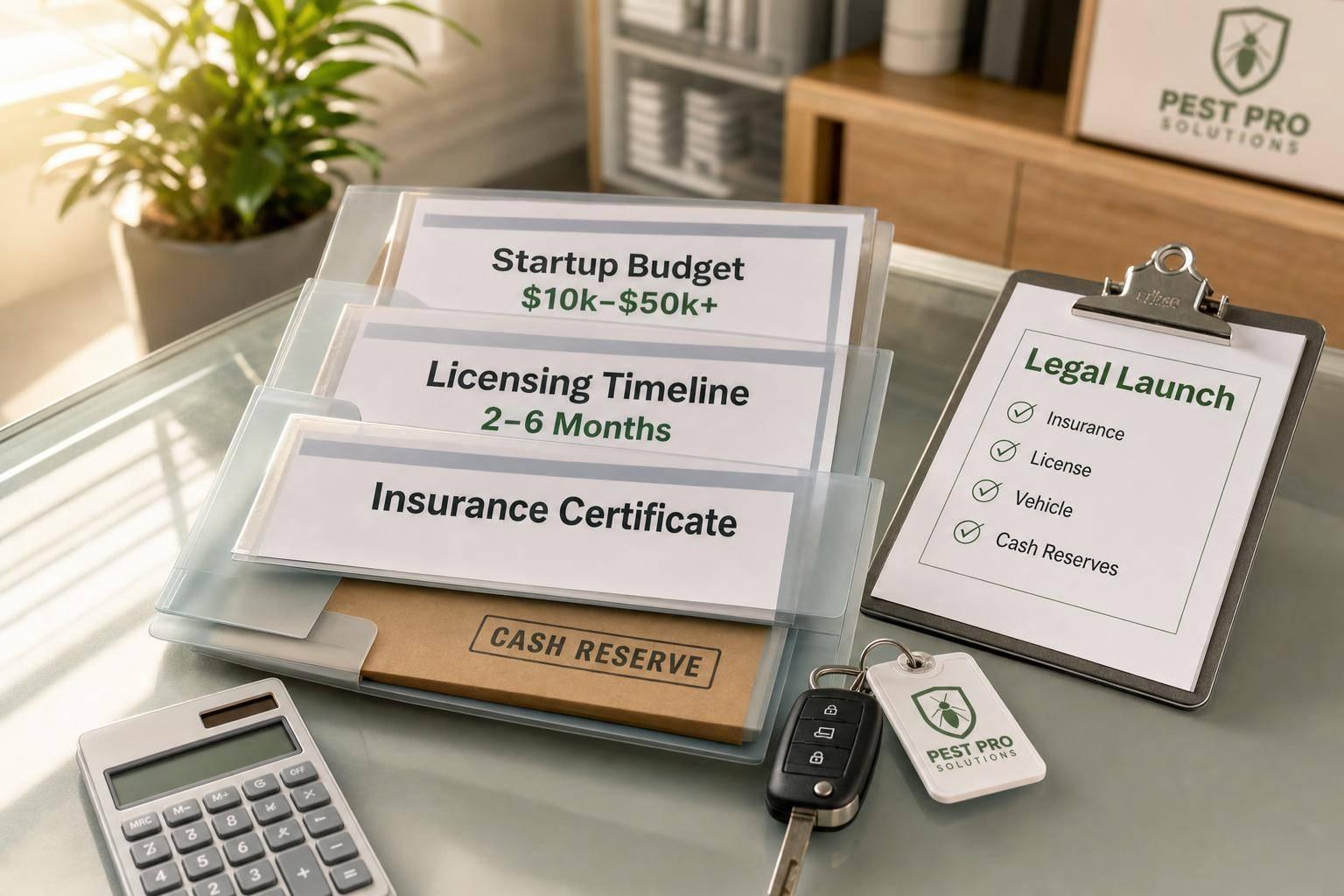
Starting a pest control business can cost about $10,000 to $50,000+ - and the license process can take 2 to 6 months. If I were planning a launch, I’d budget for licenses, insurance, gear, a vehicle, and 3 to 6 months of cash reserve before booking the first job.
Here’s the short version:
- Low-cost start: around $10,000 if I work solo, use a home garage, and start with general pest service
- Higher-cost start: $50,000+ if I add a new van, shop space, or termite and mosquito work
- Biggest cost drivers: service type, vehicle, work location, and team size
- Monthly solo overhead: about $900 to $1,800
- Break-even example: at $45 per month per recurring customer, I’d need about 34 customers to cover $1,500 in monthly fixed costs
- Main legal steps: applicator license, business license, insurance, local permits, zoning checks, EIN, and tax registration
- Penalty risk: some states fine $1,000 to $5,000 per offense for working without the right certification
If I had to sum it up in one line, it would be this: this business is less about buying sprayers first and more about getting legal, insured, and funded for year one.
A quick snapshot:
| Area | What I’d plan for |
|---|---|
| Startup budget | $10,000 to $50,000+ |
| Licensing timeline | 2 to 6 months |
| Vehicle cost | $3,000 in upgrades to $32,500 for a wrapped van |
| Insurance | About $1,500 to $5,000/year liability, plus auto and bond |
| Cash reserve | $5,000 to $15,000 |
| Early profit target | Often around 75 to 100 recurring customers |
Below, I’d focus on the costs that hit first, the licenses that slow launches down, and the numbers I’d use to check whether the business can pay for itself.
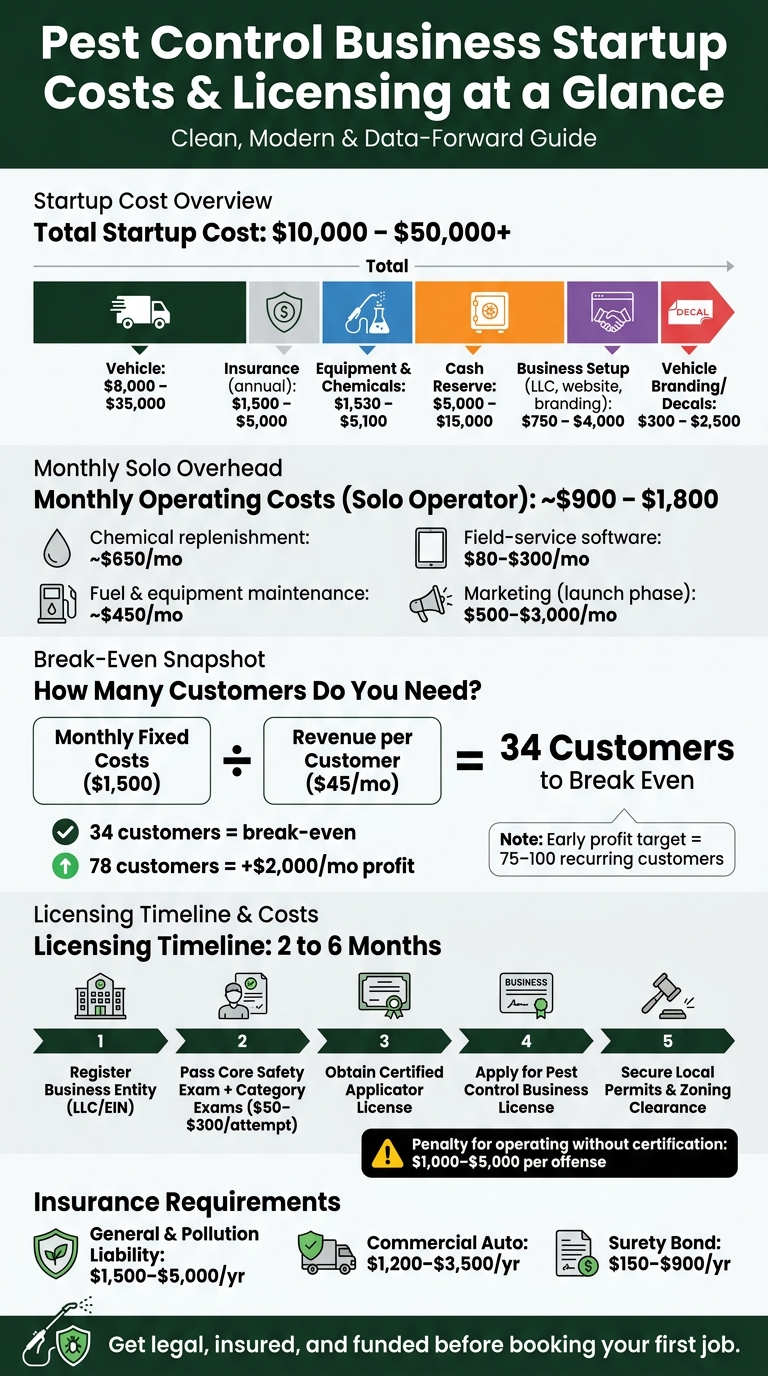
Pest Control Business Startup Costs & Licensing at a Glance
How to Start a Pest Control Business ($450k+ per year)
sbb-itb-08dd11e
Step 1: Build a Realistic Startup Budget
Before you spend a single dollar, list out every cost you’re likely to face. That means one budget for startup costs and another for monthly operating costs before you launch. If those numbers are off, cash flow can get tight fast in year one.
Equipment, Chemicals, and Safety Gear
Your field kit is the base of the business. A solid starter setup often includes a B&G compressed-air sprayer ($250–$400), a 4-gallon backpack sprayer ($200–$500), and a granular spreader ($80–$200). On top of that, PPE like a respirator, coveralls, gloves, and goggles can add another $250–$1,500.
If you want to offer mosquito or termite services right away, you’ll also need a power sprayer, which usually costs $400–$1,500. For your first chemical inventory, plan on about $600–$2,500.
Vehicle, Branding, and Business Setup Costs
Your vehicle will likely be one of your biggest early expenses. A used service van or truck usually costs $8,000–$35,000, based on age, mileage, and condition. You’ll also want a locking chemical storage cabinet, which runs about $300–$900, plus basic branding like decals or a partial wrap at $300–$2,500.
On the business setup side, expect $50–$500 for LLC filing and $400–$3,000 for a basic website and logo.
Insurance and 3–6 Months of Operating Capital
Insurance isn’t optional here. Standard general liability policies often leave out pesticide applications, so in most states you’ll need a pollution liability endorsement. A fair budget is $1,500–$5,000 per year for general and pollution liability coverage, $1,200–$3,500 per year for commercial auto, and $150–$900 per year for a surety bond.
Then there’s working capital. Set aside $5,000–$15,000 to cover your first 3–6 months in business. For a solo operator, monthly costs can look like this:
- Chemical replenishment: about $650/month
- Fuel and equipment maintenance: about $450/month
- Field-service software: $80–$300/month
- Marketing during launch: $500–$3,000/month
Once you’ve mapped out these costs, you can start figuring out how much work you need to book to cover them.
Step 2: Estimate Revenue and Find Your Break-Even Point
Once you’ve mapped your monthly costs, turn that number into a customer goal. The next step is figuring out how much monthly revenue you need to cover those costs.
Use a Simple Formula for Startup Budget and Monthly Costs
A simple way to set your launch budget is to add your one-time startup costs to 3–6 months of operating expenses. That gives you a clearer picture of how much cash you need at the start.
To avoid burning through cash too early, put every expense into one of two buckets: essential costs and delayable costs. Essential costs are the items you legally and practically can’t skip, like licensing, insurance, PPE, and basic sprayers. Delayable costs are the extras you can wait on until money starts coming in, like a full vehicle wrap, a power termite rig, or a dedicated office space.
Calculate How Many Customers You Need to Break Even
The break-even formula is simple: divide your total monthly fixed costs by the average monthly revenue per customer. That tells you the minimum number of active accounts you need before the business stops losing money.
Here’s a simple solo-operator example. Let’s say your monthly fixed costs are $1,500, and you’re selling a quarterly residential plan at $135 per visit. That comes out to $45 per month per customer. Divide $1,500 by $45, and you need 34 active recurring accounts just to break even.
Now add a modest profit goal of $2,000 per month. In that case, you’d need about 78 active accounts. That lines up with the common early-profit range of 75 to 100 recurring customers.
Route density can change the math in a hurry. A dense route with 15 to 17 stops can bring in nearly double the revenue of a scattered route with 8 to 9 stops, even with the same labor cost.
Once the numbers look right, check the licenses and permits required to operate legally.
Step 3: Cover the Basic Licensing and Compliance Requirements
Pest control is regulated at both the federal and state level, and the rules change based on where you operate and what services you offer. Miss a license or use pesticides without the right certification, and the cost can hit fast. State penalties for operating as an uncertified pesticide applicator often fall between $1,000 and $5,000 per offense.
That’s why licensing can’t be treated like a last-minute task. Delays can slow your first job, push back revenue, and force you to carry more startup cash than planned. Put those costs and wait times into your budget before launch.
State Applicator Licenses and Pest Control Operator Requirements
In most states, you need two separate credentials: a Certified Applicator License for the person doing the work and a Pest Control Business License for the company.
The split is pretty simple:
- The applicator license covers the individual applying pesticides
- The business license covers the company offering the service
To get certified, you’ll usually need to pass a Core safety exam plus Category exams tied to your service line, such as General Pest, Termite, or Fumigation. Exam fees often range from $50 to $300 per attempt.
The business license usually asks for proof of insurance, a registered business entity, and, in many states, a designated licensed manager with documented field experience. Some states also require 1 to 3 years of hands-on experience before they’ll issue business licensure.
If you plan to work near a state line, take a minute to check reciprocity rules. Some neighboring states let you skip duplicate exams through a reciprocity agreement.
Pesticide Handling, Storage, and Recordkeeping Rules
Once licensing is handled, pesticide compliance becomes the next big issue. The federal baseline is the Federal Insecticide, Fungicide, and Rodenticide Act (FIFRA). Under FIFRA, the label is the law. That means you must follow the listed rate, site, and target pest exactly. Civil penalties for commercial applicators can reach $5,000 per violation.
Only certified applicators can buy or use Restricted Use Pesticides (RUPs), and that includes many common termiticides and rodenticides.
Storage rules matter too. Chemicals must stay in their original labeled containers and be kept in a locked, ventilated area with secondary containment. In plain English: don’t treat pesticide storage like tossing supplies on a garage shelf and hoping for the best.
Federal law also requires records for all RUP applications for at least 2 years. Those records must include the:
- Product name
- EPA registration number
- Amount applied
- Date
- Location
- Target pest
- Certification number of the applicator
Many states go further and require records for all applications, not just RUPs, so check the exact retention rule with your state pesticide agency.
Local Business Permits, Zoning, and Tax Registration
State licensing is only part of the picture. Most cities and counties also require a local business license. If you’re running the company from home, you’ll likely need a home occupation permit that allows chemical storage and commercial vehicle parking on residential property.
Before you assume your garage can double as a supply room, check with your city or county zoning office. If you live in an HOA, check those rules too.
You should also register for a federal EIN through the IRS as soon as your business entity is formed. And if your state taxes pest control services, get your state sales tax permit in place before sending your first invoice.
For any chemical storage area, contact your local fire marshal to make sure you meet hazardous material handling rules, especially if you’re operating from a home garage. It may feel like a lot of boxes to check, but this is the part that keeps your launch from getting stalled by paperwork, zoning issues, or a surprise visit from local enforcement.
Conclusion: Budget for the First Year, Not Just Launch Day
Once you’ve mapped startup costs and licensing, the next question is simple: can the business make it through year one? Budget for vehicle branding, insurance, licensing, marketing, and cash reserves, not just equipment.
Money is only part of the picture. Legal readiness matters just as much. That means your annual budget should also include CEU, renewal, and re-certification fees.
After launch, the biggest cash risks usually come from taxes, collections, and seasonal slowdowns. So plan your annual reserve around taxes, slow collections, and off-season downtime. You’ll want enough cash on hand to cover slow months and recurring compliance costs without scrambling.
Before launch, build a simple monthly model that tests:
- Pricing
- Break-even point
- Slow-season cash flow
Year-one survival comes down to planning past opening day. The operators who make it through that first year are usually the ones who budget for licensing, seasonality, and renewals from day one.
FAQs
How much cash should I keep in reserve?
Set aside $5,000 to $10,000 on top of your startup costs. Think of it as a buffer for the slow months. That extra cash can help a lot in northern areas, where winter revenue may drop 40% to 60%.
A lot of startup budgets also factor in about three months of working capital. That usually comes out to roughly $7,000 to $21,000. The goal is simple: cover day-to-day expenses while you build your client base and tighten up route density.
What licenses do I need before my first job?
Before you take on your first customer, you need the right state and local approvals in place. In most cases, that means getting a state commercial pesticide applicator license. Many states also require a separate pest control business license or registration.
You’ll usually need local paperwork too, such as a city or county business license. On top of that, most operators need general liability insurance and, in many cases, a pest control surety bond before they can legally sign contracts or do the work.
Can I start from home with one vehicle?
Yes - you can start a pest control business from home with one vehicle.
You may not need a commercial office. But your setup still has to follow local zoning rules, especially when it comes to chemical storage. You’ll also need a secure, well-ventilated storage area, DOT-compliant vehicle storage, and the required state applicator and business licenses before you offer services.
Related Blog Posts
- How to Start a Pressure Washing Business With Under $1,000
- How to Start a Profitable Lawn Care Business: Complete Guide
- Pressure Washing Startup Costs: Gear, Licences, ROI
- Cleaning Business Startup Costs in Australia (2025): Real Numbers + Template