A good niche usually has 3 things: clear pain, search demand, and weak competition. If I see repeated complaints, search terms in the 1,000–5,000/month range, and search results filled with old posts, forum threads, or weak pages, I know the niche is worth a look.
Here’s the short version:
- I start with a narrow buyer and one business model
- I set a revenue floor, such as $2,000–$5,000/month
- I look for repeated pain in Reddit, forums, and reviews
- I check if search interest has gone up over 12–24 months
- I look for 5–20 active competitors, not 0 and not 50+
- I favor terms with buying intent like pricing, tool, template, and alternative
- I check if people already pay around $29–$149 or $50+/month in nearby markets
- I score the niche, then run a simple landing page test for 1–2 weeks
- I treat 10% email signup rate as a strong green light; under 5% means I need to change the idea or message
What I’m looking for is simple: people want help, but the current options are weak, old, too broad, or hard to use.
That means I’m not chasing broad markets. I’m looking for small pockets of demand where buyers already show pain, search for answers, and spend money.
If a niche has pain, proof, and timing, I test it. If not, I move on.
How I Find Low-Competition Keywords That Actually Convert
sbb-itb-08dd11e
Set your niche filters before you start researching
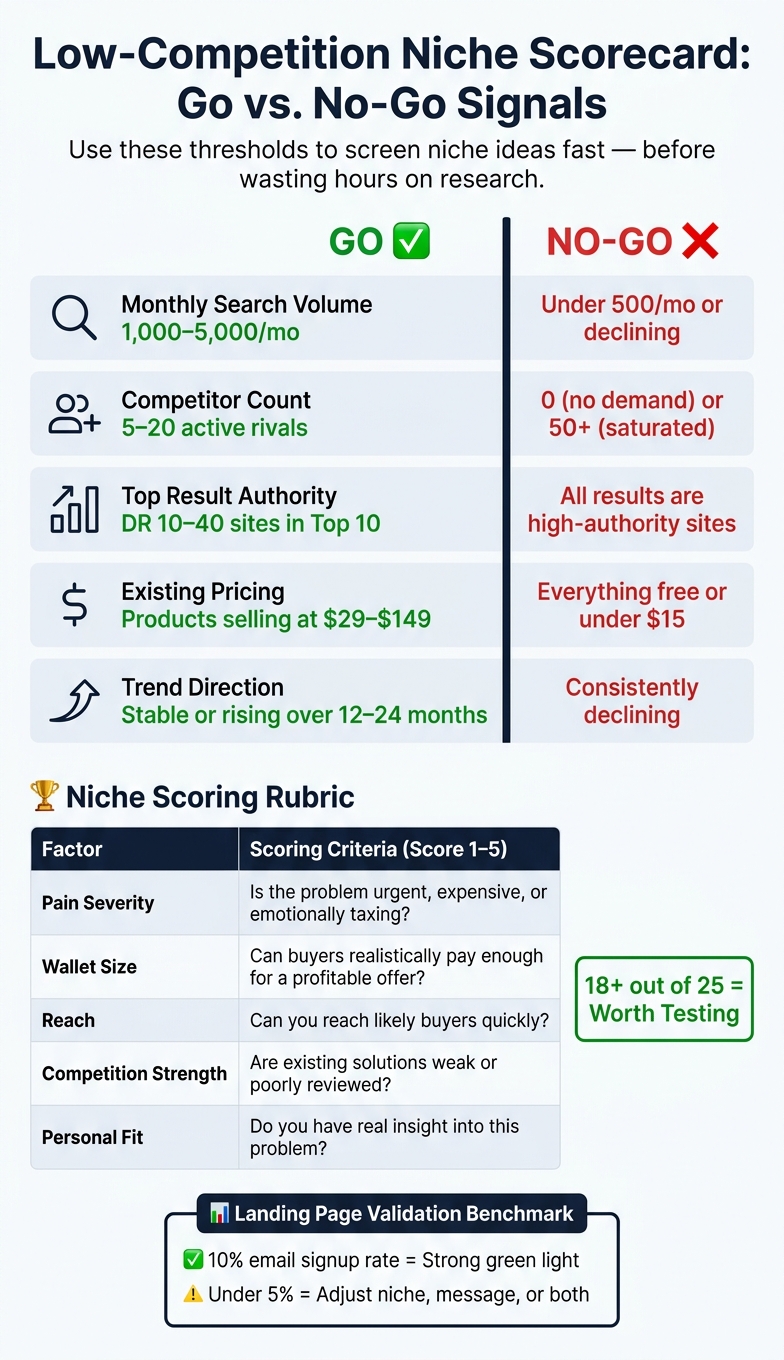
Low-Competition Niche Scorecard: Go vs. No-Go Signals
Before you dive into research, set a few filters first. This helps you spot early openings and skip niches that are crowded or too small. Put simply: you want to kill weak ideas early, not after hours of digging.
Define your customer, business model, and revenue floor
Start with a specific buyer. "Fitness" is far too broad. "AI tools for wedding photographers" is narrow enough to test. The more specific you get, the easier it is to see where those people hang out, what they buy, and what problems keep coming up.
Next, choose a business model that fits your time, skills, and budget. For low-competition niches, common options include:
- micro-SaaS
- digital products
- memberships
- services
Pick one before you start researching. That way, you're not judging ideas in the abstract. You're judging them against an actual path to revenue.
Then set a revenue floor. This is the minimum monthly income that makes the niche worth your time. A niche only matters if it can pay back the work it takes to build. For a side hustle, a practical floor is $2,000–$5,000 per month. If you're aiming for venture-scale software, look for a clear path to 1,000+ customers and a realistic $10 million+ market.
Set simple go or no-go thresholds
Once you've defined your customer, business model, and revenue floor, use a short checklist to screen ideas fast. A healthy niche usually has 5–20 active competitors.
Think of these thresholds as a quick rejection test. Use the same scorecard every time so you can compare ideas without second-guessing yourself.
| Signal | Go ✅ | No-Go ❌ |
|---|---|---|
| Monthly Search Volume | 1,000–5,000/mo | Under 500/mo or declining |
| Competitor Count | 5–20 active rivals | 0 (no demand) or 50+ (saturated) |
| Top Result Authority | DR 10–40 sites in Top 10 | All results high-authority sites |
| Existing Pricing | Products selling at $29–$149 | Everything free or under $15 |
| Trend | Stable or rising | Consistently declining |
If a niche clears these filters, it's worth a closer look. If it fails several of them, move on.
Find underserved problems before they become obvious
Once your filters are in place, the next step is simple: check whether people are already feeling the pain. The best early niches usually don't start with polished market reports. They show up in public complaints.
Mine Reddit, forums, and communities for repeated pain
Don't get distracted by one-off gripes. What matters is repeated frustration across many threads.
Search subreddits and niche communities tied to your audience for phrases like "I wish there was," "Why doesn't anyone build," "I would pay for," and "It would be better if".
Then look at what people do when no good fix exists. If users are stitching together hacks, spreadsheets, manual steps, or messy Zapier automations, that's a strong sign a dedicated product is missing. Places like r/SkincareAddiction, r/Supplements, and r/EatCheapAndHealthy are especially useful because people tend to speak plainly there.
This isn't just chatter. It's buyer language. If you see 200+ mentions of the same pain point, treat that as a strong signal. Keep a shared log, group complaints by theme, and watch for patterns that keep coming back.
After that, check whether current products are falling short in the same way.
Use Amazon reviews and weak solutions to find gaps

Amazon reviews can tell you a lot about where existing products miss the mark, especially 2-star and 3-star reviews. Unlike 1-star reviews, which are often pure venting, these usually come from people who liked something about the product but hit a clear problem again and again.
Watch for lines like "I wish it could," "I couldn't get it to," or "I'd switch if". That's the market telling you what it wants and still can't get. If negative reviews keep circling back to complexity, that's a strong opening for a simpler product.
It also helps to look at stale competitors. If an incumbent hasn't shipped a meaningful update in two or more years and still has paying customers, that suggests demand is there and the door is still open for a better offer.
One warning sign: if most negative reviews are about price, not missing features, move on. That's usually a race-to-the-bottom market, and it's hard to make money there.
Once you spot repeated pain, use search behavior to check whether interest is moving up.
Track rising search behavior with Google Trends and Exploding Topics
Search data helps confirm whether a problem is picking up steam. You're not looking for a sudden spike. You want a steady climb over 12–24 months, because that points to momentum that lasts.
In Google Trends, always check the five-year view. That's how you separate slow growth from short-term viral noise. If a topic shows a calm upward trend and search results still have limited niche content, you're probably looking at an early opening.
With Exploding Topics, pay attention to terms still labeled "Regular" or "Peaked." Once a term is marked "Exploding," the window may already be tighter. In many cases, the best entry points are keywords with 300–3,000 monthly searches, a steady upward trend, and a keyword difficulty score below 30.
Validate demand, competition, and profitability with data
Now it’s time to put numbers behind the signals: demand, competition, and price.
After you’ve seen the same pain show up across communities and noticed search interest moving up, the next step is simple: measure it. You want data that answers three basic questions:
- Are people searching for this?
- Is the competition beatable?
- Can this niche support a business?
Turn pain points into long-tail keywords
Reddit threads, review sites, and app store complaints are a gold mine for keyword ideas. Each complaint can become a keyword seed.
The trick is to get specific. “Fitness for older adults” is too broad. Phrases like “post-surgery rehab equipment for seniors” or “postpartum strength training with low-impact options” point to a clear problem and a clearer buyer.
From there, layer in intent modifiers. Terms like pricing, best, alternative, review, software, template, tool, vs, how to, and compliance often signal buying intent instead of casual browsing. That matters a lot. You’re not just looking for interest. You’re looking for interest tied to a pain people may pay to solve.
Use that keyword set as the search list for the next step.
Check search demand and assess real competition
Search volume matters, but it doesn’t tell the whole story. You also need to see who already ranks and how tough they’ll be to beat.
Search your target keywords and study the results page. Are the top pages thin, old, or only half-useful? If so, that’s an opening. Sometimes the gap is hiding in plain sight.
Intent matters too. A niche packed with “what is” searches is often tougher to monetize than one filled with people looking for tools, templates, pricing, or alternatives. One group is learning. The other is shopping.
Here’s a fast way to read the signals:
| Signal | Early/Low Competition | Hard to Win |
|---|---|---|
| Search intent | "Software", "template", "tool", "pricing" | "What is", vague curiosity terms |
| Competitor reviews | Complaints about missing features | Complaints about price only |
| Dominance | Results are split across several small players | One brand appears in nearly every result |
| Ads on keyword | Present - signals paying demand | Absent - may indicate low commercial value |
If demand looks solid, the next question is whether buyers pay enough to make the niche worth pursuing.
Estimate whether the niche can make money
A niche built around free or ultra-low-priced offers usually isn’t a strong business opportunity. In B2B, buyers often show a willingness to pay $50+ per month for nearby tools. That’s a much better sign.
Then run the math. To hit $1 million in ARR, a SaaS company would need about 833 customers paying $100/month. That number isn’t huge, but it does mean the market has to be big enough - and reachable enough.
This is where bottom-up market sizing helps. Look at the buyers you can actually reach, not some giant top-line market number. If the reachable market can’t support your revenue target, the niche may be too small to build on.
And there’s a strong reason to do this work before building anything: products with pre-launch validation have been found to achieve 3.4x higher first-month revenue than products launched without it. That’s a big gap, and it says a lot.
Rank your options and run a fast niche test
Once you've checked demand, competition, and profit potential, rank the ideas that still make sense and test just the top one.
Score each niche with a simple comparison table
Give each idea a score from 1–5 across five factors. Be blunt with yourself. If you're too generous, the test won't tell you much.
| Scoring Factor | What to Ask | Score (1–5) |
|---|---|---|
| Pain Severity | Is the problem urgent, expensive, or emotionally taxing? | |
| Wallet Size | Can buyers realistically pay enough for a profitable offer? | |
| Reach | Can you reach likely buyers quickly? | |
| Competition Strength | Are existing solutions weak or poorly reviewed? | |
| Personal Fit | Do you have real insight into this problem? | |
| Total | 18+ out of 25 = worth testing |
A score of 18+ means the niche is worth a fast test. Anything lower usually means you need tighter positioning, a better angle, or a different idea altogether.
And one more thing: treat the top score as a signal to test, not permission to build the whole thing. That's a big difference.
Run a minimal validation test before building
Start with one clear offer. Put it on a simple landing page. Then send a small batch of targeted traffic from the places your buyers already hang out.
Let it run for 1–2 weeks.
Here's the benchmark:
- 10% email conversion rate = a strong signal
- Below 5% = adjust the niche, the message, or both
This is the kind of test that keeps you from wasting months on an idea that only sounded good on paper.
Use a unique value proposition, waitlist, and community-mapping tools to tighten the pitch and get the test live faster.
Conclusion: Look for pain, proof, and timing
Look for pain. Confirm proof. Check timing.
If the score is high and the test gets traction, build. If not, move on.
FAQs
How do I know if a niche is too small?
A niche may be too small if it doesn't have enough search demand, clear ways to make money, or a customer base big enough to support your income goals.
A few red flags can tip you off fast:
- Search interest has been dropping over the past 12 months
- There’s zero competitor activity
- You can find fewer than 200 distinct customer complaints
To check whether the market has enough room, run a simple bottom-up estimate. Count how many likely customers you can realistically reach, then multiply that number by a realistic average revenue per user. That gives you a rough floor for the market size and helps you see whether the niche can support your financial goals.
What if search volume is low but pain is strong?
Low search volume paired with strong pain can point to an underserved, high-value opening. It doesn't always mean people don't care. Sometimes it just means the market hasn't caught up yet.
In cases like this, pay more attention to signs of a stubborn, repeat problem than to keyword volume alone.
Watch for signals like:
- teams relying on manual internal scripts
- clunky workarounds that patch over the same issue again and again
- repeated frustration in niche spaces like Reddit
If the problem shows up often and you can clearly spot who has it, demand may already be there even if mainstream search interest isn't.
How much traffic do I need to validate a niche?
You don’t need perfect traffic numbers. What matters is steady search demand, not a one-off spike that looks good for a month and then disappears.
For niche sites, a head term with 5,000 to 50,000 monthly searches plus 20 to 30 long-tail terms with 500+ searches each usually points to a healthy market.
For product-focused niches, here’s a simple way to size things up:
- Under 200 searches/month: very niche
- 200 to 1,000: small but viable
- 1,000 to 5,000: solid
- 5,000 to 20,000: large
That gives you a practical gut check without getting hung up on exact numbers.
Related Blog Posts
- 27 Low-Competition Business Ideas With High Margins (2025)
- Emerging Niche Markets With High Potential for Small Founders
- Low-Competition Business Ideas in Australia With Local Search Demand
- 31 Low-Competition Business Ideas With High Margins in 2026