
Yes, side projects in 2025 can be worth it - if approached strategically. They’re more accessible than ever thanks to AI tools, low startup costs, and growing demand for niche services. Here's what you need to know:
- Low Costs: Starting costs have plummeted from $50,000 in 2020 to under $5 due to AI tools like ChatGPT-5.
- Strong Earnings Potential: The average side hustle earns $12,000 annually, with top earners making $10,000–$50,000 per month.
- Demand for Specialized Skills: 72% of managers prefer hiring freelancers, especially in niche areas like AI consulting and tutoring.
- AI Efficiency: Tools like Synthesia and Jasper automate tasks, saving time and enabling part-time entrepreneurs to scale faster.
However, success depends on validating your idea, targeting specific markets, and managing time effectively. Many fail due to burnout, lack of demand, or entering oversaturated markets. Tools like IdeaFloat can help test demand, size markets, and create pricing strategies before you commit resources.
Key takeaway: With the right plan, side projects can generate significant income while offering flexibility. But don’t skip the groundwork - validate your idea, specialize, and use AI to maximize efficiency.
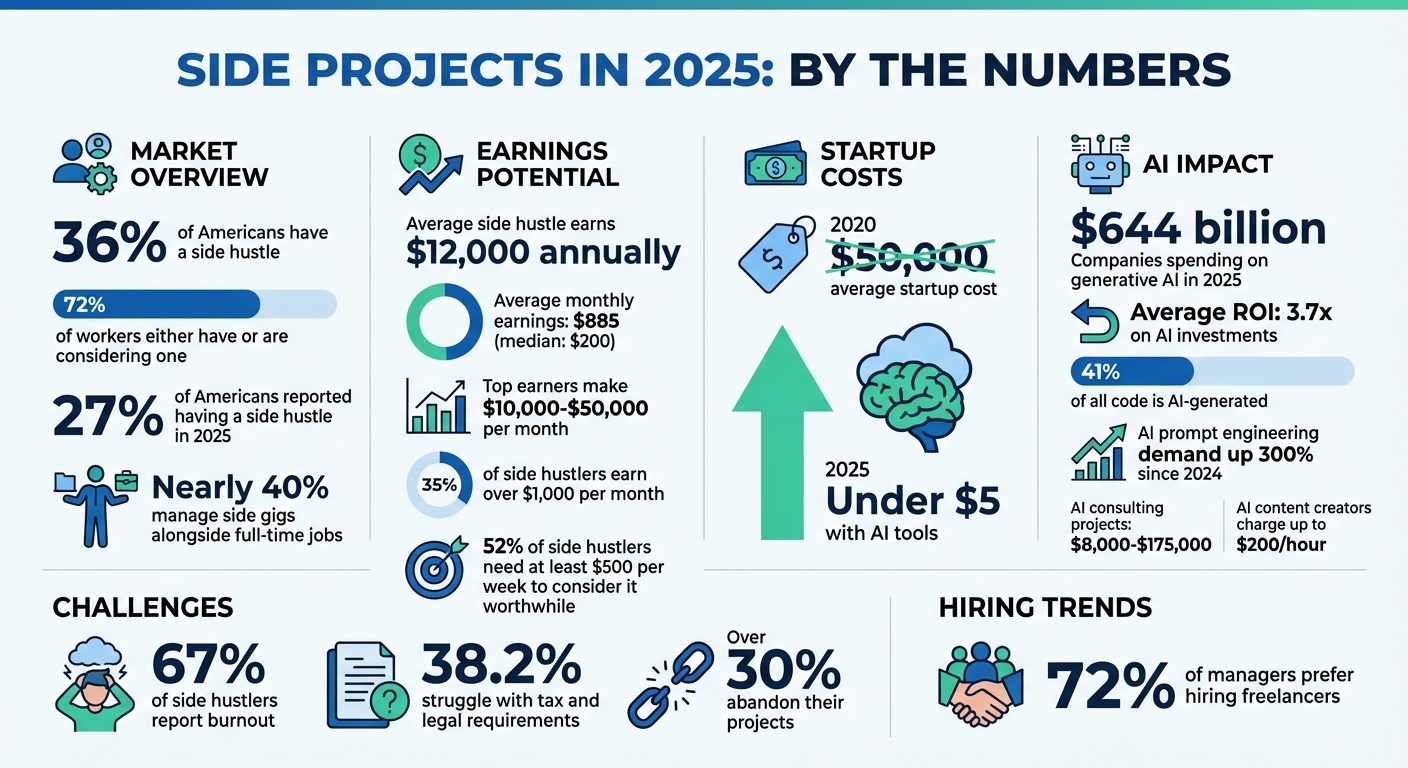
Side Project Statistics and Profit Potential in 2025
I Tried 5 Side Hustles in 2025 (Here's How Much I Made)
sbb-itb-08dd11e
Common Problems That Prevent Side Projects from Making Money
Side hustles are on the rise - with 27% of Americans reporting one in 2025 - but the harsh reality is that most never achieve steady profitability. Understanding the common reasons behind these failures can help you sidestep them and You can also learn how to launch your business to set your project up for success. Let's break down the key challenges.
Limited Time and Energy
The toughest hurdle isn't necessarily finding extra hours in the day - it's having enough energy to make those hours productive. After juggling a full-time job, commuting, and family responsibilities, most people are running on empty. Even weekend or evening work often suffers from sheer exhaustion.
This lack of energy drags out the timeline to profitability. Many side hustlers underestimate just how many hours it takes to keep things running until profits start rolling in. Without realistic expectations, you risk burning through your free time and savings on an idea that hasn't been validated yet.
But limited energy isn't the only factor slowing progress. Market conditions can make things even tougher.
Too Much Competition in Popular Markets
Jumping into a crowded market without a clear edge is a recipe for frustration. Take dropshipping, for example - it’s an incredibly popular model, but the space is so saturated that established players dominate customer attention. If your project doesn’t have a standout value or solve a specific problem, it’s hard to convince customers to choose you over competitors.
In 2025, success increasingly hinges on specialization. Instead of offering broad solutions, profitable side projects focus on solving very specific and pressing problems for niche audiences. For instance, wedding photography often commands higher rates than pet photography because couples need top-tier photos for a once-in-a-lifetime event. This kind of focus can help you break through the noise in competitive markets.
But even with a niche, there's another trap many side hustlers fall into.
Starting Without Validating Demand
Far too many side projects fail because they launch without confirming if there’s actual demand for the product or service. Building something without knowing if people will pay for it is a costly gamble.
"If your business idea will create more or bigger problems instead of solving them, you'll have trouble making sales." – Celine Roque, Business Consultant
Validation is all about ensuring your solution is worth more to your customers than the "pain" of their problem. Without that confirmation, you're risking time, money, and energy on an idea that might never take off. Testing demand early can save you months of wasted effort.
What's Working for Side Projects in 2025
In 2025, side projects are thriving thanks to the rise of AI tools, specialized niches, and new platforms that make it easier than ever to turn ideas into income.
AI Tools That Save Time and Money
AI tools have become a game-changer for side hustlers, automating tasks that used to require extra help. Take Eddy Ballesteros, for example. He boosted his content output from two scripts a week to five a day by using AI for brainstorming and outlining.
With nearly 40% of Americans managing side gigs alongside full-time jobs, tools like ChatGPT and Claude are stepping in to handle research, drafting, and even data analysis. Platforms like Synthesia allow creators to produce video content without ever stepping in front of a camera. This means you can run a profitable side project even with limited time.
The numbers back this up. In 2025, companies are spending $644 billion on generative AI, with an average return of 3.7x on their investments. For side hustlers, this levels the playing field - many of these tools are free or affordable, giving you access to the same resources as larger players.
AI isn't just about saving time; it's opening up entirely new ways to earn. The demand for AI prompt engineering has jumped 300% since 2024, with freelancers charging $50 to $150 an hour. AI consulting projects range from $8,000 to $175,000. Even reviewing AI-generated content - a service where you ensure quality for companies - pays around $27 an hour. And with only 27% of organizations currently reviewing their AI content, the demand is skyrocketing.
High-Earning Niches in 2025
The most successful side projects in 2025 focus on solving specific problems for passionate audiences. One standout area is telehealth, which is valued at $196.81 billion and expected to grow at 22.55% annually through 2034.
Online education and tutoring also remain strong. The global market for online learning is projected to surpass $350 billion by the end of 2025. Seattle-based tutor Carter Osborne earned $220,000 in 2024 working just 10 hours a week. His secret? Specializing in a high-stakes niche where parents are willing to pay premium rates.
"There's no such thing as a 'type' of person who becomes a successful business owner, so go pursue your ideas and see what happens." – Carter Osborne, Founder of Carter Osborne Tutoring
Pet care services have seen a 40% increase in demand since the pandemic. Meanwhile, tutoring boasts a 95% success rate for improving students' grades, making it both in-demand and results-driven. Other niches like digital detox coaching and virtual fitness are also gaining traction as people prioritize mental health and flexible workout options.
Physical products are still viable, but the approach has shifted. Live commerce on TikTok is shaking up the game. For instance, Kelly and Colt Bozigian's handmade jewelry brand, Coastal Caviar, hit $1 million in sales without any paid ads. Similarly, Madden and Steven Forrest's Bull Island Breaks grew from $4,000 in single-day sales to nearly $50,000 in monthly revenue by selling collectible cards live on TikTok.
These examples highlight how focusing on niche markets and leveraging modern platforms can lead to impressive results.
Comparing Profit Potential Across Different Side Projects
AI tools and niche expertise have made side projects more profitable than ever. Here's how some of the most popular options compare in 2025:
| Side Project Type | Profit Potential | Startup Costs | Success Factors |
|---|---|---|---|
| Specialized Freelancing | High ($50–$200/hr) | Very Low | AI integration, tech skills, legal expertise |
| Digital Products | Very High (Scalable) | Low | Niche targeting, SEO, marketing automation |
| Physical Reselling | Moderate to High | Moderate | Live selling on TikTok, inventory management |
| General Freelancing | Low to Moderate | Very Low | High competition; requires high volume |
Specialized freelancing in areas like AI consulting, UI/UX design, and sales funnel copywriting can command premium rates. Digital products, like e-books or productivity templates, offer unmatched scalability - you create them once and sell them repeatedly. Some creators earn as much as $12,000 per month from top-performing bundles.
Physical reselling has been revitalized by live commerce on TikTok, where real-time engagement drives quick sales. On the other hand, general freelancing remains a crowded space with lower margins unless you carve out a specific niche.
The trend is clear: 35% of side hustlers earn over $1,000 per month. Those who combine AI's efficiency with expertise in growing markets are leading the pack. With the generative AI industry projected to hit $62.72 billion by 2025, the opportunities are only expanding for those ready to adapt.
How to Validate and Build a Profitable Side Project with IdeaFloat

Tackling common obstacles like untested demand and pricing mistakes, IdeaFloat provides tools to help you create a profitable side project. It allows you to validate your idea before committing months of effort. Through its structured framework, you can test demand, measure market size, and set pricing - all before spending significant time or money. Here's how to use IdeaFloat to lay the groundwork for a successful side project.
Step 1: Confirm There’s Real Demand for Your Idea
One of the biggest mistakes side hustlers make is jumping into development without ensuring people actually want what they’re offering. IdeaFloat’s Problem Validator helps you determine if your idea solves a pressing problem that customers are willing to pay to fix. It evaluates the urgency of the problem and identifies early market signals, giving you confidence before you dive in.
To dig deeper, you can tap into Consumer Insights, which analyze online discussions to understand customer sentiment and the language they use. By exploring conversations in forums and social media, this tool helps you verify whether there’s genuine interest in your concept.
Additionally, Competitor Analysis identifies rivals and highlights underserved niches where solo entrepreneurs can thrive. It reveals competitors’ strengths and weaknesses, helping you spot opportunities to stand out in the market.
"Building is secondary to delivering value to your target market... You're nothing until you have customers who want your product." – Gagan Biyani, CEO, Maven
Step 2: Assess Your Market Size
After confirming demand, the next step is to determine whether the market is big enough to support your project. IdeaFloat’s Smart Market Sizing tool calculates key metrics like TAM (Total Addressable Market), SAM (Serviceable Addressable Market), and SOM (Serviceable Obtainable Market). It even provides cited data that can be verified by investors.
This step is critical because the online gig economy now accounts for 4.4% to 12.5% of the global labor force, creating a massive opportunity for digital services. By using this tool, you’ll gain insights into your total potential audience, realistic reach, and first-year growth potential. Once you’ve confirmed the market size, you’re ready to move on to pricing and financial planning.
Step 3: Set Pricing and Build Financial Plans
Missteps in pricing can derail even the best side projects. Statistics show that 52% of side hustlers only find their efforts worth it if they earn at least $500 per week. IdeaFloat helps you avoid these pitfalls by providing tools to develop effective pricing strategies and financial models from the start.
With Advanced Pricing Research, you can either let AI optimize pricing for you or manually adjust rates based on competitor benchmarks. For instance, if you’re offering web development services, you can compare your rates to the $52 per hour industry average. The Financial Model tool also tracks your revenues and expenses to ensure your project is financially viable.
Additionally, IdeaFloat addresses a common struggle: managing tax and legal requirements. Nearly 38.2% of side hustlers face challenges in this area. By guiding you to separate personal and business finances early, IdeaFloat helps reduce the financial risks that lead over 30% of side hustlers to abandon their projects.
Practical Ways to Make Money from Side Projects in 2025
With your idea validated, it’s time to focus on smart ways to turn it into income. In 2025, successful side hustlers are using AI tools and prioritizing activities that deliver the most value. Whether it’s leveraging AI, freelancing, or selling digital products, there are plenty of opportunities to generate revenue.
Using AI for Content and Marketing
AI has completely reshaped the way we create and share content. Tools like Jasper, Claude, and ChatGPT make it easier than ever to take one piece of content and transform it into multiple formats - perfect for social media, newsletters, and blog posts.
"The amount of graphic templates that are needed given the volume of content that people are creating and pushing out into the world today is insane" – Angelique Rewers, CEO, BoldHaus
The demand for AI-driven content creation is booming. On platforms like Upwork, AI content creators are charging up to $200 per hour. That’s a clear sign of how valuable these skills have become.
If your side project depends on organic traffic, AI tools can streamline your entire marketing funnel. For example, IdeaFloat's Consumer Insights feature helps you discover the exact language your audience uses online. Feed that data into AI writing tools to create SEO-friendly blog posts and ad copy. Meanwhile, the Community Launch Map pinpoints where your audience hangs out and generates tailored posts to spark engagement and direct traffic to your landing page.
Offering Freelance Services
Freelancing is still one of the quickest ways to start earning from a side project, especially if you focus on in-demand skills. For instance, marketing consultants can make anywhere from $20 to over $500 per hour, while IT and tech consultants typically charge between $50 and $300 per hour. Specializing in a niche and solving specific problems can help you command higher rates.
To thrive in the competitive freelance market, consider using IdeaFloat's Go-to-Market Strategy tool to create a detailed client acquisition plan. Instead of chasing low-paying gigs, aim for a handful of premium clients each month. This approach not only boosts your income but also builds a more sustainable freelance business.
Creating and Selling Digital Products
Digital products like eBooks, online courses, and templates are a fantastic way to earn money because they can be sold repeatedly without additional production costs. The online education market alone is expected to hit $375 billion by 2026. Take Kelly Rocklein as an example: she turned her user-generated content side hustle into a $100,000 business while still working a full-time job. Eventually, she transitioned to running UGC Pro as her full-time consulting firm.
Before diving into digital products, make sure there’s demand. IdeaFloat's Product & Service Creator can help you design your product lineup manually or let AI handle it. This tool also estimates how many units you’ll need to sell each month to reach profitability. Pair it with the Advanced Pricing Research tool to find the best price point for your product by analyzing competitor data and applying proven pricing strategies. For example, if you’re selling an online course, test different price levels to figure out what works best. Once you’ve validated your idea, use the Waitlist Landing Page builder to capture emails and generate excitement, even before your product officially launches.
Final Answer: Are Side Projects Worth It in 2025?
Let’s cut to the chase: side projects in 2025 can absolutely bring in real income - if you approach them with a solid plan. 36% of Americans already have a side hustle, earning an average of $12,000 annually. For those with specialized skills, the numbers climb dramatically, with some pulling in $10,000 to $50,000 per month. But here’s the catch - 67% of side hustlers report burnout, even as 72% of workers either have a side hustle or are considering one. Success lies in smart validation, niching down, and treating your project like a real business.
Key Takeaways
Start with validation. Before diving in, test your idea to make sure there’s actual demand. Simple methods like surveys, landing pages, or limited product launches can save you months of wasted effort. Take developer Piotr Kulpiński’s example: in 2025, his side project, OpenAlternative, hit 1 million unique visitors and brought in $57,361 in gross revenue. Built in just 48 hours, it reached $6,000 in Monthly Recurring Revenue (MRR) by leveraging organic SEO and community-driven submissions.
Specialize to get noticed. Broad markets are overcrowded. The real money is in niches. For instance, AI content creators on Upwork are charging up to $200 per hour, while specialized consultants command $200 to $500 per hour. The lesson? Solve a specific problem for a specific audience, and you’ll stand out.
Leverage AI to work smarter. By 2025, 41% of all code is AI-generated. This means you don’t need a team to get started. AI tools can handle tasks that once required multiple people, cutting costs and speeding up execution - a game-changer for solo entrepreneurs.
Plan your finances carefully. Know your costs, track your expenses, and calculate how much you need to break even. While the average side hustle earns $885 per month (median of $200), hitting $10,000 per month usually takes 12 to 24 months of focused effort. Before quitting your day job, ensure you’ve built a sustainable model and saved at least six months of living expenses.
What’s Next?
If you’re serious about turning your side project into a profitable venture, start with validation. Tools like IdeaFloat make this process straightforward. They help you assess demand, calculate market size, and fine-tune pricing before committing your time and resources. Use their Problem Validator to confirm people are willing to pay for your solution, and the Consumer Insights tool to understand how your audience communicates their needs. Once demand is clear, their Advanced Pricing Research and Financial Model features can help you crunch the numbers and ensure your idea is financially viable.
Stop relying on guesswork. With a data-driven approach, you can turn your idea into a successful business without unnecessary stress or wasted time. Thousands of entrepreneurs have already used these steps to launch with confidence - why not join them?
FAQs
How can I test if my side project idea is worth pursuing before spending time and money?
To test your side project idea, start by pinpointing the problem you aim to solve and identifying your target audience. Zeroing in on a specific niche can be a game-changer, as smaller, well-defined markets often engage more deeply. Use tools like Google Trends, online forums, or social media groups to quickly research market interest and scope out potential competitors.
Once you’ve done that, build a simple landing page or mock-up using no-code platforms. Clearly explain your solution, include a strong call-to-action, and collect sign-ups to gauge interest. To drive traffic, consider running a small, targeted ad campaign - spending just $5–$10 on social media can go a long way. Keep an eye on metrics like sign-up rates and cost per lead to measure how much interest your idea generates.
If the results look promising, take it a step further by offering a pre-sale or pilot program to test if people are actually willing to pay. Feedback from surveys or early adopters can provide valuable insights, helping you fine-tune your idea and set it up for success.
What are the best AI tools for growing a side project in 2025?
AI tools are set to transform the way side projects are scaled in 2025. They can help you save time, cut costs, and work more efficiently by automating tedious tasks, generating content, and analyzing data to guide smarter decisions.
Here are some key categories of AI tools that stand out:
- Automation tools: Perfect for managing repetitive tasks like email follow-ups, scheduling social media posts, or syncing data across multiple platforms.
- Content creation tools: These can quickly produce blog posts, ad copy, and product descriptions, ensuring a steady flow of content without the heavy lifting.
- Design tools: From logos to graphics and mockups, these tools can handle visual needs, slashing design expenses.
- Analytics platforms: They dig into customer trends, pricing strategies, and growth opportunities, giving you the insights needed to make informed decisions.
Using these AI-driven solutions, you can streamline your processes, expand your reach, and start monetizing your side project more quickly - all without the need for a large team.
How can I pick a profitable niche for my side project in 2025?
To pick a niche that can bring in profits, start by pinpointing where your skills and passions meet what people actually need. By 2025, about 39% of working Americans will be juggling side gigs, pulling in an average of $885 per month. Tools like Google Trends or AI-driven platforms can help you spot trending topics and confirm if your idea has potential.
Zero in on a micro-niche - a super-specific audience with a unique problem you can solve. Think of groups like "remote-working moms" or "gluten-free pet-treat enthusiasts." These focused niches are gaining momentum. Before diving in, test your idea with a small audience to see how they respond and tweak your approach as needed.
Lastly, evaluate how much money you can make. Look at what similar products or services are priced at and calculate how much you could realistically earn based on your time and resources. If the math works out and aligns with your financial goals, you’ve likely found a niche worth pursuing.
Related Blog Posts
 Report an issue
Get the newest tips and tricks of starting your business!