If I wanted to validate a business idea in Australia right now, I’d start where people are already waiting, driving too far, or patching services together. That points to four clear groups: regional care access, home and community support, pet and family services, and niche help for small business owners.
Here’s the short version:
- Regional care access stands out because many towns still lack easy access to allied health, aged care help, and vet services.
- Home and community support looks strong because older adults, NDIS participants, and busy households often need repeat help.
- Pet and family services work because pet ownership is high, demand keeps growing, and many local markets are split across small operators.
- Specialty SME services make sense because many of Australia’s 2.5 million small and mid-sized businesses still need simple admin, host, and marketing help.
A few numbers make the gap hard to miss:
- Median aged care wait times were 294 days
- Speech therapy waitlists often run 3+ months
- About 73% of households own a pet
- The NDIS is projected to reach about $58 billion by 2028
- More than 250,000 Australians lack reasonable vet access
What I take from this is simple: the best ideas here do not depend on inventing demand. They depend on serving people faster, closer, and with less friction.
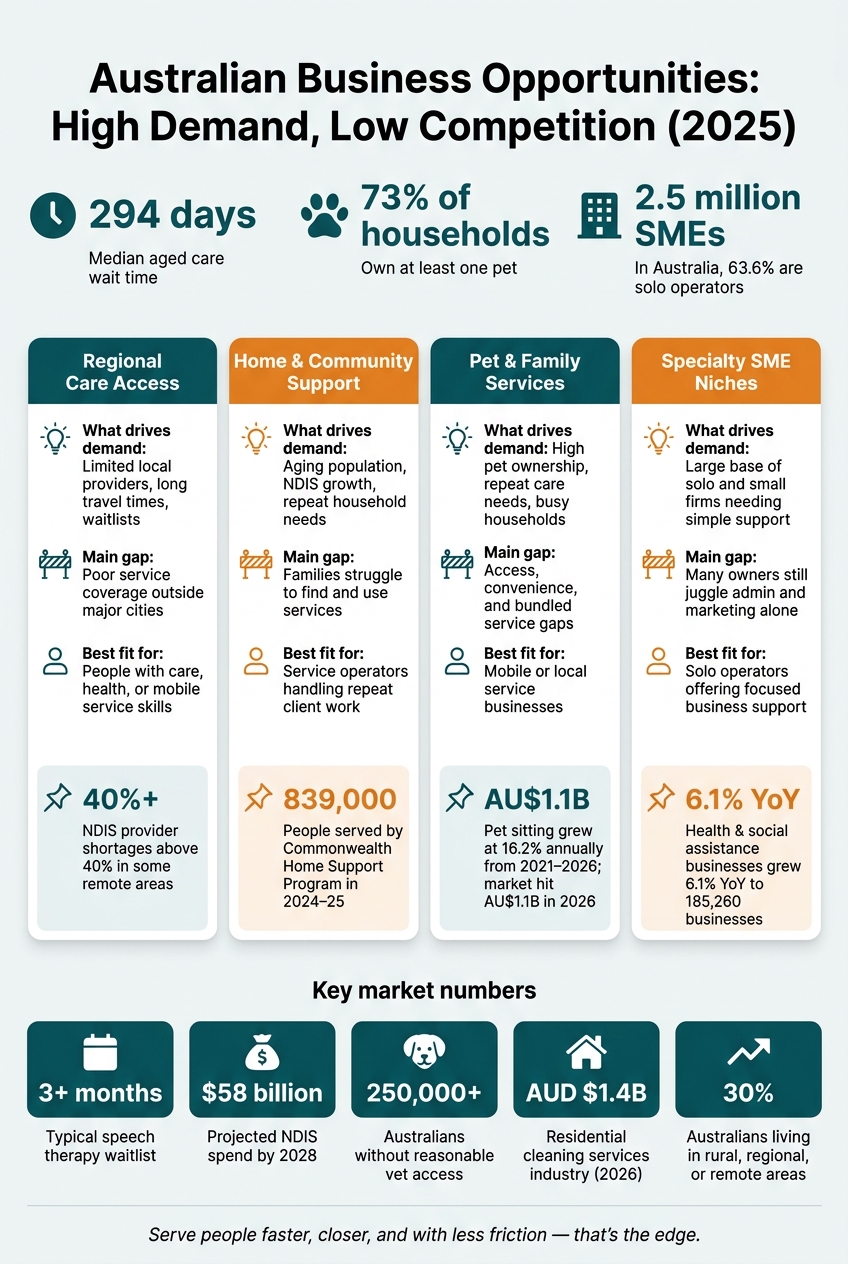
Australian Business Opportunities: High Demand, Low Competition (2025)
🇦🇺5 Small Business Ideas in Australia for 2026 | Australia New Small Business Ideas
sbb-itb-08dd11e
Quick Comparison
| Idea group | What drives demand | Main gap | Best fit for |
|---|---|---|---|
| Regional care access | Limited local providers, long travel times, waitlists | Poor service coverage outside major cities | People with care, health, or mobile service skills |
| Home and community support | Aging population, NDIS growth, repeat household needs | Families need help finding and using services | Service operators who can handle repeat client work |
| Pet and family services | High pet ownership, repeat care needs, busy households | Access, convenience, and bundled service gaps | Mobile or local service businesses |
| Specialty SME niches | Large base of solo and small firms | Many owners still juggle admin and marketing alone | Solo operators offering focused business support |
If I were sizing these up, I’d look at one thing first: where demand is already visible and local supply is still thin.
What Makes These Opportunities Attractive Right Now
These opportunities stand out for a simple reason: demand is plain to see, providers are at capacity, and many markets are still split across small players. That combination doesn’t show up every day, but Australia has a few areas where it does.
The clearest signal is the waitlist. When providers keep turning away new clients or give lead times measured in months, that usually points to a deeper supply problem. Under reporting tied to Australia's new Aged Care Act, the national median time from application to service commencement was 294 days, with jurisdiction medians sitting at about 273 to 322 days. That’s not a short-term backlog. It suggests a system under strain.
You can see the same pattern in speech therapy. More than half of surveyed practitioners said their waitlists were longer than three months, and some stretched past 12 months, with regional areas hit the hardest. In plain English, people need help and can’t get it fast enough. That’s a recurring gap, not a one-off spike.
At the same time, demographics are pushing demand higher. The number of Australians aged 65 and over is projected to more than double over the next 40 years, while the 85+ group is set to more than triple. That matters because older populations tend to need more support, more often, and across more service types.
Public funding adds another layer. The NDIS is still projected to reach about $58 billion by 2028 at current growth levels, and the Commonwealth Home Support Program served almost 840,000 people in 2024–25. So this isn’t just demand in theory. There are large, paid programs already feeding it.
But demand alone doesn’t make a market attractive. The other piece is fragmentation. In areas like home support, regional allied health, and specialty consumer niches, there often isn’t one dominant player. Instead, you get lots of small operators, uneven service, and businesses that still run mainly on word-of-mouth. That leaves room for a provider that simply does the basics well:
- Replies on time
- Delivers steady service
- Makes booking easy
That kind of operator can stand out without cutting prices just to win work.
There’s also a simple way to test whether the gap is real before you spend too much time on an idea: contact five providers in your target area and ask if they’re taking new clients. If three or more say they’re full or running a waitlist, you’re probably looking at a live opening, not wishful thinking.
The next section turns those conditions into the first opportunity cluster.
1. Regional care access
Distance turns basic care into a repeat problem in many parts of Australia. About 30% of Australians live in rural, regional, or remote areas, where access to GPs and specialists is limited. For small operators, that leaves a clear opening: show up consistently, travel when others won't, and make booking simple.
Three business ideas stand out here.
- Scheduled Allied Health Visits
Fly-in allied health services are already being used in regional Western Australia. Physiotherapists, occupational therapists, and speech pathologists visit smaller towns on a set schedule so residents don't have to travel long distances for routine care. That kind of predictability matters. When people know the visit day in advance, they can plan around it. Yet regular, easy-to-book visits are still hard to find in many towns. Remote areas also see lower GP use and more preventable hospital stays. The gap is sharp for NDIS participants too. In some remote locations, provider shortages are above 40%, which means funded participants still can't get care. You see the same issue in aged care and pet care. - Regional In-Home Aged Care Support
Older Australians in outer regional towns often have fewer local support options, and aged care service availability is lower in rural areas than in major cities. A small operator offering in-home help can meet day-to-day needs that families feel right away: mobility support, medication prompts, transport, and basic rehab. This works best in towns where larger providers don't want the travel time because margins are thin, and where family caregivers need someone dependable to step in. - Mobile Veterinary and Pet Wellness Rounds
Australia's veterinary healthcare market was about $990.6 million in 2025 and is projected to reach around $1.73 billion by 2034. That's a big market, but access is still uneven. In many regional communities, pet owners either drive long distances for routine appointments or put them off. A mobile vet that runs planned monthly rounds through groups of small towns can turn that gap into repeat business. Services might include vaccinations, parasite control, dental checks, and minor procedures.
2. Home and community support
Demand for home care is already climbing. Aged and disability care is one of Australia's fastest-growing small-business sectors, with double-digit growth across multiple states and territories in 2023–24. These ideas make sense because demand tends to repeat, and service quality can be hit or miss. Unlike regional care, the pull here comes from convenience, coordination, and repeat bookings.
Three ideas stand out in this space.
- Aged-at-home support and coordination
Domestic assistance is the most-used home support service under the Commonwealth Home Support Program. It was used by 42% of the roughly 839,000 recipients in 2024–25. Even now, many older Australians and their families have a hard time figuring out what's available, what's funded, and who to contact. A small operator can step in with non-clinical support, help with bookings, and guidance on entitlements. The Support at Home program should keep demand steady for flexible, local providers that can offer this kind of help at lower cost. The same access problem shows up in NDIS support, where clients often need help turning plans into actual services. - NDIS community navigation and support coordination
Demand for disability support workers is far ahead of supply. One parliamentary report estimated that an extra 128,000 workers would be needed by 2025 to meet NDIS service demand, with the biggest shortages in regional areas and among participants with complex needs. That leaves room for a local support coordinator, especially one serving a specific group such as young adults with autism or culturally and linguistically diverse communities. This kind of operator can build a steady client base in places where tailored local services are still thin. The work includes interpreting plans, matching clients with services, and helping participants use what they're entitled to. You see the same pattern in household services: generic providers are easy to find, but niche operators are much harder to come by. - Niche residential cleaning
Australia's residential cleaning services industry is worth about AUD 1.4 billion in 2026. But most of that market is generic and driven by price. The better opening is in niches: age-friendly cleaning for seniors living on their own, post-discharge home readiness, or home-reset services for busy households. NAB data shows only about 1 in 5 Australians cut back on home services in a recent three-month period, compared with roughly 1 in 2 cutting other spending categories. That points to home services becoming a routine expense for many households.
3. Pet and family lifestyle services
Australia’s pet market is big, but it’s still split across lots of small providers. About 73% of households own at least one pet as of 2025. Pet sitting services hit AU$1.1 billion in 2026 and grew at a 16.2% annual rate from 2021 to 2026. Even with that growth, most competition still sits in the usual places: vet clinics, pet stores, and standard grooming shops. So the opening isn’t getting more people to own pets. It’s serving pet owners better in the places, time slots, and service formats that current providers still miss.
That leaves room for three practical service ideas.
- Mobile pet wellness rounds
Set up scheduled pop-up visits for vaccinations, microchipping, parasite control, and basic checks in towns with limited vet access. More than 250,000 Australians currently don’t have reasonable access to veterinary care. A recurring route turns this into a bookable service with repeat demand, not just a one-time stop. - On-demand pet care and errands
Offer one booking system for dog walking, drop-in feeding, and simple pet-related errands. Pet sitting businesses grew 18.5% per year between 2021 and 2026, but many still stay locked into just one service type. For busy dual-income households, especially people ages 30–49, a bundled option is a much easier sell. - Family pet workshops and wellness days
Run local workshops, weekend wellness days, and kid-friendly training sessions built for families and pets together. Around 86% of pet owners say their pets have a positive impact on their lives. Most metro areas offer generic obedience classes, but far fewer run recurring family-focused sessions as paid classes or ticketed events. That’s where the gap sits. You see the same thing in smaller service niches too: demand is there, but delivery is patchy.
4. Specialty consumer and SME niches
You see the same gap in business services too. A lot of small operators need help, but they don’t want a one-size-fits-all agency. They want someone who gets their day-to-day work and can step in without a lot of fuss.
Australia has about 2.5 million SMEs, and 63.6% are solo operators. That adds up to a big market for niche, low-touch support that many generic providers miss.
A few areas stand out:
- Back-office support for solo tradies and small firms: Offer bookkeeping, invoicing, and admin help for sole traders in trades, construction, and professional services. Construction has the largest share of small businesses at 17%.
- Full-service support packages for short-stay and Airbnb hosts: Take care of turnover cleaning, restocking, and guest messaging for short-stay hosts. In many regions, hosts still piece this together with standard cleaners, which leaves room for host-focused service providers.
- Niche digital marketing for local health and allied health practitioners: Offer local SEO, content, and social media for physiotherapists, occupational therapists, and allied health clinics. Health and social assistance businesses grew 6.1% year over year to 185,260 businesses. Many small practitioners still lean on DIY marketing or generic agencies that don’t understand their field.
Before launch, check whether nearby businesses already pay for these services and which niche has the biggest gap.
How to Pressure-Test the Best-Fit Idea Before Launch
Don’t skip validation. A market can look strong on paper and still be a bad match for your local area. Before you commit, use a few simple checks to rank the four opportunity clusters above.
Start by checking whether the market is actually underserved. Look at local supply against local demand. Open Google Maps, count the providers in your target service area, and compare that with ABS data for the segment you want to serve - seniors, pet owners, or SMEs. Then look through Google reviews and local Facebook groups. If you keep seeing complaints about long wait times, poor communication, or limited hours, that’s a strong sign of unmet demand.
After that, do a basic unit economics check before you spend a dollar on branding or equipment. Estimate a realistic price range based on competitor pricing. Then model how many billable hours or jobs per week you’d need at 60–70% capacity to cover costs and earn a livable income within 12–18 months. For regional service businesses, this matters even more. Drive time and cancellations can take a real bite out of billable hours.
You’ll also want to check regulation early. Health, care, childcare, and consumer services each come with different registration, insurance, and reporting rules. Once you’ve done that, compare which idea gives you the cleanest path to launch.
A simple checklist can help you compare your shortlist side by side:
- Demand: Is local demand strong enough, and are there signs customers aren’t being served well?
- Competition: How many providers already operate in the area, and how well do they serve customers?
- Pricing: Can the market support pricing that covers costs and gets you to a livable income?
- Compliance: What registrations, insurance, and reporting rules apply, and how hard are they to handle?
Conclusion
The best openings here are practical ones, not flashy bets. These are the businesses fixing repeat problems for seniors in regional towns, families who can't count on local services, and small businesses that struggle to find skilled help nearby. That's what gives them staying power: the problem keeps coming back, so the need does too. Strong demand and thin competition sit at the center of these ideas.
Your next move is to pick the option that matches your skills and budget. Look at what you're already good at, how much money you can put in without putting yourself under pressure, how much time you can give it, and how comfortable you are with rules and day-to-day work. Some ideas are simpler to run. Others, especially in care-related fields, need more compliance and closer daily oversight. Before you go all in, validate your business ideas to check for actual customer interest.
That step matters even more in regional markets, where service gaps keep growing. Demand in these areas is climbing faster than provider capacity, which gives early entrants a clear edge.
Once you know the fit is right, go from idea to proof in one local market. Start with a single suburb or town. Then grow only after you see repeat sales and referrals. That's a steadier path to a business that lasts than chasing whatever trend looks hot right now.
FAQs
Which idea is easiest to start on a small budget?
The easiest ideas to start on a small budget are usually service-based or digital businesses. A lot of them can get off the ground for $500 to $1,000 or less.
That includes work like freelance writing, virtual assistant services, social media management, online teaching, and content repurposing.
If you want to sell physical goods, low-cost options can work too. Eco-friendly products like handcrafted soap or beeswax wraps can often start at around $300 to $500.
How can I validate demand in my local area fast?
Start by talking directly to potential customers on LinkedIn, through cold email, or inside niche community groups. Ask how they handle the problem today and what it costs them each month. That gives you a clear read on how urgent the need is.
You can also test demand with a simple version of your product or service within 90 days. For physical products, try a small pre-order run of 10 to 20 units before you scale.
What licenses or insurance might I need first?
Requirements vary by business and state, but public liability insurance is often the first thing service-based and event businesses look at.
It’s also smart to check whether your state requires certain licenses or certifications, especially for accounting, property management, or trade services. If you’re starting a hospitality or event business, look into local council rules around approvals, food safety, and any specialized insurance.
Related Blog Posts
- Best Small Business Ideas in Australia Under $30,000
- 19 Low-Cost Business Ideas in Australia With High Profit Potential
- 14 Recession-Resistant Business Ideas for Australia
- Good Business Ideas in Australia for 2026: What Demand Looks Like Now