
- Days 1–7: Confirm your idea solves a real problem. Use tools like IdeaFloat's Problem Validator and conduct customer interviews to gather insights.
- Days 8–14: Study competitors and define how your idea stands out. Identify direct, indirect, and attention competitors. Craft a clear value proposition.
- Days 15–21: Calculate market size (TAM, SAM, SOM) and plan how to acquire your first customers. Focus on platforms where your audience is active.
- Days 22–25: Build a financial model. List costs, set pricing, and forecast revenue to ensure profitability.
- Days 26–30: Prepare for launch. Finalize branding, create a landing page, and organize your business plan.
Each step ensures your idea is validated, market-ready, and financially viable. Follow this roadmap to avoid common startup pitfalls and start building a business customers want.
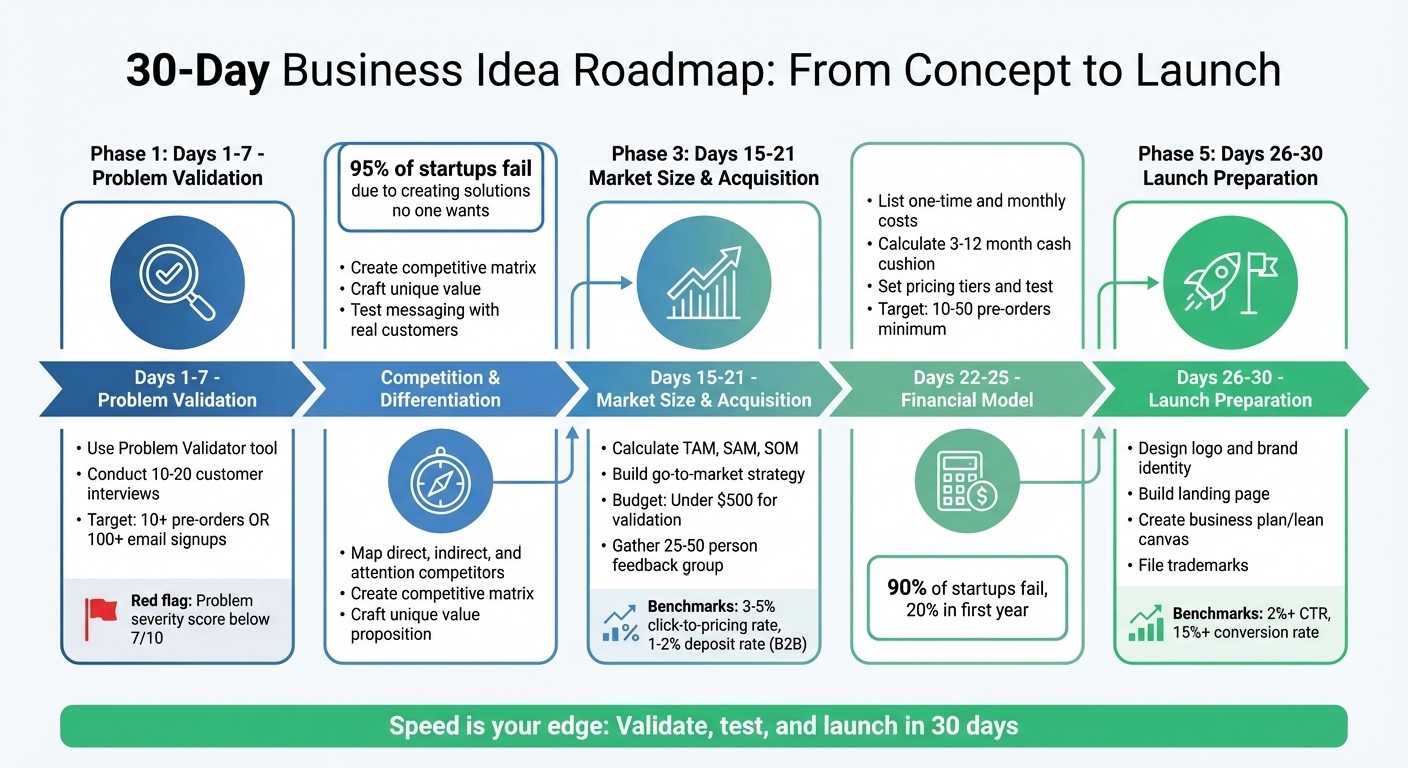
30-Day Business Idea Validation Roadmap: From Concept to Launch
Copy This Roadmap & Launch Your Startup in 2026
Days 1-7: Test If Your Idea Solves a Real Problem
The first week is all about making sure your idea addresses a problem that truly matters. Why? Because 95% of startups fail due to creating solutions no one actually wants.
"The bottom line is that you can very easily build something, but to increase your chance of creating something that is solving a real problem you need to be more rigorous in your approach".
Validate with IdeaFloat's Problem Validator
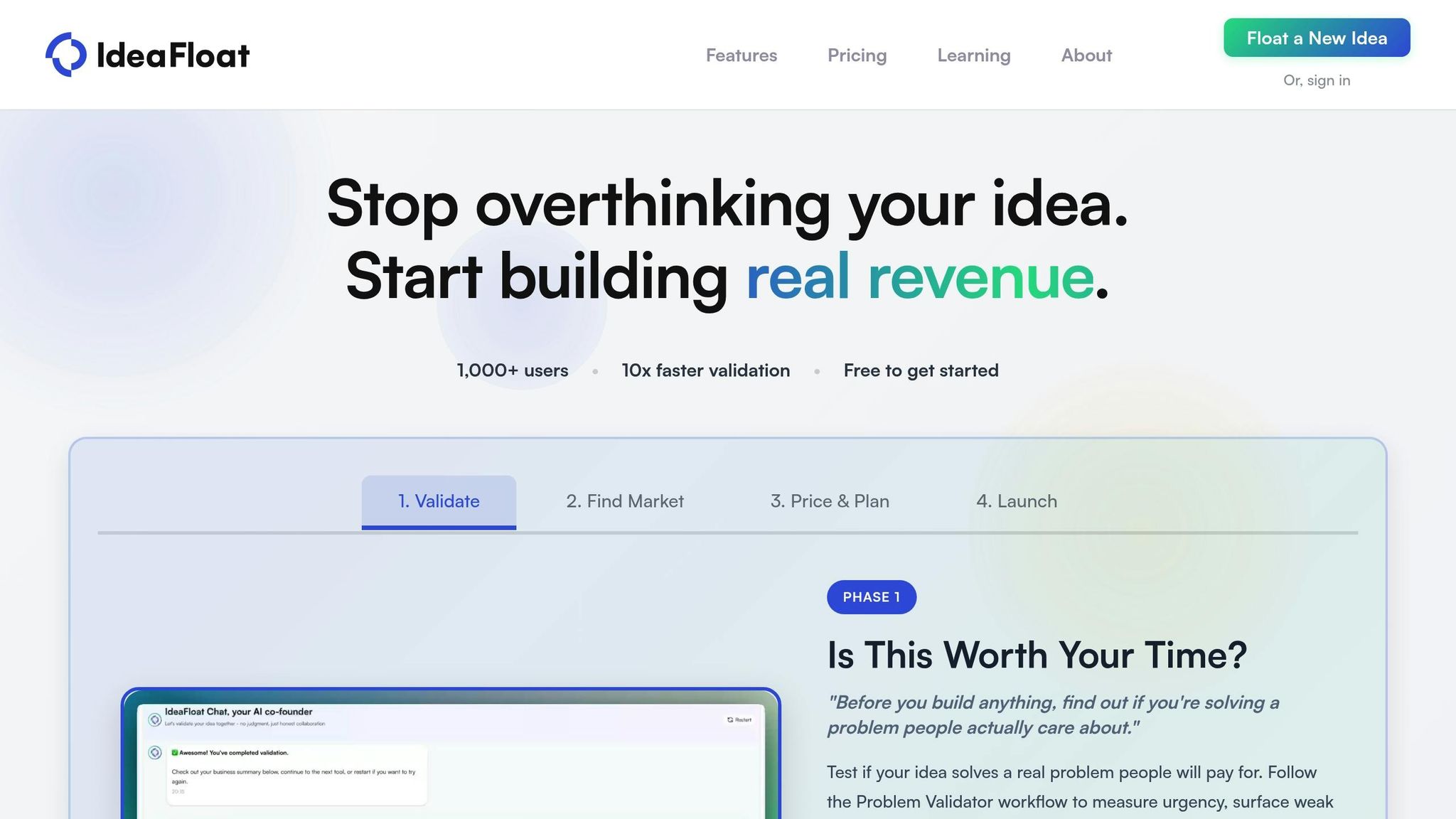
Start by using IdeaFloat's Problem Validator, a tool designed to quickly assess whether your idea tackles a problem people are willing to pay to solve. This tool offers a 15-minute, data-driven evaluation through a conversational interface, giving you actionable insights backed by live web research and verifiable citations.
The Problem Validator examines key factors like problem urgency and market demand. It doesn’t just highlight opportunities - it also flags potential challenges, helping you make informed decisions early on.
"IdeaFloat showed me real data that my problem was worth solving. Saved me months of guessing".
- Michael R., first-time founder
Pay special attention to the urgency score. If your idea scores below 7 out of 10 on problem severity, it’s a red flag that the problem might not be pressing enough to pursue.
Dive Into Customer Insights
Once you've used the Problem Validator, the next step is to gather direct feedback. Conduct 10–20 customer interviews during this week. Instead of pitching your solution, focus on describing the problem and see if it resonates with them. This approach, inspired by the "Mom Test", is all about understanding their pain points without biasing their answers.
Start with people you know - friends, family, or co-workers who fit your target audience. Then, branch out to online communities like Facebook Groups, Reddit, LinkedIn, Slack, or Discord where your potential customers are active. Use open-ended questions to encourage meaningful conversations rather than steering them toward your idea.
Take advantage of IdeaFloat's Consumer Insights feature to dig into real customer discussions online. This tool helps you uncover how people talk about the problem, verify demand, and pinpoint the language that will resonate in your marketing efforts.
Look for tangible proof of interest, like securing 10+ pre-orders or gathering 100+ email signups. By combining validated problem metrics with genuine customer insights, you'll be well-prepared to analyze competitors in the next phase.
Days 8-14: Research Your Competition and Define What Makes You Different
With your idea validated as a real solution to a real problem, it’s time to figure out who else is tackling the same issue and how you can stand out. This week is all about understanding the competitive landscape and crafting a value proposition that makes customers pick you over anyone else.
Conduct Competitor Analysis
Now that you’ve confirmed your problem is worth solving, it’s critical to map out the competition to identify where you fit in and, more importantly, how you can stand out.
Start by listing your direct competitors - these are businesses offering the same product or service to the same audience. Then, dig deeper into indirect competitors - those offering different products that address the same customer need. For example, a coffee shop and a juice bar might both compete for the same morning-routine crowd. Don’t forget about competitors of attention, which are brands that may not even be in your industry but still vie for your audience’s time on the same platforms.
Tools like IdeaFloat's Competitor Analysis can make this process much easier. This tool is designed to uncover competitors, analyze their strengths and weaknesses, and identify underserved market segments. It also helps pinpoint the unique positioning that can set your brand apart. Nick Sherwing, Founder of woohoPets, shared his experience:
"IdeaFloat saved us weeks of work by helping us explore demand for new products across different regions and took the guesswork out of finding gaps in the market".
Expand your research by diving into online resources and gathering customer feedback. Look into keyword competitiveness and monitor social media conversations relevant to your industry. One of the most valuable insights can come from asking your current or potential customers what solutions they’ve used or considered in the past.
Platforms like G2 are goldmines for understanding what customers think of existing solutions. Pay attention to recurring complaints in reviews - these gaps could be the opportunities you need to differentiate yourself. To make sense of all this data, create a competitive matrix that compares features, pricing, and perceived benefits across competitors. Alternatively, a SWOT analysis can provide a structured way to evaluate their strengths and weaknesses.
Write Your Value Proposition
With a clear picture of your competition, it’s time to define what makes your offering different - and better.
Start by identifying the "Job to be Done" - the specific outcome your customer is looking to achieve. Use their own words to describe the problem and what success looks like for them. Feedback from customer interviews is invaluable here. Avoid vague claims like being an “all-in-one” solution; instead, focus on precise, relatable messaging that resonates with your audience.
The Unique Value Proposition tool can help refine your messaging. This tool is designed to help you craft a compelling one-liner pitch, define your brand’s positioning, and create differentiation strategies. The secret? Use the exact language your customers use in reviews and interviews.
Once you’ve written your value proposition, test it with real customers. The goal is to see genuine excitement. If your messaging doesn’t spark interest, keep refining until it does. A strong value proposition is one that clearly communicates why you’re the best choice - and makes people believe it.
Days 15-21: Calculate Market Size and Plan Your Customer Acquisition
You've validated the problem and carved out a unique position for your idea. Now, it’s time to tackle two critical questions: How big is the opportunity? and How will you reach your customers?
This phase is all about crunching the numbers to gauge the market potential and crafting a clear plan to acquire your first customers.
Quantify Your Market: TAM, SAM, and SOM
Understanding your market size is essential to determine if your idea has enough potential to pursue. Michael Grinich, Founder of WorkOS, puts it this way:
"Build your startup in the biggest possible market because you can't change it later. It's like building a house: location can't change. You can tear down the structure and rebuild it, but you can't change where it is."
To quantify your market, calculate these three metrics:
- Total Addressable Market (TAM): The total universe of potential users.
- Serviceable Available Market (SAM): The portion of the market you can realistically target.
- Serviceable Obtainable Market (SOM): The slice of the market you can capture in your first year - this is your immediate focus.
Tools like IdeaFloat’s Smart Market Sizing tool simplify this process by using real-time, verified data. As Soba, the founder of a bar, Pilates, and yoga studio, shared:
"IdeaFloat replaced months of research and Excel modeling with real-time data insights."
Next, test your atomic unit - the smallest version of your value proposition. For instance, this could be a single search query or one book order. Early success benchmarks include a 3% to 5% click-to-pricing rate on qualified traffic and a 1% to 2% deposit or Letter of Intent rate for B2B offers.
Create Your Go-to-Market Strategy
Once you’ve sized up your market, the next step is to identify where and how to find your first customers.
Focus on the platforms and spaces where your target audience already spends time. For B2B ideas, this might mean LinkedIn or niche Slack communities. Consumer product audiences might be active on Reddit forums or Facebook groups.
IdeaFloat’s Go-to-Market Strategy tool can help streamline this process. It offers a personalized customer acquisition playbook, estimating costs, mapping out launch steps, and even providing outreach scripts. Its Community Launch Map identifies where your audience is most active and drafts tailored posts for each platform.
Keep your initial validation budget lean - under $500. This ensures you prioritize learning over spending. Start with hands-on outreach: connect with your personal network, former colleagues, and online groups to gather a feedback group of 25-50 people. A simple landing page with clear pricing can help test whether people will actually pay, rather than just expressing interest.
As Gagan Biyani, Co-founder and CEO of Maven, wisely says:
"You're nothing until you have customers who want your product."
To accelerate your learning, run short 7-14 day validation cycles. Each week, set up a small experiment, measure the results, and tweak your approach. These quick iterations will help you refine your SOM and customer acquisition strategy before committing significant resources.
sbb-itb-08dd11e
Days 22-25: Build Your Financial Model
You've assessed your market, but now comes the big question: Can your idea actually make money?
As Gagan Biyani, Co-founder and CEO of Maven, wisely states:
"Building is secondary to delivering value to your target market... You're nothing until you have customers who want your product."
No matter how great your idea seems, if the numbers don't work, the business won't either. This phase is all about creating a realistic financial roadmap - figuring out your costs, pricing, and whether your idea can generate a profit.
Calculate Your Costs
Start by listing every expense you can think of. Break them into two categories: one-time startup costs (like permits, logo design, or equipment) and ongoing monthly expenses (such as rent, software subscriptions, or utilities). Dig into the details - calculate per-unit costs and estimate realistic sales volumes to validate your assumptions. Use an "atomic unit" test to ensure your cost projections make sense.
Separate your costs into fixed expenses (like insurance or administrative salaries) and variable expenses (like raw materials or shipping). Don’t forget about hidden costs, such as business registration fees, acquiring a Tax ID, and securing necessary insurances.
Once you’ve mapped out your costs, calculate a cash cushion to keep your business afloat until it breaks even. Multiply your total monthly expenses by the number of months you expect it’ll take to reach profitability - typically between 3 and 12 months.
With this structure in place, you’re ready to tackle pricing and revenue forecasting.
Set Your Pricing and Forecast Revenue
Now that you know your costs, it’s time to figure out your pricing. The goal? Cover expenses and make a profit. Keep in mind that pricing is often an experiment - you’ll need to test and refine based on customer feedback.
Start by asking potential customers how much they’ve spent solving the problem your product addresses. What solutions or workarounds are they currently using? This approach, often referred to as "Mom Test 2.0", helps identify whether people are genuinely willing to pay. If they haven’t already invested in a solution, they might hesitate to spend on yours.
Consider running a pre-sale campaign to test your pricing and gauge interest. For B2B ideas, you can secure non-binding Letters of Intent (LOIs) from companies, indicating their willingness to purchase a specific number of licenses if certain features are delivered. Experiment with pricing tiers - like $29/month, $79/month, or custom plans - and track customer behavior. For instance, if many people lean toward the custom option or ask for more details, it may signal that your product is undervalued or your value proposition needs tweaking.
To make this process easier, tools like IdeaFloat’s Advanced Pricing Research can help you analyze market trends and craft effective pricing strategies. Their Financial Model tool also tracks every dollar in and out, giving you a clear picture of whether your business can turn a profit.
Finally, establish "kill criteria" before moving forward. Decide on a minimum threshold - such as 10 to 50 pre-orders - to justify continuing. If you don’t meet this target, it might be time to pause or pivot to avoid wasting resources. Keep in mind, around 90% of startups fail, with over 20% shutting down in their first year. Often, the key to survival is ensuring your unit economics are solid - your customer lifetime value must outweigh development and customer acquisition costs.
Days 26-30: Get Ready to Launch
You've validated your idea and confirmed its potential to make money. Now, it's time to build trust and establish credibility. In 2026, first impressions matter more than ever - an unpolished design can make you look amateur, while a professional appearance builds confidence in your brand. These last five days are all about creating a strong brand presence and preparing the tools you need to win over customers and stakeholders. Let’s start with your brand identity.
Design Your Logo and Brand Identity
Your brand is more than just a logo - it’s the personality and message your business conveys. Start by clarifying your brand’s purpose, researching your competitors, and understanding your target audience. Next, develop a distinct brand voice that instantly connects with people.
Remember those customer interviews you conducted earlier? Use the exact words your audience used to describe their problems in your messaging. This approach helps your communication feel authentic and relatable. As Mojca Zove from KickoffLabs says:
"The more thought you put into your branding now, the less work that will be later, or at least the easier it will be to optimize".
If you’re not a designer, tools like IdeaFloat's Logo Generator can help you create professional logos and a complete set of brand guidelines. Once you’ve finalized your brand visuals, consider protecting them legally. Filing for trademarks on your brand name, logo, and tagline ensures your hard work isn’t copied by competitors. It’s a crucial step in establishing ownership.
Build Your Landing Page and Launch Checklist
With your brand identity locked in, it’s time to create a landing page that drives action. A great landing page starts with a benefit-driven headline and a clear call-to-action (CTA) - whether that’s signing up for an email list, pre-ordering a product, or requesting a demo. Keep it simple: place key information and trust signals above the fold, use concise copy, and highlight benefits with bullet points.
Aim for these benchmarks:
- Click-through rate: 2% or higher
- Conversion rate: Over 15% from cold traffic
If you’re looking for a quick solution, IdeaFloat's Waitlist Landing Page tool can help you design a polished page with persuasive copy. It’s perfect for capturing emails and building excitement before your official launch. Pair it with their Launch Checklist to stay organized. This checklist guides you through tasks like finalizing your branding and engaging with online communities, ensuring nothing gets overlooked.
Create Your Business Plan and Lean Canvas
Now that your idea is validated and your finances are clear, it’s time to organize your strategy for launch. Whether you’re pitching to investors or simply mapping out your goals, a solid business plan is essential.
Here’s a breakdown of two approaches:
Traditional Business Plan (20–40 pages, ideal for bank loans or partnerships):
- Executive summary (write this last, 1–2 pages)
- Market analysis
- Financial projections
- Funding request
Lean Canvas (a one-page summary, great for early-stage planning):
- Key partnerships
- Value proposition
- Customer segments
- Revenue streams
- Cost structure
With IdeaFloat’s Business Plan Generator, you can create a polished, investor-ready document complete with visuals and financials in formats like PDF, Word, or PowerPoint. For a more streamlined option, their Lean Canvas tool pulls data directly from your workspace, making it easy to share with mentors or stakeholders. You can even export a complete Branding Guide to ensure your messaging and visuals stay consistent across all platforms.
Conclusion
You now have a step-by-step 30-day roadmap to turn your business idea from a rough concept into a launch-ready venture. Each phase of this plan has been designed to prepare you for success. From validating your problem to developing a financial model and building your brand identity, you've ensured your idea addresses a real need. You've also studied your competition, calculated market potential, and set the stage for a strong launch. As Ryan Robinson aptly says:
"When it comes to validating a business idea, fast and simple is the name of the game".
Given the high failure rates for new ventures, having a tested plan isn't just helpful - it's essential. But now, you're no longer relying on guesswork. Every step has brought you closer to generating real revenue, not just creating another business plan that gathers dust.
Speed is your edge. Instead of getting stuck in endless planning, you've validated your idea, pinpointed your audience, and laid down a solid foundation - all within 30 days. Tools like IdeaFloat have streamlined this process, providing live market data, AI-driven insights, and no-nonsense guidance to help you navigate both opportunities and challenges. Now, it’s time to act: launch your landing page, connect with your audience, and start building the momentum that leads to revenue.
To leave you with one more piece of advice, Gagan Biyani, Co-founder and CEO of Maven, reminds us:
"Building is secondary to delivering value to your target market. You're nothing until you have customers who want your product".
Your validation is complete. The numbers add up. The groundwork is firmly in place - now, it’s time to bring your vision to life and turn it into a thriving business.
FAQs
How do I know if my business idea solves a real problem?
To figure out if your business idea tackles a real problem, start by zeroing in on your target audience. Have direct conversations with potential customers to understand their challenges and see if your solution aligns with their needs. Market research plays a crucial role here - it helps confirm if there's actual demand for your idea.
Another approach is to test your concept with small, low-risk experiments. For example, you could create a simple prototype or offer pre-orders to measure interest. Using AI-powered tools can also give you an edge by analyzing market trends, customer feedback, and competitor activity. By focusing on customer insights and testing your assumptions early, you’ll get a clearer picture of your idea’s potential.
What should a startup include in its financial plan?
A strong financial plan is essential for any startup and should address a few key areas: revenue projections, cost estimates, and a breakeven analysis. Start by detailing your expected income sources, categorizing your expenses into fixed and variable costs, and determining the point at which your business will begin to generate a profit.
You’ll also want to include your funding needs and a realistic timeline for reaching profitability. This will clarify how much capital is required to launch and maintain your operations. Beyond serving as a roadmap for your decisions, a well-prepared financial plan showcases the viability of your business idea to potential investors or lenders.
How can I estimate the market size for my business idea?
To figure out the market size for your business idea, start by zeroing in on your target audience and defining your Total Addressable Market (TAM). This means identifying who your potential customers are and estimating how many individuals or businesses fall into that category.
Once you've done that, collect relevant data such as population figures, industry statistics, or customer demographics. Then, calculate your market's revenue potential by multiplying the estimated number of customers by an average revenue metric - like the average purchase value or annual revenue per customer.
The goal here is to get a practical understanding of your market's potential. This insight can help you refine your business idea or prepare a solid pitch for potential investors.
Related Blog Posts
 Report an issue
Get the newest tips and tricks of starting your business!