Starting a small business in Australia can be affordable and profitable, even with a budget under $5,000. The key is to focus on building repeat customers and offering services or products that meet ongoing needs. Here’s a quick summary of some of the best opportunities in 2026:
- Service-Based Businesses: Virtual assistants, subscription home maintenance, and social media management.
- E-Commerce & Subscription Models: Eco-friendly household products, pet wellness boxes, and SPF-focused skincare.
- Personalized Products: Vintage fashion, custom grooming items, and home décor using print-on-demand.
- Education & Skill Development: AI workshops, kids' STEM coaching, and tutoring services.
Australia’s growing online shopping market, regional migration trends, and government support make this the perfect time to start lean and grow quickly. By prioritizing customer loyalty, you can create steady revenue streams without heavy upfront costs.
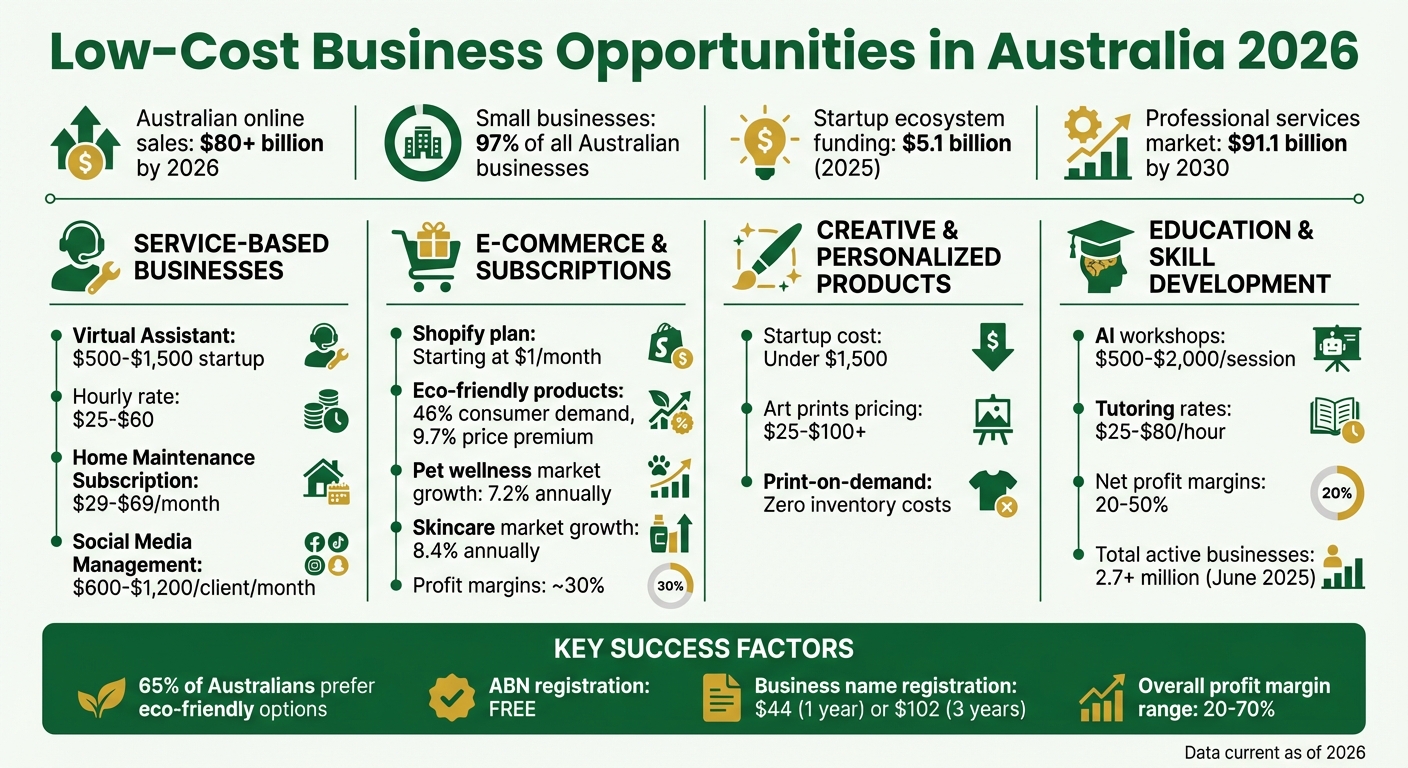
Low-Cost Business Opportunities in Australia 2026: Startup Costs and Profit Margins
10 Simple Businesses You Can Start for Under $100 in Australia
sbb-itb-08dd11e
Why Low-Cost Businesses Thrive in Australia
As of 2026, starting a lean business in Australia can cost as little as $500. For example, launching a virtual assistant service requires minimal investment. Several factors contribute to the growing success of these low-cost ventures compared to more traditional business models.
One major advantage is the ability to avoid fixed overheads. Entrepreneurs can skip long-term leases and heavy debts by working from home, using mobile setups, or operating entirely online. Modern AI tools have also transformed operations, allowing solo entrepreneurs to handle tasks that previously required three to five employees. This efficiency enables services like virtual assistance to charge competitive rates of $25–$60 per hour while managing multiple clients simultaneously.
Another factor is the strong local consumer loyalty that supports small businesses. Small enterprises account for 97% of all Australian businesses and employ nearly 5 million people. Australians have a deep-rooted preference for supporting local providers, which fuels word-of-mouth referrals and repeat business. Businesses that offer personalized and environmentally friendly services benefit even more, as 65% of Australians report favoring eco-friendly options over conventional alternatives.
The shift toward regional migration also creates fresh opportunities. As more Australians move away from major cities like Sydney and Melbourne, the demand for services in regional areas grows. This trend reduces competition and opens doors for niche businesses. For instance, mobile car detailing services charging $50–$250 per visit can now establish loyal customer bases in these less saturated markets.
Government policies further reduce the risks of starting a business. Registering an Australian Business Number (ABN) is free, and business name registration costs just $44 for one year or $102 for three years through ASIC. Federal and state governments also provide grants and incentives for sectors like fintech, renewable energy, and healthcare. In 2025, the Australian startup ecosystem raised $5.1 billion, highlighting strong institutional support for new ventures. Platforms like Airtasker offer free customer acquisition tools, eliminating the need for costly marketing campaigns. Together, these resources create an environment where low-cost business models can flourish.
These factors - low overheads, consumer loyalty, regional opportunities, and government support - set the stage for the innovative business ideas outlined in the next section.
1. Service-Based Businesses
Service-based businesses are flourishing in Australia, partly because they usually require minimal equipment and can often be operated remotely. Even better, many of these ventures can be started for under $1,500, making them an attractive option for aspiring entrepreneurs. The professional services market itself is expected to grow significantly, reaching $91.1 billion by 2030.
Virtual Assistant for Tradies is a perfect example of a niche service that fills a real need. Tradespeople often find themselves bogged down by administrative tasks like quoting, scheduling, and invoicing. A virtual assistant offers a cost-effective solution, providing ongoing monthly support without the expense of hiring full-time staff. With the help of digital tools, a single virtual assistant can handle tasks that would typically require multiple employees, freeing up tradies to focus on their core work.
Subscription Home Maintenance operates on a "Home Care Club" model, where customers pay a monthly fee - typically between $29 and $69 - for routine services like checking smoke alarms, replacing air filters, and handling seasonal repairs. This model not only ensures steady, recurring revenue but also builds strong customer loyalty. The demand for such services is particularly high among aging homeowners, especially in regional areas.
Local Social Media Management is another promising avenue. Small businesses often need help creating regular online content, and this service can be offered on a monthly retainer, which usually ranges from $600 to $1,200 per client. With the global social media management market projected to surpass $124 billion by 2032, the potential here is enormous. Plus, this business model is incredibly lean - requiring little more than a smartphone and basic design software - while the need for fresh content ensures repeat business.
Next, let’s dive into e-commerce and subscription-based models, which also thrive on low startup costs and the appeal of recurring revenue streams.
2. E-Commerce and Subscription Models
E-commerce in Australia is on a roll, with online sales expected to surpass $80 billion by 2026. It’s a space where minimal upfront investment - like a laptop, internet access, and an affordable Shopify plan (starting at just $1 per month) - can lead to long-term customer loyalty. Many entrepreneurs are finding success by combining cost-effective strategies like dropshipping or print-on-demand with products that naturally encourage repeat purchases. Let’s look at a few examples of how this approach translates into steady revenue streams.
Eco-Friendly Household Subscriptions tap into a growing consumer trend. Nearly half (46%) of Australian shoppers are actively seeking sustainable products and are even willing to pay about 9.7% more for them. This segment, growing at an annual rate of 9.8% through 2030, presents a golden opportunity for subscription services. Imagine monthly deliveries of bamboo toothbrushes, compostable sponges, or refillable cleaning concentrates. As Andrew Feld, Founder of Fresh Patch, advises:
Try and find something that is necessary and needs to be replenished.
These recurring deliveries not only meet the demand for sustainability but also create predictable monthly revenue without requiring you to manage a warehouse.
Pet Wellness Boxes are another exciting avenue. With over two-thirds of Australian households owning at least one pet, the pet care market is booming, growing at a 7.2% annual rate. This growth is driven by "pet humanization", where owners treat their pets like family. A subscription box featuring organic treats, dental chews, or seasonal toys could be a hit. Dropshipping apps like DSers or Spocket make it easy to fulfill orders without holding inventory. In fact, recurring subscribers in this niche often account for over 80% of total sales, making it a reliable source of consistent income.
SPF-Focused Skincare Subscriptions are a natural fit for Australia’s sunny climate and the "skinimalism" trend, which emphasizes fewer but higher-quality skincare products. The beauty and skincare market, projected to grow at 8.4% annually through 2026, offers plenty of room for innovation. Using print-on-demand platforms like Printful or Gelato, you can create branded packaging without stockpiling products. As Justina Blakeney, Founder of NiaWigs, points out:
Customers are becoming more interested in natural and organic products as a result of increased consumer awareness of their lifestyle choices.
Monthly deliveries of reef-safe sunscreen, vitamin C serums, or hydrating mists not only cater to this demand but also maintain profit margins around 30%.
These examples show how e-commerce entrepreneurs in Australia can build thriving businesses by focusing on products that naturally encourage repeat purchases while keeping costs low.
3. Creative and Personalized Products
Expanding on affordable services and e-commerce models, businesses that offer personalized and creative products are thriving. These ventures not only attract attention but also build customer loyalty, ensuring consistent revenue streams.
In Australia, the creative economy is growing rapidly, with personalized products carving out a profitable niche. Many entrepreneurs in this space start with budgets under $1,500, focusing on niche markets where customers prioritize individuality over mass production. As Karan Chugh, a tech consultant, insightfully notes:
"Selling to everyone is a fast way to sell to no one. Niche stores win because they fix real problems for specific people."
Here are some standout niches where personalized offerings encourage repeat business:
Curated Vintage Fashion is booming, driven by younger Australians' interest in sustainability. Instead of buying bulk inventory, you can begin by sourcing unique, high-quality second-hand items from thrift stores or estate sales. These can then be sold online through platforms like Depop or a Shopify store. The upcycling trend is expected to grow significantly in 2026. By offering carefully selected pieces, you create a loyal customer base eager to return for fresh finds.
Bespoke Men's Grooming Products cater to a growing demand for personalized grooming solutions. Products like custom-blended beard oils with distinct scents or chemical-free skincare tailored to individual needs are gaining traction. This business model is ideal for starting small, allowing you to test and refine your products with minimal upfront investment.
Hannah Perry, the owner of Floof Cotton Candy, shares how e-commerce platforms have elevated her handmade business:
"Shopify really just made my business feel more professional, and it saves me a lot of time in communicating with customers."
Custom Home Décor and Art Prints present another accessible opportunity. Leveraging print-on-demand services, you can sell framed prints ranging from $25 to $100+. Designs that highlight Australian culture, local landmarks, or niche interests resonate with buyers. This model is particularly appealing because production costs are incurred only after a sale, reducing financial risk. Plus, satisfied customers are likely to return for additional custom pieces, further strengthening loyalty.
4. Education and Skill Development
Teaching specialized skills offers one of the most dependable ways to secure repeat customers. Parents often commit to weekly sessions for their kids, while business owners sign up for ongoing training programs. This makes education-based businesses appealing for entrepreneurs looking for steady, recurring income with minimal upfront costs.
Take AI Training Workshops for Small Business Owners, for example. As of June 2025, Australia had over 2.7 million actively trading businesses, and the demand for practical AI education is growing fast. Small business owners need help integrating tools like ChatGPT, Midjourney, and CRM AI plugins into their daily operations. Offering these workshops could earn you between $500 and $2,000 per session, covering tasks like automating administrative workflows, handling customer inquiries, and streamlining accounting. Plus, as new AI tools emerge, clients often return for more training.
The startup costs for running such workshops are low - typically under $1,500 - since you can conduct sessions online or at client offices, relying mainly on your expertise. According to The Business Times:
Solopreneurs can now manage the workload of 3–5 staff
This means you can serve multiple clients without needing to hire additional help.
Beyond AI, there’s a growing market for other education services. Kids' STEM, Coding, and Robotics Coaching is booming as parents seek to equip their children with skills that schools don’t always cover. Weekly sessions during school terms provide a reliable income stream. Similarly, subject-specific tutoring - whether for languages, music, or academic subjects - commands hourly rates of $25 to $80, with many clients booking regular sessions over long periods.
With net profit margins ranging from 20% to 50%, education-based businesses rank among the most profitable low-cost ventures. Start by reaching out to your existing network and using social media to find your first clients. Once you’ve established a client base, you can repurpose your teaching materials into digital products, like online courses or workbooks, to create additional passive income.
Conclusion
Australia's small business scene in 2026 is brimming with opportunities for entrepreneurs who are ready to start small and think smart. Whether it's a service-based business or an innovative e-commerce model, the strategies outlined earlier highlight the importance of lean startups that focus on building customer loyalty while keeping costs low.
The growing emphasis on what experts call "sovereign resilience" has Australian consumers and businesses gravitating toward local solutions, streamlined operations, and personalized service. Whether you're grooming pets on the go, managing social media for local shops, or offering virtual assistance to tradespeople, success hinges on aligning your skills with unmet market needs. As Steve Jobs once said:
To me, ideas are worth nothing unless executed. They are just a multiplier. Execution is worth millions.
Testing your idea as a side hustle before committing full-time can help you avoid common cash flow challenges. Tap into your personal network to secure those first clients, use AI tools to boost your efficiency, and focus on building lasting relationships rather than chasing one-off sales. Businesses that consistently solve real problems with quality solutions tend to thrive in the Australian market.
With the nation's digital economy expanding and a strong preference for local providers, there's room for both tech-savvy entrepreneurs and traditional service businesses to flourish. Profit margins in these ventures can range anywhere from 20% to 70%, but the key ingredient is always the same: delivering value that keeps customers coming back.
The businesses shaping Australia's future aren't necessarily the ones with the deepest pockets - they're the ones that start small, stay connected to their communities, and grow quickly. Choose an idea that matches your strengths, test it with your network, and use trusted AI tools to build momentum. Your next loyal customer might just be a conversation away.
FAQs
Which idea fits my skills best?
To discover the right business idea that matches your skills, start by evaluating your strengths, experience, and interests. For instance, if you excel in digital marketing, offering social media management services could be a great fit. Are you highly organized? You might thrive as a virtual assistant, helping small businesses stay on track. If you're passionate about health and wellness, launching a fitness or Pilates studio could be the way to go. The key is to pick something that plays to your abilities while meeting a need in the market.
How do I validate demand fast in Australia?
To test demand in Australia efficiently, leverage AI-powered market research tools to determine if your idea addresses a problem that people are willing to pay to solve. Use problem validation workflows to measure both the urgency of the issue and potential customer interest. Additionally, dive into your target market by analyzing demographics (age, location, income, etc.) and psychographics (values, interests, lifestyle) to better understand your audience and identify the best ways to connect with them. These strategies streamline the process of evaluating market interest.
How do I build repeat customers quickly?
To build a base of repeat customers quickly, focus on earning loyalty and consistently providing value. One effective way to do this is by introducing a loyalty program, which can incentivize customers to return. Beyond that, prioritize outstanding customer service, offer personalized experiences, and ensure your products or services meet high-quality standards every time. These strategies are particularly useful for small businesses looking to stand out and create lasting relationships in competitive markets.
Related Blog Posts
 Report an issue
Get the newest tips and tricks of starting your business!