
Starting a business doesn’t have to cost a fortune or involve intense competition. Here’s the key takeaway: focus on niches that larger companies ignore - services that are small-scale, specific, or require a personal touch. Low-cost ideas (under $1,000–$5,000) can thrive in areas like hyperlocal services, digital solutions, specialized consulting, or AI-powered tools. But remember, low competition works only if there’s real demand.
Key Business Ideas:
- Hyperlocal Services: Simple, trust-based services like senior tech help, pet waste removal, or home organization resets.
- Digital Services: Remote options such as DMCA takedown agencies, automation maintenance, or tech concierge for seniors.
- Specialized Niches: Serve focused markets with roles like senior downsizing consultants, digital nomad visa assistance, or grant writing services.
- AI-Powered Tools: Affordable solutions like AI voice receptionists for local businesses.
Pro Tip: Test demand before committing. Tools like IdeaFloat can help validate your idea using live data. Start small, focus on recurring revenue, and grow strategically.
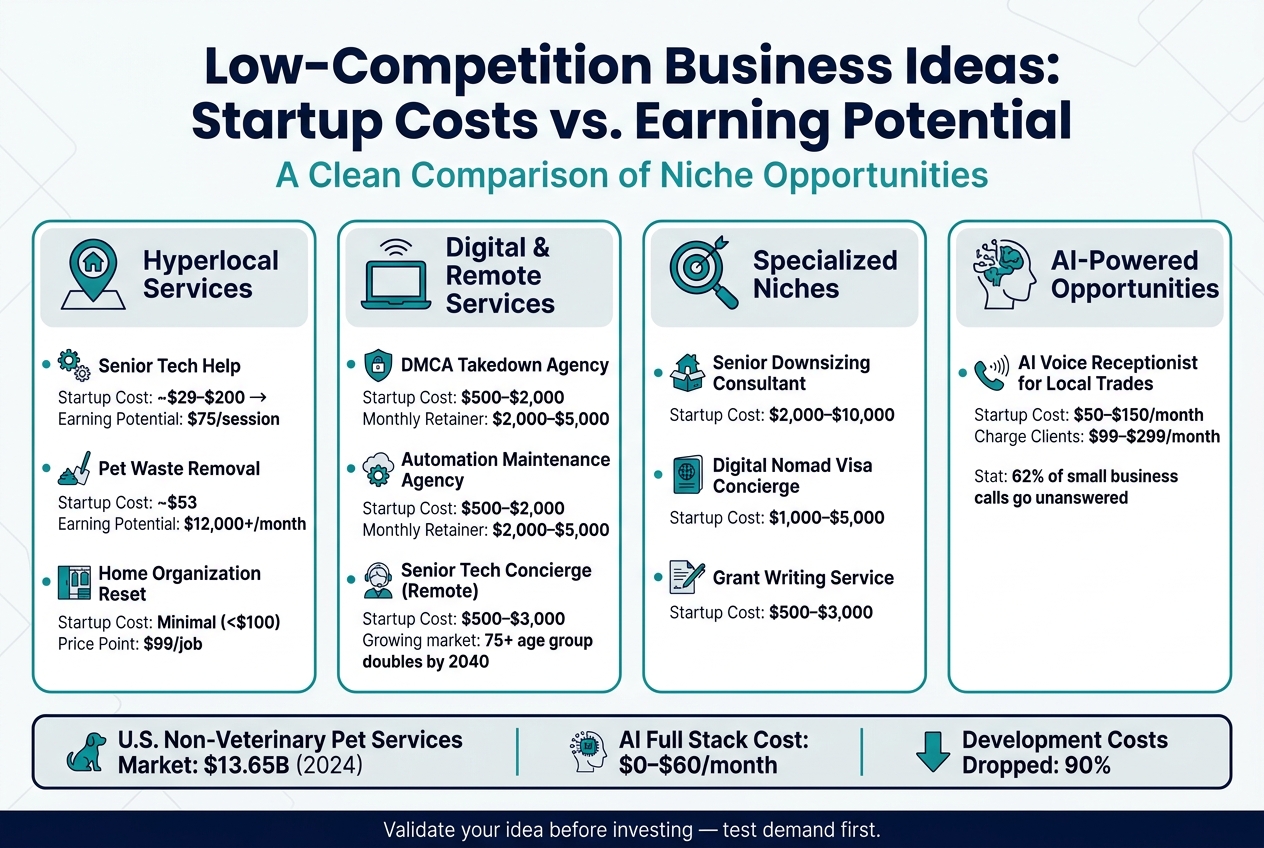
Low-Competition Business Ideas: Startup Costs vs. Earning Potential
9 Service Businesses You Can Start Under $1,000 (No Experience Needed)
sbb-itb-08dd11e
1. Hyperlocal Services
Hyperlocal services thrive on local trust and personal interaction - areas often overlooked by larger companies. The nature of these services keeps competition low, while clustering jobs within a small area helps maximize earnings. Here are three practical business ideas that tap into this growing demand.
- Senior Tech Help
Every day, about 10,000 Americans turn 65, and many of them own smartphones, tablets, or laptops that can be tricky to navigate confidently. You could offer a fixed-rate session, such as a $75, 90-minute phone and tablet setup or cleanup. Keeping the offer specific - like "90-minute phone and tablet cleanup for seniors" - makes it easier for customers to understand the service. To find clients, connect with senior centers, local libraries, and neighborhood groups like Nextdoor.
- Pet Waste Removal
This might not sound glamorous, but that’s precisely why competition is limited. A basic startup kit costs about $53, and with efficient neighborhood routes, operators can earn over $12,000 per month. Weekly recurring visits ensure steady income, and satisfied clients rarely switch providers. With U.S. spending on non-veterinary pet services reaching $13.65 billion in 2024, the demand is clearly there.
- Home Organization Reset
Target a specific service - like a $99 kitchen or closet reset - to keep marketing and delivery simple. This service is ideal for busy families or recent movers and requires minimal supplies, many of which you may already have at home.
"A $200 launch will not cover every license, insurance policy, or vehicle expense. It can cover a lean first version of a service, especially when early customers come through referrals." - Grover Nichols, Financial Writer
Before diving in, validate your idea locally. Post a short description of your service in community groups to gauge interest. That kind of direct feedback can often be more valuable than formal market research. For a structured approach, consider taking entrepreneurship courses to refine your business model.
2. Digital and Remote Services
Digital and remote services open up opportunities that are both scalable and cost-effective, with minimal overhead. Unlike traditional businesses, these services don’t require inventory or a physical storefront, and you can often get started for less than $200. Below are three niche ideas that stand out due to their low competition and focus on often-overlooked needs.
- DMCA Takedown Agency: Content creators - like indie filmmakers, course developers, and subscription platforms - frequently lose income to piracy. Yet, few services specialize in removing stolen content from search engines and social platforms. Narrowing the focus to DMCA protection specifically for indie filmmakers can help establish credibility quickly. Monthly retainers in this field typically range from $2,000 to $5,000, while startup costs are relatively low, between $500 and $2,000.
- Automation Maintenance Agency: Many businesses rely on tools like Zapier, Make, or n8n to keep their workflows running smoothly. However, when APIs update or software changes, these automations often break. Rather than creating new workflows, this service targets the ongoing need to monitor and repair existing ones - an area that’s often neglected. Monthly retainers generally fall in the $2,000 to $5,000 range.
- Senior Tech Concierge (Remote): This service caters to adult children who want to help their aging parents navigate technology. It involves tasks like setting up devices, managing passwords, and protecting against scams. With the 75+ age group expected to nearly double by 2040 and 87% of seniors expressing a desire to maintain independence, there’s a growing demand for remote tech support tailored to seniors. Startup costs typically range from $500 to $3,000.
"The bigger and shinier the opportunity, the faster it gets crowded. Real low competition lives somewhere far less glamorous." - Abdullah, founder of Cristioa
Before diving into any of these ideas, it’s wise to schedule 5–10 discovery calls with potential clients. This helps confirm that the problem you’re addressing is both real and urgent.
Just like hyperlocal strategies, these digital models prove that low startup costs and untapped niches exist in the online space as well.
3. Specialized Niches
Specialized niches present a chance to tap into focused, underserved markets with minimal competition. These niches often fly under the radar - too small for big companies to notice or too specific for generalists to tackle. As Maitreya Kulkarni, Founder of StartupIdeasDB, explains:
"The right niche is specific enough that you can write copy that feels personal, large enough to support a real business, and underserved enough that you can win attention cheaply."
Below are a few examples of specialized niches that combine low competition with strong demand.
- Senior Downsizing Consultant: With a growing senior population, there’s an increasing need for personalized downsizing services. Many moving companies focus on logistics but don’t provide the hands-on support families require during this emotional process. Starting this type of business typically costs between $2,000 and Starting this type of business typically costs between $2,000 and $10,0000,000.
- Digital Nomad Visa Concierge: Remote work has given rise to a group of travelers eager to live abroad, but navigating visa requirements can be overwhelming. Offering services like research, paperwork assistance, and application management meets a pressing need in this niche. Startup costs usually range from $1,000 to $5,000.
- Grant Writing Service: Small nonprofits, arts organizations, and startups often need grant funding but lack the expertise to craft compelling applications. The complexity of grant writing deters many generalists, leaving room for specialists to thrive. Launching this business can cost between $500 and $3,000.
What ties these ideas together? They demand trust, niche knowledge, and patience. These qualities allow entrepreneurs to establish credibility and build lasting reputations in their fields.
4. AI-Powered Opportunities
AI has slashed the costs of launching software startups, with full AI stacks now available for as little as $0 to $60 per month, and development expenses dropping by 90%. This dramatic shift creates exciting possibilities for founders without technical expertise.
This AI-driven landscape builds on the low-cost, niche strategies discussed earlier, offering opportunities to create automated, results-focused services.
- AI Voice Receptionist for Local Trades: Many local businesses - like plumbers, dentists, and salons - struggle with missed customer calls. In fact, about 62% of calls to small local businesses go unanswered. This presents a clear opportunity to step in with AI-powered call-answering services. Using existing voice AI tools, you can set up this service and charge clients a monthly fee of $99–$299. With startup costs ranging from just $50 to $150 per month for software subscriptions, it’s a cost-effective venture.
To get started, target local businesses that frequently miss calls. Offer a free 20-minute consultation to showcase how your service can improve their customer interactions and convert these leads into paying clients. As Abdullah, Founder of Cristioa, wisely noted:
"The fastest, safest AI business is selling a result, not software." - Abdullah, Founder, Cristioa
Conclusion
The business ideas discussed here all share a few key traits: they require minimal startup costs, address real consumer needs, and offer potential for growth. Take hyperlocal services like senior tech help, for instance. You can launch such a business with as little as $29, proving that you don’t need a hefty budget or an earth-shattering concept to get started.
What truly sets successful entrepreneurs apart is their knack for picking an idea that matches their skills and fits the needs of their local market. From there, they focus on quickly testing the idea before making substantial investments. As Grover Nichols, a Financial Writer, wisely said:
"The goal is not to look large on day 1. The goal is to sell a clear result, serve a specific customer, collect payment quickly, and use early revenue to improve the business."
Before diving into any business idea, it’s essential to confirm that there’s genuine market demand. An empty market doesn’t always mean untapped potential - it might just mean there’s no demand. Use tools like IdeaFloat to validate your concept. This means ensuring your idea solves a real problem people are willing to pay for, analyzing the market size with actual data, and outlining a clear plan to secure your first customers. This step can save you months of wasted effort.
Once you’ve validated your idea, start small and focus on building steady, recurring revenue. Turn one-off jobs into monthly contracts, and organize your work geographically to save time and increase efficiency. Scaling from $3,000 to $30,000 a month isn’t just about working harder - it’s about working smarter. Pick a business idea that aligns with your skills and resources, and build from there.
FAQs
How can I confirm there’s real demand in my area before starting?
If you want to validate demand for your idea, start by connecting with your potential audience. Spend about a week engaging in online spaces like forums or subreddits where your target customers hang out. This helps you understand their needs and gauge interest.
Next, take it a step further by reaching out directly to at least 10 potential customers. Try pre-selling your product or service to see if they’re willing to commit. If you’re working on a physical product, consider running a small pre-order campaign - 10 to 20 units is a good starting point.
Another effective method is creating a landing page. Use it to highlight your product or service and track how many people take action. A conversion rate above 5% is a strong indicator that you’re on the right track.
Lastly, don’t overlook your competition. If similar businesses already exist, it’s a good sign that there’s demand in the market. Competitors can validate that your idea has potential.
What’s the fastest way to get my first paying customers?
The fastest way to land your first paying customers is by focusing on direct outreach. Begin with your personal network - reach out to friends, family, and potential clients with tailored messages about your business. If you're running a service-based business, consider offering your first job at a reduced rate or even for free to gather testimonials. Afterward, share your results on platforms like Nextdoor or Facebook groups. You can also collaborate with professionals who can connect you with your target audience.
How can I turn one-time jobs into monthly recurring income?
To transform one-time jobs into steady, recurring income, consider offering subscription-based service packages. Begin by providing an outstanding initial service - something like a deep clean for a home or a well-done lawn mowing. This helps establish trust and sets the tone for ongoing collaboration.
From there, suggest discounted rates for clients willing to commit to regular schedules, whether that's weekly, biweekly, or monthly. You can also create bundles by combining related services, which adds extra value for your clients. Finally, focus on maintaining top-notch quality and clear, professional communication to keep clients satisfied and engaged over the long haul.
Related Blog Posts
- 27 Low-Competition Business Ideas With High Margins (2025)
- The Cheapest Businesses to Start in Australia That Still Have Margin
- 19 Low-Cost Business Ideas in Australia With High Profit Potential
- 21 Australian Business Ideas That Work Even in a Slow Economy