Australia’s outer suburbs are booming with opportunities for small businesses that address local needs. With rapid population growth and changing demographics, these areas are seeing increased demand for services that cater to busy families, young professionals, and growing communities. Here’s a quick summary of business ideas that thrive in these suburbs:
- Home Services: Gardening, solar panel cleaning, and mobile property maintenance.
- Pet Care: Mobile vet services, canine rehabilitation, and pet nutrition products.
- Food & Hospitality: Night-time pop-ups, food trucks, and destination dining.
- Transport Solutions: On-demand shuttle services for underserved areas.
These businesses succeed by focusing on convenience, affordability, and building community trust. Outer suburbs present a chance to start small and grow steadily by addressing real, local challenges.
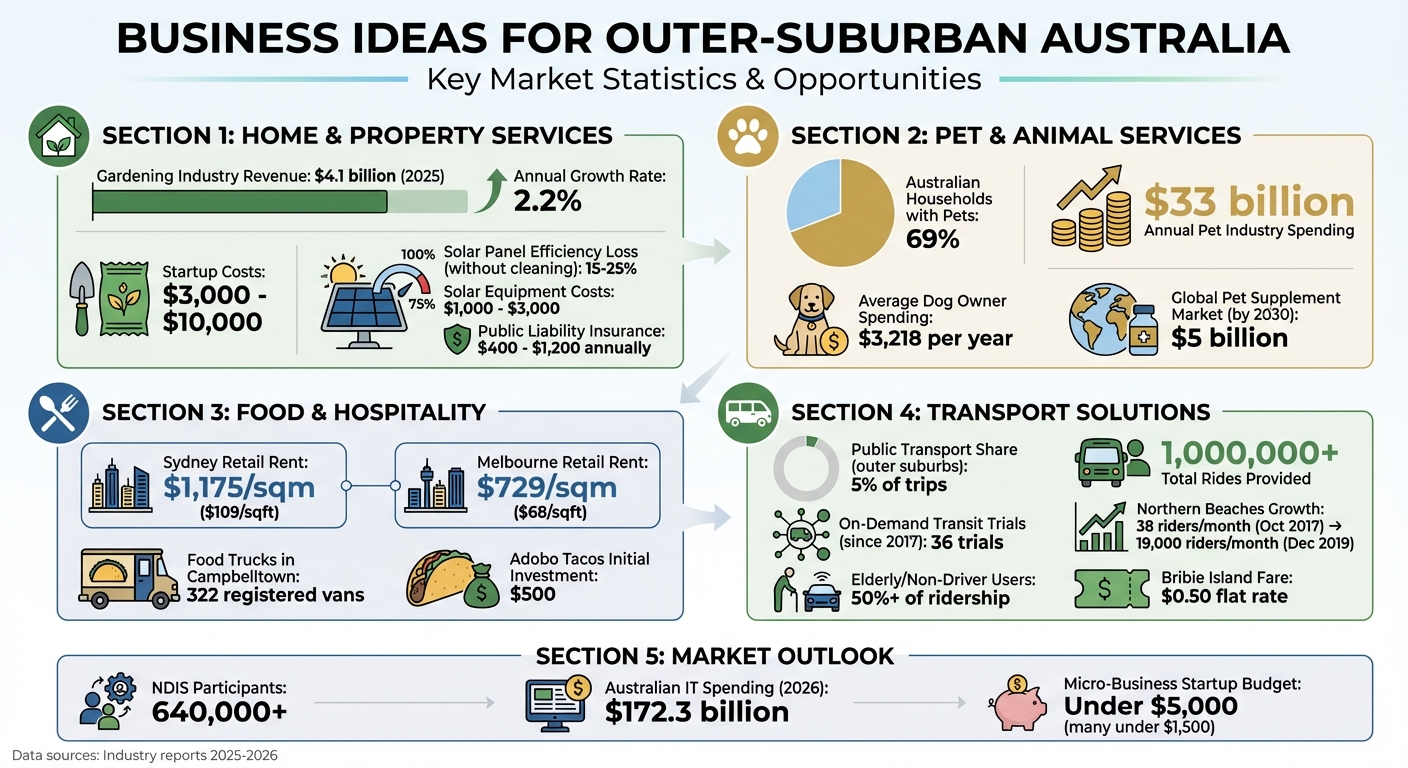
Business Opportunities in Outer-Suburban Australia: Key Statistics and Market Data
1. Home and Property Services
Life in outer suburbs often comes with its own set of challenges - longer commutes, growing families, and aging homes. These factors drive a steady demand for dependable home services. For instance, the gardening services industry alone generated $4.1 billion in 2025, growing at an annual rate of 2.2% over the previous five years. Starting a business in this area is relatively affordable, with initial costs for equipment like mowers, trimmers, and trailers typically ranging from $3,000 to $10,000. Three key service areas have emerged as particularly in-demand: gardening, solar panel care, and mobile property services.
Gardening and Lawn Maintenance
Lawn care remains a staple service for suburban homeowners, especially as busy schedules leave little time for yard upkeep. Services like bi-weekly mowing, hedge trimming, and seasonal clean-ups are always in demand. Getting started requires basic tools, which usually cost between $3,000 and $5,000. Securing recurring contracts can help maintain a steady income stream. To reach potential clients, traditional marketing methods like local Facebook groups and letterbox flyers often work better than digital ads in these areas. Additionally, public liability insurance - costing about $400 to $1,200 annually - is essential, as many property managers and commercial clients require it before hiring contractors.
Solar Panel Maintenance and Cleaning
With more suburban homes adopting renewable energy, solar panel maintenance has become a growing niche. Dust and debris can reduce a panel's efficiency by 15–25%, so regular cleaning and system checks are crucial, especially in sunny regions. Getting started in this field is relatively low-cost, with equipment and safety gear typically priced between $1,000 and $3,000. Partnering with solar installation companies for referrals and offering quarterly maintenance packages can help establish a reliable client base.
Mobile Property Services
Mobile property services are gaining traction in outer suburbs, where distance from centralized service providers can be a hassle. Services like mobile car detailing, pressure washing, and minor home repairs offer convenience by coming directly to customers. This "we-come-to-you" approach is particularly appealing to suburban residents. Setting up a Google Business Profile not only helps track local search traffic but also encourages reviews, which can significantly improve visibility and trust within the community.
sbb-itb-08dd11e
2. Pet and Animal Services
Did you know that nearly 69% of Australian households own a pet? Australians collectively spend about $33 billion each year on their furry friends, with dog owners shelling out an average of $3,218 annually. This growing investment, coupled with a shift toward preventative care, highlights the demand for specialized pet services - especially in outer-suburban areas.
Mobile Veterinary and End-of-Life Care
For many pet owners, especially seniors, getting to a vet clinic can be a real challenge. That’s where mobile veterinary services step in, offering in-home care like vaccinations, health checks, and even end-of-life services. Dr. Isabel Ling, a veterinarian who runs a mobile practice, underscores the importance of this approach: "Being able to say goodbye to your pet in the comfort of your own home... that's probably the biggest part of the business". This model not only eases the stress of travel for pets but also provides a more compassionate and personal experience for their owners during difficult times.
Canine Rehabilitation and Preventative Care
In outer-suburban and regional areas, canine rehabilitation services are often hard to find. Recognizing this, Dr. Isabel Ling took action in 2025 by opening the Rehabilitation, Education and Animal Care Hub (REACH) in Port Macquarie, NSW. It’s the only facility of its kind on the Mid North Coast, offering treatments like laser therapy, massage, and small group movement classes. These services help manage chronic mobility issues and prevent injuries in dogs. Matt Kopke, CEO of Veterinary Nutrition Group, explains the growing interest in preventative care: "What's probably contributing to the growth in the global pet supplement market size is the shift in mindset towards a preventative, rather than reactive approach to the health of our furry friends"[12].
Specialized Pet Nutrition and Supplements
The pet nutrition market is thriving, with local entrepreneurs finding creative ways to meet demand. For example, Melissa Slabskyj from Paruna, SA, created "Puppy Tucker", a pet food topper made from dehydrated, human-grade meats like chicken, kangaroo, lamb, and beef, blended with prebiotics. With support from a business incubator, she successfully launched her product online and in local stores.
Similarly, Mick Andersen of Good Country Hemp in Bordertown has tapped into the pet supplement market by repurposing hemp seed by-products. Andersen highlights the profitability of this niche: "When we take the exact same oil [as for human consumption] and put it in the same size bottle for the pet market, the market commands more in terms of price". With the global pet food supplement market expected to hit $5 billion by 2030, this sector offers exciting opportunities for growth.
3. Food and Hospitality
Food and hospitality businesses in outer-suburban Australia are finding ways to thrive by taking advantage of lower costs and creative service approaches tailored to local communities.
One of the biggest advantages for food businesses in these areas is the significantly lower rent. For example, by June 2025, neighborhood retail rents in Sydney hit $1,175 per square meter (about $109 per square foot), while Melbourne’s reached $729 per square meter (around $68 per square foot). These reduced costs allow businesses to focus more on delivering high-quality food, hiring skilled staff, and creating enjoyable dining experiences - all while keeping customers closer to home.
Night‑Time Pop‑Ups in Existing Cafes
One clever way to cut costs is by sharing spaces. For instance, in late 2024, Luis Arana and Andrea Tenorio launched Adobo Tacos inside Luxe Cafe in Rosebery. They operated just three nights a week (Thursday through Saturday) with an initial investment of $500. By subletting the cafe’s kitchen and sharing its liquor license and utilities, they avoided the heavy financial burden of a full-time lease. As Arana put it:
"If we had to rent a shop, we'd have to open seven days a week just to cover our costs... Now, I have a life, time for my kids, and because our expenses are low, we can charge less."
This approach paid off quickly, with the business becoming profitable in its first week.
Beyond pop-ups, mobile food options are another way to connect with customers in outer suburbs.
Mobile Food Trucks on Main Roads
Campbelltown, located about 37 miles southwest of Sydney’s CBD, has become a hotspot for food trucks, with 322 registered vans as of November 2025. These trucks thrive on main roads, offering convenient access, ample parking, and reliable power. A standout example is SomSom Candy, owned by Sohee Park and Charlie Shin. They turned their part-time fairy floss business - featuring designs inspired by native Australian animals like koalas and kangaroos - into a full-time operation, popular with families and social media users. Matt Levinson from the Committee for Sydney described the trend:
"Street food culture in other cities is so centered on the walking environment... When we look at Sydney, there's this really amazing food culture that is spiking up on main roads."
While food trucks keep things mobile, destination dining offers a more rooted approach to serving local communities.
Destination Dining in Underserved Suburbs
More high-end restaurants are moving into outer suburbs, catering to locals who now prefer dining closer to home. During the 2020–2021 lockdowns, Buono Italian opened in Parkdale, taking advantage of rents that were about one-third of city prices. This allowed owner Cinzia Buono to hire more kitchen staff, keep wine prices affordable, and build strong community ties. Similarly, Teddy Picker in Werribee created a pizza spot complete with a large deck overlooking the Werribee River. This setup contributed to a growing local "food hub", offering urban-style dining without the need for a long commute.
4. Convenience and Mobility
Outer-suburban communities often face unique challenges when it comes to transportation. Traditional public transit systems, like fixed-route buses, struggle to operate efficiently in low-density areas, making them financially unviable. As a result, public transport only accounts for about 5% of suburban trips. This leaves many residents without reliable travel options, creating a significant transportation gap.
On-demand transit services are stepping in to address this issue. Unlike traditional buses, these services rely on flexible routing determined by app or phone bookings. Since 2017, Australia has seen 36 on-demand transport trials, collectively providing over 1,000,000 rides. These services have proven especially beneficial for elderly residents and those without drivers’ licenses - groups that make up over 50% of users in some suburban trials. This shift highlights how tailored transit solutions can meet the specific needs of suburban communities.
On-Demand Shuttle Services for Transport Deserts
A great example of this approach is the on-demand transport trial launched by Caboolture Bus Lines in March 2026 on Bribie Island, Queensland. With a median age of 64 in the community, the service offers $0.50 flat-fare trips every day of the week. Riders can book through an app or by phone, ensuring accessibility for elderly residents who may not use smartphones.
When done right, these models can grow rapidly. For instance, the Northern Beaches on-demand service expanded from just 38 riders per month in October 2017 to over 19,000 by December 2019. Starting such services typically involves smaller fleets, like 13-seater vans or minibuses, which help keep costs low and maintain flexibility in sparsely populated areas. Many operators begin with government-funded trials or contracts with local councils, providing a solid foundation for scaling these much-needed services.
Conclusion
The business ideas discussed above highlight how outer-suburban communities have distinct and evolving needs that present exciting opportunities for entrepreneurs.
Outer-suburban Australia is poised for what some call a "golden era" for micro-businesses in 2026. This shift is fueled by regional migration, an aging population, and the growing accessibility of AI tools that allow solo entrepreneurs to compete with larger companies. The key to success here isn’t about copying big-city business models - it’s about understanding your community’s specific needs and delivering solutions that are local, affordable, and convenient.
Local businesses thrive when they address real, everyday challenges. Whether it’s home maintenance, pet care, or on-demand transport, proximity and personalized service can give small businesses a real edge over larger competitors.
If you’re starting out, consider testing your idea on a small scale first. This could mean setting up a stall at a weekend market or making discovery calls to gauge interest. Many promising businesses in 2026 can be launched with a modest budget - some for under $5,000, and others for as little as $1,500.
In outer-suburban areas, success often hinges on relationships rather than just foot traffic. Build trust by engaging with community networks, participating in local events, and leveraging word-of-mouth marketing. With over 640,000 NDIS participants driving demand for local support services and Australian IT spending projected to surpass AUD 172.3 billion in 2026, the potential is immense for businesses that align with genuine local needs.
The takeaway is simple: thriving outer-suburban businesses start small, focus on their local community, and grow steadily. By addressing local challenges with smart, lean solutions, entrepreneurs can carve out a path to success in outer-suburban Australia.
FAQs
How do I validate demand in my specific suburb?
To figure out if there's demand in your suburb, start by identifying invisible demand - those products or services that people want but can't easily access nearby. A good clue? Notice if residents regularly drive 30 minutes or more to get certain goods or services. Engage with your community directly - talk to people, ask questions, and listen to their needs. You can also check local online groups, community boards, and feedback from residents to uncover potential market gaps.
What business can I start with under $5,000?
Launching a virtual assistant service for tradespeople or small retailers is a smart way to start a business with relatively low investment. With startup costs typically under $5,000 and minimal ongoing expenses, it’s an accessible option for entrepreneurs looking to enter the market without breaking the bank.
What permits or insurance do I need to operate locally?
To run a business locally in Australia, you'll need to sort out both permits and insurance to stay compliant.
Permits and Licenses: The permits and licenses you need vary based on your business type, what you do, and where you're located. It's important to check the specific requirements for your situation.
Insurance: Certain types of insurance are mandatory. For example, if you have employees, you'll need Workers Compensation Insurance. Skipping required coverage could lead to fines or even legal trouble. To ensure you're covered, consult an industry association or a business adviser who can guide you on the specifics.
Related Blog Posts
 Report an issue
Get the newest tips and tricks of starting your business!