
If you want your money back fast in 2026, service businesses still lead. In this list, the shortest payback periods usually come from AI service agencies, niche B2B consulting, and local service businesses because they can bill customers within weeks. By contrast, digital products and micro SaaS often need more time upfront before sales stack up.
Here’s the article in plain English: the best business model is usually the one that matches your budget, your skill set, and how soon you need cash flow. A founder who starts with $1,000 to $5,000 can often get into service work faster, while micro SaaS usually needs about $8,000 to $12,000 before payback. In one example, an AI agency with $1,500 in startup costs and two $2,000/month clients could earn back its startup spend in 1 to 2 months.
What I’d take from this:
- Fastest to recover startup costs: AI service agencies and local service businesses
- Lowest startup cost: B2B consulting and some digital products
- Best for repeat monthly revenue: Micro SaaS and consulting retainers
- Best for scale after launch: Digital products and micro SaaS
- Big rule across all five: Pre-sell before you build
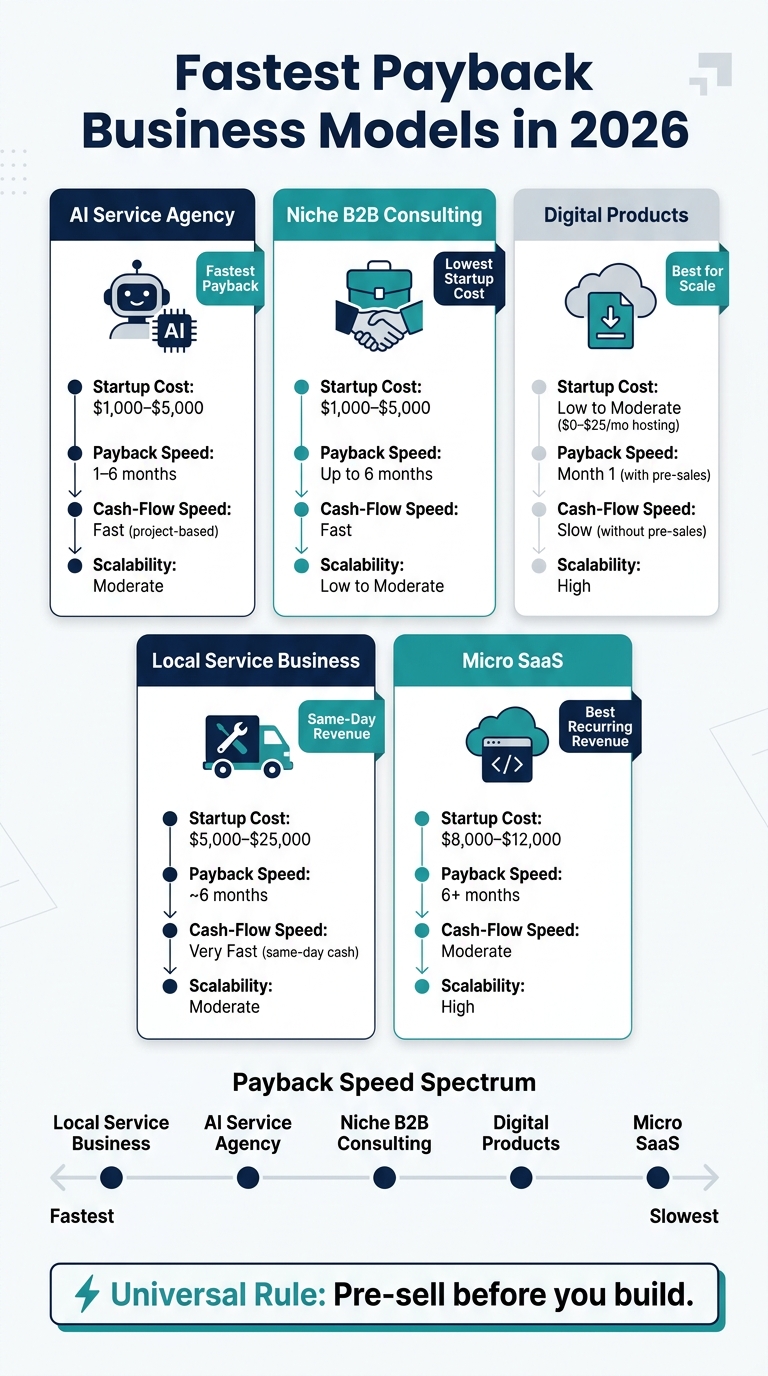
Fastest Payback Business Models in 2026: Side-by-Side Comparison
Start These Businesses to Make Money in 2026
sbb-itb-08dd11e
Quick Comparison
| Business Model | Startup Cost | Usual Payback Speed | Main Upside | Main Risk |
|---|---|---|---|---|
| AI Service Agency | $1,000–$5,000 | 1–6 months | Fast path to first invoice | Bigger software tools may copy the feature |
| Niche B2B Consulting | $1,000–$5,000 | Up to 6 months | Low overhead, high margins | Long sales cycle |
| Digital Products | Low to moderate | Can be month 1 with pre-sales | Sell the same product many times | Weak demand if you build too soon |
| Local Service Business | $5,000–$25,000 | Often around 6 months | Cash can come in the same day as a job | Seasonality, local rules, labor load |
| Micro SaaS | $8,000–$12,000 | Often 6+ months | Subscription income and low cost per extra user | Slower start and crowded niches |
The core tradeoff is simple: the faster a business can invoice, the faster it can pay back startup costs. If you need cash flow soon, service models tend to make more sense. If you can wait longer for payback, product models may give you more room to grow later.
That’s the lens I’d use before picking any of these five.
1. AI Service Agencies
An AI service agency uses AI tools to deliver one clear service to one clear type of client. That could mean workflow automation, compliance document generation, or another narrow business task. For solo founders, the first version can often go live in 4 to 12 weeks with low upfront tech costs.
If you pick the right niche, revenue can start in month one, and breakeven can happen within six months. The sweet spot is simple: go after a market where people are already paying for a slower, messier fix. Think spreadsheets, manual contractors, or old software that drags everything down.
One strong example is compliance document generation for general contractors. An agency can turn plain-language job descriptions into pre-filled permit applications or safety checklists. That works because the pain is real, it shows up again and again, and it’s tied to regulatory requirements.
The main danger is building a generic AI extra that a bigger platform can fold into its main product fast. If that happens, your revenue can disappear before you hit breakeven. That’s why the rule here is so important: sell a narrow, painful business outcome, not a broad AI feature. That same idea carries into the next model.
Technical skill helps, but validation and sales matter more. The play is to pre-sell to 5 to 10 buyers who are already paying for a manual workaround, then build only what they need. That validation-first approach is what separates fast payback from AI products that are dead on arrival.
2. Niche B2B Consulting Firms
Niche B2B consulting can be cheap to start because founders are selling expertise, not inventory or software. If you already know the space well, your main costs are usually a basic website and the tools you need to do the work. That low overhead matters most when you can land the first client fast.
Revenue usually comes from fixed-fee projects, retainers, or audits. This model can pay back faster than a product business because you can bill right away, keep costs low, and hold strong margins. Some startup models aim to hit breakeven within 6 months of launch and produce a net profit by the end of the first year. The fastest path tends to come from niches where the problem is urgent and keeps coming back.
Cybersecurity, compliance, RevOps, and AI workflow consulting are good examples. These services often sell faster when buyers are under regulatory pressure or staring at hard deadlines. That kind of urgency can compress the sales cycle and speed up the first invoice. But there’s a catch: it only works if the sales process itself stays short.
The main risk is a slow sales cycle. In plain English, if it takes too long to reach the right buyer, payback drags out. A tight niche helps because it makes it easier to spot, qualify, and reach the right person before the first call.
3. Digital Product Businesses
Compared with consulting, digital products usually take longer to validate. But once people want what you're selling, they scale in a much cleaner way. That’s the big draw here: you build once, then sell the same thing again and again. When demand is there, the payback window can be unusually short.
Digital products include things like toolkits, courses, and paid resources. Hosting, database, and payment tools can run as little as $0 to $25 per month. A solo founder can ship an MVP in 4 to 12 weeks with AI coding assistants and off-the-shelf APIs. And a priced landing page shared in niche communities like Reddit or LinkedIn can bring in pre-sales, which may move payback into month one. In some cases, a trade-skill course can sell for around $199, while a toolkit or template can sell for a one-time fee.
The main risk is pretty simple: building before you know people want it. A polished product won’t help much if the market shrugs. The better test is to solve a problem people already pay to fix badly. That might mean they’re stuck using spreadsheets or dealing with a clunky legacy tool. If you can find 5 to 10 people already paying for that kind of manual workaround, you have a much better demand signal.
Weak demand and weak differentiation usually miss payback targets. So the rule here is blunt but useful: pre-sell first, build second.
If you want the fastest path from sale to cash, and you don’t want to build a product first, the next model is local service businesses.
4. Local Service Businesses
Mobile local services can earn back startup costs fast because they start lean and bring in cash as soon as a job is booked. That’s the big difference from software: a booked job can turn into money the same day.
Take mobile auto detailing. A basic setup usually runs $4,050 to $11,800. That often includes a pressure washer, vacuum, water tank, generator, consumables, insurance, and simple marketing. A solo operator charging $150 to $300 per detail can often hit breakeven in about six months and move into net profit by year one.
Margins can look strong at the solo stage. Operators often keep 60% to 80% gross margins. Bring on an employee, though, and that can drop to 15% to 35%. That’s why premium add-ons matter so much. Ceramic coating, for example, can sell for $800 to $1,500, while material costs may be only $100 to $150.
Once you know the math works, the next bottleneck is getting found locally. A practical target is 50 Google reviews in year one to help with local search visibility and organic leads. Simple rule: ask every customer for a review right after the job, when the result is still right in front of them.
Two things can slow down cash recovery:
- Seasonality: Winter demand can fall 30% to 50% in cold-weather states, and businesses that start without a clear plan often fail by year two.
- Regulation: Rules around water discharge and chemical disposal change by area, and fines can eat up early profits fast.
Check both before launch.
If you want recurring revenue instead of one-off jobs, the next model trades labor for software.
5. Micro SaaS Products
Micro SaaS is a small software product built for one narrow niche. Think of a reporting dashboard for Shopify sellers. Startup costs usually land around $8,000 to $12,000, with most of that going toward the build, hosting, and launch.
The tradeoff is pretty simple. A service business can often send invoices within weeks. Micro SaaS usually has to wait until the product is live before money starts coming in. But once subscriptions begin, it can scale much faster because the cost of serving each extra customer stays low. So the payback period is often slower at the start, then much faster after product-market fit.
The subscription math is what makes this model so appealing. At $20 per user and $5 in variable costs, each subscriber adds $15 in contribution margin. If monthly fixed costs are $1,000, the business hits break-even at 67 subscribers.
For a new micro SaaS, a sensible target is to reach break-even within 6 months, get to net profit by the end of year one, and reach a 10% profit margin by year two. For small, solo-led SaaS products, profit margins often sit between 10% and 50%. A lot of that gap comes down to pricing discipline, which shapes how fast the founder earns back startup costs, not just the margin later on.
Pros and Cons of Each Business Model
The table below brings the five models into one simple view: how fast they can turn into cash, how far they can grow, and who they tend to suit best. If you want the shortest comparison, start there. Then match each row to how much hands-on work you're willing to do.
| Business Type | Main Advantages | Main Drawbacks | Cash-Flow Speed | Scalability |
|---|---|---|---|---|
| AI Service Agencies | Addresses urgent, repetitive work | Vulnerable to platform shifts and native-feature competition | Fast (project-based) | Moderate |
| Niche B2B Consulting | High margins; low overhead; strong demand in regulated niches | Hard to scale beyond your own hours; heavy sales effort | Fast | Low to Moderate |
| Digital Products | Build once; low delivery cost | Requires upfront time to build authority and content | Slow | High |
| Local Service Businesses | Steady demand for essential services | Labor-intensive; harder to manage as you grow | Very Fast | Moderate |
| Micro SaaS Products | Low variable cost after launch | Requires technical skill; crowded in generic niches | Moderate | High |
A simple way to think about it:
- Local service businesses fit people who are strong in operations
- Niche B2B consulting fits people with deep subject-matter expertise
- Micro SaaS products fit people who can build with code
- Digital products fit people who can turn repeatable know-how into something packaged and easy to sell
Digital products make the most sense for experts who can package what they know into templates, courses, or toolkits. The upside is strong scale. The downside is slower cash recovery, which can test your patience early on.
There’s a clear pattern here. Models that pay back fast often come with a lower ceiling. Models with more room to grow usually take longer before the money comes back. So the better pick isn’t the one that sounds best on paper. It’s the one that lines up with your cash needs, your skills, and how much slow build-up you can handle.
Conclusion
In 2026, the fastest payback tends to come from models that are simple to sell, cheap to start, and built around urgent problems. Across these five options, services usually pay back first, and software comes later. Why? Because you can sell the value to your first customer without waiting for scale, a big audience, or platform effects to kick in.
The bigger issue isn’t just picking a model. It’s finding a problem that people are already paying to solve badly.
That’s why validation matters more than the model on its own. Before you launch, check demand, pricing, and validate your business idea. If there’s no existing spend in the market, none of these five models are likely to pay back fast. The best fit is the one that lines up with your cash, your skills, and how fast you can get to market.
IdeaFloat can help with financial modeling and breakeven analysis before you put money in. Run each model through a forecast before you commit.
Forecast first. Launch second.
FAQs
Which business model fits my budget best?
Your ideal business model depends on two things: how much money you can put in up front and how fast you need to start bringing money back in.
Here’s the simple version:
- $100–$500: Rank and Rent
- $1,500–$5,000: service businesses like window cleaning, digital marketing, or health and wellness coaching
- $10,000–$25,000: a coffee cart
A break-even analysis helps you make that call based on your budget. It shows how long it may take to earn back what you spend, which matters a lot if cash is tight or you need income soon.
How do I validate demand before launching?
Focus on specific, urgent pain points instead of broad service offers. That makes the problem feel immediate, and it gives people something concrete to react to.
Reach out to at least 30 potential customers on LinkedIn, through cold email, or inside niche online communities. Ask how they deal with the problem today and what it costs them in time, money, or lost output.
You can also test demand by asking what they already spend on workarounds, such as manual spreadsheets or pricey contractors. If people are already paying to patch the issue, that’s a strong signal. It also helps to use data-based tools like the IdeaFloat Problem Validator to check whether the problem has enough demand behind it.
What usually slows down payback the most?
The biggest factor is high upfront costs. Think equipment, a physical location, or heavy product development work. Those expenses push fixed costs up, which means revenue has to cover a bigger bill before the business can get into the black.
Other common causes include weak demand, poor marketing, inefficient operations, surprise expenses, cash flow issues, and long sales cycles.
Related Blog Posts
- 5 Profitable Industries To Start a Business In 2025
- The Most Profitable Service Businesses You Can Start From Home in 2025
- Best Small Business Ideas in Australia Under $5,000
- Business Ideas in Australia With Low Startup Cost and High Repeat Customers