Starting a cleaning business in Australia requires careful planning, especially when estimating startup costs. Here’s a quick breakdown:
- Solo Residential Cleaning: Costs range from $1,280 to $3,200. This covers basic equipment, personal vehicle use, and minimal marketing.
- Small Team Cleaning: Requires $3,200 to $12,800. Expenses include multiple equipment sets, employee insurance, and a branded vehicle.
- Commercial Cleaning: Costs can soar between $38,400 and $108,800+ due to industrial-grade equipment, higher insurance, and compliance requirements.
Key expenses include:
- Equipment: $300–$19,200 depending on scale.
- Insurance: $512–$5,120 annually.
- Marketing: $128–$2,560+.
- Vehicle Costs: $0–$25,600, based on business size.
To succeed, plan for 3–6 months of operating expenses and consider using tools like IdeaFloat's Cost Analysis Tool to refine your budget. Tailor your strategy to your business size and target market for a smoother launch.
Cleaning Business Startup Costs in Australia by Business Size (2025)
cleaning business STARTUP costs… MUST KNOWS 💰
sbb-itb-08dd11e
Cleaning Business Startup Costs: Complete Breakdown
Getting a clear picture of your startup costs is a must when launching a cleaning business. Whether you're working solo, building a team, or targeting larger commercial clients, your budget will vary. Here's a detailed look at the key expenses for 2025.
Equipment and Supplies
Your equipment costs fall into two categories: long-lasting tools and consumables you’ll need to restock regularly. For residential cleaning, expect to spend between AUD 900 and AUD 2,200. This includes essentials like:
- A commercial-grade HEPA vacuum (AUD 200–AUD 600)
- Mops, buckets, and microfiber cloths (AUD 150–AUD 400)
- A three-month supply of cleaning solutions (AUD 200–AUD 500)
If you're diving into commercial cleaning, the costs rise due to specialized equipment. You’ll need items like:
- Professional carpet cleaners (AUD 900–AUD 3,000)
- Floor polishers (AUD 800–AUD 2,500)
- Window cleaning kits with extension poles (AUD 100–AUD 300)
- Commercial pressure washers (AUD 300–AUD 800)
Transportation is often a big-ticket item. A used cargo van, such as a Toyota Hiace, can cost anywhere from AUD 8,000 to AUD 25,000, with branding for the vehicle adding AUD 50–AUD 800. Don’t forget personal protective equipment (PPE) and uniforms, which can range from AUD 300 to AUD 1,000 for a three-month supply for a small team. Using color-coded microfiber cloths is a smart way to prevent cross-contamination and adds a professional touch.
To save money, consider buying from janitorial wholesalers, which can cut supply costs by 20–30%.
Next, let’s look at the legal and insurance essentials to get your business off the ground.
Legal, Insurance, and Registration Expenses
Every cleaning business in Australia needs an Australian Business Number (ABN), which is free and available through the Business Registration Service. If you're not using your personal name, you’ll need to register a business name with ASIC, costing AUD 44–45 annually or AUD 102–104 for three years. For a Proprietary Limited Company, expect a one-time fee of AUD 597–611, which provides limited liability protection but comes with added administrative responsibilities. If your revenue exceeds AUD 75,000 annually, you’ll also need to register for GST.
Insurance is non-negotiable. Public liability insurance averages AUD 500–AUD 1,500 annually (around AUD 48 monthly for $1 million/$2 million coverage). Workers' compensation is required for employees and costs AUD 400–AUD 2,000 per employee annually, with most businesses paying under AUD 200 monthly. Janitorial bonds are an additional AUD 11 monthly, and background checks for employees working in sensitive environments like schools or aged care facilities cost AUD 50–AUD 150 per person.
State-specific regulations can also affect your setup. For instance, in New South Wales, cleaning jobs over AUD 5,000 in labor and materials require a contractor license or a qualified supervisor certificate under the Home Building Act. Other states like Victoria and Queensland have similar requirements for businesses that supply staff. As Colin Lua from Sleek explains:
"Most compliance issues in cleaning businesses don't come from the work itself, they come from worker misclassification, missing insurance, or unclear contracts".
To cover initial legal and accounting needs, set aside AUD 550–AUD 2,000. This includes contract templates and bookkeeping systems. If you’re using a vehicle for work, don’t forget to upgrade to commercial vehicle insurance. A .com.au domain for your website is a small but important expense at AUD 10–20 for the first year.
Marketing and Branding
Early marketing doesn’t have to break the bank. With AUD 150, you can create a DIY website and print business cards to establish a professional presence. As your business grows, aim to spend about 10% of your revenue on marketing.
A free Google Business Profile is essential for showing up in local search results. Social media platforms like Facebook and Instagram are great for sharing before-and-after photos and client testimonials. Many small cleaning businesses allocate around AUD 1,000 monthly for a mix of organic and paid advertising. Vehicle branding, such as wraps or magnetic signs, costs between AUD 50 and AUD 800 and turns your van into a mobile ad. Branded uniforms also help reinforce your image.
Christine Hodge from Clearview Washing offers this advice:
"Join local networking groups. They're very, very, very low cost per month. That's your way of getting your name out in the community".
Building connections with local real estate agents, strata managers, and Airbnb hosts can also open doors to new clients. Referral programs offering discounts on services are another effective way to encourage word-of-mouth marketing.
Once your marketing is set, managing labor costs efficiently will be the next critical step.
Labor Costs and Training
If you’re starting solo, labor costs might not be a concern right away. But as soon as you hire employees, they’ll become a major part of your budget. Australia’s national minimum wage is AUD 24.10 per hour, plus the 11.5% superannuation guarantee, which will increase to 12% on July 1, 2025. In residential cleaning, labor typically accounts for 40–50% of revenue, while in commercial cleaning, it’s closer to 30–40%. General cleaning services are usually billed at AUD 30–AUD 50 per hour.
Training costs depend on the services you offer. Basic residential cleaning requires little formal training, but specialized services like biohazard cleanup or mold remediation can involve certification programs costing several hundred dollars per employee. Investing in scheduling software, which costs AUD 20–AUD 100 monthly, can save you 5–10 hours of admin work each week by streamlining client appointments and optimizing routes.
As David Blamire, CEO of XO2, puts it:
"Specialists always earn more than generalists for good reasons".
Employees trained in niche services - like carpet restoration or high-rise window cleaning - can justify higher wages and allow you to charge premium rates of AUD 50–100 per hour.
Startup Costs by Business Size
The overall startup costs for a cleaning business can vary widely depending on the scale of your operation. While the earlier section outlined general expenses, this breakdown dives deeper into how the size of your business impacts your budget.
Solo Cleaning Business (Low-Cost Startup)
Starting a solo residential cleaning business is one of the most affordable entry points, with costs ranging from approximately AUD 1,500 to AUD 5,000 (around $950–$3,200 USD). As a sole operator, you can bypass the company registration fees associated with setting up a Pty Ltd. Instead, you can leverage personal resources like your own vehicle and equipment, keeping your initial outlay minimal. Essential tools include a vacuum, mop, bucket, and microfiber cloths - just the basics to get started.
Marketing at this level is often grassroots. Many solo cleaners rely on word-of-mouth referrals, a free Google Business Profile, and local networking. Take Sarah M. from Bondi as an example. She grew her client base through community connections and reinvested her early profits into marketing efforts to expand her reach.
This lean approach provides a practical foundation for solo entrepreneurs.
Small Team Cleaning Business (Mid-Range Costs)
Expanding your business to include employees increases startup costs to about AUD 5,000–AUD 20,000 (roughly $3,200–$12,800 USD). When hiring staff, you'll need to consider business registration fees, workers' compensation insurance, and additional equipment for each team member. For instance, each team will require its own cleaning kit, as outlined earlier.
Transportation costs also rise. A used cargo van, such as a Toyota Hiace, may cost between AUD 8,000 and AUD 25,000. Adding professional vinyl wraps for branding can run an additional AUD 400 to AUD 800. To manage operations efficiently, many businesses at this stage invest in field service management software for scheduling and job tracking. Marketing efforts also expand to include professional branding, local SEO strategies, and social media advertising.
Colin Lua, Portfolio Lead at Sleek Australia, offers this advice:
"Choose your business structure based on where you want the business to go, not just how small it starts. Many cleaning businesses outgrow sole trader structures once they begin hiring staff".
This step-up in costs reflects the needs of a growing team and positions your business for sustainable expansion.
Commercial or Specialized Cleaning Business (High-End Costs)
For businesses venturing into commercial or specialized cleaning, startup costs typically range from AUD 15,000 to AUD 100,000+ (about $9,600–$64,000+ USD). The higher end of this range is often tied to specialized services, such as cleaning medical facilities or industrial sites. According to David Blamire, CEO of XO2, startup costs in these areas can surpass AUD 100,000.
A significant portion of these expenses comes from industrial-grade equipment. For example, professional carpet extractors cost around AUD 1,500–AUD 5,000, while floor scrubbers and buffers range from AUD 800 to AUD 2,500 each. Commercial pressure washers typically cost between AUD 300 and AUD 800. Insurance requirements are also more stringent. Many corporate clients require public liability coverage of AUD 10 million to AUD 20 million, compared to the standard AUD 5 million for residential work.
In New South Wales, cleaning jobs exceeding AUD 5,000 in labor and materials require a contractor license under the Home Building Act. Similarly, states like Victoria and Queensland mandate Labour Hire Licences for businesses supplying staff to third parties. Additionally, larger cash reserves are essential, as commercial clients often operate on payment terms of Net 30 to Net 60 days, unlike residential clients who typically pay immediately.
While costs are higher, the rewards can be substantial. Commercial cleaning businesses often see profit margins of 15–28%, compared to the 10–15% margins typical in residential cleaning. These higher costs and margins reflect the specialized services, extended payment cycles, and increased financial planning required at this level. This tiered breakdown highlights the importance of aligning your startup strategy with your business goals and resources.
How to Use IdeaFloat's Cost Analysis Tool
Budgeting for your cleaning business becomes much simpler with IdeaFloat's Cost Analysis Tool. Building on the expense details discussed earlier, this tool organizes your costs into four main categories: Capital costs (one-time purchases like equipment), Startup costs (registrations and marketing), Ongoing costs (rent and wages), and Running costs (daily supplies like cleaning solutions). This structured approach ensures no expense - whether a one-time investment or a recurring cost - slips through the cracks.
To get started, input your actual expenses, tailored to your business location. For example, include one-time purchases, registration fees, daily supplies, and often-overlooked items like domain registration, web hosting, police checks for employees, and any necessary permits for handling industrial chemicals. Careful planning is critical, and the tool refines your budget further by recommending a contingency reserve of 10–20%.
The tool also evaluates how your available capital stacks up against your total startup costs, flagging the need for additional funding if necessary. For instance, launching a solo residential cleaning business might require $2,000–$5,000 (around $1,280–$3,200 AUD) for supplies and equipment. On the other hand, a commercial cleaning operation could demand more substantial investments, such as industrial floor scrubbers priced between $800 and $2,500 each, along with higher insurance coverage.
Adding a contingency reserve of 10–20% to your budget is a smart move to handle unexpected costs during the first 3–6 months. The tool also helps estimate your break-even period by calculating how many months of operating expenses - typically $5,000 to $20,000 (approximately $3,200–$12,800 AUD) for 3–6 months of payroll and overhead - you need to cover before reaching profitability.
Once all the data is entered, the tool provides a clear picture of your financial situation, showing whether you have a surplus or a deficit. If there’s a shortfall, it highlights the additional funding required. By replacing guesswork with solid numbers, this tool gives you the confidence to move forward or adjust your plans as needed. The surplus or deficit analysis integrates seamlessly into your overall startup strategy, giving you a clear path to financial stability.
Startup Cost Estimation Table
Here’s a detailed breakdown of startup costs, converted to USD using an approximate exchange rate of 0.64. These estimates are based on 2025 Australian costs and are categorized for solo, small team, and commercial ventures.
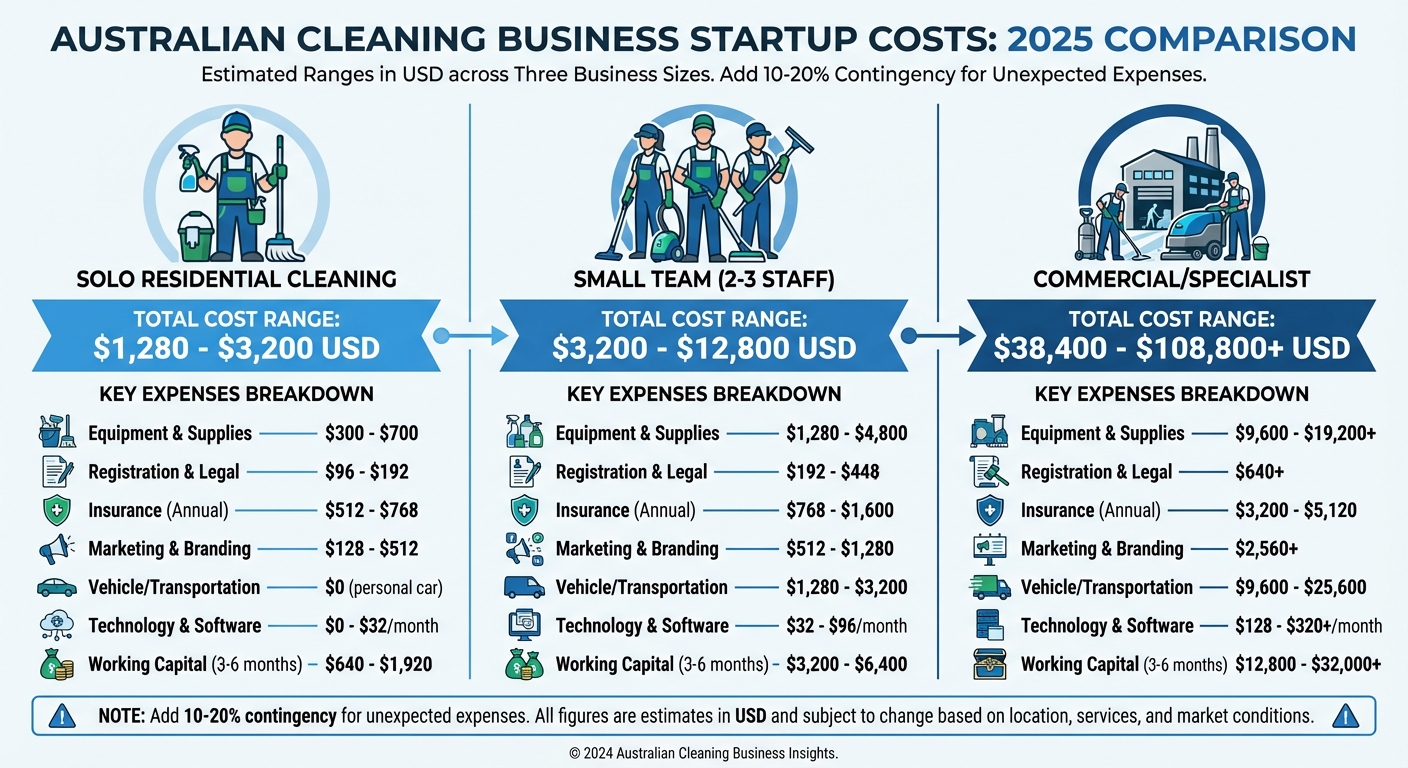
| Expense Category | Solo/Residential | Small Team (2-3 Staff) | Commercial/Specialist |
|---|---|---|---|
| Equipment & Supplies | $300 – $700 | $1,280 – $4,800 | $9,600 – $19,200+ |
| Registration & Legal | $96 – $192 | $192 – $448 | $640+ |
| Insurance (Annual) | $512 – $768 | $768 – $1,600 | $3,200 – $5,120 |
| Marketing & Branding | $128 – $512 | $512 – $1,280 | $2,560+ |
| Vehicle/Transportation | $0 (personal car) | $1,280 – $3,200 | $9,600 – $25,600 |
| Technology & Software | $0 – $32/month | $32 – $96/month | $128 – $320+/month |
| Working Capital (3-6 months) | $640 – $1,920 | $3,200 – $6,400 | $12,800 – $32,000+ |
| TOTAL STARTUP COST | $1,280 – $3,200 | $3,200 – $12,800 | $38,400 – $108,800+ |
- The Solo/Residential category assumes a home-based setup, basic equipment, and a personal vehicle.
- Small Team costs include multiple equipment kits, workers' compensation insurance, and a business vehicle.
- The Commercial/Specialist tier factors in industrial-grade equipment, higher insurance coverage (up to $15 million in public liability), and dedicated commercial vehicles.
It’s wise to set aside an extra 10–20% as a contingency for unexpected expenses. Keep in mind that costs may vary depending on your location, specific services, and whether you’re purchasing or leasing equipment. Use this table as a guide to refine your budget and lay the groundwork for a smooth launch.
Conclusion
Understanding startup costs goes beyond simply listing expenses - it's about creating a financial plan that sets you up for success from the very beginning. With over 45,000 cleaning businesses operating in Australia and an industry projected to reach $18.05 billion in 2024, competition is intense. Thriving in this environment requires careful planning, avoiding common pricing pitfalls, and ensuring you have the right insurance coverage.
Startup costs can vary significantly depending on whether you're working solo, managing a small team, or pursuing larger commercial contracts. The critical step is to have a clear grasp of your financial needs before securing your first client. As one industry expert wisely notes:
"The biggest mistake new cleaning business owners make is under-pricing their services. They forget to factor in all real costs - travel, insurance, supplies, tax, and paying themselves a wage." - Endurego.
Setting accurate cost benchmarks is essential for effective budgeting. Tools like IdeaFloat's Cost Analysis Tool can help refine your estimates, accounting for all key expenses such as equipment, legal fees, marketing, and working capital. By replacing guesswork with clarity, this platform streamlines financial planning, consolidates research, and simplifies launch strategies, potentially saving you 5–10 hours of administrative work each week.
The Australian cleaning industry has seen consistent growth, with a 5.7% annual increase between 2020 and 2025. This upward trend highlights the opportunities available for those who plan carefully. With the right tools and a realistic budget, you can position your business to succeed in this expanding market. Start by focusing on essential investments like insurance and commercial-grade equipment, and leverage technology to monitor your progress as you grow.
Ready to take the leap? Use the cost estimation table to tailor figures to your specific services and market, adjust as needed, and take the first step toward building a profitable cleaning business.
FAQs
How do I price jobs so I don’t undercharge?
To set the right price for cleaning jobs and avoid undercharging, start by calculating all your expenses. This includes startup costs like equipment, permits, and insurance, as well as ongoing costs such as labor and supplies. Once you have a clear picture of your expenses, add a profit margin to ensure you're not just covering costs but also earning a sustainable income.
Using tools like cost estimation or budget templates can help you structure your pricing strategy effectively. Additionally, researching industry rates will give you a sense of what competitors are charging, helping you stay competitive while ensuring your prices reflect the value of your services. This method keeps your pricing fair, profitable, and in line with market expectations.
What insurance do I need for residential vs. commercial cleaning?
When running a residential cleaning business, you'll usually need general liability insurance to protect against accidents or damages and workers' compensation insurance if you have employees. For commercial cleaning, the requirements can be more extensive. You might need property insurance and other specialized liability policies, depending on the specific services you provide. It's important to carefully assess your business's unique needs to make sure you have the right coverage in place.
How much cash should I keep for the first 3–6 months?
Maintaining cash reserves equivalent to 3–6 months of operating expenses is a smart move when starting your cleaning business. This financial cushion can help you navigate unexpected costs or slower growth periods, ensuring stability during those crucial early months.
Related Blog Posts
 Report an issue
Get the newest tips and tricks of starting your business!