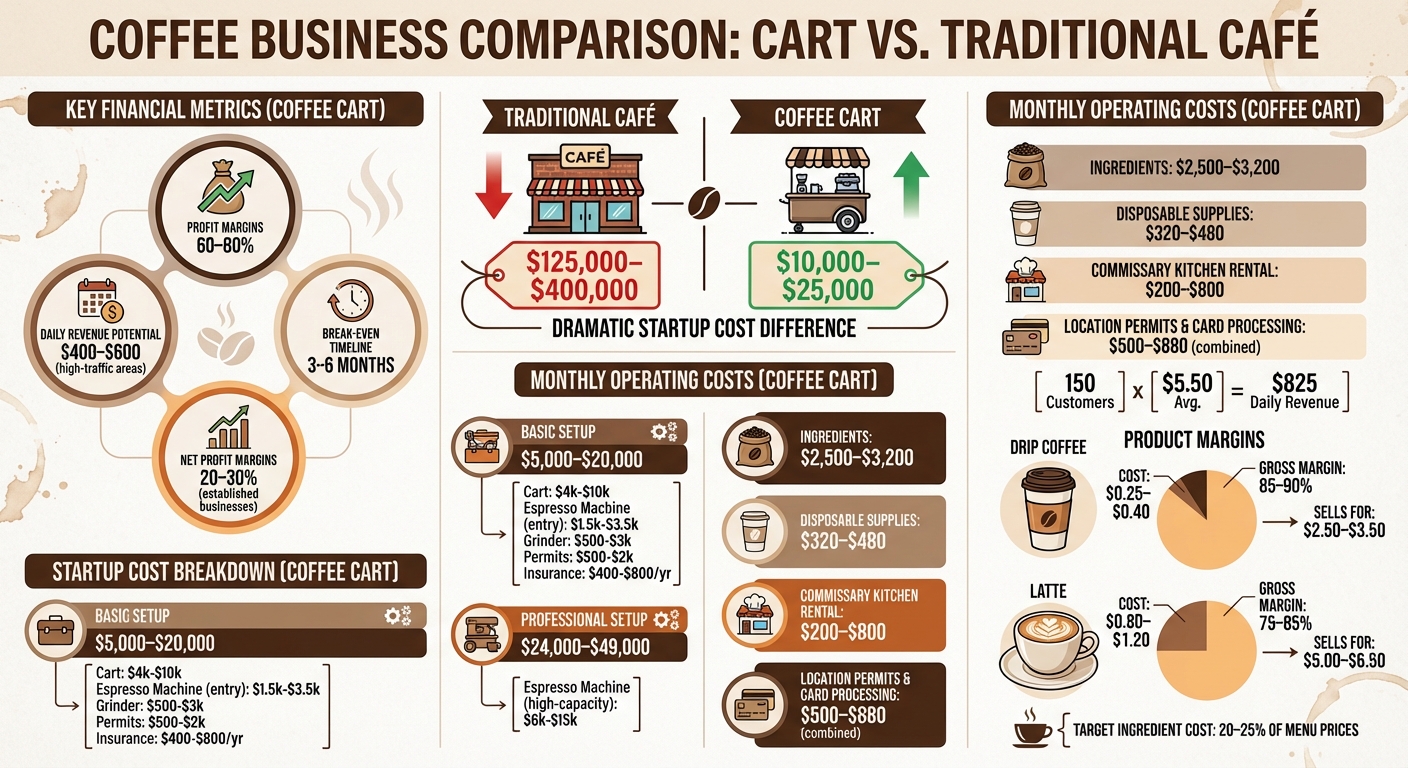
Launching a coffee cart is a cost-effective way to enter the coffee industry. Compared to traditional cafés, which cost $125,000–$400,000 to open, a coffee cart only requires $10,000–$25,000. With profit margins of 60–80%, low startup costs, and daily revenue potential of $400–$600 in high-traffic areas, many operators break even within 3–6 months.
Key Takeaways:
- Startup Costs: $10,000–$25,000
- Profit Margins: 60–80%
- Daily Revenue Potential: $400–$600 in busy locations
- Break-Even Timeline: 3–6 months
To succeed, focus on:
- Licensing: Secure federal, state, and local permits (e.g., business registration, food safety, zoning).
- Location: Target high-traffic areas like transit hubs or business districts.
- Margins: Keep ingredient costs at 20–25% of menu prices.
This guide explains licensing, finding locations, and managing costs to maximize profits.
Coffee Cart Business Startup Costs vs Traditional Cafe Comparison
How to Start A Coffee Cart | Our 5 Tips to Get you Started!
sbb-itb-08dd11e
Licensing Requirements for Coffee Carts
Before you serve your first cup of coffee, you’ll need to secure federal, state, and local licenses. It’s a process that can take time - start preparations 4 to 6 months in advance, as licensing typically requires 2 to 4 weeks. Operating without the proper permits isn’t just risky; it can cost you between $500 and $5,000 in fines per violation. And here’s another hurdle: about 40% of initial applications are rejected due to missing information or errors. Below, we’ll break down the specific permits you’ll need to legally operate your coffee cart.
Business Registration and Basic Licenses
The first step is establishing your business. Choose a legal structure - whether it’s an LLC, sole proprietorship, or corporation - and get a free EIN (Employer Identification Number) from the IRS. You’ll also need a state sales tax permit from your Department of Revenue to handle sales tax on your coffee sales. Beyond that, most cities require a general business license, which can cost anywhere from $50 to $500, depending on your location. Keep in mind that your business structure will influence your tax responsibilities and personal liability.
Health and Food Safety Permits
Health and food safety are big priorities. Start by obtaining a Mobile Food Vendor Permit from your local health department. This involves an inspection of your cart’s equipment and hygiene practices. Additionally, everyone handling food must have a Food Handler’s Certification, which typically costs between $10 and $50 per person.
Food preparation and cleaning must take place in a certified commissary kitchen. To meet this requirement, you’ll need a Commissary Kitchen Agreement signed with a licensed commercial kitchen. Commissary rentals can cost anywhere from $200 to $800 per month. Health departments will also review your cart’s design and conduct 2 to 4 unannounced inspections each year.
Common reasons for failing inspections include:
- Inadequate hand-washing facilities (35%)
- Improper food storage temperatures (28%; cold items must stay below 40°F, and hot items above 140°F)
- Missing or expired certifications (20%)
If your cart uses propane or high-voltage equipment, you’ll also need to obtain fire department permits, which usually cost between $50 and $200. Staying compliant with these regulations helps you avoid disruptions and fines.
Zoning and Operating Permits
Where you can set up shop depends on local zoning laws. These rules are often designed to manage foot traffic and prevent market saturation. Mobile food vendors are usually limited to specific zoning districts, such as Business, Industrial, or Urban Center zones, while residential areas typically prohibit commercial food service. Some jurisdictions also enforce distance requirements, such as staying at least 20 feet away from residential property lines, schools, or existing restaurants.
In some cities, there are limits on cart density - for example, one mobile vendor per 10,000 square feet of lot space. If you plan to operate in public spaces, you’ll likely need a Public Space Permit. In Washington D.C., for instance, a Sidewalk Site Permit costs $1,200.
To avoid costly mistakes, confirm zoning compliance early. Obtain a zoning map from your city’s planning department and double-check that your target locations allow mobile vending. If you’re operating on private property, such as a shopping center, secure written authorization from the property owner, as inspectors may ask for proof.
Other important considerations include operating hours, which are often restricted (e.g., 7:00 AM to 10:00 PM on weekdays). Liability insurance is also a must, with coverage typically ranging from $500,000 to $2 million. If your cart is part of a trailer or truck, it will need to meet Department of Transportation standards, including commercial registration and specialized insurance. Once you’ve handled these requirements, you’ll be ready to focus on finding the best locations to maximize your profits.
Choosing Profitable Locations for Your Coffee Cart
Where you set up your coffee cart plays a massive role in how successful your business will be. A well-chosen location can mean the difference between thriving sales and a struggling operation.
Identifying High-Traffic Areas
Your location is everything. A prime spot can bring in $400–$600 a day, while a poorly chosen spot might barely hit $100–$150. Around 60–70% of your daily sales will likely happen during the morning rush from 6:30 AM to 9:30 AM. This makes it crucial to position your cart where commuters naturally pass by - most people won’t go more than 2–3 minutes out of their way for coffee.
To find the best spot, conduct traffic studies during peak hours with a digital tally counter or app. Focus on areas like:
- Business districts
- Transit hubs
- Medical centers
- College campuses
Conversion rates vary by location - business districts might see 4–6%, while special events can hit 8–15%.
Also, check the infrastructure of potential sites. You’ll need access to fresh water and electricity. If these aren’t available, you may need to invest in generators or water tanks, which can add to your costs. At busy transit hubs, aim to serve customers quickly - within 90 seconds to 2 minutes - to keep lines moving. Weather is another factor: rain can cut foot traffic by 30–50%, while colder days might increase coffee demand by 15–30%. However, campus locations could see revenue drop by 50–70% during summer breaks.
Once you’ve found a high-traffic area, make sure it aligns with local zoning laws.
Understanding Zoning and Location Rules
Before committing to a spot, ensure you’re legally allowed to operate there. Reach out to your city’s planning department for zoning maps and guidelines. Many cities have rules about how close mobile vendors can be to certain properties.
On public sidewalks, you’ll likely need a Public Space Permit. For private property, you’ll need written permission from the owner. Permit costs vary by city, and some areas may have size restrictions for your setup. For example, permits for transit hubs can cost $1,000 to $5,000 annually and might take 3–6 months to process.
If you’re using private property, consider offering a revenue-sharing agreement. Property owners often expect 10–15% of your gross sales in return for access. In some cities, like Seattle, unrenewed vending spots are assigned through a lottery system every January, so check your city’s application timelines and vending maps.
Using Multiple Locations
One of the perks of running a coffee cart is mobility. Expanding to multiple locations can help boost your daily revenue. For instance, in Washington D.C., a single Vending Business License allows you to operate at up to three different sidewalk spots. This flexibility lets you adapt to different customer bases throughout the week.
You could rotate between business parks on weekday mornings and farmers’ markets or festivals on weekends. Event fees typically range from $100 to $2,000 or are based on 10–25% of your gross sales, with conversion rates for events often reaching 8–15%.
To maximize your revenue, create a weekly schedule that targets different customer groups. For example, hospital locations might offer extra opportunities during shift changes at 6:30 AM, 2:30 PM, and 10:30 PM. Just make sure each location complies with local permits and operating hour rules before setting up.
Calculating and Improving Profit Margins
After setting up your coffee cart and locking in a prime location, managing your finances effectively becomes the next big step. Coffee carts typically enjoy profit margins of 60-80% due to low ingredient costs and often break even within 3-6 months - much faster than the 12-24 months it takes for traditional cafes.
Startup Costs and Ongoing Expenses
Starting a coffee cart business can cost anywhere from $5,000-$20,000 for basic setups, while professional-grade operations might run you $24,000-$49,000. Key expenses include:
- Cart: $4,000-$10,000
- Espresso machine: $1,500-$3,500 for entry-level models, or $6,000-$15,000 for high-capacity versions
- Grinder: $500-$3,000
- Permits: $500-$2,000
- Insurance: $400-$800 annually
- Initial inventory: Variable
You can trim costs by choosing refurbished equipment, which often costs 40-60% less than new machines without sacrificing performance. If you plan to scale your business, standardizing machines and grinders can also save money on spare parts and technician training.
Monthly operating costs include:
- Ingredients: $2,500-$3,200
- Disposable supplies: $320-$480
- Commissary kitchen rental: $200-$800
- Location permits: $300-$600
- Credit card processing fees: $200-$280
To maintain strong margins, keep ingredient costs at 20-25% of your menu prices. For example, if a latte costs $0.80-$1.20 to make, pricing it at $5.00-$6.50 ensures a gross margin of 75-85%.
Once you've accounted for costs, the next step is to determine pricing that maximizes revenue.
Setting Prices and Calculating Revenue
Start by researching competitors within a one-mile radius. Coffee carts often price their drinks 10-20% lower than brick-and-mortar cafes due to reduced overhead. Using psychological pricing - like ending prices in .95 or .99 - can boost sales by 15-20%. Position premium options at the top of your menu to create a higher reference point, making standard drinks appear more affordable.
"Your price signals quality, so do not undervalue your product." - Jim.com
Adding high-margin extras, like flavored syrups or specialty milks priced at $0.50-$1.00, can significantly increase your profits. For instance, a basic cup of drip coffee that costs $0.25-$0.40 to make can sell for $2.50-$3.50, yielding an 85-90% gross margin. Keeping your menu simple - 5 to 12 core items - helps speed up service during busy hours.
Revenue depends on customer count and average sale value. If you serve 150 customers during the morning rush with an average sale of $5.50, that’s $825 in daily revenue. Since 60-70% of sales typically occur between 6:30 AM and 9:30 AM, efficiency during this time is crucial.
After setting prices, tracking financial metrics will help you maintain profitability over time.
Tracking Profitability and Managing Finances
To ensure your business stays profitable, keep your "Prime Cost" (Cost of Goods Sold + Labor) under 60-65% of total revenue. Use these formulas to monitor your financial health:
- Gross Profit Margin: (Revenue - COGS) ÷ Revenue × 100
- Net Profit Margin: (Revenue - All Expenses) ÷ Revenue × 100
"A good rule is to try to keep your prime costs at under 65 percent." - Ming-Tai Huh, Head of Restaurants, Square
Invest in tools like Square (hardware costs $0-$800) or JIM App (1.99% per transaction) to track sales automatically. Pair these with bookkeeping software like QuickBooks or Wave to keep an eye on monthly profit and loss statements. Analyzing sales data can help you identify best-sellers and adjust inventory to reduce waste, particularly for perishables like milk, which only lasts 7-10 days.
Plan for seasonal fluctuations. Revenue at campus locations often dips by 50-70% during summer breaks, while colder months may increase coffee demand by 15-30%. Building a cash reserve to cover at least three months of fixed expenses can help you navigate these swings. Once established, many coffee cart businesses achieve net profit margins of 20-30%.
Conclusion: Getting Your Coffee Cart Business Running
Starting a coffee cart business requires a mix of careful planning, regulatory compliance, and smart decision-making to set yourself up for success. Let's break it down.
First, make sure you navigate the licensing process effectively. This involves handling federal, state, and local requirements, which can take anywhere from 8 to 16 weeks. Double-check every permit and document before submitting them to avoid unnecessary delays - this step is crucial.
When it comes to location, test out multiple spots like office parks, farmers' markets, and special events to figure out where your cart performs best. Also, ensure you have at least six months' worth of operating capital to cover essentials like inventory, rent, and maintenance.
Streamlining your operations is just as important. A simple menu with 5 to 7 items can help you serve customers faster, especially during the morning rush when 60–70% of your daily sales are likely to occur. Consistency is key - maintain high-quality standards and keep your records organized to stay on top of health inspections.
The potential rewards are significant. Coffee carts can achieve profit margins of 60–80%. With the global coffee market projected to surpass $70.2 billion by 2025, and with 46% of American adults drinking specialty coffee daily - a number that's grown by 80% since 2011 - there's a clear demand for what you're offering.
FAQs
What licenses do I need for a coffee cart in my city?
To operate a coffee cart, you'll usually need a general business license and a Mobile Food Vending License issued by your local health department. Some cities may also require extra permits for selling in public areas. It's important to contact your local licensing office to understand the specific rules and requirements for your area, as these can differ widely. Additionally, you’ll likely need to comply with food safety guidelines and successfully pass health inspections.
How do I find a legal, high-traffic spot to park my cart?
Before setting up shop, the first step is to dig into the local permits and licensing requirements. These rules often dictate where you're allowed to park and operate. Focus on high-traffic spots like commuter hubs, college campuses, or popular event venues - places where people naturally gather and are likely to stop by.
To ensure you're following the law, secure any necessary permits, such as sidewalk vending permits, which might be required in your area. It's equally important to check with local transportation or health departments for specific restrictions. These could include limits on the number of vendors allowed in certain areas or rules about how and where you can set up your operation. Doing this homework upfront can save you from potential headaches down the road.
How much should I charge to keep strong profit margins?
To keep your profit margins healthy, target a pricing strategy that delivers 70–80% profit margins. Prioritize offering high-margin coffee products, and pay close attention to cost management. By carefully balancing revenue growth with controlled expenses, you can optimize profitability.
Related Blog Posts
 Report an issue
Get the newest tips and tricks of starting your business!