
Want to start a small business in 2026? Focus on niche markets with high growth potential.
Solo founders now drive $1.7 trillion in U.S. economic activity, with advancements like AI and no-code tools making it easier than ever to launch and scale businesses. But success depends on targeting the right opportunities and validating demand upfront.
Here are 5 promising niche markets for small entrepreneurs in 2026:
- AI Agent Systems: Automate workflows for specific industries like legal or HVAC. Market size: $10.91 billion.
- Longevity & Biohacking Services: Offer personalized wellness coaching using wearables. Market size: $141.7 billion.
- Mental Wellness Retreats: Provide digital detox experiences or corporate wellness programs. Market size: $1.1 trillion.
- B2B Circular Economy Platforms: Help businesses meet sustainability regulations with tools or consulting. Market size: $712 billion.
- Decentralized Green Energy Solutions: Offer energy audits, microgrid consulting, or green-tech training.
Key to success? Validate your idea first. Use tools like IdeaFloat to test demand, size the market, and identify barriers before investing heavily.
19 Most Profitable Niche Business Ideas With Low Competition
sbb-itb-08dd11e
5 High-Growth Niche Markets for 2026
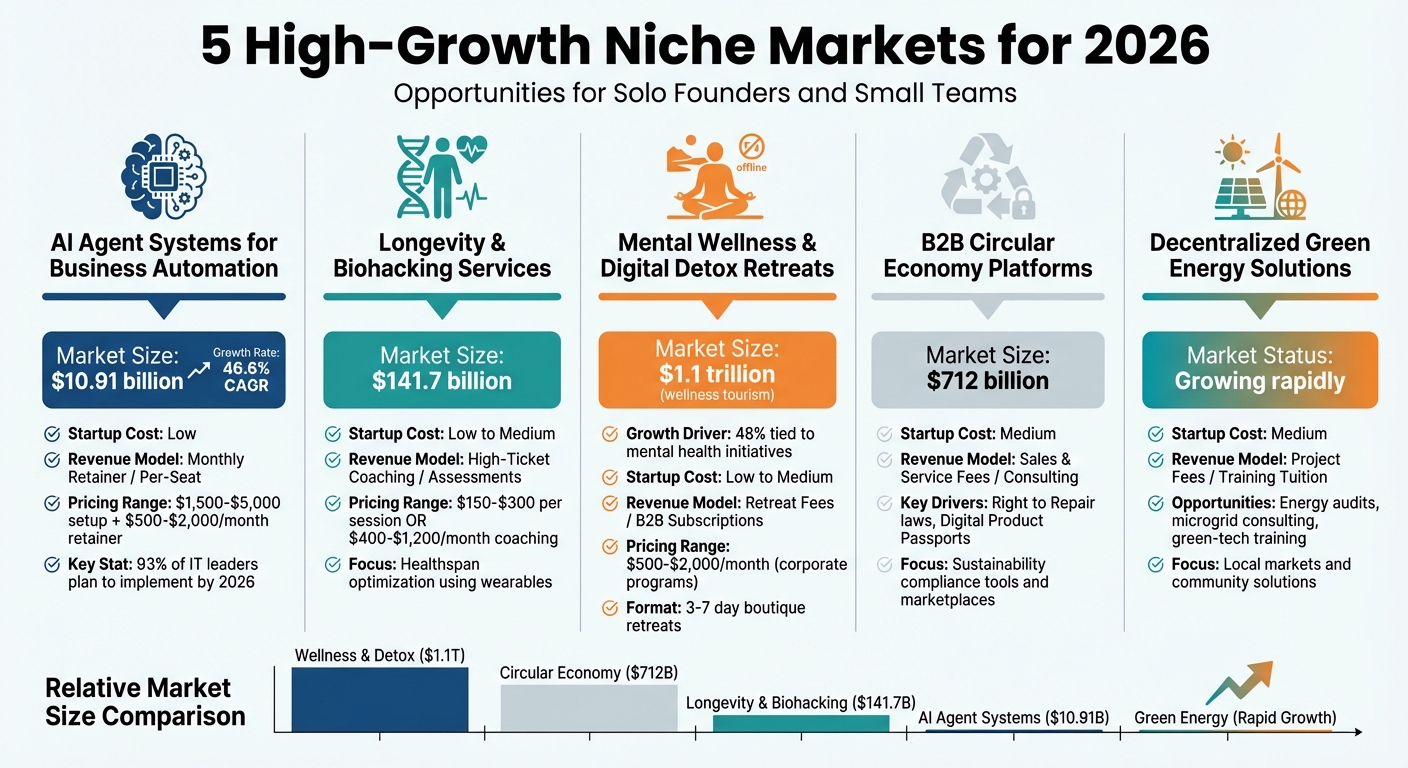
5 High-Growth Niche Markets for Small Founders in 2026: Market Size and Revenue Models
Niche markets with high growth potential in 2026 are shaped by evolving market demands and are well-suited for solo entrepreneurs or small teams. These markets allow founders to start small - often as service providers - and gradually expand into scalable products. Below are five promising markets where technology and specialization open doors for new opportunities.
AI Agent Systems for Business Automation
The AI landscape is evolving rapidly, moving beyond simple tools that assist humans to autonomous agents capable of completing complex tasks independently. These systems handle multi-step workflows without constant user input. According to Gartner, 40% of enterprise applications will include task-specific AI agents by the end of 2026. The market for these agents is projected to reach $10.91 billion, growing at an impressive 46.6% CAGR. Additionally, 93% of IT leaders plan to implement autonomous agents by 2026.
This shift, known as "intent-based computing," allows users to specify what they want, leaving the AI to figure out how to achieve it. For instance, a legal AI agent could review contracts, identify compliance issues, and draft amendments - all without human intervention between steps.
Solo entrepreneurs can carve out niches by focusing on industry-specific automation solutions. For example, automating workflows in areas like dental scheduling, HVAC dispatch, or legal compliance can command premium prices. Small businesses typically pay $1,500 to $5,000 for setup and $500 to $2,000 monthly retainers for these services. AI legal assistants for small businesses offer tiered plans ranging from $99 to $499 per month.
Platforms like Make.com, Bubble, and Arahi AI make it easier than ever for solo founders to create these solutions without large development teams. By identifying manual processes that currently require two or more employees - such as service dispatching or contract review - you can enter the market quickly with tools available in 2026.
Longevity and Biohacking Services
The wellness industry is shifting focus from lifespan to healthspan, with consumers prioritizing quality of life over simply living longer. This trend fuels the growth of personalized wellness and biohacking services, with the precision medicine market expected to hit $141.7 billion by 2026.
Opportunities abound in offering tailored advice to help individuals reduce biological age and optimize cellular health. Devices like Oura and Whoop provide metabolic data that drive demand for personalized coaching. Entrepreneurs can start small by offering longevity assessments, typically priced at $150 to $300 per session, or monthly coaching packages ranging from $400 to $1,200.
A hybrid approach works best: combine wearable device tracking with personal coaching to provide high-value services. No medical credentials are required to begin. Many successful coaches focus on lifestyle improvements - like optimizing sleep, nutrition, and stress management - using data from consumer wearables. Over time, you can expand into digital products such as courses or subscription-based programs.
Mental Wellness and Digital Detox Retreats
The need for "digital detox" has gone from being a trendy concept to an essential part of mental wellness. Wellness tourism is projected to grow to $1.1 trillion by 2026, with 48% of that growth tied to mental health initiatives. While wellness apps often struggle with user retention, high-value retreat experiences and B2B mental health solutions present lucrative opportunities.
Boutique retreats, offering structured digital detox programs, are particularly profitable. These retreats - lasting 3 to 7 days - help participants disconnect from technology and focus on stress reduction and mental clarity. Pricing is premium, as the benefits are tangible and immediate.
The corporate side is equally promising. Businesses are increasingly investing in mental wellness programs to combat burnout and improve employee retention. Monthly subscriptions for corporate wellness programs range from $500 to $2,000, depending on company size. Tools that track outcomes, helping HR teams demonstrate ROI, are especially valuable.
Starting a retreat business is manageable. By partnering with existing venues like farms, retreat centers, or state parks, you can focus on programming and marketing. Begin with weekend retreats to test demand before scaling to longer programs or dedicated facilities.
B2B Circular Economy Platforms
Sustainability is becoming a business imperative, driven by new regulations like "Right to Repair" laws and "Digital Product Passports" that require companies to adopt circular economy practices - recycling materials, reducing waste, and reusing products. The B2B circular economy market is expected to grow to $712 billion by 2026.
Solo founders can find opportunities by building platforms or services that help businesses adapt to these requirements. Examples include marketplaces for refurbished industrial equipment, blockchain-based tools for repair history verification, or consulting services for circular supply chain implementation.
An emerging niche is circular retail boutiques, which specialize in repairing and reselling designer goods and electronics. These boutiques use Digital Product Passports to verify authenticity and repair history, enabling them to charge premium prices.
For tech-savvy founders, there’s a growing need for software that integrates with ERP and accounting systems to track material flows and generate sustainability reports. These tools help businesses meet regulatory demands, creating consistent demand regardless of economic conditions.
Decentralized Green Energy Solutions
Energy production is becoming more localized as rising costs and grid instability push businesses and communities toward microgrids and battery storage systems that operate independently of traditional utilities. For small entrepreneurs, the opportunity lies in addressing the shortage of skilled technicians and offering community-focused energy solutions.
One promising area is green-tech vocational training. There’s significant demand for workers who can install EV chargers, conduct solar energy audits, and maintain heat pump systems. Entrepreneurs can establish "micro-schools" to provide certification programs and job placement services, generating revenue through tuition and placement fees. These schools require relatively low startup costs, focusing on curriculum and instructor recruitment rather than expensive equipment.
Another viable option is energy consulting for small businesses and residential communities. Many property owners are eager to cut energy costs but lack the expertise to get started. By offering energy audits, coordinating installations with certified contractors, and helping clients navigate rebates and incentives, you can build a service-based business with minimal upfront investment.
Focusing on local markets is key, as energy solutions often require strong community ties and localized expertise.
| Niche Market | Startup Cost | Primary Revenue Model | 2026 Market Size |
|---|---|---|---|
| AI Agent Systems | Low | Monthly Retainer / Per-Seat | $10.91 billion |
| Longevity Services | Low to Medium | High-Ticket Coaching / Assessments | $141.7 billion |
| Mental Wellness | Low to Medium | Retreat Fees / B2B Subscriptions | $1.1 trillion |
| Circular Economy | Medium | Sales & Service Fees / Consulting | $712 billion |
| Green Energy | Medium | Project Fees / Training Tuition | Growing rapidly |
How to Validate Niche Market Opportunities
Before diving into development, it's crucial to validate your idea. Why? Because 72% of new products fail due to a lack of market need. On the flip side, validated ideas can generate 3.4 times more revenue in their first month.
Validation isn't about achieving perfection - it's about minimizing risk. To get started, ask yourself these three key questions: Does the problem you're solving matter? Is the market big enough? And can you enter the market without facing insurmountable obstacles?
Using IdeaFloat to Test Market Demand
IdeaFloat is a powerful tool that helps you figure out if your niche idea addresses a problem that people are willing to pay to solve - all before you commit to full-scale development. Here's how it works:
- Problem Validator: This feature checks how urgent the problem is and analyzes early demand signals, giving you data to make better, informed decisions.
- Consumer Insights: By scanning online communities, this tool captures how customers talk about their challenges in their own words. Knowing this language can make your marketing much more effective.
- Competitor Analysis: This maps out the key players in your niche while identifying underserved areas.
- Smart Market Sizing: With detailed calculations for Total Addressable Market (TAM), Serviceable Available Market (SAM), and Serviceable Obtainable Market (SOM), you’ll understand the real potential of your idea.
This initial validation lays a strong foundation for the next step: diving deeper into market sizing.
Calculating Market Size and Growth Potential
Understanding your market size is critical for figuring out whether your niche has long-term potential. Focus on these three key metrics:
- TAM (Total Addressable Market): This is everyone who could potentially benefit from your solution.
- SAM (Serviceable Available Market): This is the portion of the TAM you can realistically reach.
- SOM (Serviceable Obtainable Market): This is the share of the SAM you aim to capture, often in your first year.
For example, if you're targeting dental practices, start by estimating the total number of potential customers. Then, refine this number by focusing on your ideal customer profile and calculating the share you can realistically secure. Combine these figures with your pricing to estimate both initial and recurring revenue.
With IdeaFloat, you can access real revenue estimates and trend data for the next 6–12 months, helping you stay agile and adjust your strategy as needed.
Market sizing doesn't just confirm the opportunity - it also helps you identify potential roadblocks.
Identifying and Addressing Entry Barriers
It's essential to spot entry barriers early. These could include market dominance by existing players, high technical or capital demands, or distribution challenges.
One way to uncover opportunities is by reviewing low-rated competitor reviews. For instance, if customers complain that a product is "too complicated", you can focus on offering a simpler solution.
For technical or capital challenges, tools like Bubble, Webflow, or Zapier allow you to create functional products in just weeks - without heavy development costs. If your niche requires significant capital investments, consider using a "Wizard of Oz" MVP. This approach involves manually simulating automation to test your idea before committing to a full-scale build.
The ultimate validation? Pre-sales. Getting early adopters to pay for your solution - even at a discounted rate - is the strongest proof that your idea has real market value. As the InsightRaider Team aptly puts it:
"The hardest part isn't running the tests. It's being honest about the results."
Once you've validated your market opportunity, you're ready to take actionable steps toward entering and thriving in your niche.
Steps to Enter and Succeed in Niche Markets
You've validated your market - now it's time to take action. Here's how you can effectively establish yourself in a niche.
Creating a Clear Value Proposition
Your value proposition should focus on solving a specific problem. As Michael Lovegrove, EMEA General Manager at Antler, explains:
"Your ideal customer does not care what your product does or what technology it uses. They care about what problem your product solves."
Start by defining your "relevant market", which is a segment where you dominate all alternatives. Use the SSNIP Test - imagine raising your price by 10%. If your most price-sensitive customers stick around because they can’t find a substitute, you’ve successfully carved out a niche.
It’s crucial to emphasize the problem your product solves rather than the product itself. For instance, instead of showcasing your technology, highlight how it eliminates tedious manual tasks. To build trust, share insights into your process and not just the end result. This is especially important in markets where buyers can’t gauge value before purchasing.
Finally, pinpoint your "secret" - a unique insight or truth about your industry that others overlook. For example, Three Putt Golf Clothing avoided direct competition with large sportswear brands by targeting a specific audience: golfers who prefer streetwear over traditional corporate styles. By narrowing their focus, they created a niche within the crowded apparel market.
Once your value proposition is solid, the next step is planning how to reach your customers.
Using IdeaFloat to Build Your Go-to-Market Plan
With a clear value proposition in hand, you need a strategic roadmap to connect with your audience. IdeaFloat's Go-to-Market Strategy tool can help you locate your customers, calculate acquisition costs, and provide scripts for outreach.
Leverage the Advanced Pricing Research feature to optimize your pricing strategy. Even a small 1% price increase can lead to an average 8.7% boost in operating profit. Use the Product & Service Creator to figure out the monthly sales needed to break even, and conduct Financial Projections & Breakeven Analysis to outline your funding requirements and profit timeline.
To build anticipation, create a Waitlist Landing Page to capture emails and turn casual visitors into eager customers before your official launch. Pair this with the Logo Generator to establish a professional brand identity right from the start.
Once your plan is in place, shift your focus to engaging your first customers.
Getting Your First Customers
The quickest way to validate your business idea is by starting with services. Many successful solopreneurs begin this way to generate revenue quickly and gather market feedback before expanding into products.
For acquiring customers, prioritize low-cost, high-impact methods. In February 2026, Caleb Dean launched Runify by using a ChatGPT-generated landing page. He secured 2,000 waitlist signups and 90 paying customers before even writing production code, proving the effectiveness of lean validation.
Utilize IdeaFloat's Community Launch Map to identify online spaces where your target audience gathers. The tool provides custom posts to spark conversations and drive traffic. Nearly 60% of users return to niche-specific platforms within a month because they find the content more relevant than broader alternatives.
For SEO-focused niches, aim for low-difficulty keywords to rank faster. Instead of competing for a broad term like "golf" (difficulty: 84), target something more specific, like "golf trousers" (difficulty: 5), particularly if your site has a low Domain Rating.
Finally, try the $5 Validation Test: create a simple landing page and offer an "Early Adopter" lifetime deal for $5. If 50–100 people pay, your idea is validated. Caleb Dean puts it well:
"If you find a niche with no competition, you haven't found a gold mine - you've found a graveyard. High-revenue competitors are the ultimate proof of user demand."
Early customer acquisition not only validates your business but also sets the stage for your growth. With the solo founder economy contributing $1.7 trillion to the U.S. economy in 2026, accounting for 6.8% of total economic activity, there’s never been a better time to dive into a niche market with purpose and precision.
Conclusion
Opportunities in fast-growing niche markets are everywhere, but they don’t last forever. With the rise of the solo founder economy, small-scale entrepreneurs now have the chance to compete and succeed - if they move quickly and strategically.
As discussed earlier, timing and a strong focus on a specific niche are key. Instead of targeting broad markets, zero in on a hyper-specific micro-niche like senior dog wellness and then branch out into related areas. Before diving in, apply the 4-Point Validation Framework to evaluate key factors: search trend velocity, supplier availability, competitive intensity, and the potential for repeat purchases.
To put these ideas into action, tools like IdeaFloat can streamline your decision-making process. Its Problem Validator ensures there’s real demand for your idea, while the Go-to-Market Strategy tool identifies the best ways to reach your audience. The Advanced Pricing Research feature helps you set prices that maximize profitability. Once you’ve validated your idea, tools like the Waitlist Landing Page and Community Launch Map enable you to build an email list and engage with your first customers - even before your official launch.
FAQs
Which niche should I pick if I’m starting solo?
If you're venturing out on your own, take a look at micro SaaS opportunities. These involve building highly focused software tools that cater to niche markets with unmet needs. Another exciting option? AI-powered tools. There's a rising demand for solutions like chatbots, automation systems, and tools for repurposing content. The key is to choose a niche that matches your expertise and passions, paving the way for a scalable and rewarding business.
How can I validate demand before I build anything?
Before diving into creating a full-fledged product or service, it's smart to validate the demand first. This means testing the waters with minimal effort and resources to see if people are genuinely interested - and willing to pay.
Start by launching a simple version of your idea. This could be a basic prototype, a stripped-down version of your service, or even just a concept presented clearly. The goal is to get it out there quickly and start gathering feedback from real potential customers.
Here are a few quick ways to test demand:
- Surveys: Ask your target audience about their needs and willingness to pay for your solution.
- Landing Pages: Create a page that explains your product and measures interest through sign-ups or clicks.
- Pre-order Campaigns: Offer your product for pre-sale to see if customers are ready to commit.
These methods help you understand if there's genuine interest and reduce the risk of spending time and money on something people don’t want. Plus, it gives you direct insights into what your audience values most.
What’s the fastest way to get my first paying customers?
The quickest path to landing your first paying customers is to zero in on emerging niches that combine high demand with low competition. Look for underserved areas that are gaining traction - think AI-driven workflow automation or niche-specific digital products. These markets often have eager audiences but fewer players competing for attention.
Begin by validating your chosen niche. This means confirming there's genuine interest and a willingness to pay for your solution. Once that's clear, develop a minimum viable product (MVP) - a streamlined version of your offering that showcases its core value.
From there, focus on targeted marketing to connect with early adopters. Use channels where your audience is most active, such as niche forums, LinkedIn groups, or industry-specific newsletters. To sweeten the deal, offer incentives like discounts or exclusive access. Most importantly, deliver outstanding value and build trust. If people love what you’re offering, they’ll spread the word, sparking organic growth.
Related Blog Posts
 Report an issue
Get the newest tips and tricks of starting your business!