Scaling from 10 to 100 customers isn’t about working harder - it’s about shifting your approach. What got you your first 10 customers (like personal outreach or founder-led sales) won’t work at scale. To grow effectively, you need to focus on three key levers:
- Customer Acquisition: Build repeatable systems to find and convert new customers without relying on manual efforts. This includes identifying your ideal customer profile (ICP), testing 2–3 acquisition channels, and tracking meaningful metrics like Customer Acquisition Cost (CAC).
- Customer Retention: Keeping customers is cheaper and more effective than constantly acquiring new ones. Focus on reducing churn, improving onboarding to deliver faster results, and segmenting users to tailor messaging and support.
- Customer Engagement: Turn happy customers into advocates who bring in referrals. Build communities, set up referral programs, and track engagement metrics like Net Promoter Score (NPS) and referral rates.
These three levers work together to create a self-sustaining growth engine. The key is to document and systematize what works, so your growth doesn’t depend on manual effort. Start by refining your ICP, optimizing onboarding, and creating referral opportunities. With the right systems in place, scaling becomes much more manageable.
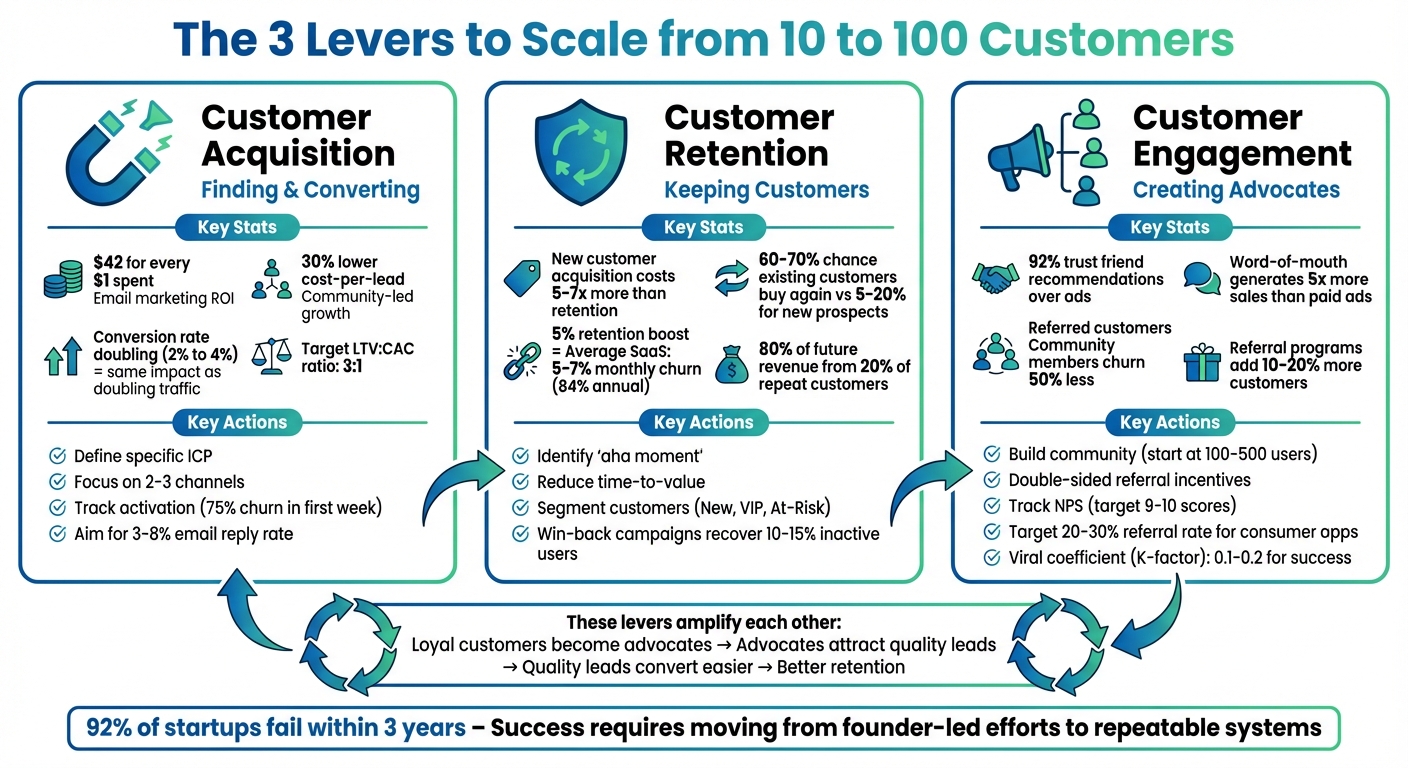
Three Growth Levers for Scaling from 10 to 100 Customers
Dare to Grow: How to Fix Your Revenue Engine and Scale with Demand, Acquisition, and Retention
sbb-itb-08dd11e
Lever 1: Customer Acquisition - Finding and Converting Your Next Customers
The strategies that helped you land your first 10 customers - like personal outreach and founder-led sales - won’t scale to 100. To grow, you need repeatable systems that don’t rely on personal effort. This involves clearly defining your target audience, selecting effective channels, and measuring performance to refine your approach.
Identifying Your Target Customers
Those first customers likely supported you because of personal connections. As Talha Fakhar explains: "Your first 10 customers don't count... They bought because they know you and want to support you, not because your go-to-market motion works". Now it’s time to analyze those early wins. Look for patterns: Who benefited the fastest? Who had the shortest sales cycle? Who referred others? These insights point to the types of customers you should target next.
Your Ideal Customer Profile (ICP) needs to be specific. Instead of a broad category like "marketing teams", narrow it down to something like "Series A SaaS companies with 30–150 employees struggling with revenue forecasting across multiple spreadsheets". This level of detail helps you identify triggers that prompt action, such as recent funding, product launches, or platform migrations like switching to Shopify. Use the P-TASK checklist - Pain, Timeline, Authority, Success, Key integration - to qualify prospects effectively.
Next, conduct interviews with 10–20 potential customers who fit your ICP. Ask them about their workflows and frustrations, and note the exact language they use - this will inform your marketing copy. Also, figure out where they spend time: What blogs do they read? Which YouTube channels do they watch? Are they active in specific Slack or Reddit communities?.
Once you’ve nailed down your ICP, you can focus on channels that connect with these buyers.
Choosing the Right Acquisition Channels
The best companies focus on just 2–3 channels at a time. As Exsposer points out: "The companies winning are not those running 20 simultaneous marketing campaigns. They are the ones who deeply understand their ICP, commit to a motion that fits their product and market, and execute 2-3 channels exceptionally well before expanding".
To find the right channels, use the Bullseye Framework: brainstorm 20 possibilities, pick the top five to test, and run 90-day experiments on 1–2 of the most promising options before scaling. Each test should have a clear hypothesis, a target Customer Acquisition Cost (CAC), and a decision point after 13 weeks. Email marketing remains a standout performer, offering an average return of $42 for every $1 spent. Meanwhile, community-led growth on platforms like Reddit can deliver 30% lower cost-per-lead and 26% higher retention rates compared to paid ads.
Improving your conversion rate can be a game-changer. Doubling your conversion rate from 2% to 4% has the same impact as doubling your traffic, but without additional costs. If your funnel isn’t optimized, scaling acquisition spend is like “pressing the gas pedal with the parking brake on”. Calculate your CAC by factoring in all direct costs, such as ad spend, tools, and team time. A healthy benchmark is a 3:1 LTV:CAC ratio - your customer’s lifetime value should be three times the cost to acquire them.
After choosing your channels, the next step is tracking their effectiveness.
Tracking Acquisition Performance
Scaling customer acquisition requires tracking the metrics that matter. Vanity metrics like page views or social media followers won’t help. As Nomiki Petrolla, CEO of Theanna, says: "If a number makes you feel good but doesn't change what you do tomorrow, it's noise. If a number makes you uncomfortable but tells you exactly what to fix, that's signal". Focus on activation, which measures how quickly users experience their first meaningful value from your product. This is critical because 75% of users typically churn within the first week of signing up. Improving activation by 25% can lead to a 34% revenue boost over 12 months.
Track actionable metrics. For email outreach, aim for a 3–8% positive reply rate and around 7–15 meetings per 1,000 emails sent. Keep an eye on hard bounce rates - pause campaigns if they exceed 1%. For paid channels, calculate cost-per-meeting (CPM) and compare it to benchmarks: community-driven acquisition often costs $3–10 per meeting, while outbound sales can cost over $1,980 in CAC.
AI tools can simplify tracking and personalization as you scale. These platforms can analyze segments, draft tailored outreach messages, and identify buying signals like visits to your pricing page or recent funding announcements. They also handle technical details like SPF, DKIM, and DMARC setups, ensuring your emails land in inboxes, not spam folders. The goal isn’t to manipulate people - it’s to connect efficiently with those who genuinely need your product.
Lever 2: Customer Retention – Keeping Customers Coming Back
Once you’ve nailed down a system for acquiring customers, the next step is ensuring they stick around. Long-term growth relies on keeping the customers you’ve worked so hard (and spent so much) to gain.
Why is retention so important? For starters, acquiring new customers costs five to seven times more than retaining existing ones. Plus, the odds are in your favor with current customers: there’s a 60% to 70% chance they’ll buy again, compared to just 5% to 20% for new prospects. Even a small 5% boost in retention can increase profits by 25% to 95%. It’s clear - retention isn’t just a nice-to-have; it’s a must-have for sustainable growth.
Companies that focus on retention from the beginning often see two to three times higher lifetime value and more predictable revenue streams. But here’s the challenge: the average SaaS company loses 5% to 7% of customers monthly, which can snowball into an 84% annual churn rate. Jason Lemkin, founder of SaaStr, sums it up perfectly:
"Customer Success isn't just a department. It's how you make sure your customers get value from your product, and ultimately, how you grow your business".
The secret lies in transitioning from one-off, manual efforts to scalable processes that ensure long-term success.
Developing Clear Messaging That Resonates
Your first customers might forgive onboarding hiccups, but the next wave won’t be so lenient. Clear, compelling messaging is key to showing customers they made the right choice. This starts with identifying your product’s "aha moment" - that critical action where users experience its value. For example, in e-commerce, it could be completing a purchase within 14 days. For SaaS, it might be engaging with three or more features during the first session.
Take Slack as an example: they found that teams sending 2,000+ messages were almost guaranteed to renew. That insight became their North Star, shaping their engagement strategy to help new users hit that milestone. To guide your customers toward their own aha moments, consider automating three key campaigns:
- Welcome Series: Helps users find value within the first week.
- Activation Nudge: Targets users who sign up but don’t complete a core action within 3–5 days.
- Win-back Sequence: Re-engages users who’ve been inactive for 30+ days.
Personalization matters here - 71% of consumers expect tailored experiences, and 76% get frustrated when they don’t receive them.
Using Customer Data to Improve Your Offering
Companies like Stripe have shown how valuable customer data can be. By closely analyzing their customers’ first-month journeys, they cut early cancellations by 40%. They pinpointed behaviors that led to long-term success and redesigned onboarding around those actions. You can do the same by studying your most engaged users. Ask yourself: What did they do differently in their first week? Which features captured their attention? How quickly did they achieve their first win?
Uptake, an enterprise IoT company, saw retention jump from 76% to 91% in just nine months. Their strategy included reducing time-to-value (TTV) from 14 weeks to 4 weeks and conducting weekly health checks for customers. Speed is crucial - monitor your TTV and streamline onboarding to help users see results faster.
Segment your customers into groups like New, VIP, and At-Risk, and tailor your messaging to each. For example, if someone hasn’t logged in for two weeks, send a check-in email highlighting a feature they haven’t tried yet. For heavy users who haven’t upgraded, share a case study showing the benefits of premium features. And don’t forget to act on feedback - letting customers know their input led to updates builds trust and loyalty.
Applying Retention Tactics That Work
Proactive support can make all the difference. Customers who have their issues resolved effectively are 2.4 times more likely to stay. AI chatbots can handle simple queries 24/7, freeing your team to tackle more complex problems. Set up usage thresholds - like login frequency or feature adoption - to flag customers at risk of leaving.
For subscription models, offering a "pause instead of cancel" option can save up to 15% of customers who might otherwise churn due to temporary issues like budget cuts or seasonal changes. A 90-day retention roadmap could look like this:
- Days 1–30: Launch a welcome series to emphasize the aha moment.
- Days 31–60: Send activation nudges to keep users engaged.
- Days 61–90: Roll out win-back campaigns and A/B test your subject lines.
Well-timed win-back campaigns can recover 10% to 15% of inactive users. Instead of waiting six months, reach out after 30–45 days with a reason to return, like a new feature addressing a previous pain point. Track your efforts using metrics like Customer Retention Rate, Churn Rate, and Net Revenue Retention. Keep in mind, 80% of your future revenue will likely come from just 20% of your repeat customers.
Lever 3: Customer Engagement - Turning Customers into Advocates
Once you've nailed acquisition and retention, the next step is all about amplifying customer engagement. You've brought customers in and kept them around - now it's time to tap into the ultimate growth driver: turning happy customers into advocates who bring in even more customers.
Here’s why this matters: 92% of people trust recommendations from friends and family more than any form of advertising. Referred customers don’t just convert better - they stick around longer and are 3x more likely to refer others, creating a snowball effect. In fact, word-of-mouth generates 5x more sales than paid ads, making it one of the most cost-effective ways to grow.
Creating Spaces for Customer Connection
Building a community can turn passive users into active participants. For example, Guillaume Moubeche, CEO of Lemlist, created a Facebook group called "The Sales Automation Family", which grew to nearly 10,000 members. Instead of pushing his product, he focused on helping salespeople succeed. This approach not only strengthened the community but also helped Lemlist surpass a $2 million run rate. Here’s the kicker: community-engaged members churn 50% less than those who aren’t involved.
The best time to start a community is when you have between 100 and 500 users - this keeps it personal and genuine. Anthony Kennada, Gainsight’s former CMO, grew the "Pulse" conference from 300 to 6,000 attendees by positioning it as the go-to event for the customer success industry. This initiative eventually drove 85% of the company’s deals. To build a thriving community, start with high-value content that helps users immediately, whether it’s a Slack group, Discord server, or Facebook group. Make it about a mission bigger than your product.
Strong communities naturally pave the way for effective referral programs.
Setting Up Referral Programs
Referral programs take the word-of-mouth already happening and give it a boost. Double-sided incentives - rewarding both the referrer and the new customer - usually outperform single-sided ones by 30% to 50% when tied to the product’s value. A great example is framing the referral as a gift, like "Give your friends $20 off", rather than focusing on what the referrer gets.
Morning Brew’s tiered and gamified referral program is a standout. It helped the company grow from 100,000 to 1.5 million subscribers in just 18 months, with nearly a third of that growth driven by referrals. Timing is everything here. Prompt customers to refer at moments of peak satisfaction - right after a purchase, following a high NPS score, or when they hit a key milestone with your product. Behavioral triggers tied to these moments can deliver referral rates 3x higher than generic campaigns.
Make the process as easy as possible. One-click sharing via SMS, email, or social media, along with pre-written, personalized messages, reduces the effort for customers who want to share. A well-designed referral program can add 10% to 20% more customers to your acquisition pipeline.
| Reward Model | Ideal For | Advantage |
|---|---|---|
| Standard (Flat) | E-commerce/Simple Products | Simple and easy to communicate |
| Tiered | SaaS/Subscriptions | Encourages ongoing referrals and high volume |
| Gamified | Communities/High Engagement | Leverages competitive and social dynamics |
| Experience-Based | Luxury/Lifestyle Brands | Reinforces brand value without discounting |
Measuring Customer Engagement
To identify potential advocates, track the right metrics. Net Promoter Score (NPS) is a great place to start. Customers who score you a 9 or 10 are your best candidates for referrals. For consumer apps, a healthy referral rate is between 20% and 30% of active users, with referrals ideally happening within three days of activation.
Another key metric is the DAU/MAU ratio (Daily Active Users to Monthly Active Users), which shows how engaged your users are. For referral programs, track your viral coefficient (K-factor) - calculated by multiplying the number of invites per user by the conversion rate of those invites. Most successful non-social apps hit a K-factor of 0.1 to 0.2. Referred users should convert at 2x to 3x the rate of cold traffic.
Finally, compare the lifetime value (LTV) and retention rates of referred customers against those acquired through paid channels. This helps you understand which channels drive the best results over time. Engaging customers effectively doesn’t just build loyalty - it creates a growth engine that sustains itself.
Combining the Three Levers for Growth
Acquisition, retention, and engagement don’t work in isolation - they amplify each other when combined effectively. Together, they create a feedback loop: loyal customers become advocates, these advocates attract high-quality leads, and those leads are easier to convert. But here’s the catch: your growth strategy must adapt as your business scales. The approach that helped you land your 10th customer won’t necessarily work for your 100th.
Take the example of Gleam co-founder Stuart McKeown. Back in 2013, he managed to grow from zero to 100 paying customers in just five months - all without a marketing budget. How? By creating a single, integrated system where acquisition drove retention, retention fueled engagement, and engagement, in turn, reduced acquisition costs. This interconnected strategy is what sets the stage for scaling. Each lever strengthens the others, creating a cycle of growth.
As you move from 10 customers to 100, your tactics need to shift. Relying on founder-driven efforts - what some call “founder heroics” - won’t cut it anymore. Steli Efti, founder of Close, explains this evolution perfectly:
"Your customer acquisition strategy should evolve over time. What you do to persuade your 1,000th customer to buy will probably not be the same thing that persuaded your 10th customer to buy".
To scale effectively, you need to document and systematize your winning strategies. This means turning what works into repeatable playbooks, so growth doesn’t depend on personal charm or ad-hoc efforts.
The next step? Pairing these systems with the right tools. Platforms like IdeaFloat help you integrate these three levers into a cohesive framework. For acquisition, tools like the Problem Validator and Consumer Insights refine your targeting. For engagement, the Go-to-Market Strategy helps you create repeatable outreach playbooks. And when it comes to retention, tools like the Waitlist Landing Page and Community Launch Map transform early customers into enthusiastic advocates. Meanwhile, the platform’s Financial Model and Pricing Research ensure your retention strategies are built on a solid foundation.
Conclusion
Reaching 100 customers isn’t just about working harder - it’s about working smarter by focusing on three critical areas: acquisition, retention, and engagement. Acquisition brings new customers through the door, retention ensures they stick around, and engagement transforms them into loyal advocates who drive your growth forward. Together, these create a cycle where each piece strengthens the others, making every effort and dollar count.
Here’s a sobering reality: 92% of startups fail within three years, often because they struggle to grow beyond their initial user base. The key difference between those who thrive and those who don’t lies in one crucial shift - moving from founder-led efforts to repeatable, scalable systems. This transition is essential for building a foundation your team can execute consistently.
Start by analyzing your early customers to uncover patterns that signal growth opportunities. Use this information to refine your ideal customer profile and document the processes that are already working - things like sales scripts, handling objections, and demo strategies.
Scaling from 10 to 100 customers requires balancing short-term actions with a long-term vision. Automate what works, such as outreach sequences, and incorporate referral opportunities directly into your product. Keep a close eye on vital metrics like churn rate, LTV/CAC ratio, and time to value. And if 40% of your users would feel a significant loss without your product, you’ve hit product-market fit and are ready to scale.
With IdeaFloat’s integrated tools, you can tackle each of these growth levers systematically. Start today by optimizing one area, tracking your results, and refining your approach. Your 100th customer isn’t as far away as it might seem - especially when you’ve got the right systems driving you forward.
FAQs
Which lever should I focus on first?
Building strong customer relationships is the cornerstone of closing deals and growing your business. It’s not just about the products you offer - what truly drives growth is earning your customers' trust and keeping them engaged. When you prioritize these connections, you’ll find it much easier to reach that milestone of 100 customers.
How do I pick the best 2–3 acquisition channels?
To find the top 2–3 acquisition channels for your business, start by figuring out where your target audience spends the most time - whether that's on social media, in online communities, or through search engines. Experiment with different strategies like SEO, social media marketing, paid ads, cold outreach, or partnerships, but keep it small at first to test the waters.
Track performance using key metrics such as customer quality and acquisition cost. Once you identify the channels that deliver the best results, focus your efforts on scaling those for more efficient growth.
What’s the fastest way to reduce churn early?
The fastest way to cut down on early churn is to spot users who might leave early, fix any issues causing frustration in the product experience, and put a plan in place to actively help customers succeed. Prioritize making the onboarding process smoother, offer support when it’s needed most, and make sure your product shows its value right from the start.
Related Blog Posts
 Report an issue
Get the newest tips and tricks of starting your business!