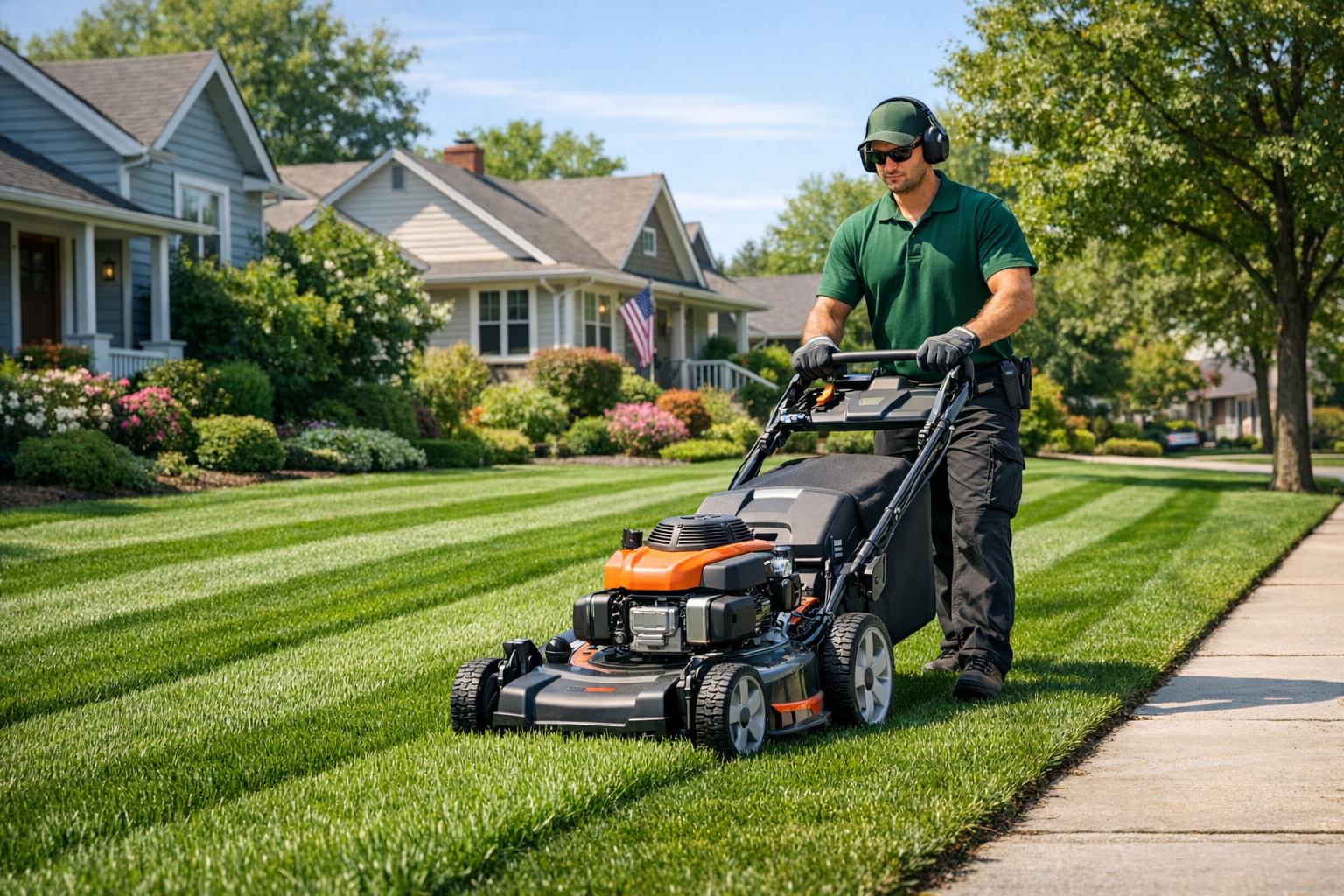
Starting a lawn care business in 2025 is a low-cost, high-potential opportunity in a growing $79.55 billion industry. With startup costs ranging from $500 to $1,000 (using pre-owned equipment) and the ability to earn $5,000–$10,000 per month as a solo operator, this guide breaks down everything you need to know.
Key Steps:
- Market Research: Identify local demand and gaps in competitors' services.
- Legal Setup: Register as an LLC or sole proprietorship, secure licenses, and obtain insurance.
- Equipment: Start small with basic tools or invest in professional-grade equipment as you grow.
- Pricing: Use hourly rates, flat fees, or packages; aim for 18–35% profit margins.
- Marketing: Build an online presence (Google Business Profile, website) and leverage local outreach (flyers, door-to-door).
- Scaling: Hire reliable employees, expand services (e.g., fertilization, aeration), and optimize routes for efficiency.
With demand for eco-friendly solutions and advanced techniques rising, offering services like organic treatments or sustainable landscaping can set your business apart. Focus on building customer trust through reliability and quality work, and reinvest profits to grow strategically.
Whether you're starting as a side hustle or aiming to scale into a larger operation, this guide provides actionable insights to help you succeed in the lawn care industry.
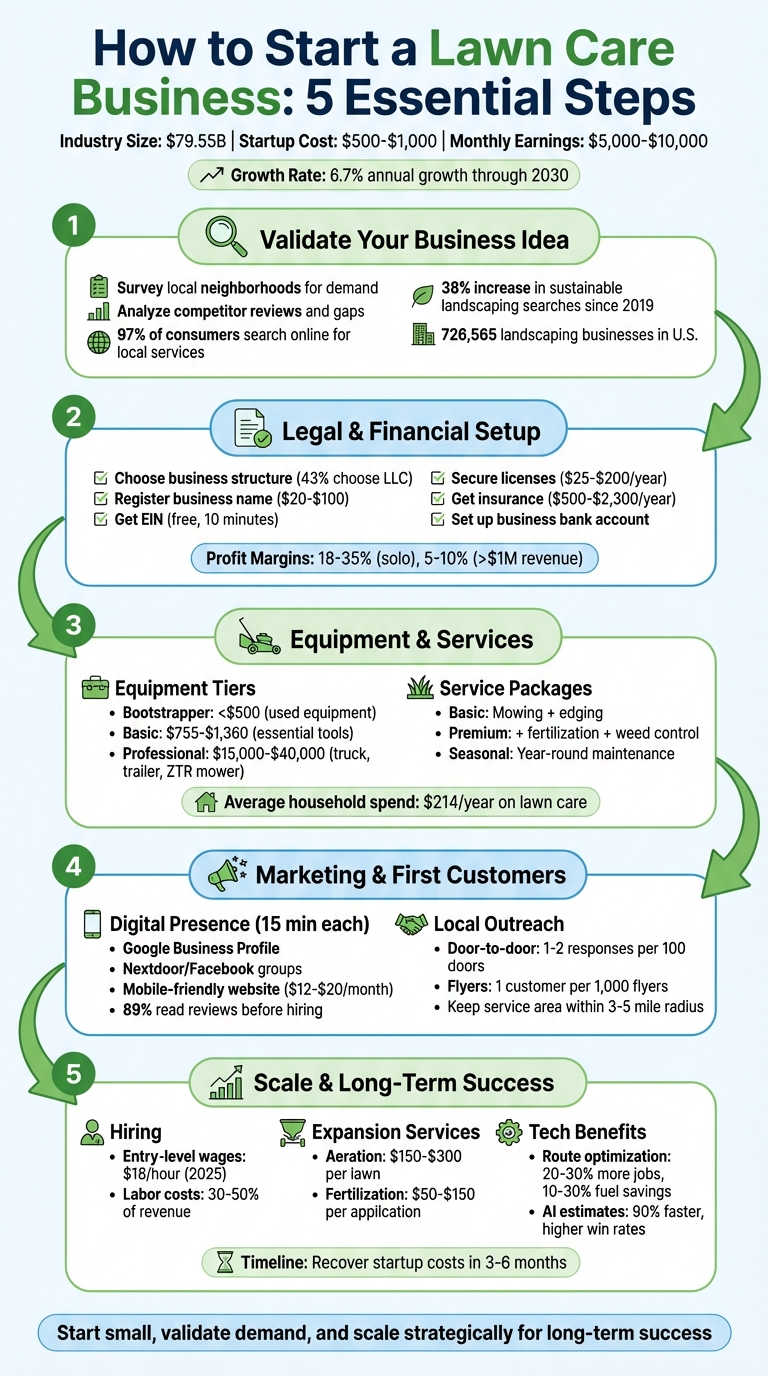
5 Steps to Start a Lawn Care Business in 2025
Start a Lawn Care Business 2025 | 10 Essential Steps You Need to Know | Make Money Mowing Grass
Step 1: Validate Your Lawn Care Business Idea
Before you invest in equipment or start designing your logo, it's crucial to confirm there's a real demand for your lawn care services. This step isn't about relying on instincts - it's about collecting solid evidence to ensure your business will attract paying customers.
Understanding Customer Needs
Start by surveying local neighborhoods for signs of neglected lawns or overgrown shrubs. Areas with visible maintenance issues could be ripe with opportunities. Talk to residents to find out if they already work with lawn care providers and identify common frustrations, such as unreliable service or inconsistent quality.
Don’t stop there - check out local digital forums. Platforms like Facebook and Nextdoor are goldmines for understanding what people in your area are looking for. Look for posts where residents discuss lawn care needs or complain about existing providers. For instance, if you notice repeated complaints about poor scheduling or sloppy work, you’ve uncovered an opportunity to stand out. It’s worth noting that 97% of consumers search online for local services, so paying attention to these online conversations is key.
Once you’ve nailed down what customers want, shift your focus to understanding your competition.
Analyzing the Competition
After identifying customer needs, take a closer look at local competitors to spot their weaknesses. Start with Google Business Profiles and Yelp. Pay attention to businesses with low ratings - their negative reviews can reveal issues like missed appointments, poor communication, or subpar work.
"Marketing your lawn company in the neighborhoods that your lowest-reviewed competitors service is a good idea because some customers are likely to be unhappy with their service and looking for an alternative."
– Fit Small Business
Beyond reviews, check whether competitors offer specialized services, such as organic treatments or smart irrigation systems. While there are over 726,565 landscaping businesses in the U.S., many stick to basic mowing services. This could be your chance to stand out - especially since searches for sustainable landscaping have jumped by 38% since 2019. If local providers aren’t meeting these growing demands, you’ve found a gap to fill.
When it comes to pricing, don’t just aim to undercut competitors. Instead, develop a pricing strategy that reflects the quality and reliability of your services. Customers are often willing to pay more for consistent, high-quality work.
Using Data-Driven Tools to Validate Your Idea
To back up your insights, make use of data-driven tools. For example, IdeaFloat's Problem Validator helps you confirm whether your business idea addresses a real customer need. It guides you in assessing urgency and identifying weak points before you spend money on equipment or marketing.
Another helpful tool is the Consumer Insights feature, which scans online communities to understand how people talk about lawn care. This can help you craft messaging that resonates - phrases like "reliable weekly service" or "organic fertilizer options" might strike a chord with potential customers.
For competitive research, IdeaFloat’s Competitor Analysis tool maps out local competitors, highlighting their strengths and weaknesses while identifying underserved customer groups. Pair this with their Unique Value Proposition tool to refine your messaging, emphasizing what makes your service stand out - whether it’s eco-friendly practices, timely updates, or other specialized offerings.
Finally, test your ideas with small-scale experiments. Distribute flyers in a specific area - industry benchmarks suggest you might gain one new customer for every 1,000 flyers. Or, offer discounted services to friends and family to build a portfolio and start gathering those all-important first reviews.
Step 2: Legal and Financial Setup
Once you've validated your business idea, it's time to lay a strong legal and financial foundation. This step is crucial for protecting your assets and ensuring smooth operations as your lawn care business grows.
Choose Your Business Structure
One of the first decisions you'll face is selecting the right business entity. Many lawn care entrepreneurs opt for an LLC (Limited Liability Company) because it safeguards personal assets - like your home or savings - from business debts and lawsuits. In fact, nearly 43% of small businesses choose this structure. If you're starting small or testing the waters as a side hustle, a sole proprietorship is a simpler and cheaper option, but it does leave you personally liable for any business debts.
"For most starting out, an LLC provides the best balance of simplicity and protection."
– Lawn Squad
You'll need to register your business name with your state and file a DBA (Doing Business As) if you're operating under a different name. This typically costs between $20 and $100. Additionally, apply for an Employer Identification Number (EIN) through the IRS website. It's free, takes about 10 minutes, and is necessary for opening a business bank account.
Make sure to secure the required licenses and permits. Most cities mandate a general business license, which costs between $25 and $200 annually. If you plan to use fertilizers, herbicides, or pesticides, you'll need a pesticide applicator license from your state's Department of Agriculture. Licensing requirements vary - California, for example, requires a contractor license for landscaping jobs over $500, while Texas only requires a DBA and Tax ID. Check with your local Chamber of Commerce or municipal office to confirm what's necessary in your area.
Insurance is another must-have. General liability insurance protects you if, for instance, a mower sends a rock flying through a client's window or someone gets injured on your property. Expect to pay between $500 and $2,300 per year. If you hire employees, most states require workers' compensation insurance, which costs about $450 per employee annually. Some states, like Louisiana, even mandate liability insurance for lawn care businesses.
Set Up Business Finances
Once your legal structure is in place, focus on organizing your finances. Start by opening a dedicated business bank account to separate personal and business funds, which simplifies tax preparation and audits. Most banks will ask for your EIN and business registration documents.
To keep your finances in order, invest in accounting software like FreshBooks, QuickBooks, or Xero. These tools make it easy to track income and expenses, and they often include automated invoicing features to help maintain steady cash flow. For added convenience, consider equipping your team with mobile card readers so clients can pay on the spot.
Plan your budget carefully. Labor typically accounts for 30% to 50% of total revenue, and equipment will need regular maintenance. Set aside funds for routine tasks like oil changes, blade sharpening, and unexpected repairs. Since lawn care work is seasonal - most revenue is earned over 7 to 9 months - think about saving summer profits or offering winter services like snow removal to keep cash flow steady.
Startup costs can vary widely. If you're starting small with used equipment, you could launch for as little as $300. However, a more professional setup - including a vehicle and commercial-grade tools - can cost between $5,000 and $15,000. Be sure to budget for essentials like business licenses ($50–$200), liability insurance ($500–$2,300 annually), and basic equipment (e.g., mower, trimmer, and blower) which costs around $300–$700.
Develop a Pricing Strategy
Setting the right prices is key to staying competitive while ensuring profitability. Here are some common pricing models and when to use them:
- Hourly Rates: These range from $45 to $75 per hour and are ideal for jobs where the scope is unclear. They ensure you're fairly compensated for your time but offer less price certainty for customers.
- Flat Fees: Popular with residential clients, these range from $50 to $150 per lawn. Flat fees provide transparency but can sometimes lead to underestimating time on challenging properties.
- Square Footage Rates: For larger commercial properties, charging $0.05 to $0.10 per square foot provides clear, data-driven quotes but requires precise measurement tools.
- Seasonal or Monthly Packages: These offer stable, predictable revenue and are great for recurring maintenance. However, they require a commitment to a fixed schedule.
| Pricing Model | Suitable For | Advantages | Disadvantages |
|---|---|---|---|
| Hourly Rate | Complex or unknown job lengths | Fair compensation for labor | Less price certainty for customers |
| Flat Fee | Standard residential lawns | Transparent and straightforward pricing | Risk of underestimating time |
| Square Footage | Commercial properties/parks | Clear, data-driven quotes | Requires precise measurement tools |
| Seasonal/Monthly | Recurring maintenance | Stable, predictable revenue | Commitment to a fixed schedule |
Use tools like IdeaFloat's Cost Analysis to calculate expenses like fuel and insurance, helping you determine your break-even point before quoting jobs. Additionally, the Advanced Pricing Research tool can provide insights into local market rates, ensuring your prices remain competitive without undervaluing your services.
Keep a close eye on labor costs relative to revenue. Small teams and solo operators often see profit margins between 18% and 35%, while larger businesses (those earning over $1 million annually) may see margins shrink to 5% to 10%. If certain jobs regularly take longer than expected, adjust your pricing or look for ways to improve efficiency.
Step 3: Acquire Equipment and Build Your Service Offering
With your business foundation in place, it's time to focus on the tools and services that will shape your daily operations. Choosing the right equipment and crafting tailored service packages are key to running efficiently and starting to generate income.
Equipment Needed for a Lawn Care Business
The equipment you’ll need depends on how much you’re willing to spend and how ambitious your plans are. If you’re looking for a low-cost way to get started, consider a "Bootstrapper" approach. You can find used tools in good condition on local marketplaces for under $500. Just make sure they meet commercial-grade standards to handle regular use.
For a slightly larger budget, a "Basic" setup will run between $755 and $1,360. This includes essential tools like a push mower, string trimmer, edger, leaf blower, and safety gear. If your goal is to service bigger properties or expand quickly, a "Professional" setup might be the way to go. This can cost anywhere from $15,000 to $40,000 or more and typically includes a truck capable of towing up to 9,800 pounds, a trailer, and a Zero-Turn-Radius (ZTR) mower. ZTR mowers are faster and great for navigating around landscaping, making them ideal for properties larger than half an acre.
To get the most out of your equipment, prioritize regular maintenance. Keep blades sharp, check oil levels before each use, and winterize gas engines during the off-season. Predictive maintenance can cut unplanned downtime by 40% and save up to 60% on repair costs. Additionally, many cities restrict storing commercial trailers on residential streets, so you may need to invest in proper storage.
Define Your Service Packages
Once you’ve secured your equipment, it’s time to decide on your service offerings. Many lawn care businesses thrive by providing recurring services, such as weekly or bi-weekly mowing, during the growing season, which typically lasts 7 to 9 months. To attract a range of clients, consider creating tiered packages:
- Basic Package: Includes mowing and edging.
- Premium Package: Adds services like fertilization and weed control.
- Seasonal Package: Offers year-round maintenance, including spring cleanups, aeration, and leaf removal.
You can also stand out by specializing in niches like organic lawn care or native plant installations. These options not only differentiate your business but also help secure steady, recurring income.
In 2023, U.S. households spent an average of $214 on lawn care services, and the industry is expected to grow at a rate of 6.7% annually through 2030[1,7]. To maximize efficiency, keep your service area within a 3–5 mile radius at first to cut down on fuel costs and non-billable drive time. Offering off-season services, such as snow removal, gutter cleaning, or holiday light installation, can also help maintain cash flow throughout the year.
If you’re unsure how to structure your offerings, tools like IdeaFloat's Product & Service Creator can help you design packages that match both local demand and your business capabilities.
Use Technology for Efficiency
After finalizing your service tiers, consider using technology to streamline operations and improve service quality. The right tools can save you time and reduce administrative headaches, allowing you to focus on billable work.
Start with scheduling and route optimization software. These tools use traffic data, job locations, and crew availability to create efficient daily routes. Businesses that adopt route optimization often increase job capacity by 20–30% and cut fuel costs by 10–30%.
For estimates, AI-powered tools like SiteRecon can measure properties using satellite imagery in just minutes, reducing estimate times by up to 90% and increasing project win rates. Larger operations might benefit from robotic mowers equipped with LiDAR and GPS, which have been shown to lower labor costs by 60% and boost revenue by 28% within 18 months.
If you’re just starting out, focus on affordable scheduling and invoicing software, which typically costs $200–$500 per month. High-tech solutions like robotic mowers can come later, as they cost $15,000 or more per unit. Additionally, AI tools like ChatGPT can help you draft professional job descriptions, safety guides, and personalized sales pitches. Using integrated communication platforms can further enhance efficiency by reducing missed messages and improving response times.
sbb-itb-08dd11e
Step 4: Marketing and Acquiring Your First Customers
Once your business groundwork is in place, it’s time to focus on marketing to attract your first paying clients. The good news? You don’t need a huge budget to get started - 97% of consumers search online for local services. The key is to combine a strong digital presence with targeted local outreach to maximize your visibility.
Create an Online Presence
Start by claiming your Google Business Profile (GBP) to ensure your business appears in local searches and on Google Maps. The setup takes about 15 minutes, and verification via postcard typically takes 5–7 days. Next, create a simple, mobile-friendly website that outlines your services and pricing. Modern website builders are affordable, costing around $12–$20 per month. This website will serve as both a credibility booster and a central hub for your online presence.
Expand your reach by posting in Nextdoor and local Facebook groups. Share before-and-after photos of your work on Instagram and Facebook to showcase your expertise. With over half of all web traffic now coming from mobile devices, make sure your website and social profiles are optimized for mobile users. Reviews are another critical piece - 89% of consumers read reviews before hiring a local service provider. Even a few reviews from friends or family can help build initial trust.
To complement your digital efforts, incorporate local outreach strategies to connect with potential customers in your area.
Use Local Marketing Tactics
Door-to-door outreach remains an effective method, often resulting in 1–2 positive responses for every 100 doors you knock on. Always carry business cards featuring a QR code that links directly to your GBP or website. Flyers are another option, though they typically have a response rate of less than 1%, meaning you might need to distribute about 1,000 flyers to gain one new customer. Printing 500 flyers can cost between $50 and $100, making it a relatively low-risk investment. Focus on neighborhoods with well-maintained homes and keep your service area within a 3–5 mile radius to save on fuel and maximize your time.
For added visibility, consider using vehicle wraps, magnetic signs, branded uniforms, and yard signs (with homeowner permission). Networking is also invaluable - connect with realtors, property managers, and local contractors who can refer you to homeowners looking for reliable lawn care services. Attending local chamber of commerce meetings or community events can also help you establish these connections.
Pairing these local strategies with a solid review and referral system can further strengthen your marketing efforts.
Build Credibility Through Reviews and Referrals
Ask for reviews immediately after completing a job, while the experience is still fresh for the customer. Make it easy by providing a business card with a QR code that links directly to your Google review page. To quickly establish credibility, consider offering a launch special, such as free or discounted initial services, to gather 5–10 verified reviews.
Referrals are another powerful tool for growing your client base. Offer rewards like $25 off a future service or a 15% discount for every successful referral. Gene Caballero, Co-founder of GreenPal, emphasizes the importance of referrals:
"Referrals will be your most valuable method of getting new business."
Use automated follow-ups to stay top-of-mind with your clients. Send a text or email 24–48 hours after completing a job, including a direct link to leave a review. Sharing before-and-after photos via text can also encourage clients to spread the word about your services.
| Marketing Channel | Time to Set Up | Primary Benefit |
|---|---|---|
| Google Business Profile | 15 Minutes | Visibility in local searches |
| Nextdoor/Facebook Intro | 15 Minutes | Immediate local community leads |
| Professional Website | 5–15 Minutes | 24/7 lead capture and credibility |
| Character Reviews | 20 Minutes | Initial trust and social proof |
Step 5: Scaling Up and Ensuring Long-Term Success
Once you've built a steady customer base and consistent revenue stream, it's time to think about scaling your lawn care business. With the lawn care industry expected to grow at an annual rate of 6.7% through 2030, there's plenty of room for businesses that can expand thoughtfully. The key is to focus on growing your team, broadening your services, and fine-tuning your financial strategies to support sustained growth.
Hire and Train Employees
Hiring is often the biggest challenge for lawn care businesses looking to grow [38,14]. If you're consistently booked out four or more weeks in advance or turning down work, it's a clear sign you need more hands on deck. When hiring, prioritize traits like reliability, punctuality, and a positive attitude over technical skills - those can be taught [1,4]. Mike Andes, founder of Augusta Lawn Care, advises:
"Sometimes it's better to pay more to get a better employee now, rather than pay less and risk getting an employee with a poor work ethic who will end up causing more problems than he is worth."
Entry-level wages have climbed significantly, from $11/hour in 2014 to $18/hour by 2025. To attract quality candidates, consider offering referral bonuses to your current employees, such as $50 for bringing in someone who commits to a 40-hour work week. Trial periods are another effective way to gauge a new hire's work ethic before offering full-time employment [38,1].
Training should cover both technical skills, like equipment operation, and customer service. To maintain consistent quality, conduct regular inspections and provide standardized training materials [2,14]. Make sure at least one crew member per team has a valid driver’s license to keep routes flexible. Retaining good employees is just as important as hiring them - offer competitive wages, show respect, and consider benefits like health insurance or retirement plans [38,34].
Expand Service Areas and Offerings
Once your team is in place, you can start looking at ways to grow your services and reach. Expanding strategically is essential to increasing revenue without overextending your resources. High-margin add-on services like aeration ($150–$300 per lawn), overseeding, fertilization ($50–$150 per application), and weed control are great ways to boost income without significantly increasing overhead [3,1]. For off-season revenue, consider offering services like snow removal, fall leaf cleanup, or holiday decoration installations [3,8,1].
When expanding your service area, aim for route density rather than sheer geographic reach. Target neighborhoods with local marketing tools like flyers or door hangers to minimize travel time and maximize efficiency [9,14]. Avoid investing in expensive commercial-grade equipment like riding mowers until your monthly revenue consistently exceeds $5,000. To get the most out of your team, cross-train employees so they can handle multiple tasks, such as mowing and chemical applications, which improves productivity without adding headcount.
Trevor Kokenge offers a great example of scaling efficiently. Starting with just $300 in used equipment, he grew his business to generate $29,000 in monthly revenue with a small team of two employees. His success came from focusing on efficiency and reinvesting in the business rather than expanding too quickly.
Monitor Finances and Plan for Growth
Scaling your business also means keeping a close eye on your finances. Labor costs typically make up 30% to 50% of total revenue, so knowing your numbers is critical. Calculate your hourly operating costs - including fuel, maintenance, insurance, and labor - to ensure your pricing is accurate. Profit margins for lawn care businesses generally range from 18% to 35% for solo operators but can shrink to 5%–10% as revenue scales beyond $1 million [1,14].
Use accounting software like QuickBooks, FreshBooks, or Xero to track your financials, including profit and loss, expenses, and tax preparation [8,4]. For long-term planning, tools like IdeaFloat can help you run breakeven analyses and model different growth scenarios. Automate invoicing to save time and encourage digital payments. Transitioning to recurring service programs can also provide a steady cash flow.
To handle the seasonal nature of lawn care, plan for off-season income streams or save a portion of your peak-season profits to cover slower months [8,4]. Aim for a profit margin of at least 20% to grow without taking on debt, though a 45% margin is ideal for faster expansion. Regularly conduct a SWOT analysis to identify financial strengths, weaknesses, and opportunities for higher-margin services.
Conclusion: Key Takeaways for Starting a Lawn Care Business
If you're considering starting a lawn care business, the opportunities in 2025 are promising. With the U.S. market expected to hit $79.55 billion by 2030 and growing at an annual rate of 6.7%, there's plenty of room for success. The key lies in solid planning, understanding customer needs, and leveraging technology effectively.
Begin by validating your business idea through local market research. Once you've covered the legal and financial groundwork, focus on building a strong foundation for your services. Start with essential offerings and consider adding extras like aeration or seasonal services to maintain steady income throughout the year. Digital tools for scheduling and invoicing are now indispensable in the industry - adopting these can save time and enhance your professionalism.
When it comes to marketing, claim your Google Business Profile and create a simple, SEO-friendly website to attract local customers. Reliability and clear communication are essential. Send automated texts to notify clients when you're on the way, and follow up with photos of completed work to build trust. To gather reviews early on, offer discounted services to friends and family - these reviews will help establish your reputation.
As your business grows, keep in mind that labor costs typically make up 30% to 50% of your revenue. Hiring carefully and providing thorough training will ensure your team performs well. To boost efficiency, group clients by location to cut down on travel time, which can significantly impact profits. With startup costs often recoverable within 3 to 6 months, disciplined planning and smart execution can lead to quick returns.
Ultimately, the lawn care industry rewards those who deliver quality service while running their operations efficiently. Whether you're aiming to make $5,000 to $10,000 per month as a solo operator or planning to build a larger team, the formula remains consistent: validate your market, cover your legal bases, invest in the right tools, and prioritize customer relationships. Start small, reinvest your earnings, and grow strategically to meet market demand. By combining these practical steps with the industry insights discussed earlier, you can build a thriving and scalable business.
FAQs
What are the best ways to market a new lawn care business?
To market your lawn care business effectively, start by establishing a strong online presence. Build a simple, mobile-friendly website that showcases your services, pricing, and contact information. Make sure to optimize it for local SEO so your business shows up in searches like "lawn care near me" and appears on Google Maps. Don’t forget to claim your Google Business Profile - this is a great place to share before-and-after pictures of your work and gather positive customer reviews. These steps are cost-effective ways to attract local clients without breaking the bank.
Combine your online efforts with community outreach to connect with customers in your area. Hand out flyers or door hangers in neighborhoods you want to target, sponsor local events or sports teams, and offer referral incentives - like a free service for every new client a customer brings in. Partnering with related businesses, such as garden centers or real estate agents, can also help you exchange leads and expand your reach. Using these strategies together allows you to connect with potential clients while keeping your budget in check.
How can I make my lawn care business stand out in a crowded market?
To make your lawn care business stand out in a crowded market, focus on delivering distinctive services and crafting an exceptional customer experience. Using cutting-edge technology, like AI-powered robotic mowers, can set you apart by offering quieter, more accurate cuts while also lowering labor costs and minimizing environmental impact. Pair this innovation with tailored services such as soil testing, customized fertilization plans, and pest management to establish your business as a go-to expert in lawn health.
Take it a step further by prioritizing a customer-focused strategy. Offer subscription plans that include seasonal treatments, guaranteed quick response times, and detailed service reports to keep clients informed and satisfied. Highlight specialized options like pet-friendly products, organic lawn care programs, or drought-resistant grass solutions to appeal to specific customer needs. By combining smart tools, a wide range of services, and a personal touch, you’ll attract loyal customers and carve out a unique space for your brand.
What legal steps do I need to take to start a lawn care business?
To legally kick off a lawn care business in the U.S., there are a few essential steps to tackle. First, decide on a business structure - options include a sole proprietorship, LLC, or corporation - and register your business name with your state’s Secretary of State office. This step not only legitimizes your business but also helps protect your personal assets.
Next, apply for a federal Employer Identification Number (EIN) through the IRS. Depending on your state, you may also need a sales tax permit to handle any applicable taxes. Additionally, check for local licensing requirements - many areas require a general business license. If your services will involve using herbicides or pesticides, you’ll likely need a pesticide applicator license, as most states regulate this closely.
Don’t overlook insurance. General liability insurance is crucial to cover potential property damage or injuries, and if you plan to hire employees, workers’ compensation insurance is a must. Following these steps ensures your lawn care business is set up legally and ready to operate in 2025.
Related Blog Posts
 Report an issue
Get the newest tips and tricks of starting your business!