A well-prepared business plan is your key to securing funding from banks and investors. It serves as a detailed roadmap, showcasing your vision, market strategy, and financial projections. Here's what you need to know to create a plan that meets professional standards:
- Why It Matters: Businesses with formal plans grow 30% faster, and entrepreneurs with detailed plans are 16% more likely to succeed long-term.
- What Banks and Investors Want: Banks focus on repayment ability (cash flow, collateral), while investors prioritize clear strategies for returns.
- Key Components: A strong plan includes:
- Verified historical data (if applicable)
- Five-year financial projections with detailed year-one cash flow
- Breakdown of funding needs and allocation
- Market analysis, SWOT analysis, and competitive insights
- Structure: Use a nine-section format covering Executive Summary, Market Analysis, Financial Projections, and more.
Pro Tip: Tools like IdeaFloat's Business Plan Generator simplify the process with templates, automated financial calculations, and industry-specific examples. Export your plan in multiple formats (PDF, Word, PowerPoint) to suit your needs.
Start crafting your business plan today to build trust and stand out in funding applications.
How to Write a Winning Business Plan | What Your Executive Summary Must Prove
How to Build an Investor-Ready Business Plan
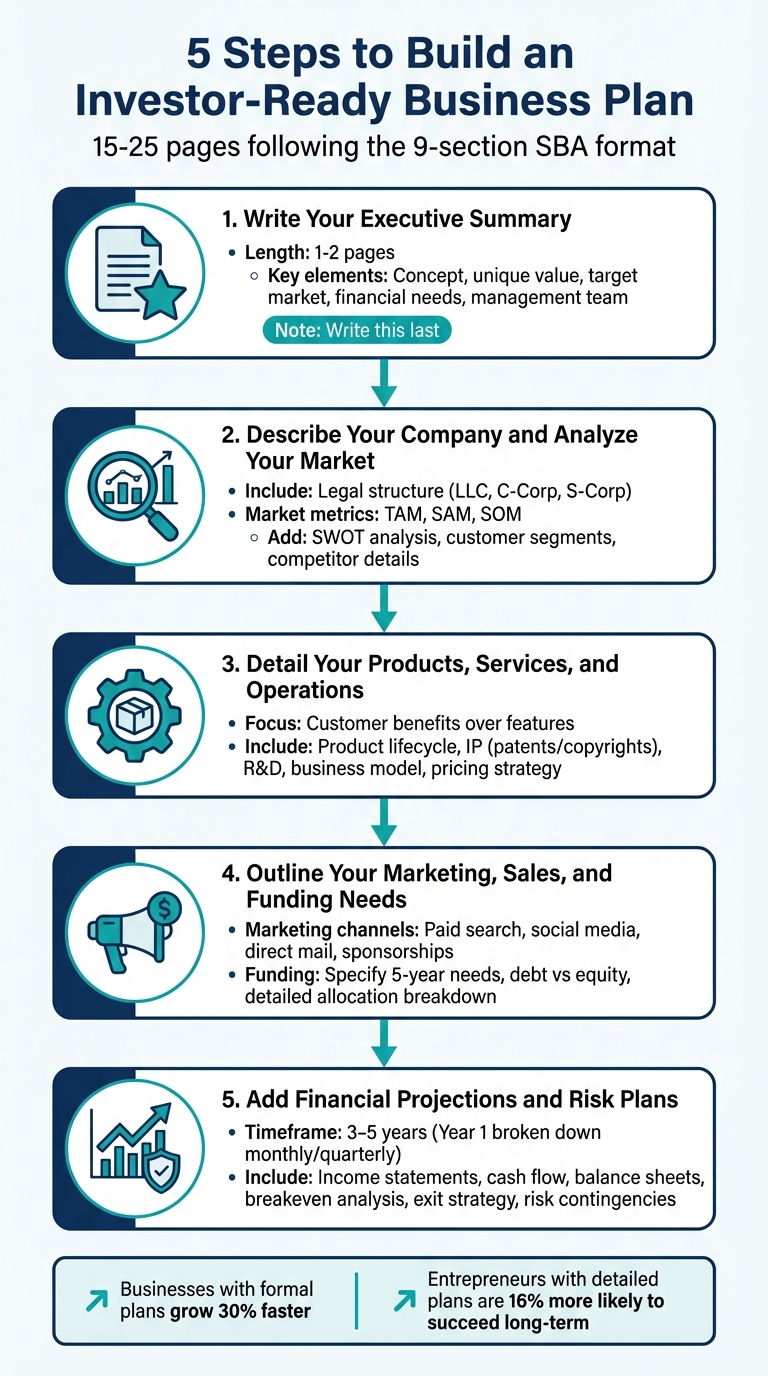
5-Step Process to Create an Investor-Ready Business Plan
A solid business plan typically spans 15–25 pages and follows a nine-section format that banks and investors expect. It tells the story of your business idea, from concept to financial outlook, in a way that’s clear and easy to understand - even for someone outside your industry. Here’s how to create a plan that meets professional standards.
Step 1: Write Your Executive Summary
Think of the executive summary as your elevator pitch in written form. It’s a concise 1–2-page overview of your business that highlights key points: your concept, what sets your product or service apart, your target market, marketing strategy, financial needs, and your management team’s qualifications. Although it’s the first section, write it last - this ensures it reflects the rest of your plan. This section is critical because it determines whether an investor will dive deeper or move on.
Step 2: Describe Your Company and Analyze Your Market
Start by explaining your legal structure - whether you’re an LLC, C-Corp, or S-Corp - and the problem your business solves. For the market analysis, include metrics like TAM (Total Addressable Market), SAM (Serviceable Available Market), and SOM (Serviceable Obtainable Market) to quantify your opportunity. Add a SWOT analysis (strengths, weaknesses, opportunities, and threats) and break down your customer segments. Don’t forget to list competitors, complete with details like their websites and social media profiles. This shows you’ve done your homework and identifies the gap your business will fill.
Step 3: Detail Your Products, Services, and Operations
Focus on how your product or service benefits customers rather than just listing its features. Walk through the product lifecycle, from development to delivery, and include any intellectual property like patents or copyrights, as well as R&D efforts. In the operations section, describe your business model - whether you’re selling directly to consumers or through distributors - and explain your pricing strategy.
Step 4: Outline Your Marketing, Sales, and Funding Needs
Lay out your customer acquisition channels, such as paid search, social media, direct mail, or sponsorships, and explain the steps involved in making a sale. For funding, specify the exact amount you need for the next five years, whether you’re seeking debt or equity, and provide a detailed breakdown of how the funds will be used. This could include equipment, salaries, inventory, or debt repayment.
Step 5: Add Financial Projections and Risk Plans
Include 3–5 years of financial projections, such as income statements, cash flow statements, and balance sheets. For the first year, break these down monthly or quarterly for more detail. Add a breakeven analysis to show when your business will turn a profit. For investors, include an exit strategy - such as selling to a larger company or going public via an IPO - so they know how they’ll see a return on their investment. Be upfront about potential risks and outline contingency plans to show you’re prepared to handle challenges.
Using the IdeaFloat PDF Template for Your Plan
The IdeaFloat template is designed around the nine-section SBA format that banks and investors are familiar with. It covers all the essential components outlined by the U.S. Small Business Administration: Executive Summary, Company Description, Market Analysis, Organization and Management, Service or Product Line, Marketing and Sales, Funding Request, Financial Projections, and Appendix. This structure ensures your business plan meets professional standards from the start.
What's Included in the IdeaFloat Template
This template is user-friendly, featuring pre-filled sections and guided prompts, so you don’t need prior experience in business writing. It also includes automated financial tables that calculate figures based on your inputs. To make your plan visually appealing, charts and graphs are included to display trends and market data - perfect for catching the attention of lenders. Additionally, you can select from 10 different document themes to align with your business branding and give your plan a polished appearance.
Another helpful feature is access to over 550 industry-specific examples that you can refer to or adapt for your business. These examples can be a lifesaver if you’re unsure how to describe your competitive edge or outline your marketing strategy. By seeing how others in your industry have approached similar challenges, you can create a plan that stands out.
This well-structured framework makes it easy to move into the customization phase when you're ready to export and edit.
How to Export and Edit Your Plan
After completing your plan, you can export it in multiple formats: as a PDF for secure submissions to banks, a Word document for more detailed edits, or a PowerPoint presentation for pitching to investors. If you need to work with your forecasts further, you can download them as .CSV files for use in Excel. The template also allows for flexibility, letting you modify sections to better fit your business model. This means you can tailor your plan to emphasize what matters most - whether it’s an in-depth market analysis for investors or a conservative cash flow projection for a bank loan officer.
sbb-itb-08dd11e
How to Win Over Investors and Banks
Once your plan is complete, it’s time to convince lenders and investors of your financial discipline and strategic thinking. Banks want proof you can repay loans - usually focusing on collateral and steady cash flow - while investors are drawn to high returns and scalability. In both cases, you need to show credibility, clarity, and confidence in your financial projections to make a strong impression.
Use Verified Data and Realistic Numbers
Your financial projections must reflect actual market conditions, not overly optimistic guesses. Investors can easily spot inflated numbers. Aim for a five-year forecast that demonstrates long-term planning. Include the three essential financial statements - Income Statements, Balance Sheets, and Cash Flow Statements - to provide a complete financial picture. If your business is already operational, add historical data from the past three to five years. Back up every assumption with market research and industry trends, and have an accountant review your numbers for accuracy.
"Many investors say they bet on the team behind a business more than the business idea, trusting that talented and experienced people will be capable of bringing sound business concepts to life."
– Bank of America
Show Exactly Where the Money Will Go
Be specific about how you’ll use the funds you’re requesting. Instead of vague categories like "business expenses", break it down into clear allocations. For example, if you need $150,000, outline it as $60,000 for manufacturing equipment, $40,000 for first-year salaries, $30,000 for digital marketing, and $20,000 for working capital. This level of detail reinforces your credibility and shows you’ve carefully planned your financial needs. Also, highlight your personal financial contribution - your "skin in the game" - to demonstrate your commitment and build trust with potential backers.
Address Potential Risks and Your Backup Plans
After laying out your financial strategy, tackle potential risks and how you plan to manage them. Acknowledging challenges doesn’t weaken your case - it strengthens it. Conduct a SWOT analysis to identify strengths, weaknesses, opportunities, and threats, and address these honestly. Discuss industry-specific risks and outline contingency plans to handle them. Additionally, include an exit strategy that details how investors could eventually cash out, such as through a sale to a larger company or an IPO. Keep your business plan current by updating it quarterly or annually as market conditions evolve, demonstrating your ability to adapt.
"A transparent business plan is one of your best assets in gaining the trust of bankers and investors."
– BDC
Conclusion
Main Points to Remember
A well-crafted business plan is your roadmap to success. To stand out, ensure your plan includes a persuasive executive summary, a market analysis grounded in real data, five-year financial projections, and a clear breakdown of how funds will be used. Don’t overlook potential risks - address them with detailed contingency plans. Also, include an exit strategy to show investors how they can eventually see a return on their investment. A formal, detailed plan can significantly improve your chances of securing funding and achieving growth.
The difference between success and rejection often lies in the details. Use verified market research to back up your assumptions, avoid overly optimistic projections, and present your plan professionally. Keep the language straightforward and avoid unnecessary jargon. Remember, your plan isn’t static - it should evolve as your business grows and market conditions change. Regular updates, whether quarterly or annually, are key to staying on track.
With these principles in mind, you’re ready to take the next step.
Get Started with IdeaFloat
Ready to bring your plan to life? IdeaFloat makes it easy with its guided Business Plan Generator. This tool walks you through every critical element - market sizing, competitive analysis, financial projections, and more - ensuring your plan meets the expectations of banks and investors. Plus, it integrates live research from credible sources, reinforcing the importance of data-driven insights emphasized in this guide.
Once completed, you can export your plan as a professional PDF, Word, or PowerPoint file, complete with financial statements, charts, and supporting data formatted to industry standards. Whether you’re applying for an SBA loan or pitching to investors, IdeaFloat equips you with everything you need to approach those conversations with confidence.
Visit IdeaFloat.com to start building your investor-ready business plan today and turn your vision into a reality.
FAQs
What key elements should an investor-ready business plan include?
An investor-ready business plan needs to show that your business has the potential to succeed and generate profits. To do this effectively, it should include the following key elements:
- Executive summary: This is a brief but powerful overview of your business idea, the funding you're seeking, and your main goals.
- Financial projections: Provide detailed estimates of your expected revenue, cash flow, and when you anticipate turning a profit.
- Market research: Offer insights into your target audience, the size of your market, emerging trends, and who your competitors are.
- Team expertise: Emphasize the skills and experience your team brings to the table.
- Use of funds: Clearly outline how you'll allocate the funding you're requesting.
By covering these points, your business plan will come across as professional and persuasive, giving investors or lenders the confidence to support your venture.
How can I make sure my financial projections are accurate and trustworthy?
To craft reliable financial projections, begin with thorough research and dependable data. Dive into your target market, examine industry standards, and leverage historical data to inform your assumptions about sales, expenses, and growth rates. Staying grounded in reality is key - steer clear of overly optimistic forecasts.
Make it a habit to update your projections regularly. Using financial models to explore various scenarios adds an extra layer of credibility. Stick to conservative estimates and clearly document the reasoning behind your assumptions. This transparency not only builds trust with investors and lenders but also strengthens the overall case for your business plan.
Why should I include an exit strategy in my business plan?
Including an exit strategy in your business plan is crucial because it reassures investors and lenders that you’ve thought ahead about how they’ll eventually recoup their investment. This part of your plan details how you intend to leave the business - whether by selling it, merging with another company, or handing it over to new leadership. It shows you’ve considered both long-term goals and potential challenges.
Having a clear exit strategy also helps define the future direction of your business. Whether your goal is to scale the company for a sale or prepare it for a leadership transition, this foresight can enhance confidence in your business’s stability. It also makes your venture more attractive to potential investors and financial institutions, as it demonstrates both credibility and forward-thinking.
Related Blog Posts
 Report an issue
Get the newest tips and tricks of starting your business!