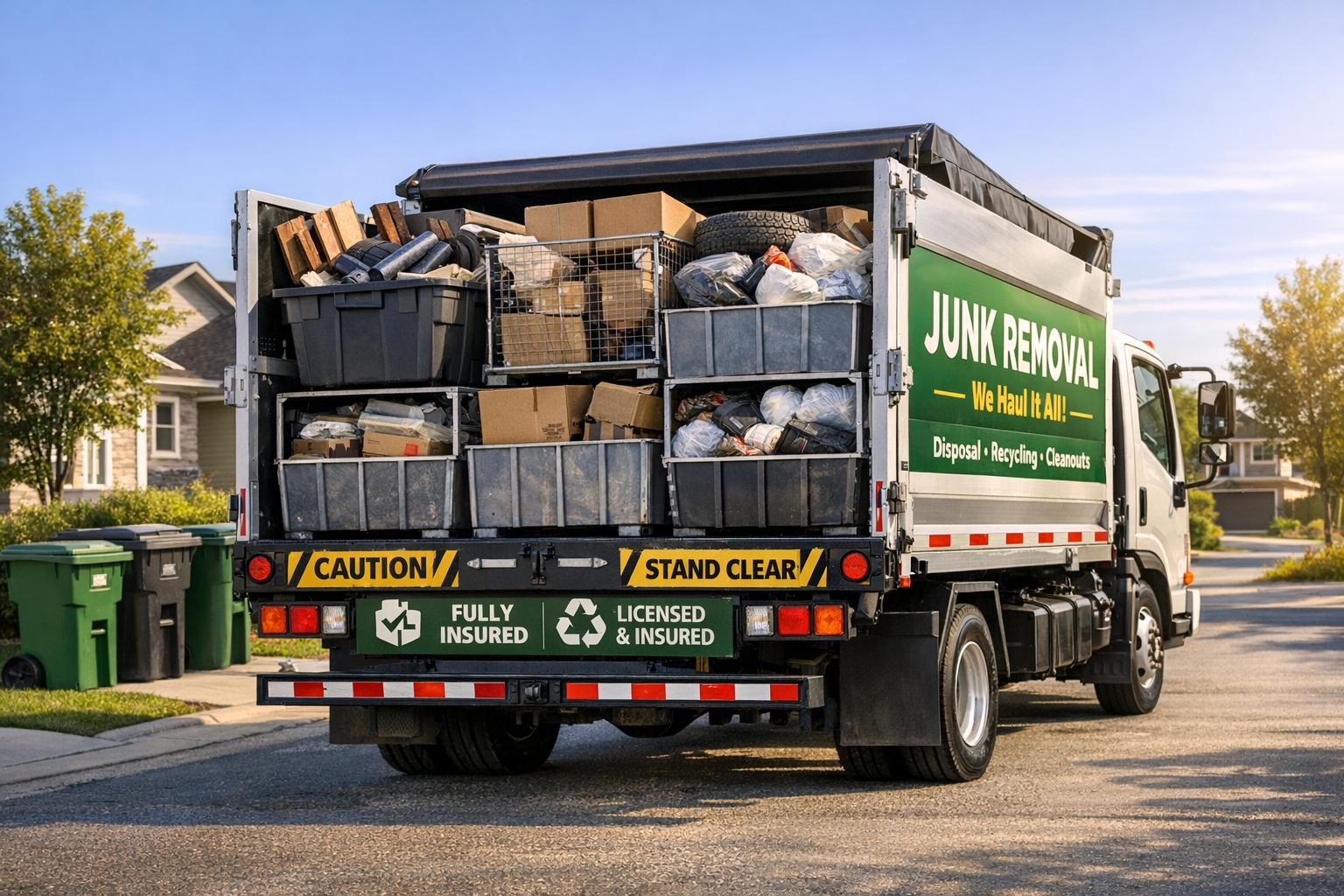
Running a junk removal business successfully comes down to three key factors: pricing, disposal costs, and insurance. Here's a quick breakdown of what you need to know:
- Pricing by Volume: Most companies charge based on how much space junk takes up in the truck. Rates vary by region but typically range from $25–$65 per cubic yard. Smaller jobs have higher per-yard rates to cover fixed costs, while larger loads use tiered pricing for competitiveness.
- Disposal Costs: Fees for landfills and recycling centers can range from $30–$100 per ton, depending on location. Specialty items like refrigerators or hazardous waste require extra fees, which should be passed on to customers.
- Insurance Essentials: General liability, commercial auto, and workers' compensation insurance are critical. Costs vary but ensure protection from property damage claims, work-related injuries, and vehicle accidents.

Junk Removal Pricing Guide: Load Sizes, Costs & Disposal Fees
How To Price In Junk Removal. My Pricing Sheet, Extra Fees, And Sales Tips.
How to Price by Cubic Yard
Pricing by cubic yard helps create a transparent structure that customers can easily understand before any work begins. The idea is to calculate all associated costs and organize them into tiers that accommodate both small cleanouts and full truckloads.
How to Calculate Your Base Rate
Start by adding up four major expenses: labor, disposal fees, operating costs, and fixed overhead. Labor is usually the biggest slice, taking up about 35% to 50% of your revenue. To cover payroll taxes, workers' compensation, and benefits, increase wages by 20%. Disposal fees can vary widely depending on your area - ranging from $30 per ton in some places to over $100 in others. Once you know your total costs, use this formula to determine your price:
Price = Total Costs ÷ (1 – Desired Profit Margin).
For example, if your costs are $350 and you aim for a 30% profit margin, your final price would be $500. This calculation directly impacts your pricing tiers and overall profitability.
It's also important to set a minimum fee - typically around $70 - to cover truck and crew mobilization. A minimum charge generally accounts for about 1.5 to 2 cubic yards, ensuring smaller jobs remain profitable. Don’t forget to include surcharges for heavy or challenging items like concrete, dirt, or anything that requires extra effort, such as stair carries, as these increase both labor and disposal costs.
Setting Up Volume-Based Price Tiers
Instead of charging exactly half the price for a half-truck load compared to a full truckload, use a tiered pricing model. This method reduces the price per cubic yard as the volume increases. It helps maintain healthy margins on smaller jobs while staying competitive for larger ones. Aim for about 12 incremental price points, such as 1/8, 1/6, or 1/3 of a truckload.
As Lee Godbold, Co-founder of Junk Removal Authority, points out:
Most customers don't pay any attention to your interior price points – they only care about the minimum and full load charges.
Intermediate tiers improve crew efficiency and reduce pricing disputes. A standard junk removal truck can hold roughly 420 to 480 cubic feet, or about 16 cubic yards, so plan your tiers accordingly. Keep in mind that regional adjustments are necessary - cities like New York or Seattle might require rates 25% to 35% higher than the national average, while rural areas could be 15% to 20% lower.
Industry Pricing Benchmarks
National averages can guide your pricing, but local labor and disposal costs will ultimately shape your rates. Here's a typical breakdown of what operators charge across the U.S.:
| Load Size | Volume (Cubic Feet) | Average Price Range |
|---|---|---|
| Minimum Load | Up to 60 ft³ | $75 – $150 |
| 1/4 Truck Load | 80 – 120 ft³ | $150 – $300 |
| 1/2 Truck Load | 180 – 240 ft³ | $300 – $500 |
| Full Truck Load | 420 – 480 ft³ | $500 – $800 |
Per-cubic-yard rates typically range from $25 to $65, with smaller loads priced higher to cover fixed costs. Specialty items like refrigerators may cost between $100 and $250 due to Freon disposal requirements, while a sofa (around 2 cubic yards) might cost $160 to $200. For debris removal, construction waste averages $95 per cubic yard, yard waste about $18, and general home debris close to $22. Profit margins are highest on small jobs - around 60% for 1/8 truckloads - and decrease to about 45% on full truckloads as fixed costs spread across a larger volume.
Next, we'll look at disposal methods to account for regional fee differences.
Disposal Methods and What They Cost
Understanding disposal fees is crucial for setting accurate service prices, especially when combined with a volume-based pricing model. After you’ve filled a truck with junk, the next step is calculating the disposal costs. Landfills and transfer stations typically charge between $30 and $100 per ton, depending on the location. For instance, in North Carolina, the average fee is about $42 per ton, while in high-cost metro areas, it can climb well above $100. Recently, these fees have risen by roughly 12%, driven by inflation and limited landfill capacity. Disposal fees, like base pricing, vary by region and play a big role in determining your final costs.
Recycling sorted scrap metal is more affordable, ranging from $15 to $45 per ton. Handling e-waste, however, can be pricier, with small electronics costing $10 to $25 and CRT televisions falling between $50 and $200. According to Jeel Patel, CEO of FieldCamp:
Environmental regulations have become stricter in many states, particularly regarding electronic waste and hazardous materials disposal.
Disposing of hazardous waste, such as chemicals, paint, and asbestos, costs significantly more - anywhere from $100 to $500 per ton. This process often requires permits, and failing to comply can lead to fines up to $500. Items like refrigerators, which contain Freon, require proper refrigerant removal at an additional cost of $50 to $150. Tires, on the other hand, typically cost $5 to $15 each to dispose of. These factors highlight the importance of exploring alternative disposal methods and understanding their costs.
Landfill Fees
Standard landfill fees range from $30 to $100 per ton. Construction debris, including concrete, masonry, and roofing materials, tends to be heavier and more expensive, with costs between $75 and $300 per ton. These materials often max out truck weight limits quickly. For extremely dense loads, some operators use "bedload" pricing, which covers smaller volumes (about 4 cubic yards) but accounts for weights up to 8,000 lbs.
Building strong relationships with multiple disposal facilities can help you negotiate better commercial rates and gain a clearer understanding of fee variations. Additionally, sorting recyclables and scrap metal during the loading process can lower landfill costs since recycling centers often charge less than half the rate of a landfill.
Recycling and Hazardous Waste
Recycling isn’t just about environmental compliance - it can also cut down on disposal costs. Sorted metals and materials typically cost between $15 and $45 per ton at recycling centers. Items in good condition can be donated or resold, which helps offset disposal fees.
When it comes to hazardous materials, special handling protocols are required, which can significantly impact your pricing strategy. For example, latex paint disposal costs range from $5 to $10 per gallon or $50 to $150 per container. Refrigerators and other appliances with refrigerants must be serviced by certified technicians, adding $50 to $150 to your disposal costs. Mattresses, which pose unique disposal challenges, generally cost $70 to $120 each to dispose of. To maintain your profit margins, it’s wise to pass these additional costs directly to your customers.
Cost Breakdown by Waste Type
Disposal requirements and costs vary depending on the type of waste. Here’s a quick summary of what you might encounter:
| Waste Type | Disposal Method | Estimated Cost | Regulations/Notes |
|---|---|---|---|
| General Waste | Landfill / Transfer Station | $30 – $100 per ton | Non-hazardous |
| Construction Debris | Specialized Landfill / Recycling | $75 – $300 per ton | Very heavy |
| Green Waste | Composting Facility | $70 – $100 per load | Organic debris |
| E-Waste | Certified Recycler | $10 – $200 per item | Recycling mandated |
| Hazardous Waste | Specialized Treatment Facility | $100 – $500+ per ton | Permits required |
Tracking your disposal costs by material type is essential for fine-tuning your pricing strategy. Since some facilities adjust their fees during busy seasons, it’s also important to account for these potential fluctuations when setting your rates.
sbb-itb-08dd11e
Required Insurance for Junk Removal
Running a junk removal business without the right insurance leaves you exposed to significant risks. For starters, commercial auto insurance is legally required in 49 states for any vehicle used in business operations. Similarly, workers' compensation insurance is mandatory in almost every state as soon as you hire your first employee, covering medical expenses and lost wages for work-related injuries. Failing to carry workers' comp coverage can lead to criminal charges and fines of up to $10,000 per employee.
Although general liability insurance isn’t always a legal requirement, it’s practically essential. Many commercial clients, property managers, and municipalities won’t allow you on-site without proof of coverage. Mark Fitzpatrick, a Licensed Property and Casualty Insurance Producer, emphasizes:
"General liability is the most critical coverage for junk removal companies because property damage claims happen frequently when hauling heavy items through homes".
The standard for general liability coverage in this industry is $1 million per occurrence and $2 million aggregate. If your business handles hazardous materials - like chemicals, paint, or electronics - you’ll also need pollution liability insurance to cover EPA-mandated cleanup costs and fines. These policies not only safeguard your business but also help manage unexpected costs and legal risks. Below are the key insurance types every junk removal operator should have.
General Liability Insurance
General liability insurance is a must-have for junk removal businesses. It protects you when accidents happen - like damaging a client’s property or causing injuries during a job. For example, it covers incidents such as breaking furniture while moving it, damaging landscaping with your truck, or a client tripping over equipment left in their driveway. The average cost for $1 million in coverage ranges from $450 to $1,000 per year.
Your premiums will depend on factors like annual revenue, the number of employees, and the types of services you offer. If your work involves higher risks, such as handling hazardous materials or demolition, be prepared for higher rates. Once you secure a policy, make sure to get a Certificate of Insurance (COI) to show clients as proof of coverage. For jobs involving commercial properties or apartment complexes, you might need to add the property owner as an "additional insured" on your policy, which usually costs $25 to $50.
Commercial Auto Insurance
Every vehicle you use for junk removal must have commercial auto insurance. Personal auto policies won’t cover accidents or damages when you’re hauling junk for profit. Most businesses carry $1 million in combined single limit coverage, which far exceeds state minimums. For instance, South Carolina only requires $25,000 per person and $50,000 for multiple injuries.
The cost of commercial auto insurance typically ranges from $2,000 to $10,000 per year, depending on factors like your fleet size and driver records. Operating in high-traffic urban areas can increase your premiums due to the higher risk of accidents. The type of vehicles you use - such as heavy dump trucks versus smaller haulers - also affects your rates. To save on costs, consider bundling policies and working with multiple insurers to negotiate better deals.
Workers' Compensation Insurance
Once you hire employees, workers' compensation insurance becomes non-negotiable. It covers medical bills and lost wages for employees injured on the job. The cost of workers' comp typically ranges from 13% to 16% of your total payroll, or about $5 to $20 per $100 of payroll, depending on your state and the risk involved in your operations.
To avoid disruptions, renew your COIs at least 45 days before they expire, ensuring your regular clients have up-to-date documentation - especially during busy seasons. Additionally, bundling general liability and commercial property insurance into a Business Owner’s Policy (BOP) can save you up to 10% on premiums. Many online insurers also offer lower rates for small businesses compared to traditional firms.
Using IdeaFloat to Set Your Prices

Setting the right rates for your services involves more than just guessing what feels fair. You need to consider your actual costs, local market trends, and the profit margins you want to achieve. That’s where IdeaFloat's Advanced Pricing Research tool steps in, giving you access to real market data and a way to test different pricing strategies to find the sweet spot - where you attract customers and stay profitable.
Analyzing Market Data
Pricing can vary wildly depending on location. For instance, rates in cities like New York and San Francisco can be 40–70% higher than the national average, while rural areas often fall 10–25% below it. IdeaFloat’s Advanced Pricing Research tool collects up-to-date pricing information from your area, showing you what competitors charge for various load sizes - minimum loads, quarter trucks, half trucks, and full truckloads. This is crucial because, as Lee Godbold from Junk Removal Authority explains:
Most customers don't pay any attention to your interior price points - they only care about the minimum and full load charges.
The tool doesn’t stop there. It also tracks local disposal fees, which can significantly impact your costs. For example, landfill tipping fees range from $42 per ton in North Carolina to over $100 per ton in some northern states. With this data, you can adjust your rates to reflect these regional differences. Labor costs, which typically account for 40–50% of total pricing, are also factored in. IdeaFloat helps you calculate your "loaded hourly rate", which includes wages plus about a 20% markup to cover taxes, workers' compensation, and benefits. This detailed cost analysis forms the backbone for testing different pricing strategies.
Testing Different Pricing Scenarios
Once you’ve gathered market data, the next step is to see if your pricing structure will actually generate a profit. With IdeaFloat, you can experiment with various models - volume-based, weight-based, or hybrid approaches. Using the pricing formula mentioned earlier, the platform helps you aim for the industry standard of a 25–35% net profit margin.
For example, you can test tiered pricing, where a half-truck load is priced higher than half the cost of a full truck - say $330 instead of $200 - to account for fixed costs like travel and setup. The tool also helps you set minimum load prices to ensure even small jobs stay profitable. By testing up to 12 different price points instead of relying on simple quarter-truck increments, you can strike a balance between offering fair rates to customers and maintaining consistent profit margins. Once you’ve fine-tuned your pricing scenarios, you can link them to your financial model to see their full impact.
Connecting Pricing with Financial Planning
A solid pricing strategy is only as good as its connection to your overall financial picture. IdeaFloat integrates your pricing research with its financial modeling tools, helping you see how your rates translate into monthly revenue, cover your overhead, and drive profit. It breaks down fixed costs like insurance and operating expenses across your job volume, while also accounting for variable costs such as fuel, rising disposal fees (up 12% recently), and surcharges for specialty items like refrigerators ($50–$250), mattresses ($75–$150), and CRT TVs ($50–$200).
This comprehensive approach gives you a clear view of your per-job costs and overall cash flow - what comes in from sales, what goes out in expenses, and what remains as profit. By tying your pricing to your financial plan, you ensure your business isn’t just competitive - it’s built to thrive from the start.
Summary: Pricing, Disposal, and Insurance Basics
Running a profitable junk removal business means getting three key factors right: pricing, disposal fees, and insurance. These elements are deeply connected and need to work together from the very beginning.
First, your pricing has to cover all actual costs. This includes labor (don’t forget to add a 20% markup for taxes and benefits), disposal fees (which can vary a lot depending on your location), and prorated insurance premiums based on your expected workload. For smaller jobs, you also need to account for fixed costs like fuel, travel time, and crew deployment. This all-encompassing approach ensures your pricing strategy supports your business effectively.
Disposal fees are anything but predictable. For example, landfill fees have risen by 12% recently. Plus, handling specialty items like refrigerators can cost anywhere from $50 to $250 just for Freon disposal. If you don’t factor these fluctuating costs into your quotes, they’ll slowly eat away at your profit margins. The most successful operators aim for a 25–35% net profit margin, giving them enough flexibility to handle rising fees and unexpected costs without scrambling to change their pricing mid-year.
Insurance is the backbone of your business’s financial safety net. It’s not just another expense - it’s a critical part of your financial plan. As Wisdom Insurance Agency explains:
General Liability Insurance is not just a legal formality but a critical component in protecting your business from potential claims and ensuring its longevity.
When you align pricing, disposal costs, and insurance, you create a business that runs smoothly and transparently. You’re not guessing at what to charge; you’re setting up a sustainable operation where every job contributes to long-term success. By integrating these principles into your pricing and financial planning, you build a strong foundation for your business’s future.
FAQs
How can I set the most profitable pricing for my junk removal services?
To figure out the best pricing for your junk removal services, start by calculating every expense tied to a job. This includes labor costs (wages, taxes, and benefits), disposal fees (like landfill or recycling center charges), fuel, vehicle maintenance, and any other operational expenses. Add these together to determine your total cost for each load size - whether it’s a 1/4-truck, 1/2-truck, or a full-truck. Once you have that number, tack on your profit margin - most businesses aim for around 20–30% - to establish your base price.
Next, check your pricing against the local market to ensure you stay competitive. Across the U.S., junk removal jobs typically cost between $150 and $350, with an average per-cubic-yard rate of $1.50–$2.00. If a specific load size isn’t hitting your profit targets, you might need to tweak your pricing or reduce costs. For example, you could optimize routes to save on fuel or negotiate better rates for bulk disposal. It’s also smart to regularly reassess your pricing to account for regional differences and keep your business both profitable and competitive.
What should I consider when estimating disposal costs for different types of junk?
When figuring out disposal costs, the first step is to determine the type of waste you're dealing with. Hazardous materials - like chemicals, electronics, or large appliances - often need special handling, permits, or treatment, which can drive up expenses. In contrast, items such as furniture, yard waste, or construction debris might be less expensive to dispose of and could even be recyclable.
You’ll also need to consider location-based factors. If the job is in a remote area, on narrow streets, or far from a landfill, additional costs may come into play, like extra fuel, mileage, or surcharges for difficult access. Plus, the volume and weight of the waste are critical - larger or heavier loads can mean higher tipping fees or landfill charges.
Lastly, don’t overlook operational costs. Labor, truck capacity, and safety equipment all impact the bottom line. For example, bulky or awkward items might require more crew members, longer loading times, or even larger vehicles, adding to the overall cost. By carefully assessing these factors, you can create estimates that not only cover expenses but also safeguard your profit margins.
Why is having multiple types of insurance essential for a junk removal business?
Protecting your junk removal business from unexpected risks means having the right mix of insurance coverage. Key policies like general liability, workers’ compensation, vehicle insurance, and property insurance can shield your business from challenges such as accidental damage to a client’s belongings, workplace injuries, vehicle collisions, or equipment losses.
Operating without proper insurance could leave your business exposed to hefty out-of-pocket costs for claims or legal battles, jeopardizing your financial stability. By securing thorough insurance coverage, you’re not only ready to handle unforeseen issues but also reinforcing trust with both your clients and your team.
Related Blog Posts
 Report an issue
Get the newest tips and tricks of starting your business!